Duckpool Beach
A Quiet National Trust Cove Beneath Steeple Point
Duckpool Beach, near Bude, Cornwall, EX23 9JN
Duckpool is a small, unspoilt beach a couple of miles north of Bude, tucked beneath the dramatic headland of Steeple Point where the Coombe Valley meets the sea. A mix of shingle and sand, backed by high cliffs and crossed by a freshwater stream, it has none of the commercial trappings of Bude's town beaches - no cafe, no shop, no crowds - which is exactly its appeal for anyone after a quieter stretch of coast. The name is entirely literal: at the top of the beach, the stream flowing down from the Coombe Valley pools up behind a natural bank of pebbles before it finds its way through to the sea, forming the shallow "duck pool" that gives the beach its name.
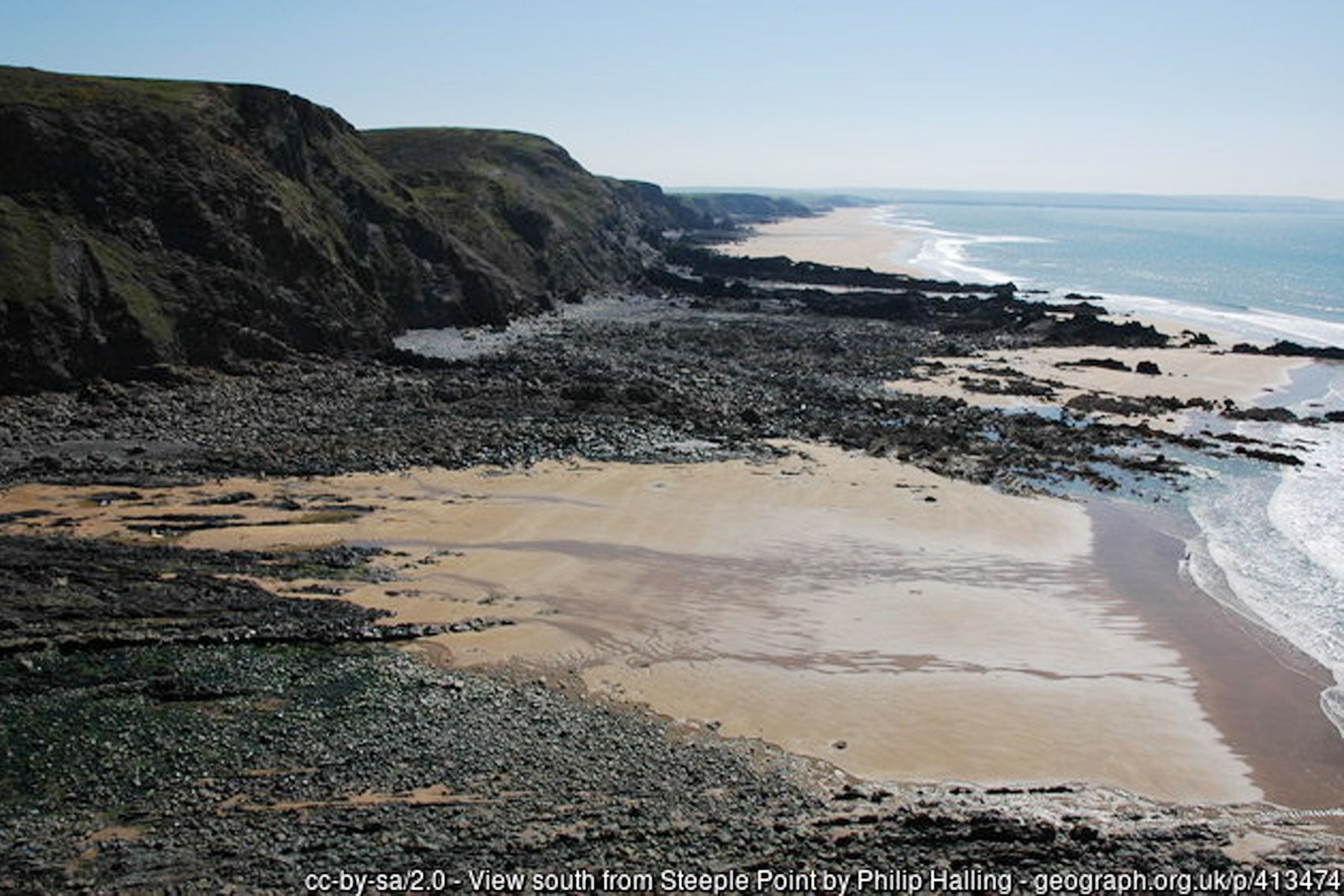
The beach sits within National Trust land, and access is refreshingly straightforward for this stretch of coast: a small car park sits right behind the beach, with a level, easy walk down to the sand and shingle rather than the steep cliff paths found further along the coast at Bossiney or Crackington Haven. The South West Coast Path passes directly behind Duckpool, with Stanbury Mouth around a mile to the north and Sandymouth a couple of miles to the south - both fine stretches of coastal walking, with sweeping views along the cliff line in either direction.
There is no lifeguard cover at Duckpool, and the sea here can be genuinely hazardous - conditions are often more dangerous than they look, particularly around low tide and towards the northern end of the beach where currents run close to the rocks. Anyone swimming or bodyboarding should treat it with real caution and keep to the main central section of sand. Dogs are welcome at Duckpool all year round, provided they are kept under control - unlike several of Bude's more central beaches, there is no seasonal ban here, though it is always sensible to check current signage at the car park.
Geologically, this stretch of coast is rated of national importance. The cliffs to either side of the beach, and the wave-cut rock platform in front of them, are built from alternating shales, mudstones and sandstones laid down around 300 million years ago in the Upper Carboniferous period, when this part of Cornwall lay at the edge of a shifting river delta feeding into a deep sedimentary basin. Natural England has designated the coastline running south from Duckpool to Furzey Cove, near Maer, as a Site of Special Scientific Interest specifically for these rock exposures, which preserve long sequences of turbidite deposits - the record of ancient underwater sediment flows - since tilted, folded and exposed by millions of years of coastal erosion. The same rocks and the same folding forces reappear a few miles south at Millook Haven, where tightly compressed "chevron" folds in the cliff face are rated among Britain's most important sites for studying rock folding and faulting, and they have shaped every headland along this coast, Steeple Point included.
At low tide, the rocks at the northern end of the beach open up into a good spread of rock pools, home to the usual cast of shore life found along this coast - shore crabs, beadlet and snakelocks anemones, blennies and the occasional small pollack or wrasse caught out by the retreating tide. The cliffs above form part of a longer run of coastline known for its breeding seabirds: fulmars, kittiwakes and razorbills nest on the ledges through spring and summer, gulls and cormorants are present year-round, oystercatchers work the tideline, and Cornwall's reintroduced choughs have gradually spread back along stretches of this coast in recent years. In early summer the cliff slopes carry a good showing of maritime wildflowers, including thrift, sea campion and sea lavender, while the sheltered, wooded valley immediately behind the beach is a quite different habitat - its damp valley floor and old orchards standing in sharp contrast to the exposed, salt-pruned cliff tops on either side.
The stream reaching the sea at Duckpool drains the Coombe Valley, a steep, wooded combe running inland to the small hamlet of Coombe, a little over a mile from the beach. Coombe is a genuinely old settlement, first recorded in the 16th century, and its centrepiece is a substantial three-storey watermill rebuilt to its present form in 1842, according to a datestone on the building, though a mill is known to have stood on the site for considerably longer. Grade II* listed, the mill retains its original iron waterwheel and both French millstones and Cornish granite stones for grinding, and it continued in commercial use into the 1940s, with some of its machinery reportedly still turning as late as 1972. The novelist Charles Kingsley, who knew this coast well, used the building as the setting for a key scene in his 1855 novel Westward Ho!, thinly disguised as "Stow Mill". Coombe and most of its cottages have belonged to the Landmark Trust since the 1960s, which restores and lets them as holiday accommodation, and the old mill is now itself recognised as a Site of Special Scientific Interest in its own right - not for its architecture, but for the bat roost inside it.
The valley's history runs back further still. Coombe and Duckpool once lay within the estate of the Grenvilles of Stowe, one of Cornwall's most powerful landed families from the 14th century onward, whose principal seat stood a couple of miles inland near Kilkhampton. Sir Richard Grenville of Stowe commanded the Revenge in her famous final action against a Spanish fleet off the Azores in 1591, and a later Grenville, Sir Bevill, led Cornish Royalist forces to victory at the Battle of Stratton (also known as the Battle of Stamford Hill), fought a few miles from here near Bude in May 1643, before he was killed in action later that same year. The Grenvilles' grand house at Stowe, built in the 1670s and said to have rivalled any other in the county, proved too costly to maintain and was demolished in 1739, its materials reused in buildings as far away as Prideaux Place in Padstow; only a converted stable range survives today, along with earthworks and field boundaries. The eccentric Victorian vicar of neighbouring Morwenstow, Robert Stephen Hawker - now chiefly remembered for writing "The Song of the Western Men" ("Trelawny") and for introducing the harvest festival as a church tradition - held that parish, which borders the valley, through much of the nineteenth century.
Like most of this coast, the waters off Duckpool have claimed their share of shipping over the centuries; the Spanish brig Juanito, driven onto the rocks here in January 1865, is one of several recorded wrecks along this shore. More recent history is visible on the beach itself, where a scatter of concrete anti-tank blocks, installed as part of Britain's coastal defences before the Second World War, still sits among the pebbles - a low-key reminder that this now-peaceful cove was once considered a plausible invasion point.
Duckpool is markedly tidal, and it is well worth timing a visit around the tide table: at high water the beach can shrink to little more than a narrow band of pebbles pressed against the cliff, while a good low tide opens up a much wider expanse of sand, rock and pools. It is also a recognised surf spot, generally rated as one of the first proper breaks travelling south down this coast from the Devon border - a west-facing beach picking up plenty of Atlantic swell, working best around low to mid tide with light or offshore winds. Scattered rocks, a rough seabed and strong currents mean it suits confident, experienced surfers and bodyboarders rather than beginners, particularly given the lack of lifeguard cover. Out of season, on a calm, clear morning with the tide out, Duckpool can feel almost deserted, which is when many regulars think it looks its best; the small car park fills quickest on fine summer weekends and through the school holidays.
Inland, waymarked circular walks climb from the beach up through the Coombe Valley to the hamlet of Coombe and the mixed woodland of Stowe Wood, taking in the old mill and passing close to the site of the Grenvilles' vanished mansion, before dropping back down to the coast - a good way to combine Duckpool's geology and coastal views with the valley's much quieter, more sheltered history on the same visit.
Visitor Information
Parking
Small National Trust car park directly beside the beach, off the coast road near Stibb. Fills quickly on sunny days in peak season.
Facilities
Toilets at the car park. No cafe, shop or lifeguard cover - the nearest refreshments are in Bude, about two miles south.
Disabled Access
Level, easy access from the car park to the beach - one of the more accessible coves on this stretch, though the beach surface itself is shingle and sand. No dedicated Blue Badge bays are confirmed - the car park is small and informal. Check with the National Trust before you travel if this affects your visit.
Things to Do Nearby
- Sandymouth Beach, a short drive or coast path walk north
- Bude Town Guide - shops, restaurants, the canal and Bude Castle, about two miles south
- Bude Surf Beaches Map & Complete Surf Guide - other surf spots near Duckpool
- Hidden Valley - The Puzzle Park, Launceston, a family attraction around 13 miles inland
Places to Stay
Frequently Asked Questions
Page last updated: 8 September 2026.