Northcott Mouth Beach
Family Sands and Rock Pools North of Bude
Northcott Mouth Beach, near Bude, Cornwall, EX23 9EL
Northcott Mouth sits a mile or so north of Bude, a west-facing beach where a mixture of sand and pebbles gives way to broad expanses of sand as the tide falls. It has a slightly quieter, more local feel than Bude's town beaches while still offering a small car park and a cafe right on the beach, making it an easy, low-fuss choice for a family day out. Note that current National Trust guidance lists no public toilets at the beach itself - the nearest are in Bude - though some older local guides mention seasonal toilets here, so it is worth checking current signage if this affects your visit.
Northcott Mouth is one of a handful of named coves along the low cliffs immediately north of Bude, sitting roughly midway between Sandymouth to the north and Crooklets and Summerleaze towards the town centre to the south. The beach and the cliffland around it are owned by the National Trust, which manages the site as part of a much longer run of coast stretching up towards Duckpool and Sandymouth. The South West Coast Path runs along the cliff top directly above the beach, and walkers heading either way can enjoy good views back along this stretch of the Heritage Coast; the route south towards Crooklets is a popular short stroll, while the path north climbs past Menachurch Point towards Sandymouth. On a clear day, the higher ground around neighbouring Maer Cliff is said to offer glimpses of Lundy Island out in the Bristol Channel.
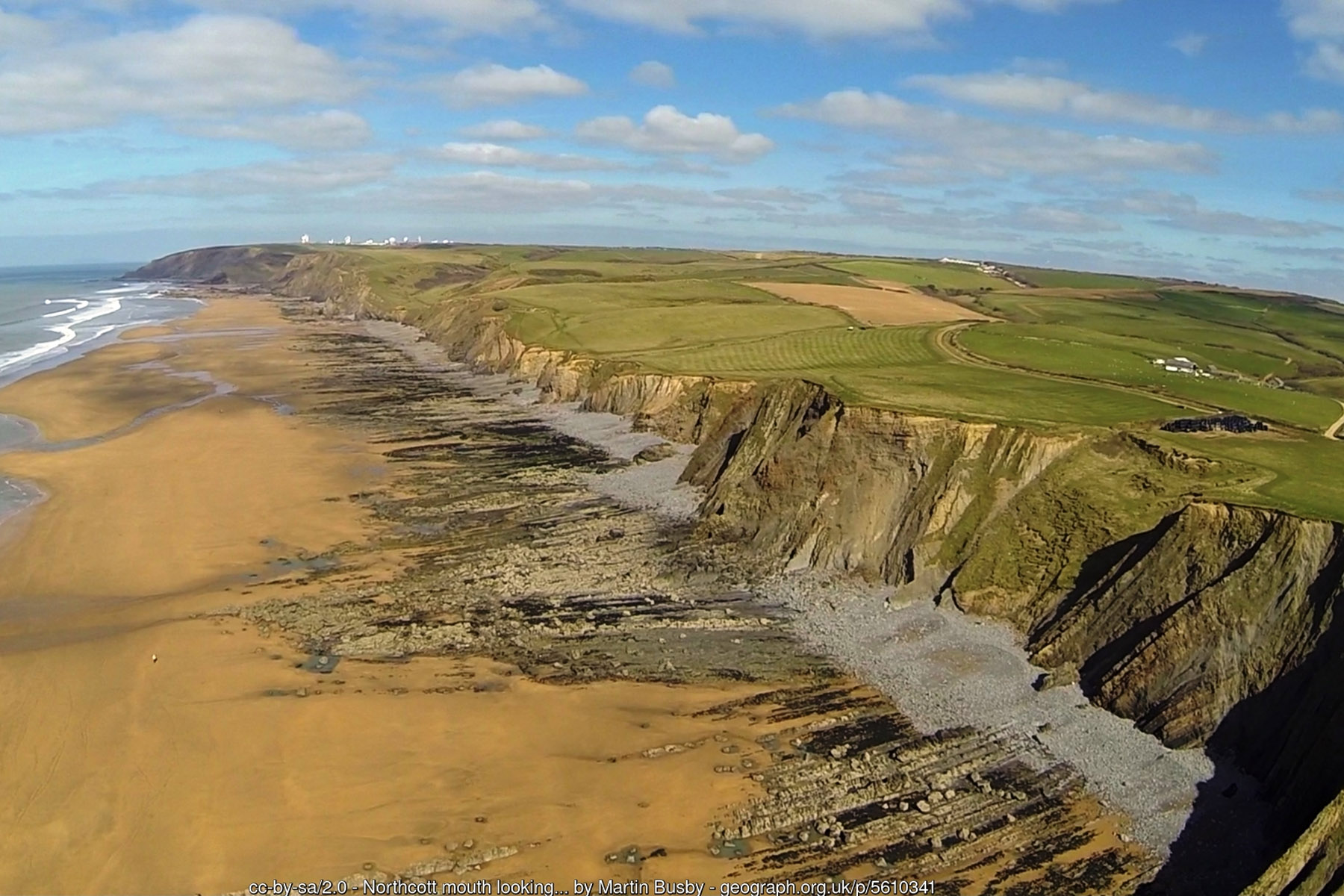
Distinctive rocky outcrops run along the beach, creating rock pools that are a highlight for children exploring at low water, while the consistent Atlantic swell also makes Northcott Mouth popular with surfers and bodyboarders. At low tide the sand links up with Sandymouth to the north and Crooklets and Summerleaze to the south, forming one long stretch of shore - it is a lovely walk, but it is genuinely easy to get cut off by the incoming tide if you are not watching the time, so check tide tables before setting off along the beach. A small stream crosses the beach on its way to the sea, feeding some of the pools and adding another point of interest for children exploring at low water.
Geologically, Northcott Mouth sits within the Bude Formation, a sequence of alternating sandstone and dark shale beds laid down around 300 million years ago during the Carboniferous period, when this part of Cornwall lay beneath a shallow, subsiding sedimentary basin rather than open coastline. Several million years after these layers were deposited, the collision of continental plates that built the Variscan mountain belt across Devon and Cornwall crumpled the flat-lying beds into a series of folds - upward-arching anticlines and downward synclines - some of which are clearly exposed in the rock at Northcott Mouth and along the cliffs either side. What is visible on the beach today is the eroded root of what was once a substantial mountain range, its softer overlying rock long since stripped away by rain, rivers and the sea. The same shale-and-sandstone sequence forms the mile-long crag locally known as Maer Cliff, which runs south from Northcott Mouth towards Bude and is leased by the National Trust to a local outdoor activity centre for climbing and abseiling.
The beach also has a documented piece of maritime history. In November 1917 the steamship Belem - built in Germany, seized from Portuguese ownership by the Allies during the First World War and armed with a stern gun - ran aground in fog close to Northcott Mouth while sailing empty from Gibraltar towards Barry. Her crew of 33, including two Royal Navy gunners, were brought ashore safely by breeches buoy, and the ship broke up where she lay. Sections of her boiler and hull plating are still visible in the sand at low spring tides, close to Menachurch Point, and locals are said to have recovered her propeller shaft some decades later - it now does duty supporting a barrel on Bude breakwater. It is a reminder that this quiet stretch of coast, gentle as it can look on a calm day, sits on a notoriously exposed and fog-prone section of the Bristol Channel approaches.
Surfers know Northcott Mouth as a reef-influenced beach break rather than a straightforward sandy shore break, with the better banks generally forming towards Menachurch Point at the northern end. It tends to work best from mid to low tide, when the underlying rock and reef create more defined peaks; at high water the beach narrows considerably and the swell can become messier and harder to read. It is a slightly more exposed, less crowded alternative to the surf schools and beginner-friendly breaks at Crooklets and Summerleaze in Bude itself, and is generally considered better suited to more experienced surfers who are comfortable reading a reef break and handling the rip currents that can form here, as they do along most of this coastline.
RNLI lifeguards patrol Northcott Mouth during the summer months; outside this period there is no supervision, so take extra care. Dogs are allowed at Northcott Mouth all year round, with no seasonal restriction - one of the more relaxed policies on this stretch of coast, and popular with dog walkers as a result.
Away from the sand, the cliffs and farmland around Northcott Mouth form part of a wider stretch of coastal habitat that National Trust rangers manage for wildlife alongside public access. Their work here includes surveying butterflies, birds, bats and dormice, restoring wildflower-rich meadows that were lost to more intensive farming from the 1930s onwards, timing summer hay-cuts to protect ground-nesting species, and maintaining old orchards and ponds as habitat. Coast path maintenance is a year-round job too - drainage and stone-laying through the winter to stop paths becoming impassable, and vegetation clearance in summer - carried out in partnership with tenant farmers and conservation bodies including the RSPB and Natural England. It is unglamorous, ongoing work, but it is a large part of why the cliffline above Northcott Mouth still feels like open, undeveloped coast rather than a manicured beach car park.
Tide state matters more here than at some of Bude's better-known beaches. At low water the sand at Northcott Mouth joins up with Sandymouth to the north and, further south, with Crooklets and Summerleaze, so it is possible to walk a long, largely unbroken stretch of shore - but the returning tide can cut off sections of that route more quickly than it looks, and walkers should always check tide times rather than assume they can simply retrace their steps. At high tide the beach itself all but disappears against the pebble ridge and low cliffs, leaving very little sand to sit on. Because it lacks the town-centre convenience of Crooklets or Summerleaze, Northcott Mouth tends to see noticeably fewer visitors even in peak season, and it is often treated locally as a quieter overflow option when Bude's main beaches and car parks are busy on a hot day - a reasonable trade-off given the short drive or coast path walk involved.
The wider area has older history too: Bronze Age burial mounds have been recorded on the cliffs above nearby Maer, evidence that this coastline has drawn people to it for thousands of years, long before it became a beach for surfing and rock pooling. Today, the appeal of Northcott Mouth remains fairly simple: a genuine rock-and-sand cove with a working stream, decent rock pools at low water, a reef break for surfers prepared to work for it, and enough distance from central Bude to feel a little more remote than its scale really justifies. It rewards a bit of planning around the tide rather than a spontaneous drop-in at the wrong state of water, but for anyone happy to check the tide table first, it is one of the more satisfying smaller beaches on this stretch of the Heritage Coast.
Visitor Information
Parking
Small car park directly beside the beach. Space is limited, so it can fill on busy summer days.
Facilities
A cafe on the beach. No public toilets are provided here per current National Trust guidance (nearest are in Bude) - older guides list seasonal toilets, so check current signage. RNLI lifeguards on duty during the summer months.
Disabled Access
Access from the car park to the beach is relatively short, though the beach surface is mixed sand and pebble. No dedicated Blue Badge bays are confirmed at this small car park - check locally before you travel.
Things to Do Nearby
- Sandymouth Beach, a short drive or coast path walk north
- Crooklets Beach, a short drive or coast path walk south
- Duckpool Beach, further north along the coast path
- Bude Town Guide - shops, restaurants, the canal and Bude Castle
- Bude Surf Beaches Map & Complete Surf Guide - other surf spots near Northcott Mouth
Places to Stay
Frequently Asked Questions
Page last updated: 8 September 2026.