Sandymouth Beach
Dramatic Rock Strata on Bude's Heritage Coast
Sandymouth Beach, near Bude, Cornwall, EX23 9HW
Sandymouth is one of the most striking beaches on the north Cornwall coast, a National Trust property set within a designated Heritage Coast a couple of miles north of Bude. Its defining feature is geological: dramatic layers of folded rock strata run through the cliffs and out onto the foreshore, creating a landscape that looks almost sculpted, and at low tide the exposed rocks and pools become a natural playground for exploring.
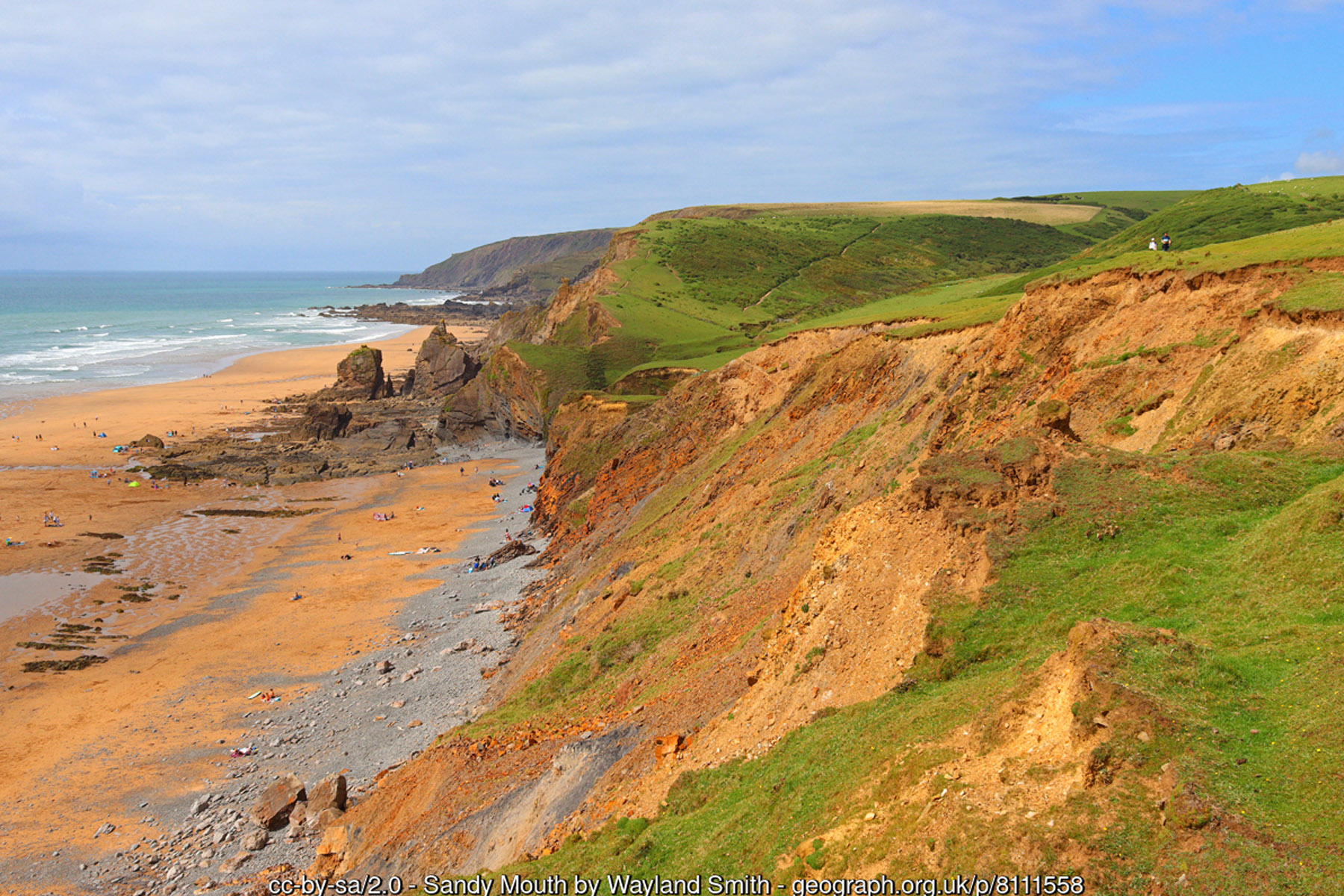
The beach itself is a mix of sand and shingle, with a broad, sandy expanse revealed as the tide drops - at high tide it becomes considerably narrower and stonier, so timing a visit around the tide tables pays off. The exposed, west-facing aspect picks up consistent Atlantic swell, making Sandymouth a popular spot with surfers and bodyboarders, while the rock pools at the northern end are a magnet for families exploring at low water.
A National Trust car park sits a short, moderately steep walk above the beach, with an overflow car park that opens once the main one fills - and on a sunny day in the school holidays, it fills quickly, so arriving before mid-morning is worth it. RNLI lifeguards are on duty during the summer high season; outside these times there is no supervision, so take extra care, particularly around the rocks. Dogs are allowed at Sandymouth all year round with no seasonal restriction, one of the more relaxed dog policies among Bude's beaches.
Sandymouth's cliffs are one of the best places in Cornwall to see the county's underlying geology laid bare. The rock here belongs to the Culm Measures, a thick sequence of Carboniferous-age sandstones and shales that underlies much of north Cornwall and north Devon; the local sequence, known to geologists as the Bude Formation, is made up of alternating beds of sandstone and darker mudstone, built up in a vast shallow basin - sometimes nicknamed "Lake Bude" by geologists - around 300 million years ago. What makes Sandymouth so photogenic is what happened next: those flat-lying beds were later crumpled by the same continental collision that raised the Variscan mountain belt across southwest Britain and Brittany, squeezing the once-horizontal layers into tight, seaward-plunging zigzag folds. The result, exposed in cross-section along the cliffs and across the wave-cut rock platforms at low tide, is a landscape of contorted, sharply angled strata that looks almost artificial - ridges of harder, rust-stained sandstone standing proud where softer shale has worn away between them. It's a textbook example of chevron folding, and walkers with even a passing interest in geology tend to linger here far longer than they planned to.
Sandymouth has long been rated among the more serious surf beaches on this stretch of coast. Its north-westerly exposure means it picks up swell that other, more sheltered Bude beaches miss, and a seabed that shelves fairly sharply produces punchy, well-defined beach-break peaks rather than the gentler, more forgiving waves found at nearby Crooklets or Summerleaze. Conditions work best from mid to low tide, when the banks are more clearly defined; a pushing tide tends to bring the short, quick sections that bodyboarders favour. A licensed surf school operates from the beach in season for anyone wanting proper tuition rather than going it alone, and the beach's reputation with local surfers goes back decades - it's one of the spots regularly name-checked in round-ups of the Bude area's best breaks. As with any exposed Atlantic beach, rip currents can develop around the gutters and rock outcrops, especially on a dropping tide, so it's worth taking local advice or sticking to the lifeguarded area in season.
The tide governs almost everything about a visit to Sandymouth, more so than at most Bude beaches. At low water the sea retreats to reveal well over a mile of sand studded with rock pools, weed-draped gullies and, after wet weather, a small waterfall that spills down the cliff face onto the beach - a favourite spot for photographs. As the tide comes in, that huge expanse shrinks quickly to a narrow band of shingle and pebbles hard against the cliff base, so it's not a beach to relax on regardless of the state of the tide; checking tide times before setting out, and leaving enough time to walk back before the sea cuts off the low-tide sand, is genuinely important rather than just cautious advice. The rock pools exposed at low water are some of the richer ones in the Bude area, sheltering anemones, small crabs, blennies and the usual seaside life of the Culm Measures shoreline, and they're as much a draw for families as the sand itself.
Above the beach, the clifftops are grazed year-round by cattle and sheep, which keeps the maritime grassland open for the wildflowers that colour the cliff edge through summer. The coast path along the top is a genuinely good spot for birdwatching - blackcaps, linnets and stonechats are regularly seen and heard along the hedgerows and scrub around Stowe Wood, a little inland, while gulls, fulmars and other seabirds work the cliffs and headlands either side of the beach itself, Steeple Point to the south and Menachurch Point to the north. It's a stretch of coast that rewards slowing down rather than heading straight for the sand.
Sandymouth also makes a good base for walking beyond the beach itself. The South West Coast Path runs along the clifftop in both directions: north, a roughly two-and-a-half-mile stretch leads to Duckpool, Cornwall's next National Trust beach along this coast, with sweeping views back over Sandymouth's folded cliffs; a longer circular option of around four and a half miles extends the same route inland through Stowe Wood, a mature, centuries-old woodland in the valley behind the coast, for a walk that mixes dramatic sea cliffs with a completely different, sheltered wooded landscape. South along the path towards Bude, the coastline continues past Northcott Mouth towards Compass Point and Crooklets, giving a genuinely varied stretch of Heritage Coast walking without needing a car to move between beaches.
The beach and its surrounding cliffland are owned and managed by the National Trust as an unspoilt stretch of the Heritage Coast, with a car park open from dawn to dusk (overnight camping in vehicles is not permitted) a short, fairly steep walk above the sand. A seasonal café near the car park - independently run rather than a National Trust operation - serves food and drinks through the summer months, alongside the toilets and lifeguard cover already noted in the Visitor Information above. At over a mile of sand at low tide, Sandymouth is often described as the longest of Bude's beaches, and its position away from the town itself, closer to the scattered hamlets of Stibb, Houndapit and Stowe Barton than to any settlement of its own, adds to the sense of a wilder, less developed beach than its near neighbours closer to Bude.
Sandymouth sits within Cornwall's Area of Outstanding Natural Beauty, and the wider Heritage Coast designation along this section of the north coast exists precisely because of cliffs like these - dramatic, largely undeveloped, and geologically significant enough to draw specialist interest as well as holidaymakers. The beach is sometimes referred to as Sandymouth Bay, though Sandymouth is the name used locally and by the National Trust. Getting down to the sand involves a sloping track and a run of steps followed by a stretch over large pebbles before the sand proper begins, which is worth knowing if pushchairs, wheelchairs or anyone with limited mobility are part of the visit - it's one of the more physically demanding beaches to reach on this part of the coast, in exchange for one of the more dramatic settings once you're there.
Visitor Information
Parking
National Trust car park a short, moderately steep walk from the beach, with an overflow car park for busy periods. Fills quickly in summer - arrive early.
Facilities
Toilets and refreshments near the car park. RNLI lifeguards on duty during the summer high season.
Disabled Access
The walk down from the car park is moderately steep and stony, making this one of the harder beaches on this stretch for wheelchair or pushchair access. No dedicated Blue Badge bays are confirmed at the National Trust car park - check with the National Trust directly before you travel.
Things to Do Nearby
- Duckpool Beach, a short drive or coast path walk north
- Northcott Mouth Beach, a short drive or coast path walk south
- Bude Town Guide - shops, restaurants, the canal and Bude Castle
- Bude Surf Beaches Map & Complete Surf Guide - other surf spots near Sandymouth
Places to Stay
Frequently Asked Questions
Page last updated: 8 September 2026.