Crooklets Beach
Bude's Blue Flag Beach, Right by the Town
Crooklets Beach, Bude, Cornwall, EX23 8NF Blue Flag 2026
Crooklets is Bude's most convenient beach, a short stroll from the town centre and one of Cornwall's Blue Flag award-winning beaches for 2026 - recognition for consistently high water quality, environmental management and safety standards. A relatively small bay of mixed sand and pebble, it becomes a much wider expanse of sand at low tide, when it joins up with Summerleaze and Northcott Mouth to the north.
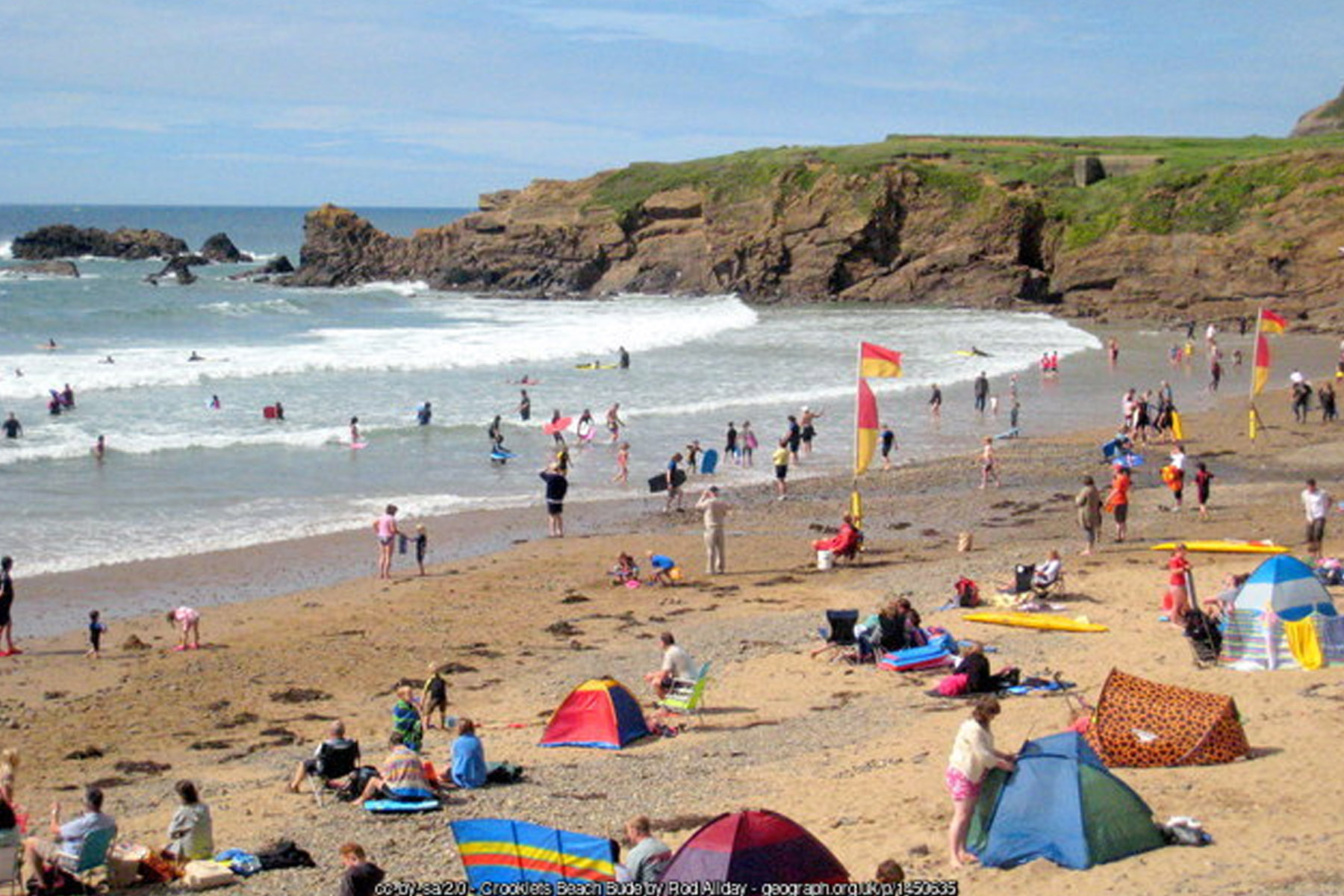
What sets Crooklets apart is how easy it is to use: a car park sits directly behind the beach with level access down to the sand, and the town's shops, a cafe and toilets are all within a short walk. Because it is so accessible and so close to the town centre, Crooklets does get busy and can feel congested on a warm day in peak season, but for a straightforward, well-facilitated beach day it is hard to beat locally.
RNLI lifeguards provide daily cover through the main summer season (broadly 19 May to 30 September, though it is worth checking the exact current dates locally), and a bookable sand chair is available through the Summerleaze Beach Office (01288 352226) for anyone who needs it. Dogs are welcome outside the summer season but banned between 10am and 6pm from 15 May to 30 September, in line with most of Bude's other main beaches.
Geographically, Crooklets is a broad, west-facing bay bounded by low rocky ledges at both ends, with a mix of golden sand and pebble that shifts noticeably with the tide. At low water the beach opens right out and joins seamlessly with Summerleaze to the south, giving a long, walkable stretch of firm sand toward the harbour and canal mouth; as the tide comes in, Crooklets narrows back down into its own more contained crescent, hemmed in by the rocks either side. Surfers generally reckon the mid-to-low tide range produces the best-shaped sandbanks, when the beach break throws up the peaky, fairly fast waves the spot is known for.
Bude built its reputation as a surfing town on beaches very much like this one, and Crooklets is still counted among its two or three principal surf beaches, alongside Summerleaze and Widemouth Bay along the coast. It is a fairly straightforward, exposed beach break that works across a good range of swell and tide, and one of the easier local spots for visiting surfers and bodyboarders to weigh up from the car park before heading down. It generally suits confident intermediate surfers best; on bigger or messier days, and for complete beginners, the more sheltered water at Summerleaze or a lesson with one of the town's surf schools is usually the gentler introduction.
Crooklets also has a genuine claim to a significant place in British surfing history, because it was here that organised surf lifesaving began in this country. Australian servicemen who had passed through Cornwall after the Second World War had spoken warmly of the surf at Bude, and it was an Australian, Alan Kennedy, who came to see it for himself in May 1952 - recognising both the quality of the waves and the complete lack of any formal rescue provision, and arranging for surf lifesaving equipment to be sent over from Australia. When it arrived in August 1953, Kennedy ran an intensive week's training for a group of local youngsters, all of whom passed their Bronze Medallion award - and Bude Surf Life Saving Club, generally regarded as the first of its kind in Britain, was born. A further batch of volunteers qualified the following year, and the model Kennedy brought to Crooklets went on to be adopted by more than twenty other clubs that have since sprung up around the Cornish coast. The Bude club has grown steadily throughout: it is run entirely by volunteers today, with well over 100 adult and intermediate members and more than 150 juniors and nippers training across its Nippers, Juniors and Seniors sections, and it has recorded well over a thousand rescues in its history, with several members recognised for bravery along the way. The club's clubhouse still stands on Crooklets Road, right by the beach, and its members train not only in the sea here but also in the calmer waters of the Summerleaze sea pool and along the Bude canal when conditions off the beach are too rough for safe practice.
The cliffs and rock ledges framing the beach are part of the wider geology of the Bude coast: a thick sequence of alternating sandstone and mudstone known to geologists as the Bude Formation, laid down around 300 million years ago in the Carboniferous period, when this stretch of what is now Cornwall lay beneath a vast tropical lake. Those flat sand and mud layers were later folded and crumpled when the ancient landmasses of Britain and continental Europe collided, and the result - tight zigzag folds of harder and softer rock, visible in cross-section along the wave-cut platform - is one of the more striking things to look out for on the rock ledges at either end of the beach. Fossil fish from this ancient lake, including a species unique to the area, Cornuboniscus budensis, have been found in the rock locally and are on display at Bude Castle Heritage Centre in the town.
Those same rocky ledges are good territory for rockpooling at low tide, typically holding anemones, small crabs, blennies and a range of seaweeds - a straightforward, low-key activity for families staying close to the car park rather than venturing further round the coast. The wider run of coast around Bude, north past Duckpool towards the Devon border, is designated Heritage Coast, valued as much for this exposed geology as for its wildlife and scenery.
The South West Coast Path runs along the clifftop directly above Crooklets, linking it on foot into a much longer stretch of this coastline. Heading north, the path climbs past Maer Down - National Trust land where Wrangle Point gives one of the best views back over Bude, and where ancient burial mounds and Mesolithic-era finds point to a much older history along this stretch of coast - on its way to Northcott Mouth and Sandymouth; walkers dropping down onto the sand rather than staying on the clifftop should keep an eye on the tide, since parts of this shoreline can be cut off as the water comes in. To the south, the path drops down towards Summerleaze, the mouth of the River Neet, Bude's historic sea lock and the start of the Bude Canal, and on to the breakwater - all comfortably walkable from Crooklets in well under half an hour.
Like the rest of this coastline, Crooklets faces the full run of the Atlantic, so conditions can turn from flat and gentle to boisterous and wind-blown within a single day, and there is little natural shelter compared with more enclosed south-coast coves. High summer brings the busiest crowds, given how easily the beach is reached from the town centre, while spring and early autumn - when the lifeguards are still on duty but the car park is quieter - are often reckoned a more comfortable time to visit for anyone put off by peak-season congestion. Whatever the season, it is worth checking the tide times before setting out, since so much of what makes Crooklets pleasant - the wide connecting sands towards Summerleaze, the accessible rock ledges, the easy coast path walking either way along the clifftop - depends on catching it somewhere between mid and low water rather than at the top of a big spring tide.
Visitor Information
Parking
Car park directly behind the beach, a short walk from Bude town centre. Busy on warm summer days.
Facilities
Toilets, cafe and shops nearby. RNLI lifeguards on duty through the main summer season.
Disabled Access
Level access from the car park to the beach. A bookable sand chair is available via the Summerleaze Beach Office (01288 352226). Blue Badge spaces are available at the car park - one of the more accessible beaches locally for drivers with a Blue Badge.
Things to Do Nearby
- Northcott Mouth Beach, a short drive or coast path walk north
- Summerleaze Beach, a short walk south, next to Bude town centre
- Bude Town Guide - shops, restaurants, the canal and Bude Castle
- Bude Surf Beaches Map & Complete Surf Guide - other surf spots near Crooklets
Places to Stay
Frequently Asked Questions
Page last updated: 8 September 2026.