Bossiney Cove
A Sheltered Cove Near Tintagel - Check Access First
Bossiney Cove, near Tintagel, Cornwall, PL34 0AY
Bossiney Cove is a small, sheltered, north-facing beach a short distance from Tintagel, tucked beneath spectacular cliffs on one of the most scenic parts of the north Cornwall coast. Its size and seclusion are part of the appeal - this is a quiet, undeveloped cove rather than a facilities-led beach - but that same seclusion means access needs real care and planning before you set off.
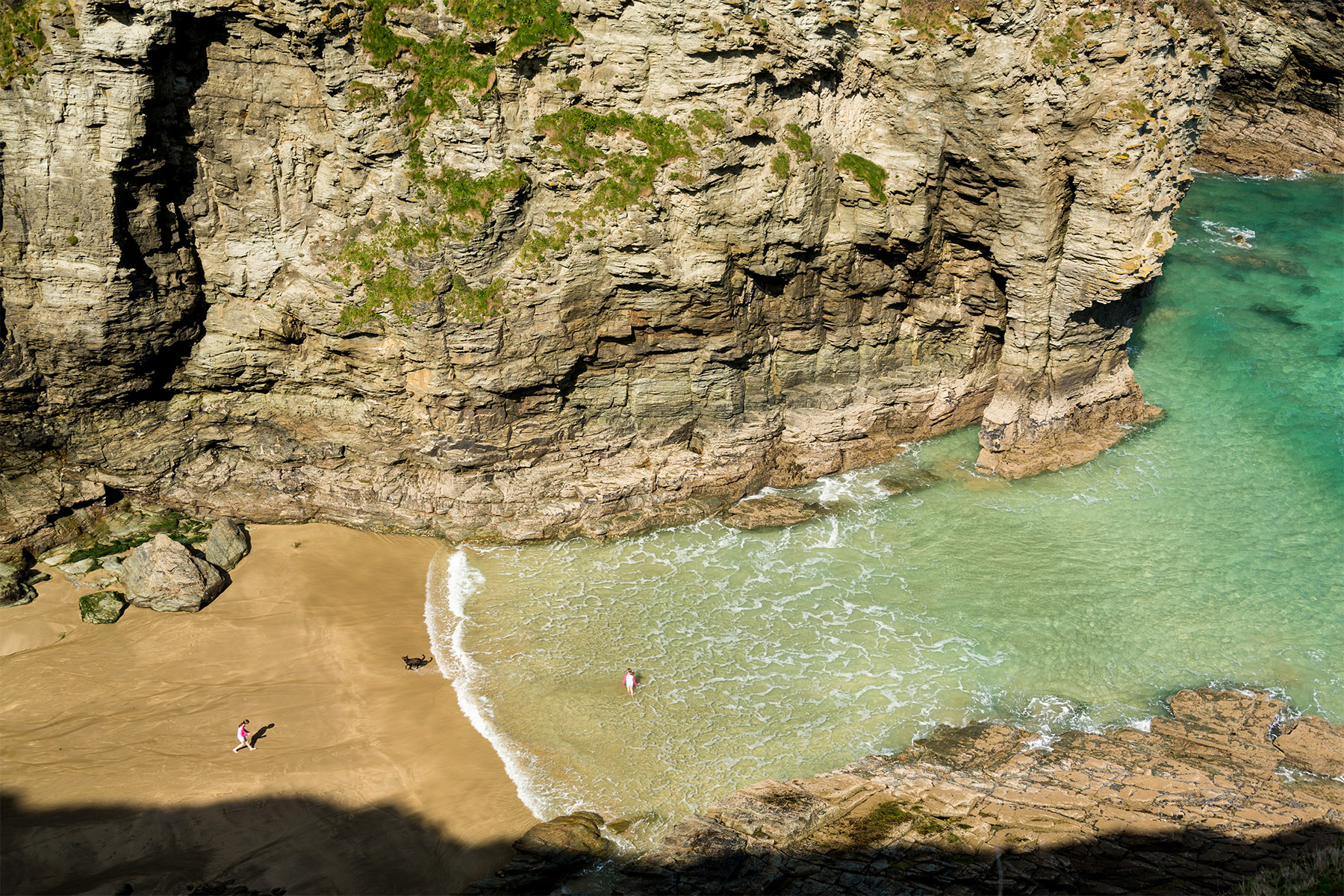
The cove lies within the Tintagel Cliffs Site of Special Scientific Interest, a stretch of coastline recognised as much for the geology in its cliffs as for its beaches. The rock here is a folded and faulted mix of Devonian and Lower Carboniferous slates and volcanic material, shaped by the same Variscan earth movements responsible for much of Cornwall's coastal structure, and Bossiney is a well-studied example of how erosion along these old fault lines and joint planes has carved out the bays, headlands, stacks and caves typical of this shore. The most striking result is Elephant Rock, a natural arch at the eastern end of the beach whose silhouette - trunk, head and all - gives it its name. Close by, a sizeable sea cave runs back into the cliff, reportedly around sixty feet high at the entrance but narrowing to only fifteen or twenty feet wide, opening into a larger chamber with further caverns beyond and, by some accounts, a trickle of water somewhere inside - striking to look into, but not somewhere to explore casually, and never as the tide is coming in.
Bossiney sits roughly a mile along the cliffs east of Tintagel and some three miles short of Boscastle - the Cornish name for the cove, Porth Boskyny, simply means "cove at Bossiney." Facing north, it is sheltered from the south-westerly winds that dominate much of the Cornish coast, but fully open to anything coming from the north, so a calm, sunny morning can turn choppy and unwelcoming with very little warning if the wind swings round. The clarity of the folding and faulting on display in the cliffs here has also made this stretch of coast a regular stop for geology students and field trips studying the Variscan mountain-building period that shaped so much of the South West.
A note on access: the cliff path down to Bossiney Cove has been affected repeatedly in recent years by rockfall, with visitors reporting the path closed, handrails missing from the steps, or temporary fencing in place. Access has reopened and closed again more than once, so please do not rely on an old description of "a steep half-mile path" being accurate on the day you visit - check current conditions locally, for example via the National Trust or Cornwall Council, before making the walk down. When open, the path is steep, uneven in places, and unsuitable for pushchairs; it is not a route for anyone uneasy with heights.
The closures are not exaggerated: the beach was reported shut in February 2023 because of unstable ground on the cliff above, and visitor accounts since have described the flight of steps at the bottom missing its handrail, with temporary fencing appearing and later being taken down as conditions change. The land either side of the cove forms part of a 2.7-mile run of coastline the National Trust has been assembling in stages - from Barras Nose, taken on in 1897 as the Trust's very first coastal acquisition anywhere in England, through to Smith's Cliff, a former golf course bought in 2023, and on to Bossiney itself. It is a beautiful, actively eroding piece of coast, and the same cliff movement that produces the scenery is also what closes the path from time to time.
There is no lifeguard cover and no facilities at the cove itself - the nearest toilets, cafes and shops are in Tintagel. Dogs are allowed at Bossiney Cove all year round. For many visitors, the safer and equally rewarding option is to enjoy the view from the coast path above rather than attempting the descent, particularly if access is in any doubt.
Tide timing matters more here than at most Cornish beaches, since there is very little sand to speak of once the tide is fully in. As the water drops, the beach widens and joins up with the neighbouring sand of Benoath Cove around the headland to the east, together forming a much longer stretch than either cove offers alone at high water. Benoath Cove has a reputation for strong rip currents around low and ebbing tide, though, so it is worth treating the extra sand as somewhere to walk and explore rather than somewhere to swim without care. Check a tide table before setting out, and plan to be back up the path well before the tide turns - there is no lifeguard to help if the sea catches you against the cliffs.
Bossiney's other claim to fame lies inland, on the low ridge above the cove. Bossiney Mound - the earthwork remains of Bossiney Castle, a Norman motte thought to date from the 11th or 12th century, possibly raised for Robert, Count of Mortain, who held the manor at the time of the Domesday survey - still stands close to the coast road, a grass-covered mound roughly 46 metres across and originally nearly 6 metres high, ringed by its original ditch. It fell out of use once the better-known Tintagel Castle was built nearby by the mid-13th century, but had one more official life afterwards: from the 16th century until the Reform Act of 1832, the results of Bossiney's parliamentary elections were declared from the top of the mound. Given how close this is to Tintagel, it's no surprise the site picked up its own thread of Arthurian folklore - local tradition holds that Arthur's golden Round Table lies buried beneath it, said to surface briefly on Midsummer's Eve, while another version has Arthur and his knights sleeping under the mound, ready to wake if Cornwall's hour of need ever comes. The mound itself is on private land with no public access, but is visible from the road through Bossiney village on the way down towards the cove.
The South West Coast Path runs directly above Bossiney Cove and is how most visitors actually see it, since the steep drop to the beach puts many people off the full descent. Heading north, the path climbs past Willapark, a headland whose earthworks may once have formed an Iron Age cliff castle - a National Trust survey in 2001-02 could not confirm this either way - before dropping down towards Rocky Valley, a wooded gorge with a stream, a ruined mill and faint, much-debated "cup and ring" rock carvings, and on towards Boscastle. South of the cove, the path continues past Barras Nose and Tintagel Island towards Tintagel Haven, running through National Trust land for almost the whole way. The cliffs and grassland along this stretch, part of the wider Tintagel Cliffs SSSI, support breeding seabirds including peregrine falcons, kittiwakes and razorbills, with puffins recorded in season, alongside maritime grassland plants such as autumn squill and hairy bird's-foot-trefoil that are scarce elsewhere in Britain. Whether or not the beach itself is open on the day you visit, the coast path above it is one of the best short stretches of walking on this part of the coast.
Visitor Information
Parking
No dedicated car park - parking is limited to a nearby layby, with a steep walk down to the beach.
Facilities
No facilities at the cove itself. Nearest toilets, cafes and shops are in Tintagel.
Disabled Access
Not accessible - a steep, uneven cliff path affected by rockfall damage, currently unsuitable for wheelchairs or pushchairs. Check current access before visiting. No Blue Badge provision - there is no dedicated car park, and the path itself is unsuitable for wheelchairs.
Things to Do Nearby
- Crackington Haven, a scenic drive north
- Trebarwith Strand, a short drive south
- Tintagel Castle (English Heritage), a short walk from the village
- Tintagel Village Guide - shops, cafes and the village itself
- South West Coast Path Guide - walking routes along this stretch of coast
Places to Stay
Frequently Asked Questions
Page last updated: 8 September 2026.