The Strangles
A Remote National Trust Beach Reached Only on Foot, Beneath Cornwall's Highest Cliff
The Strangles, near Crackington Haven, Cornwall, EX23 0LQ National Trust
The Strangles is one of the wildest and least visited beaches on Cornwall's Heritage Coast, a National Trust-owned strand of sand, shingle and rock tucked beneath towering cliffs a mile or so south west of Crackington Haven. There is no road to it and no car park at the beach itself - the only way in is on foot, along a section of the South West Coast Path that drops steeply from the clifftop down to the shore. That single fact shapes everything about the place: no crowds, no facilities, no easy access, and in exchange a genuinely dramatic, unspoilt corner of coastline that rewards the walk with some of the best scenery in north Cornwall.
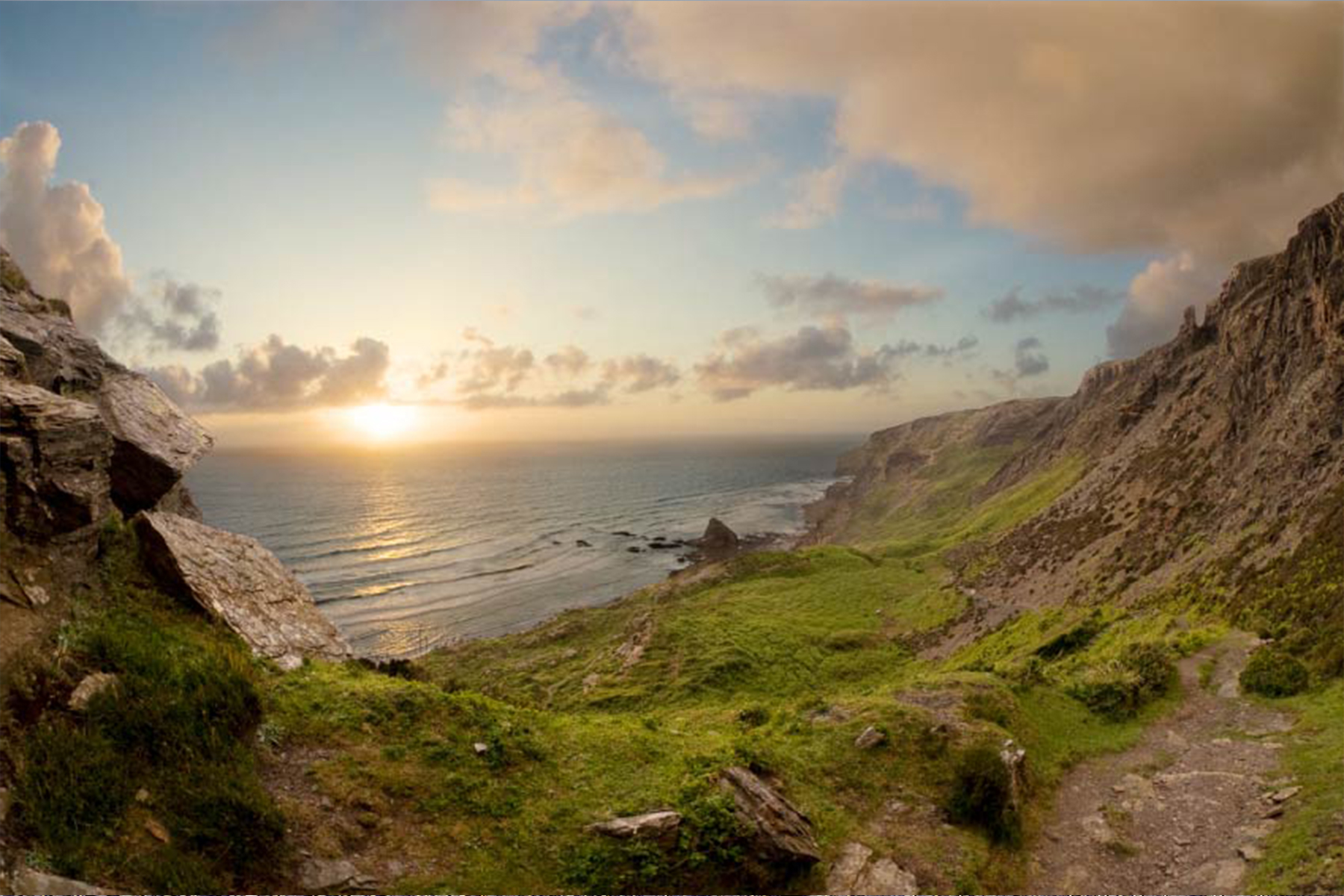
Getting there takes a little planning. Most walkers approach either from Crackington Haven itself, following the coast path south west for around a mile with a testing amount of up and down along the way, or from inland near Trevigue and Strangles Wood, where a small National Trust roadside layby (with an overflow field that opens in busier summer weeks, and a donation box to support upkeep of the path) gives onto a footpath joining the coast path above the beach. From that inland car park the walk down is around 20 to 30 minutes each way, on a path that is well used and reasonably maintained for most of its length but turns properly steep and narrow for the final stretch, with wooden steps, an unprotected cliff edge in places, and a scramble over rocks to reach the sand. It is not a walk to take lightly in poor weather, in the wrong shoes, or with anyone who struggles on steep, uneven ground - but for a reasonably fit walker prepared for the return climb, it is entirely manageable and very much part of the appeal.
The beach that greets you at the bottom is in two parts. The main strand faces open water beneath the cliffs, mixed sand, shingle and rock, with rock pools scattered among the boulders at its edges. A short scramble beyond a large rock outcrop known locally as Samphire Rock leads to a second, smaller cove, Little Strand, and at low tide the two come together across the exposed sand into one long, uninterrupted beach. A natural rock arch and freestanding sea stacks punctuate the shoreline, the kind of eroded, sculptural rock formations that draw photographers and geologists as much as beach-goers. Low to mid tide is by far the best time to visit: at high water the sand narrows considerably and much of the beach's character is lost beneath the waves.
The cliffs themselves are part of the draw. Immediately behind and above the beach rises High Cliff, at 223 metres (735 feet) the highest point on the entire Cornish coastline - taller by some margin than the cliffs at Land's End or Lizard Point, both under 130 metres. It is often described locally as the highest sheer-drop cliff in Cornwall, and the claim holds up; what does not quite hold up is the wider claim sometimes made that it is the highest cliff on the English mainland as a whole. That distinction is generally credited to Great Hangman on the North Devon coast, a little further along the same South West Coast Path near Combe Martin, which rises higher still. High Cliff is, however, unquestionably the dominant feature of this stretch, and the short detour up to its summit from the coast path is a worthwhile add-on to a visit to the beach below, with sweeping views along the coast towards Cambeak headland to the south and, on a clear day, back towards Crackington Haven and beyond.
Geologically, this is one of the more celebrated stretches of the Cornish coast. The cliffs here are formed of the Crackington Formation, Carboniferous-age sandstones and grey shales laid down around 300 million years ago and subsequently folded and contorted by immense pressure during the mountain-building episode that shaped much of Devon and Cornwall's coastline. The result, visible in the cliff faces around Cambeak and along the coast path towards High Cliff, is a landscape of dramatically bent and buckled rock strata, studied by generations of geology students and regularly cited as among the best exposed folded rock sequences in Britain. It is worth taking the time to look properly at the cliffs themselves here, not just the beach - the geology is genuinely part of the attraction.
The area is also managed by the National Trust for its wildlife as much as its geology. A herd of wild goats, originally introduced from the Valley of Rocks near Lynton in North Devon, grazes the steep grassland around Cambeak and The Strangles to keep the cliff-top vegetation from becoming overgrown and scrubby - a deliberate piece of conservation grazing rather than a chance encounter, though walkers do sometimes spot them on the slopes above the beach. Choughs, Cornwall's emblematic red-billed crow and a bird that had been absent from the county for decades before a natural return in the early 2000s, are now seen along this coast, and peregrine falcons hunt from the cliffs, capable of diving at extraordinary speed. The fissured cliff faces provide roosting sites for several species of bat, and the surrounding grassland was historically home to the Large Blue butterfly before it died out in Britain in the late 1970s, with the coastal grazing regime here partly aimed at making the habitat suitable again should reintroduction ever bring it back to this part of Cornwall.
The Strangles carries a serious safety warning that should not be glossed over: this is not a beach for swimming. Like much of this exposed, rocky stretch of the north Cornwall coast, it has a reputation for strong currents and undertow, made more hazardous by submerged rocks, and there is no lifeguard cover here at any time of year - unlike Crackington Haven a mile away, which has seasonal RNLI patrols. Anyone visiting should check tide times before setting out, since the beach narrows sharply as the tide rises and it is possible to be caught out on the sand beneath the cliffs, and should treat the water itself with real caution rather than as an incidental extra to the walk. The reward for visiting is the scenery, the solitude and the sense of a genuinely wild coastline, not a swim.
There are no facilities of any kind at The Strangles - no toilets, no cafe, no shop, nothing beyond the beach and the cliffs themselves - so anyone planning a visit should bring whatever food, water and equipment they need, and allow plenty of time for the return walk as well as the outward one. Precisely because it demands this level of effort, The Strangles remains one of the quietest beaches in Cornwall even at the height of summer, a rare stretch of coastline that has largely escaped the crowds and development found elsewhere along the county's more accessible beaches. It suits walkers, photographers and anyone drawn to wild, unmanaged coastal scenery far more than it suits a conventional family beach day, and it is best treated as a highlight of a longer coast path walk from Crackington Haven rather than a destination in its own right.
Visitor Information
Parking
No car park at the beach. A small National Trust roadside layby near Trevigue/Strangles Wood inland (overflow field in summer, donation box) is the usual starting point, or park in Crackington Haven and walk the coast path.
Facilities
None at all - no toilets, cafe or shop at the beach or the layby. Nearest facilities are a mile away in Crackington Haven. No lifeguard cover at any time of year.
Disabled Access
Not accessible. A steep, narrow coast path with steps, an unprotected cliff edge and a final rock scramble - unsuitable for wheelchairs, pushchairs or limited mobility. No dedicated Blue Badge parking or accessible route - the layby is small and the path down is steep and unsuitable for anyone with restricted mobility.
Things to Do Nearby
- Crackington Haven, the nearest beach with parking, cafes and facilities, roughly a mile along the coast path
- Crackington Haven Village Guide - more on the village and surrounding area
- South West Coast Path Guide - the wider walking route linking Crackington Haven, The Strangles and High Cliff
Places to Stay
Frequently Asked Questions
Page last updated: 7 September 2026.