Port Gaverne
A Quiet Pebble Cove on the Edge of Port Isaac
Port Gaverne, near Port Isaac, Cornwall, PL29 3SQ
Port Gaverne is a small, north-facing beach a five minute walk from Port Isaac, tucked into its own quiet cove beside the larger, better-known fishing village. It is a fairly small, pebbly beach with sand exposed at low tide, and its relative lack of facilities compared with Port Isaac itself is exactly what keeps it peaceful even when the main village is busy with visitors.
The hamlet's name is thought to come from the Cornish "Karn Hun", meaning something close to "rocky haven" - an apt description of the tight, cliff-bound cove it sits in. Written references to the settlement go back further than most coves of this size: a Havener's account of 1338 records tithes paid jointly by Port Gaverne, Port Isaac and Port Quin, and the Elizabethan antiquarian John Norden, surveying this coast in the late sixteenth century, already described Port Gaverne as having "divers buildings, all decayed since the growing up of Port Isaac" - suggesting it was being overshadowed by its larger neighbour as early as the 1580s, even though its busiest years still lay ahead.
Those busiest years came with the pilchard boom of the early nineteenth century. The Guy family, who took leases here from 1802, built four large U-shaped fish-processing cellars nicknamed the "pilchard palaces" - Union, Rashleigh, Venus and Liberty. Each summer, boats landed huge catches of pilchards, which were layered with salt inside the cellars for several weeks and then pressed under heavy stones to extract the oil - once used to fuel household and street lamps - before the fish were packed into barrels, or "hogsheads" of around 3,000 fish apiece, for export as far afield as Italy and the West Indies. One especially good week in 1815 is recorded as having processed around 1,000 tons of pilchards through the cove, a striking volume for a settlement of only a few dozen households. Like most of Cornwall's pilchard fisheries, the trade collapsed as shoals declined through the late 1820s.
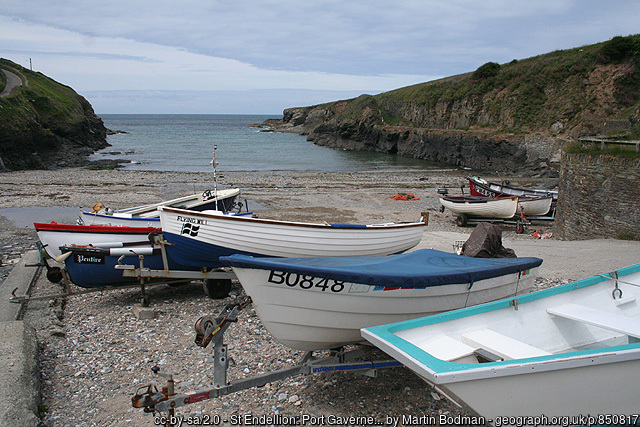
With the pilchards gone, Port Gaverne's economy turned to slate. From the 1830s it became a principal shipping point for the Delabole quarry a few miles inland - already, by the 1860s, one of the largest slate quarries in the country, employing close to a thousand men and producing around 120 tons of slate a day. Flat-bottomed ketches were run onto the sand at high tide, secured with lines to posts driven into the beach, and loaded by hand as the tide fell; much of this hard physical work was done by women, since the men were often away at sea fishing. The trade ended abruptly once the railway reached Delabole in the 1890s, giving the quarry a faster, cheaper route to market and leaving Port Gaverne's small quay - built on the cove's north-eastern side but never given a proper protecting breakwater - increasingly redundant.
Alongside fishing and slate, the cove also did a modest trade in sand, valued by farmers for its lime content as a soil improver; women and children carried on gathering and selling it well into the twentieth century, long after the larger trades had ended. A limekiln once stood in the hamlet too, fed by limestone and coal brought in by sea, though like the quay and the fish cellars it has long since gone out of use.
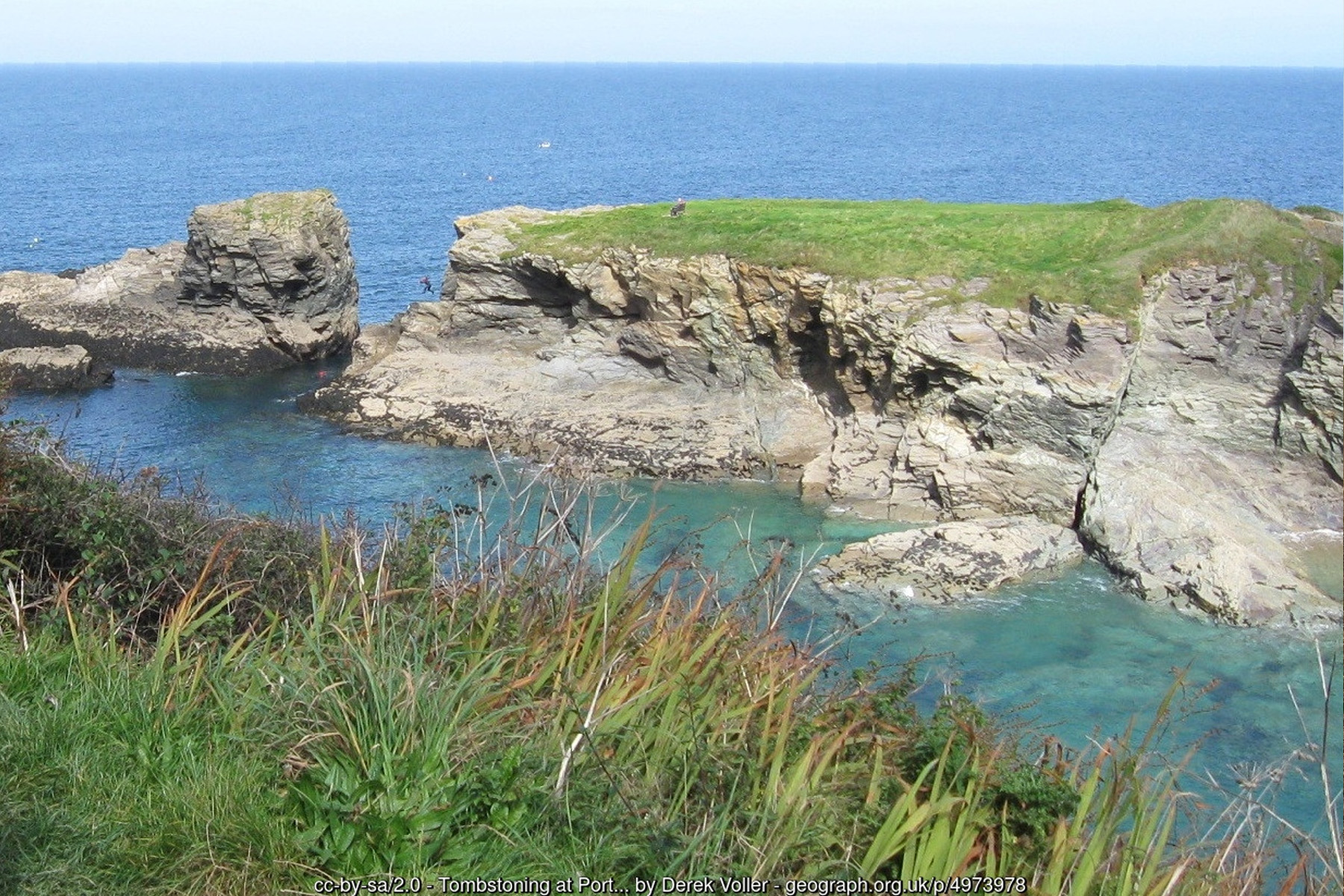
Access is via a short walk down the hill from parking on the outskirts, and the cove's sheltered position makes it a pleasant, generally calm spot for families in summer, with the pub right beside the beach a popular spot for a drink with a view. At high tide the deeper water close to the cliffs is well regarded locally for diving, while lower tides expose more sand and rock to explore.
There is no lifeguard cover at Port Gaverne, so swim with the usual care you would take at any unsupervised Cornish cove. Dogs are allowed at Port Gaverne all year round. Most facilities - shops, cafes, toilets - are a short walk away in Port Isaac itself, which is well worth the visit in its own right for its harbour and cobbled streets.
The four Georgian pilchard cellars still stand today, and their later conversions trace the hamlet's shift from working port to holiday destination: Union Cellar now provides a base for the coasteering, climbing and kayaking operator Cornish Rock Tors; Rashleigh Cellar has been converted into National Trust holiday cottages alongside public toilets; and Venus and Liberty (the latter later renamed Gullrock) have likewise become holiday accommodation, with Liberty spending a spell in the early twentieth century as a small hotel. The stone and slate buildings throughout the hamlet have changed little in appearance for two centuries, giving Port Gaverne a settled, unhurried character that contrasts with the busier lanes of Port Isaac just around the headland.
The Second World War brought a different chapter: some of the old fish cellars were pressed into use housing evacuee children sent from Britain's cities, and tank traps were installed on the beach as part of the wider coastal defences against invasion - a reminder that this quiet inlet has not always been given over entirely to holidaymakers.
Port Isaac itself, reached by a coast path and lane walk of well under a mile, is by far the larger and more visited of the two settlements, with a working harbour, a tight knot of whitewashed cottages and cobbled slipways that have made it a popular film location - most famously as "Portwenn" in the ITV drama Doc Martin, and also used for scenes in the 2019 film Fisherman's Friends. One Port Gaverne cottage was itself used on screen as the police house in the same series. Nearly all practical amenities for visitors - shops, cafes, a surgery, a small Co-op store and the RNLI lifeboat station - are found in Port Isaac rather than at the cove itself, which is one reason Port Gaverne has kept its quiet, undeveloped feel even at the height of summer.
The beach is a small, sheltered sand-and-shingle cove, hemmed in by dark, steeply folded cliffs of Devonian-age slate and shale - rock laid down as sediment roughly 300 to 400 million years ago and later crumpled by the immense pressures of the Variscan mountain-building period, the same forces that gave Cornish slate the fine, even grain that made it so valuable for roofing. Sand is at its most extensive at low tide, uncovering a good stretch for building sandcastles and exploring; as the tide rises, the cove narrows to little more than a stony strip beneath the rocks. The falling tide also exposes rock pools among the ledges on either side of the cove, home to shore crabs, anemones and small fish and offering plenty for children to investigate, while the deeper, calmer water by the cliffs at high tide has long been an informal, locally popular spot for a swim or a dip - though, as everywhere on this stretch of coast, without any lifeguard supervision.
Port Gaverne sits directly on the South West Coast Path, which runs along the cliff top in both directions - west through Port Isaac and on towards Trebarwith Strand and Tintagel, and east past Doyden Point towards the abandoned fishing hamlet of Port Quin and on to Polzeath. This is designated heritage coast within the Cornwall Area of Outstanding Natural Beauty, and its cliffs and rocky headlands support breeding seabirds; a little further east towards Port Quin, the offshore island of the Mouls hosts noisy colonies of kittiwakes, gannets and puffins through spring and early summer, while fulmars and gulls nest on ledges much closer to Port Gaverne itself. Grey seals are also occasionally spotted hauled out on rocks or fishing just offshore along this quiet stretch of coastline.
Visitor Information
Parking
Most convenient parking is in Port Isaac village, just over half a mile's walk away. Limited roadside parking exists at Port Gaverne itself.
Facilities
A pub just off the beach. Most other facilities - shops, cafes, toilets - are a short walk away in Port Isaac.
Disabled Access
Access involves a walk down a hill from the parking area, and the beach surface is pebbly - limited for wheelchairs. No dedicated Blue Badge provision at Port Gaverne itself - check parking options in Port Isaac before you travel.
Things to Do Nearby
- Trebarwith Strand, a short drive north
- Port Isaac, Port Quin & Port Gaverne Guide - the harbour village a five minute walk away
- Cornish Rock Tors - coasteering, kayaking and climbing, based right here at Port Gaverne
- South West Coast Path Guide - walking routes along this stretch of coast
Places to Stay
Frequently Asked Questions
Page last updated: 8 September 2026.