Marazion & St Michael’s Mount, Cornwall – Town, Beach, Marsh & Dunes on Mount’s Bay
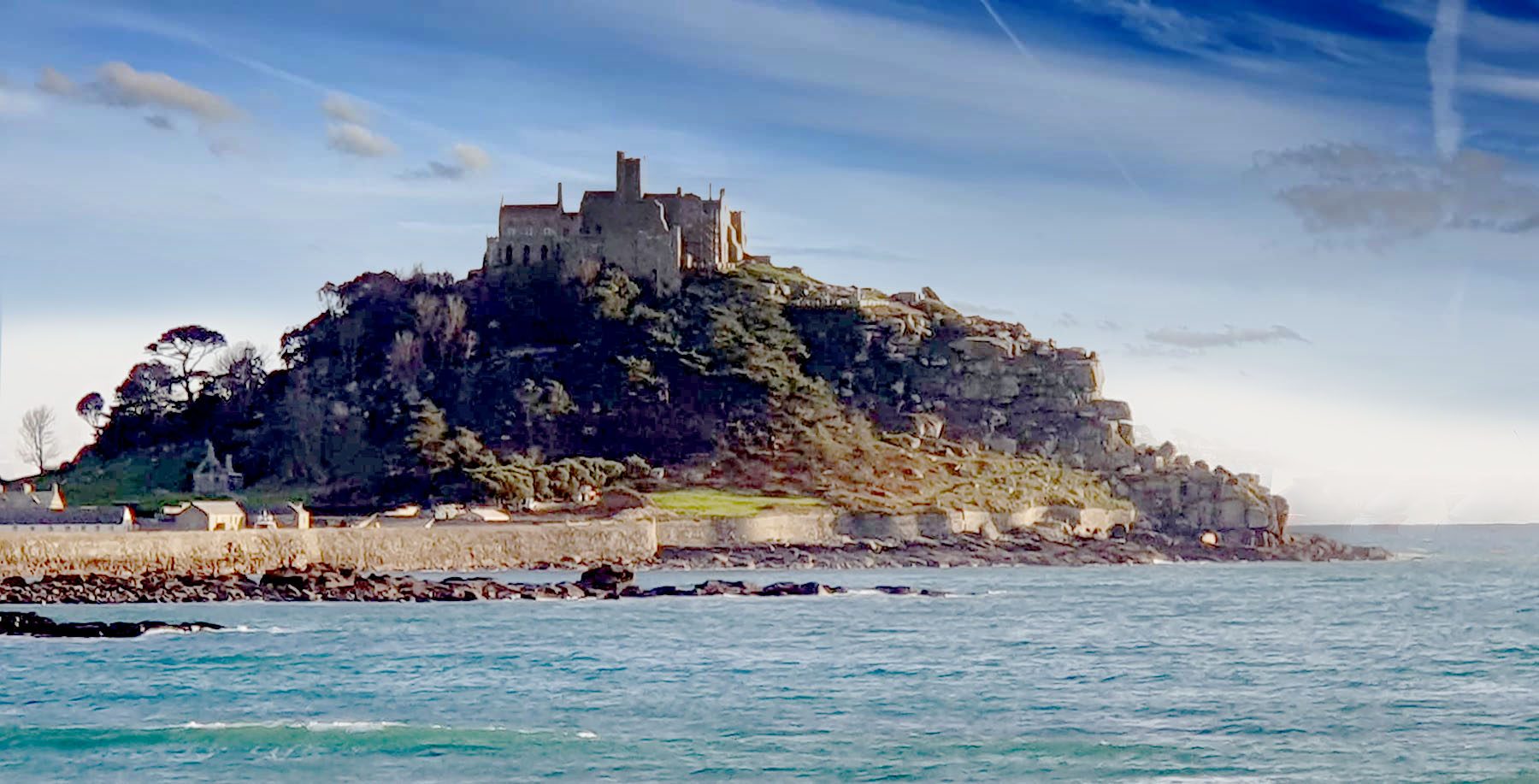
Marazion & St Michael’s Mount
Cornwall Online | West Cornwall Towns and Villages | Isles of Scilly | Sennen Cove & Land’s End | Pendeen | St Just | Porthcurno | Lamorna | Mousehole | Newlyn | Penzance | Marazion – St Michael’s Mount | Praa Sands | Porthleven | Gunwalloe – Church Cove | Mullion | Helston | The Lizard Peninsula
On This Page
- Holidays in Marazion
- Best Time to Visit
- The Town of Marazion
- Marazion Beach
- St Michael’s Mount
- Crossing to the Mount – Causeway & Boats
- History of St Michael’s Mount
- Marazion Marsh (RSPB)
- Marazion Sand Dunes
- History of Marazion
- Key Buildings
- Notable People
- Filming Guide
- Walks from Marazion
- Things to Do
- Local Events
- Places near Marazion
- Visitor Information
- Stay & Explore
- Family Holidays & Short Breaks
- Frequently Asked Questions
Marazion at a Glance
Small market town on the shore of Mount’s Bay, about three miles east of Penzance, facing St Michael’s Mount across a tidal causeway. One of Cornwall’s oldest chartered towns – market rights since the Middle Ages and a charter of incorporation from Elizabeth I in 1595. Long, sandy, RNLI-lifeguarded Marazion Beach; the RSPB’s Marazion Marsh, Cornwall’s largest reedbed; the Marazion Dunes, being restored by local volunteers; galleries, pubs, cafés and a free town museum. Population about 1,480 (2021).
Before you cross to the Mount
The causeway is only open for a few hours around low tide. Always check the causeway times on the St Michael’s Mount website on the day of your visit, and book castle and garden tickets in advance.
HOLIDAYS IN MARAZION
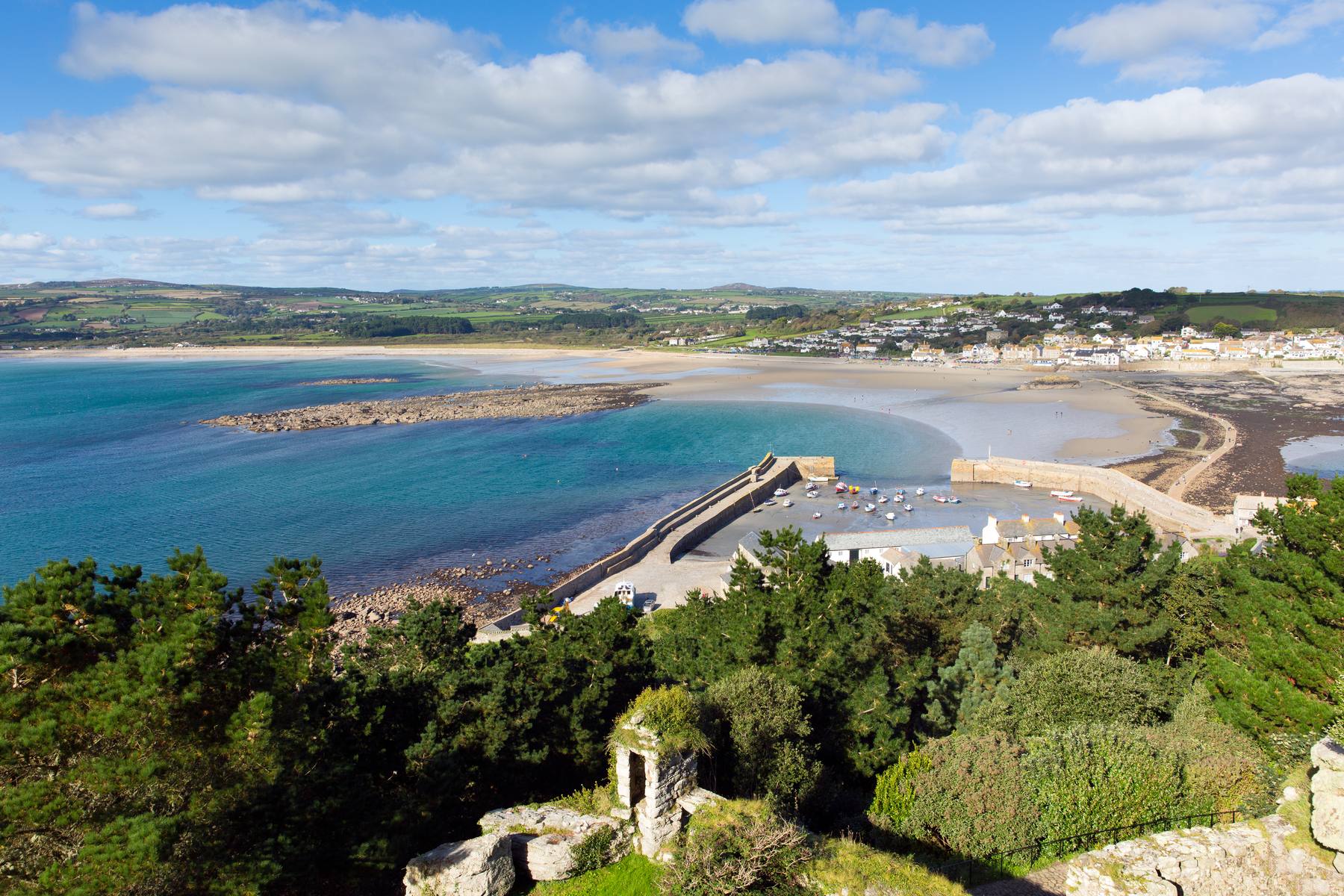
Marazion is the small, historic town on the shore of Mount’s Bay that looks straight out at St Michael’s Mount – the castle-crowned tidal island that is one of the most famous sights in Britain. At low tide an ancient cobbled causeway runs from Marazion’s beach to the island’s harbour; when the tide covers it, small boats ferry visitors across in season.
But there is far more to Marazion than the view of the Mount. The town has a long, sandy, south-facing beach that sweeps west towards Long Rock and Penzance, with RNLI lifeguards in summer and some of the best windsurfing, kitesurfing and dinghy sailing waters in Cornwall. Just behind the beach is Marazion Marsh, the RSPB nature reserve that holds Cornwall’s largest reedbed, and along the shore the Marazion Dunes are being restored by volunteers as a home for wildflowers and insects and a natural defence against the sea.
The town itself is one of the oldest chartered towns in Cornwall. Its name comes from the Cornish words for its medieval markets, and it received a charter of incorporation from Elizabeth I in 1595. Today its narrow main street – West End, the Square, Market Place and Fore Street – is lined with granite cottages, merchants’ houses, art galleries, gift shops, pubs and cafés, with the little Marazion Museum in the Town Hall.
Marazion is a lovely base for a family holiday in the far west. Penzance is just three miles away along the coast, and St Ives, Land’s End, the Minack Theatre, the Lizard and the beaches of Perranuthnoe and Praa Sands are all within easy reach. The South West Coast Path and the pilgrim route of the St Michael’s Way both pass through the town.
Because Marazion is small, it is quieter than its famous view might suggest – especially in the evenings, when the day visitors have gone and the sun sets behind Penzance across the bay.
For somewhere to stay, see Marazion holiday cottages and holidays and short breaks in Marazion.
Best Time to Visit Marazion
Spring brings migrant birds to the marsh, the gig regatta in the bay and the opening of the Mount’s castle for the new season. Summer is the season for the beach, the lifeguards, watersports, the Marazion Carnival and the Mount’s terraced garden, which opens on weekdays from May to early September. Autumn is quieter and still mild, and from late autumn into winter thousands of starlings gather over Marazion Marsh at dusk.
Whatever the season, plan your day around the tide. The causeway is usually walkable for around two hours either side of low tide; out of season the island’s boats do not run, so the causeway is the only way across.
↑ Back to topTHE TOWN OF MARAZION
Marazion is built along a single long street that follows the shore of Mount’s Bay. Coming in from Penzance you pass the marsh and the big beach car park at Folly Field, then the road becomes West End, climbing gently past cottages, guest houses and galleries into the Square and Market Place, before continuing as Fore Street past All Saints church towards the eastern end of the town and the road to Helston.
The heart of the old town is Market Place, where the granite Town Hall of 1871 houses the volunteer-run Marazion Museum on its ground floor – in what was once the headquarters of the Marazion and District Fire Brigade, with a reconstructed cell from the old town gaol at the back. Opposite All Saints church stands the town’s war memorial, bearing the words of the hymn Abide with Me by Henry Francis Lyte, who was a curate in Marazion as a young man.
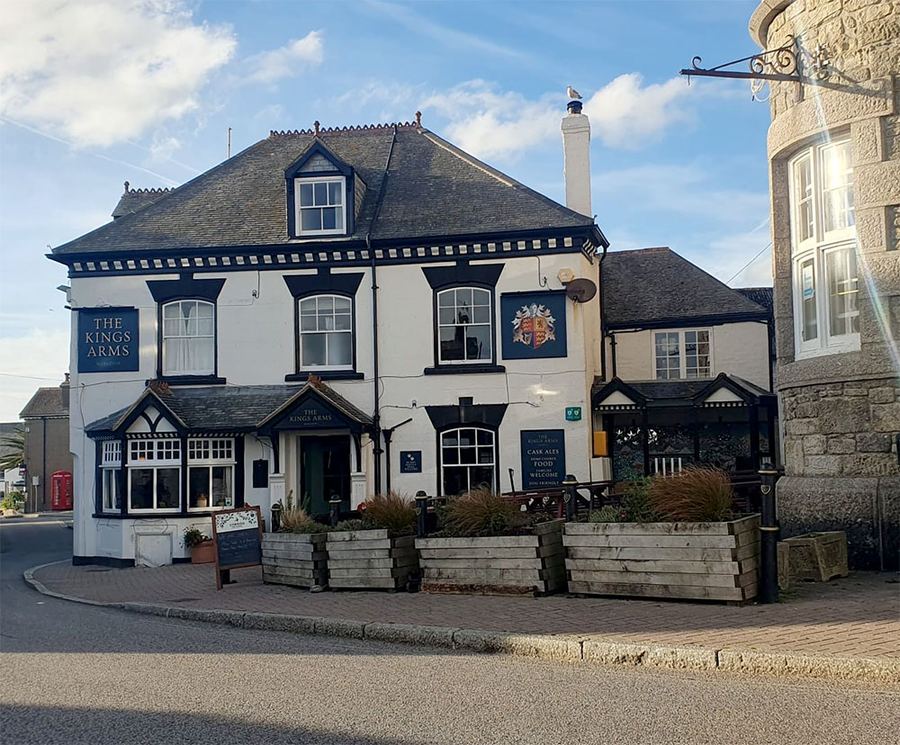
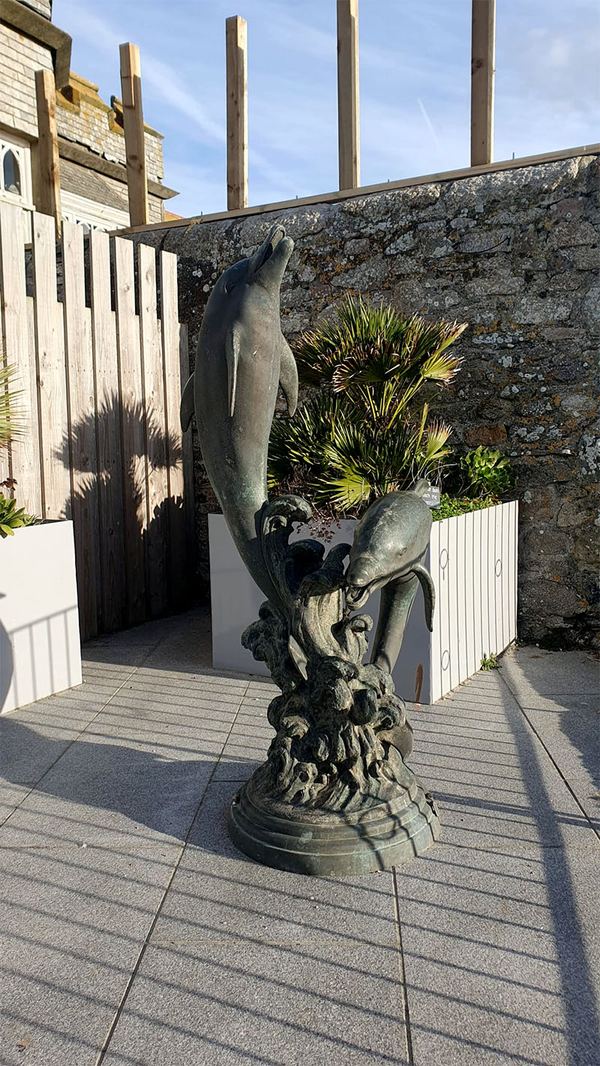
Marazion has long been popular with artists, drawn by the light and the ever-changing view of the Mount, and the town has a good number of art galleries, craft shops and potteries, alongside gift shops, delis, a fudge shop, cafés, restaurants and traditional pubs. Look out for The King’s Arms in the Square, and for the Dolphin fountain in the Maypole Gardens next to the Godolphin, with its planters, benches and wide views over the bay.
Down on the seafront, the Godolphin – an old inn rebuilt as a hotel, bar and restaurant – sits right on the beach beside the start of the causeway, and next to it is the clubhouse of Mount’s Bay Sailing Club. There is a children’s play area and grassy space at Folly Field, and public toilets at Folly Field and in the Square.
↑ Back to top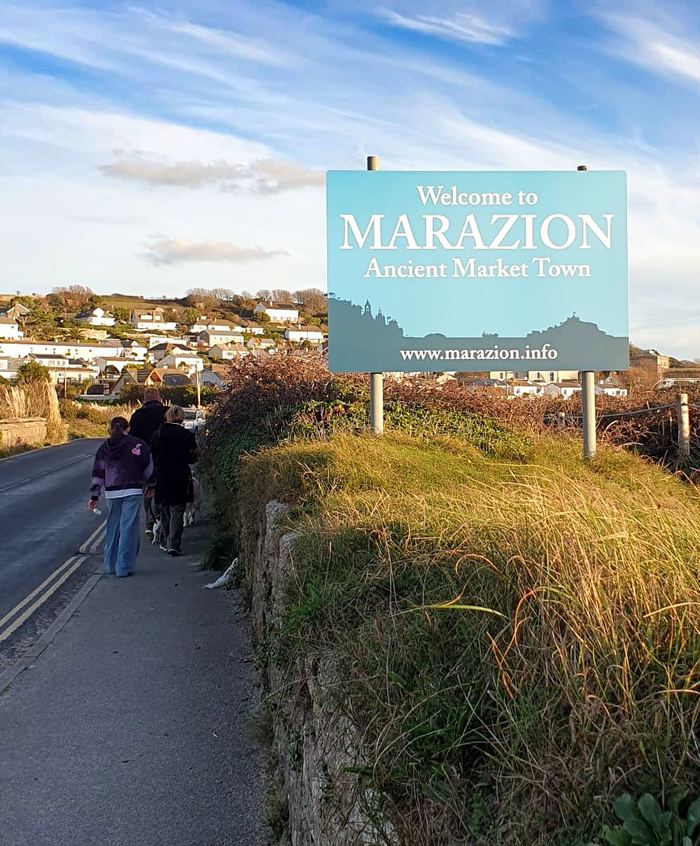
Marazion Museum
Where: ground floor of the Town Hall, Market Place, Marazion
Building: Town Hall of 1871, Grade II listed
Inside: the town’s history, the old fire brigade headquarters and a reconstructed gaol cell
Run by: volunteers – check opening times before you visit
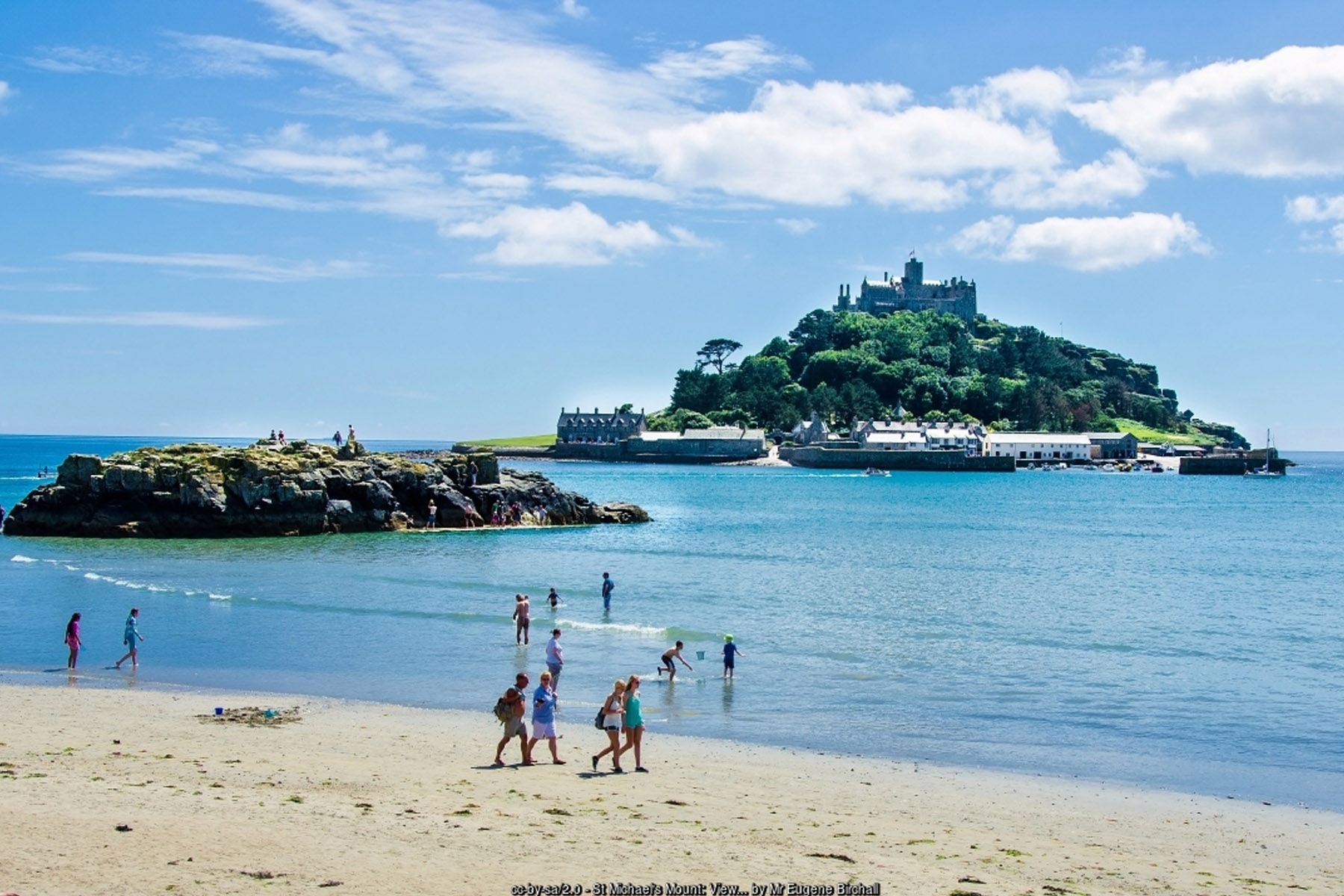
MARAZION BEACH
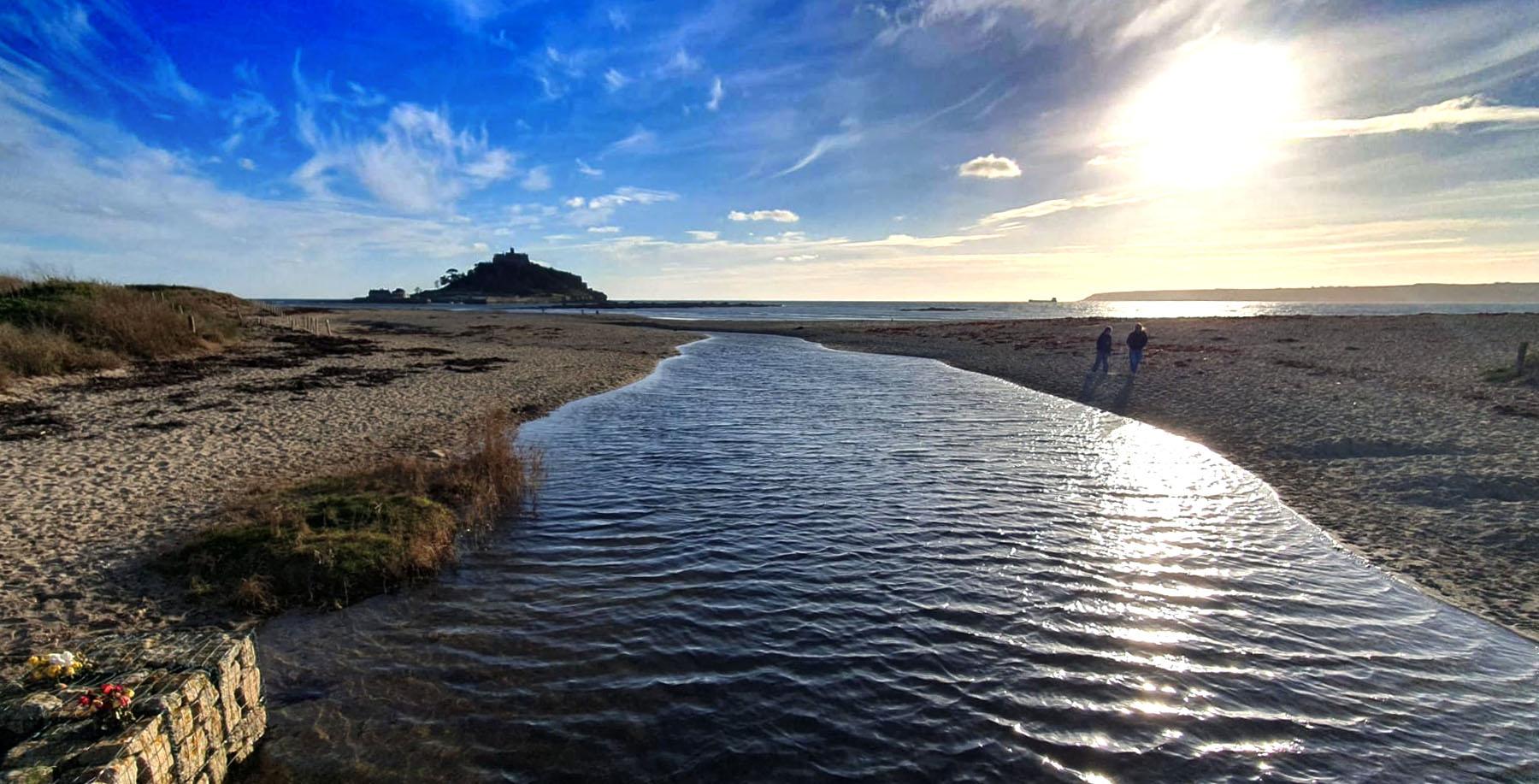
Marazion Beach is one of the great family beaches of west Cornwall – a long sweep of firm, golden sand that faces south across Mount’s Bay, with St Michael’s Mount on one side and the Lizard peninsula on the horizon. At low tide the sand stretches far out and the beach runs on westwards past the Red River and the marsh to Long Rock and Penzance, about three miles away, while at the eastern end there are rock pools around Chapel Rock and the old harbour beside the causeway.
The bay is sheltered from the prevailing Atlantic swell, so the sea is usually gentle for swimming, paddling and sandcastles, and the water shelves slowly. RNLI lifeguards patrol the main beach during the summer season from 10am to 6pm – always swim between the red and yellow flags, and take care with inflatables if the wind is blowing offshore. Families have everything they need close at hand: parking right behind the beach at Folly Field, toilets, a play area, refreshments in season and the shops and cafés of the town a few steps away.
Marazion is also one of Cornwall’s best-known watersports beaches. When the wind blows across the bay it is a favourite spot for windsurfing and kitesurfing, and on calmer days for stand-up paddleboarding and kayaking; lessons and hire are available locally. Mount’s Bay Sailing Club, beside the Godolphin, races dinghies in the bay and welcomes visiting sailors, and the Mount’s Bay Pilot Gig Club rows traditional Cornish gigs from the beach.
Dogs: from 1 July to 31 August there is a seasonal dog ban on the main beach between 10am and 6pm; outside those hours, and for the rest of the year, dogs are welcome. To the east of the causeway, Gwelva Beach is popular with dog walkers. Please keep dogs out of the fenced dune areas and on a lead on the marsh.
- Marazion Beach – full beach guide
- Marazion & Mount’s Bay beaches
- RNLI – Marazion Beach lifeguard information
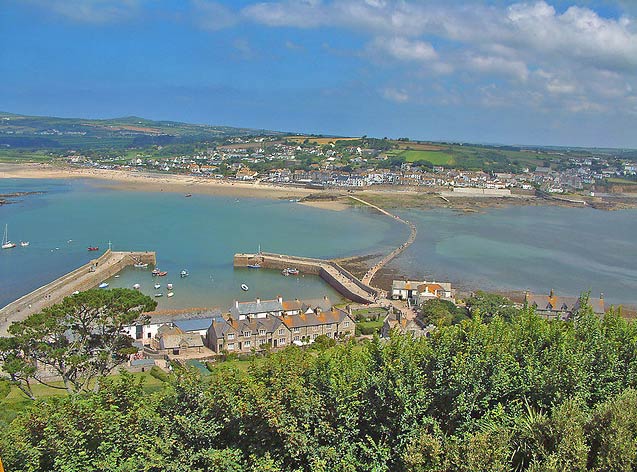
Marazion Beach
Type: long, south-facing sandy beach, rock pools at the eastern end
Lifeguards: RNLI, summer season, 10am–6pm
Dogs: not allowed 10am–6pm, 1 July–31 August
Parking: Folly Field long stay and the Slipway short stay car parks
Good for: families, swimming, windsurfing, kitesurfing, sailing, paddleboarding
Postcode: TR17 0EG (Folly Field car park)
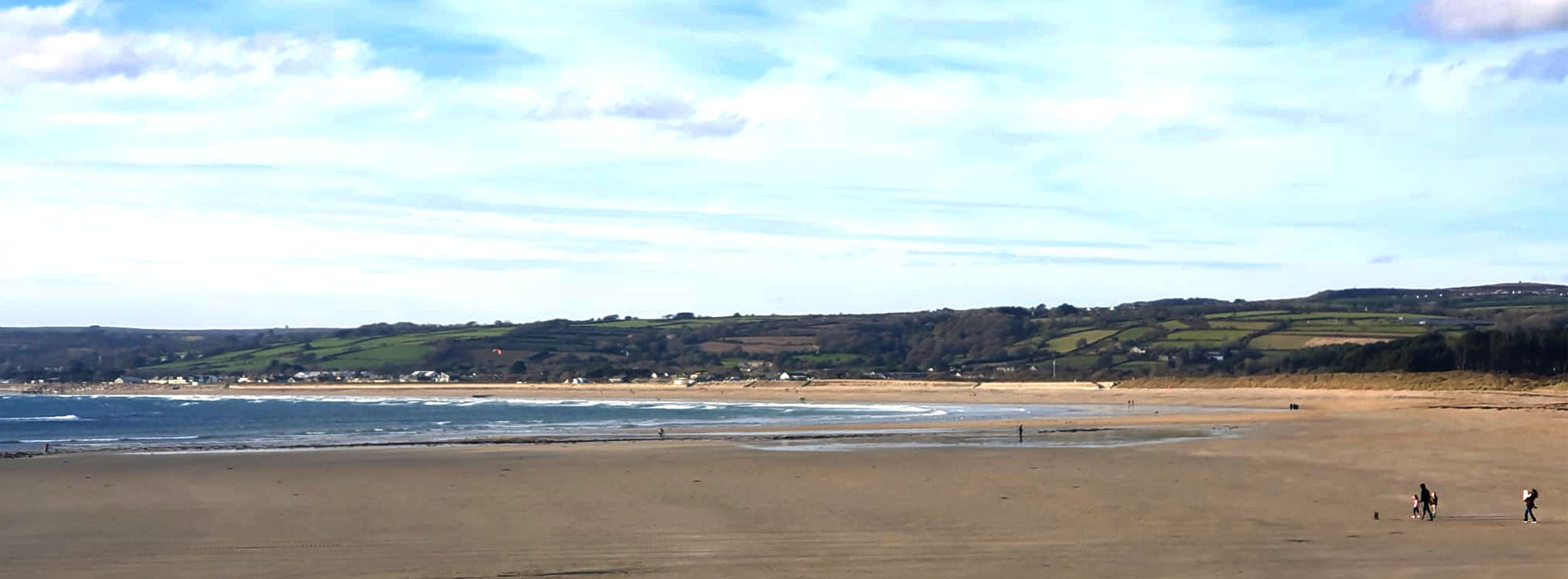
ST MICHAEL’S MOUNT
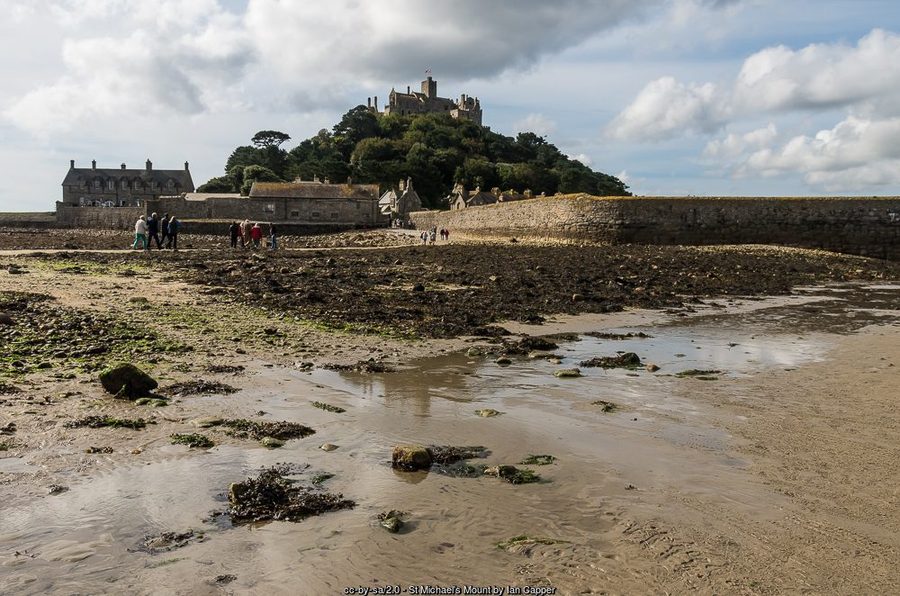
St Michael’s Mount is a granite island about 400 yards (some 365 metres) off the shore at Marazion, rising steeply from the sea to a medieval church and castle on its summit. Its Cornish name, Karrek Loos yn Koos, means ‘the grey rock in the wood’ – a memory of the forest that once covered this part of Mount’s Bay before the sea rose, around 1700 BC; the stumps of the drowned trees are still sometimes uncovered on the beach after storms.
The island has been the home of the St Aubyn family since Colonel John St Aubyn bought it in 1659. In 1954 Francis St Aubyn, 3rd Baron St Levan, gave most of the island to the National Trust, together with an endowment, and the family kept a 999-year lease to live in the castle, which they open to visitors in partnership with the Trust. Lord St Levan still lives in the castle today.
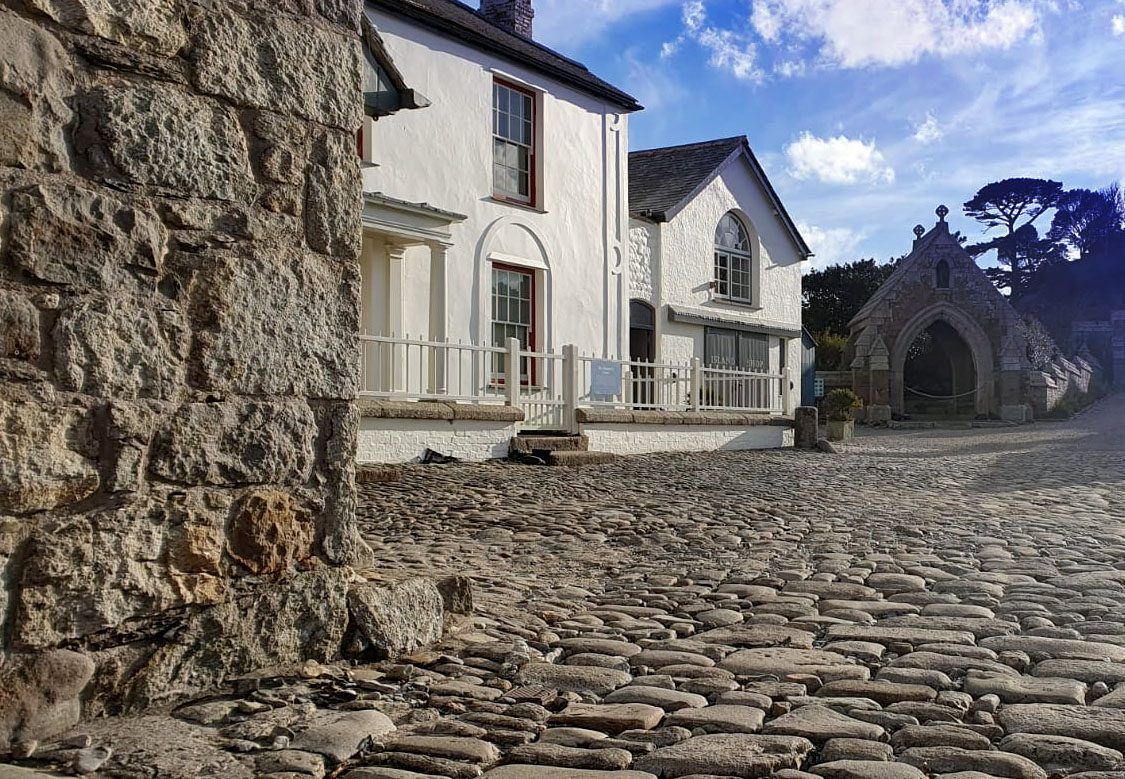
A visit begins at the harbour, where a small village of granite cottages – home to around 30 islanders – clusters around the quays, with the Island Café, a restaurant, shops and a gallery. In the harbour wall you can find the footprint of Queen Victoria, inlaid in brass where she stepped ashore in 1846. From the harbour, a steep, cobbled pilgrims’ path climbs through the woods to the castle; it is uneven and rocky, so wear sensible shoes.
Inside the castle you can see rooms that span almost 900 years – from the medieval priory buildings and the Chevy Chase Room, the old monks’ refectory with its hunting frieze, to the elegant 18th-century Blue Drawing Rooms – together with armour, portraits, furniture and family treasures. At the very top stands the 15th-century Church of St Michael, still used for services, and the views from the battlements over Mount’s Bay are tremendous.
Below the castle on the island’s south-eastern slopes are the extraordinary terraced gardens, laid out in the 19th century and planted with succulents, aloes and other tender plants that survive here in a sheltered microclimate, warmed by the granite and the sea. The garden is fragile and has restricted opening, usually on weekdays from May to early September.
Legend says the Mount was built by the giant Cormoran, who waded ashore to steal cattle and sheep from the mainland until a local boy named Jack lured him into a pit on the island – and so became Jack the Giant Killer. Look out for the giant’s stone heart set into the path on the way up to the castle.
↑ Back to top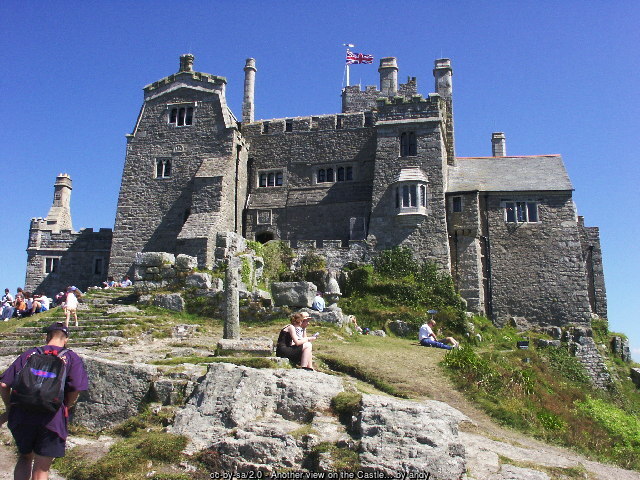
St Michael’s Mount
Owned by: National Trust (since 1954), home of the St Aubyn family since 1659
Distance offshore: about 400 yards (365 m)
Reached by: the causeway at low tide, or by boat in season
Castle: medieval priory and fortress, family home
Church: 15th-century Church of St Michael
Garden: terraced garden, laid out 1887 – weekdays May to early September
Harbour village: open all year, free to visit
Tickets: book castle and garden in advance (National Trust members free, but must book)
CROSSING TO THE MOUNT – THE CAUSEWAY, TIDES & BOATS
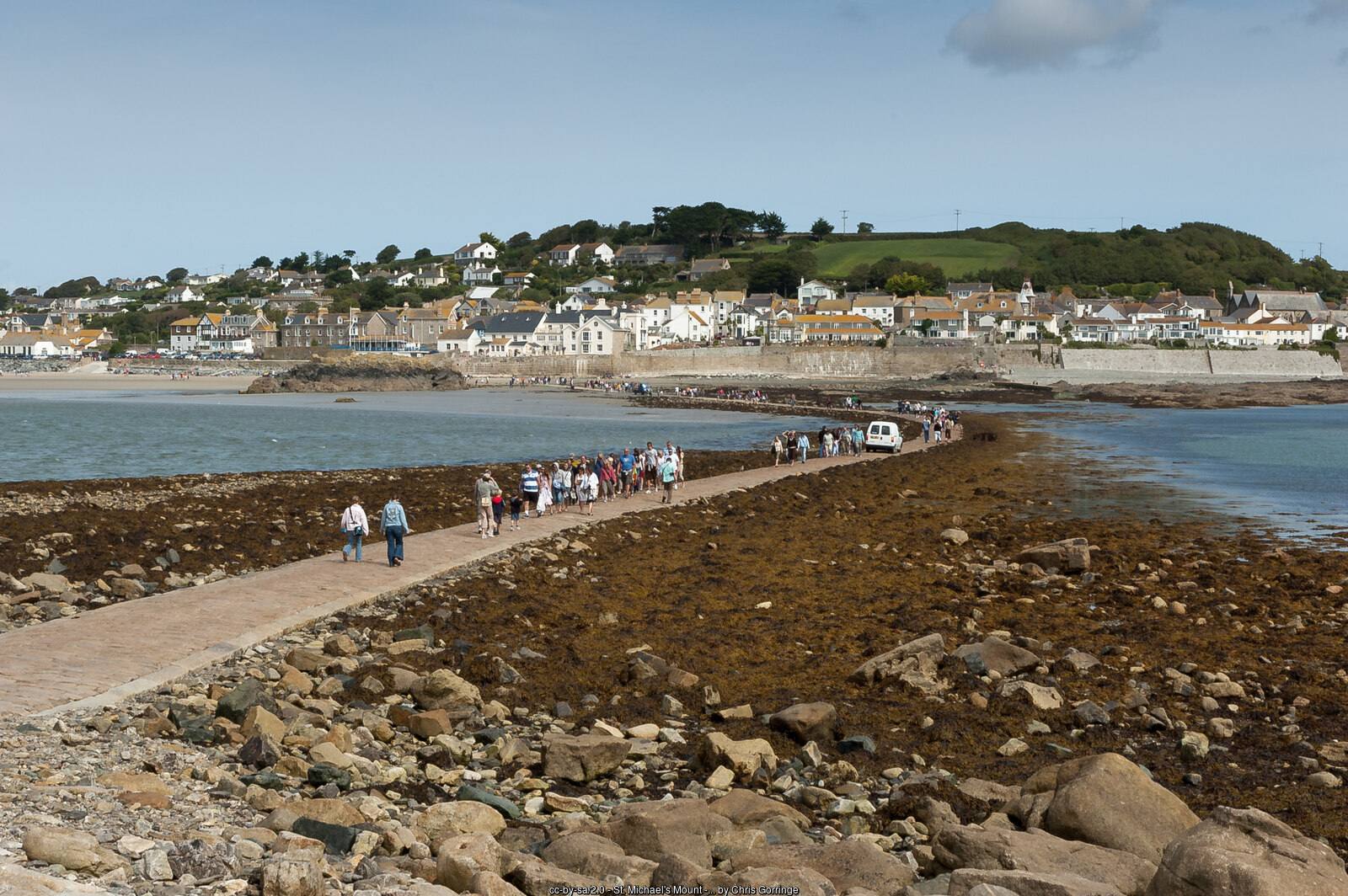
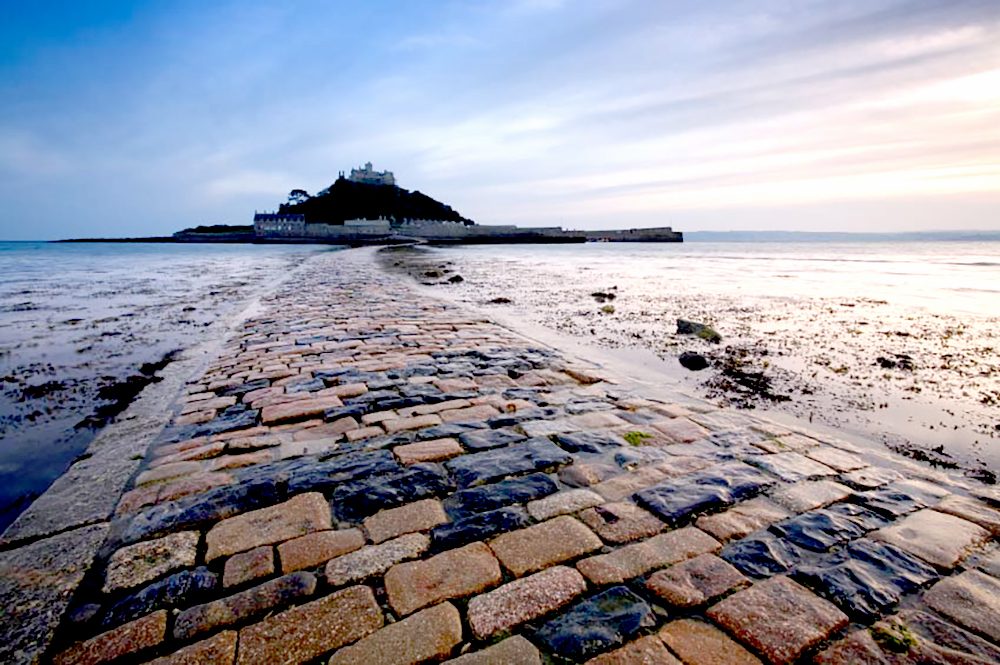
Walking across the causeway is one of the great experiences of a Cornish holiday. The path of granite setts runs from the beach beside the Godolphin to the island’s harbour, and as the tide falls it emerges from the sea, still wet and glistening, with seaweed-covered rocks on either side. People have crossed this way for centuries – pilgrims, traders, nobles and islanders – and the walk takes around ten to fifteen minutes.
The causeway is usually walkable for around two hours either side of low tide, but the exact times change every day with the tides and the weather. The tide rises quickly in Mount’s Bay – the sea level can change by up to five metres between low and high water – so check the causeway opening and closing times before you go, and never start to cross once the causeway is closing.
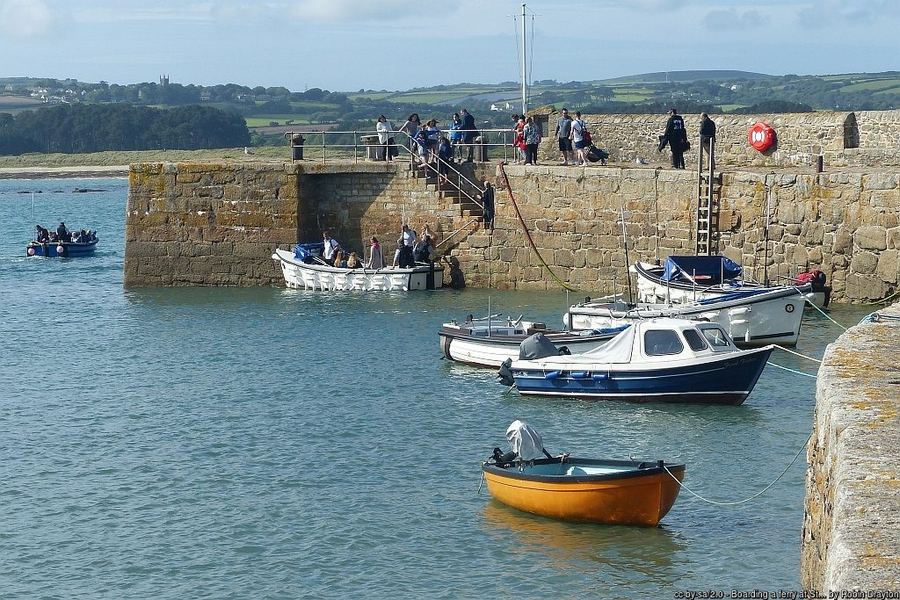
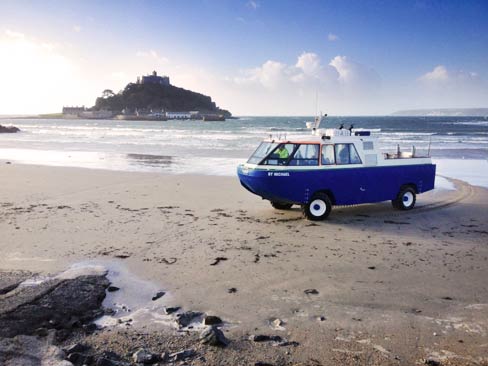
When the tide covers the causeway, the island’s small passenger boats run between Marazion and the Mount’s harbour during the main visitor season (in 2026 the last boats ran on 31 October). The crossing takes only a few minutes; there is a small charge, and queues can build up on busy summer days. Out of season, and at low water, the causeway is the only way across. The causeway itself is rough and uneven, so it is not suitable for wheelchairs or pushchairs, and the island’s paths are steep.
Safety: Do not try to wade across when the causeway is covered, and keep children close – the stones are slippery and the incoming tide can cut you off. If you get into difficulty at sea, call 999 and ask for the Coastguard.
↑ Back to top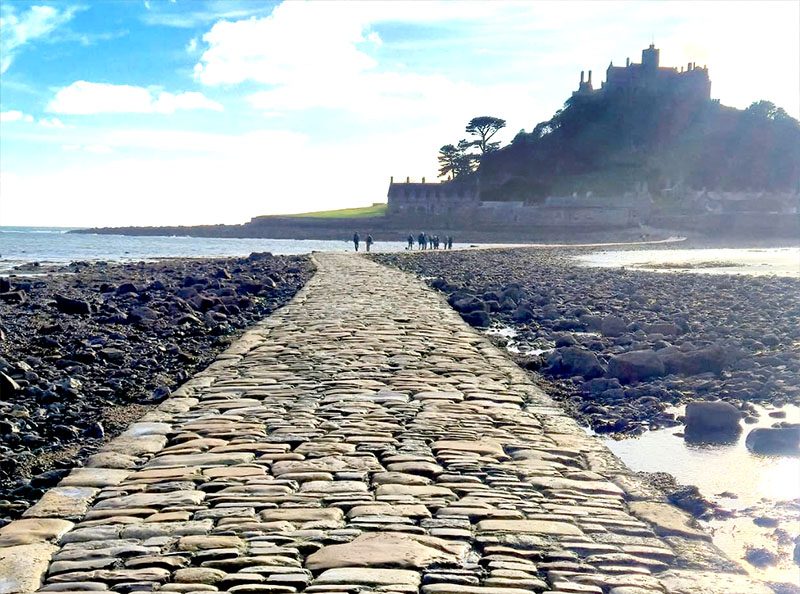
HISTORY OF ST MICHAEL’S MOUNT
People have lived around the Mount since prehistoric times – a Neolithic flint arrowhead has been found on the island, and stony banks on its north-eastern slopes are thought to be the remains of an Iron Age cliff castle. The Mount is also one of the places suggested as Ictis, the tidal island described by the Greek historian Diodorus Siculus in the 1st century BC, where the people of Britain brought tin across at low tide in wagons to sell to merchants. No one knows for certain where Ictis was, and Mount Batten at Plymouth is among the other candidates – but the description fits the Mount remarkably well.
The story that the Archangel Michael appeared to fishermen on the rock in the year 495 is a much later tradition. What is recorded is that Edward the Confessor gave the Mount to the Benedictine monks of Mont-Saint-Michel in Normandy, its twin across the Channel, and a priory was built on the summit in the 12th century. The Mount was both a place of pilgrimage and a fortress: in 1473–74 the Earl of Oxford held it for 23 weeks against Edward IV’s forces, in 1497 Perkin Warbeck occupied it, and in 1549 its governor, Sir Humphrey Arundell, led the Prayer Book Rebellion. In the Civil War it was held for the King until July 1646.
After the Civil War the Mount was sold in 1659 to Colonel John St Aubyn, and over the following centuries his family turned the fortress into a home. Harbour improvements in 1727 made the island a flourishing little port, and by 1821 more than 200 people lived on the Mount. When the railway reached Penzance in the 1850s the trade moved away and the village shrank; the causeway was raised by a foot in 1879, and around 1900 a steep underground railway was built to carry goods up to the castle – it is still used, but not open to the public.
In 1954 the 3rd Lord St Levan gave the Mount to the National Trust. During the Second World War it was fortified against invasion, and three pillboxes survive. In 2014 winter storms damaged the causeway, which was repaired by March 2016, and in 2026 Storm Goretti brought down most of the trees in the island’s wood.
↑ Back to topSt Michael’s Mount – key dates
c.1700 BC – the forest of Mount’s Bay drowned by the sea
1st century BC – Diodorus describes the tin island of Ictis
11th century – given to Mont-Saint-Michel by Edward the Confessor
12th century – priory and earliest castle buildings
1424 – passes to Syon Abbey
1473–74 – Earl of Oxford’s 23-week siege
1497 – Perkin Warbeck occupies the Mount
1549 – Prayer Book Rebellion
1646 – Royalist garrison surrenders
1659 – bought by Colonel John St Aubyn
1727 – harbour improved
1846 – Queen Victoria lands
1879 – causeway raised
c.1900 – underground railway built
1954 – given to the National Trust
2016 – storm-damaged causeway repaired
MARAZION MARSH – RSPB NATURE RESERVE
In the shadow of St Michael’s Mount, just west of the town and separated from the beach only by the coast road, lies Marazion Marsh – a nature reserve looked after by the RSPB and home to Cornwall’s largest reedbed, the most westerly on mainland Britain. Reedbeds are one of the rarest habitats in the UK, and with its open water, pools, ditches, willow scrub and wet grassland, the marsh is a haven for wildlife: more than 250 bird species, 500 plants, 500 insects and 18 mammals have been recorded here.
The marsh is a Site of Special Scientific Interest, and in 2001 it was designated a Special Protection Area for two rare birds – the bittern, which visits in winter and skulks deep in the reeds, and the aquatic warbler, a globally threatened migrant that stops here on passage in late summer. Reed warblers, sedge warblers and Cetti’s warblers nest in the reeds, grey herons and little egrets fish the pools, and in spring and autumn all kinds of migrants pass through. The pools are also good for dragonflies and damselflies in summer.
The great spectacle comes from late autumn into winter, when starlings – many of them visitors from the Continent – gather in huge flocks at dusk, swirling and wheeling over the reeds in a murmuration before they drop down to roost. Watch from the roadside or the beach as the light fades; numbers vary from year to year, and so do the places they roost.
The reserve is free to visit and open at all times, with public footpaths and a viewing area on the edge of the reedbed. Paths can be wet and muddy after rain. Please keep dogs on a lead and stay on the paths, as the reserve is managed as a safe home for breeding birds; barbecues are not allowed. There are no toilets on the reserve – the nearest are at the Marazion Station car park and at Folly Field.
↑ Back to top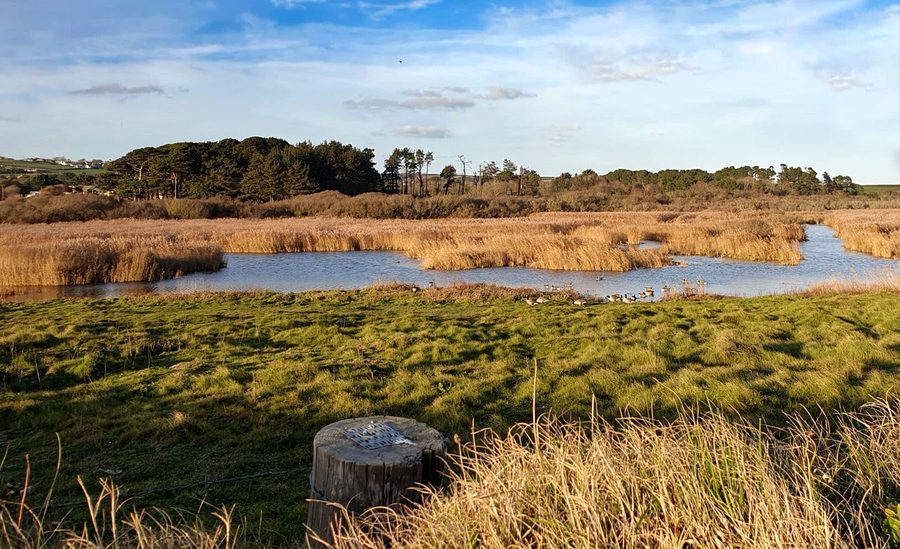
Marazion Marsh
Managed by: RSPB
Habitat: Cornwall’s largest reedbed, open water, wet grassland, willow scrub
Designations: SSSI; Special Protection Area (2001) for bittern and aquatic warbler
Records: 250+ birds, 500 plants, 500 insects, 18 mammals
Best for: winter bitterns and starling murmurations, spring and autumn migrants, summer warblers and dragonflies
Entry: free, open at all times
Address: Marazion Marsh, Marazion TR17 0AA
MARAZION SAND DUNES
Between the beach and the coast road, the low sand dunes along the shore at Marazion are small but precious. Sand dunes are among the most threatened habitats in Europe, and here the marram grass, sea holly, wildflowers, insects and reptiles of the dunes live within sight of St Michael’s Mount. The dunes also do a vital job for the town: they act as a natural sea defence, absorbing the energy of winter storms and helping to protect Marazion and the marsh behind from flooding and erosion.
Years of trampling, storms and rising seas have worn the dunes down, so they are now being restored through Making Space for Sand, one of 25 projects funded by Defra through the Flood and Coastal Resilience Innovation Programme, run by the Environment Agency. At Marazion the work is led by volunteers from the Mount’s Bay Marine Group, in partnership with Cornwall Wildlife Trust, Cornwall Council, the Environment Agency, St Aubyn Estates and local people.
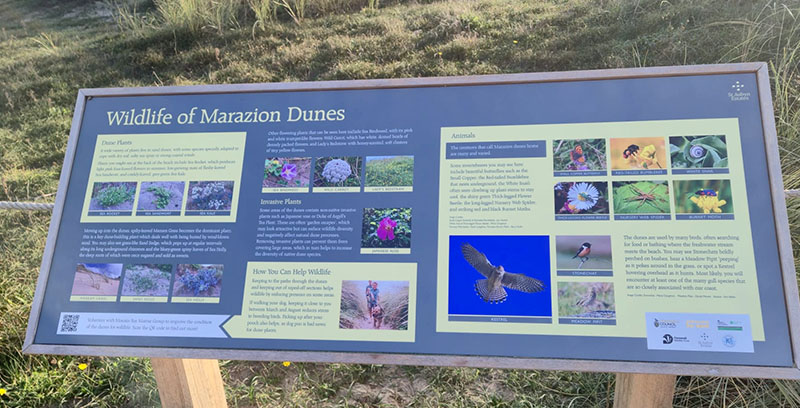
Low fencing now protects areas of the dunes so that they can regenerate, and volunteers have planted native species to bind the sand and support wildlife. Information boards explain the wildlife of Marazion Dunes. You can help by keeping to the paths, staying out of the fenced areas and keeping dogs out of them too.
- Cornwall Wildlife Trust – Making Space for Sand at Marazion
- St Michael’s Mount – dune preservation at Marazion Beach
Marazion Dunes
Project: Making Space for Sand
Volunteers: Mount’s Bay Marine Group
Partners: Cornwall Wildlife Trust, Cornwall Council, Environment Agency, St Aubyn Estates
Funding: Defra Flood and Coastal Resilience Innovation Programme
Why it matters: wildlife habitat and a natural flood defence for the town
Please: keep to the paths and out of fenced areas
HISTORY OF MARAZION
Marazion grew up on the mainland opposite St Michael’s Mount, where the markets granted to the monks of the Mount were held. A charter attributed to Robert, Count of Mortain, half-brother of William the Conqueror, gave the Mount the right to hold a market on Thursdays, and in 1257 Richard, Earl of Cornwall, granted a further charter for fairs and markets. The town’s name comes from those markets: in Cornish there was Marghas Byghan, ‘the little market’, and Marghas Yow, ‘the Thursday market’. Over time the two names became Marazion and Market Jew – which is why the main street of Penzance is called Market Jew Street. Despite a story you may still hear, neither name has anything to do with a Jewish community.
Remains of an ancient furnace found near the town suggest that tin was smelted here very early, and Marazion has long been linked with the tin trade and with Ictis. Earlier versions of this page, first written with Penwith tourism officers in 1995, said that Marazion ‘can claim to be the oldest town in Britain, called Ictis by the Romans’ – a line that has since been copied widely across the internet. In fact Ictis was an island described by Greek writers, and the Mount is only one of several candidates. Marazion can more safely claim to be one of the oldest chartered towns in Cornwall.
In the first half of the 16th century the town was plundered twice – by French raiders in 1513 and by Cornish rebels during the Prayer Book Rebellion of 1549. On 13 June 1595 Elizabeth I granted Marazion a charter of incorporation, with a mayor, eight aldermen and twelve capital burgesses; it was the first town in the Penwith hundred to become a borough, though Penzance followed in 1614 and soon overtook it. The borough seal shows three castles with the motto Semper Eadem, ‘always the same’.
The town remained a busy little port and market centre, and the Cornish language lingered here late – John Nancarrow of Marazion, a native speaker, was still living in the 1790s. The coming of the railway brought visitors in Victorian times, when the present All Saints church (1861) and Town Hall (1871) were built. In 1947 the battleship HMS Warspite, veteran of both world wars, broke her tow on the way to the breakers and ran aground at Prussia Cove; in 1950 she was refloated and beached off Marazion, where she was cut up over the following years – a memorial stone stands on the seafront. Today Marazion is a much-loved resort and artists’ town, and in 2021 it even applied for city status.
↑ Back to topMarazion – key dates
11th century – Thursday market granted to the Mount
1257 – market and fair charter from Richard, Earl of Cornwall
1308 – chapel of St Hermes recorded in the town
1513 – town plundered by the French
1549 – plundered during the Prayer Book Rebellion
1595 – charter of incorporation from Elizabeth I
1817 – Henry Francis Lyte becomes curate
1861 – All Saints church built
1871 – Town Hall built
1947–50 – HMS Warspite wrecked at Prussia Cove, then beached at Marazion
1974 – Marazion Town Council formed
2021 – population about 1,480
Key Buildings
- St Michael’s Mount castle and Church of St Michael – the medieval priory and fortress on the summit of the Mount, home of the St Aubyns since 1659; the church is 15th century. See St Michael’s Mount above.
- Church of All Saints, Fore Street – the parish church, built in 1861 to a design by J. Piers St Aubyn on the site of the medieval chapel of St Hermes; Grade II listed.
- Marazion Town Hall, Market Place – built in 1871, with the council chamber upstairs and Marazion Museum on the ground floor; Grade II listed.
- Methodist Church – a classical-style chapel of 1862 with galleries inside.
- Quaker Meeting House – one of the town’s three places of worship.
- The causeway and harbour of St Michael’s Mount – the cobbled causeway, raised in 1879 and repaired in 2016, and the harbour improved in 1727.
NOTABLE PEOPLE
- Colonel John St Aubyn – who bought St Michael’s Mount in 1659; his descendants, the Lords St Levan, still live in the castle.
- Pascoe Grenfell (1761–1838) – businessman and Member of Parliament, born in Marazion, who made his fortune in the copper trade.
- Henry Francis Lyte (1793–1847) – the hymn writer of Abide with Me and Praise, My Soul, the King of Heaven, who became curate at Marazion in 1817 and met his wife, Anne Maxwell, here. Words from Abide with Me are carved on the town’s war memorial.
- J. Piers St Aubyn (1815–1895) – the Victorian architect of All Saints church and of much other work in Cornwall, including on St Michael’s Mount, who lived for a time in Marazion.
ST MICHAEL’S MOUNT FILMING GUIDE
With its castle, causeway and tides, St Michael’s Mount has long attracted film-makers. On-screen appearances include:
- Dracula (1979) – the Mount stood in for the exterior of Count Dracula’s castle in John Badham’s film starring Frank Langella and Laurence Olivier.
- Never Say Never Again (1983) – the James Bond film with Sean Connery, in which cruise missiles fly over the island.
- Johnny English (2003) – the Mount doubled as a French château in Rowan Atkinson’s spy comedy.
- Mariah Mundi and the Midas Box (2012) – family adventure film shot partly on location here.
- House of the Dragon (2022) – the HBO series filmed scenes at the Mount in 2021.
WALKS FROM MARAZION
The easiest and most rewarding walk is across the causeway to St Michael’s Mount and back – timed with the tide. Westwards, you can walk along the beach (or the coast path beside the railway) past the Red River and Marazion Marsh to Long Rock and on into Penzance, an easy, level walk of about three miles with the Mount behind you all the way; return by bus.
Eastwards, the South West Coast Path climbs out of the town past Trenow Cove to Perranuthnoe, about two miles away, and continues around Cudden Point to Prussia Cove and Praa Sands – a beautiful stretch of cliffs and coves. Marazion is also the end of the St Michael’s Way, a waymarked pilgrim route of about 12 miles across the peninsula from Lelant on the north coast, once used by pilgrims and traders crossing to the Mount rather than sailing round Land’s End.
↑ Back to topTHINGS TO DO IN AND AROUND MARAZION
Marazion packs a remarkable amount into a small town – a castle on an island, a big sandy beach, a nature reserve and a coast path, all within a few minutes’ walk of each other.
It is also perfectly placed for exploring the far west of Cornwall. Penzance, Newlyn and Mousehole are just along the bay; St Ives is half an hour away on the north coast; and Land’s End, the Minack Theatre at Porthcurno and the Lizard peninsula are easy day trips.
On a wet day, there are galleries and museums in Marazion and Penzance, and the castle on the Mount is a memorable visit whatever the weather – as long as the tide is right.
- Walk the causeway to St Michael’s Mount and visit the castle, harbour village and church – check the tide times first.
- Visit the terraced garden on the Mount, open on weekdays from May to early September.
- Spend a day on Marazion Beach – RNLI lifeguards in summer, rock pools at low tide.
- Try windsurfing, kitesurfing or paddleboarding in Mount’s Bay.
- Watch the birds at Marazion Marsh – and the starling murmurations on winter evenings.
- See the Marazion Dunes and the work to restore them.
- Visit Marazion Museum in the Town Hall, and browse the town’s galleries.
- Walk the coast path to Perranuthnoe and Prussia Cove.
- Head into Penzance for Penlee House Gallery & Museum, the Jubilee Pool and the Isles of Scilly ferry.
LOCAL EVENTS
- Cornish Seaweed Festival (May, in some years) – rock-pooling, foraging and talks on the shore at Marazion.
- Mount’s Bay Pilot Gig Club Regatta (late May) – traditional Cornish gigs racing across the bay, best watched from Marazion Beach.
- Marazion Triathlon (late May or early June) – starting from Marazion Beach.
- Marazion Carnival (late July) – a colourful procession through the town ending with an afternoon of family fun at Folly Field.
- Marazion 10K (late September) – road race around the town and its lanes.
- Starling murmurations (late autumn and winter) – nature’s own show over Marazion Marsh at dusk.
- Christmas lights switch-on (early December) – in the town centre.
Dates change from year to year – check Marazion Town Council and the St Michael’s Mount events page for this year’s events.
↑ Back to topPLACES NEAR MARAZION
- Perranuthnoe – a sheltered sandy beach and village about two miles east along the coast path.
- Prussia Cove – secluded rocky coves famous for smuggling, beyond Cudden Point.
- Praa Sands and Kenneggy Sands – beaches further east around Mount’s Bay.
- Penzance – west Cornwall’s main town and the ferry port for the Isles of Scilly, about three miles away.
- Newlyn and Mousehole – the fishing port and the harbour village beyond Penzance.
- St Ives – on the north coast, reached on foot by the St Michael’s Way.
VISITOR INFORMATION
Parking & EV Charging
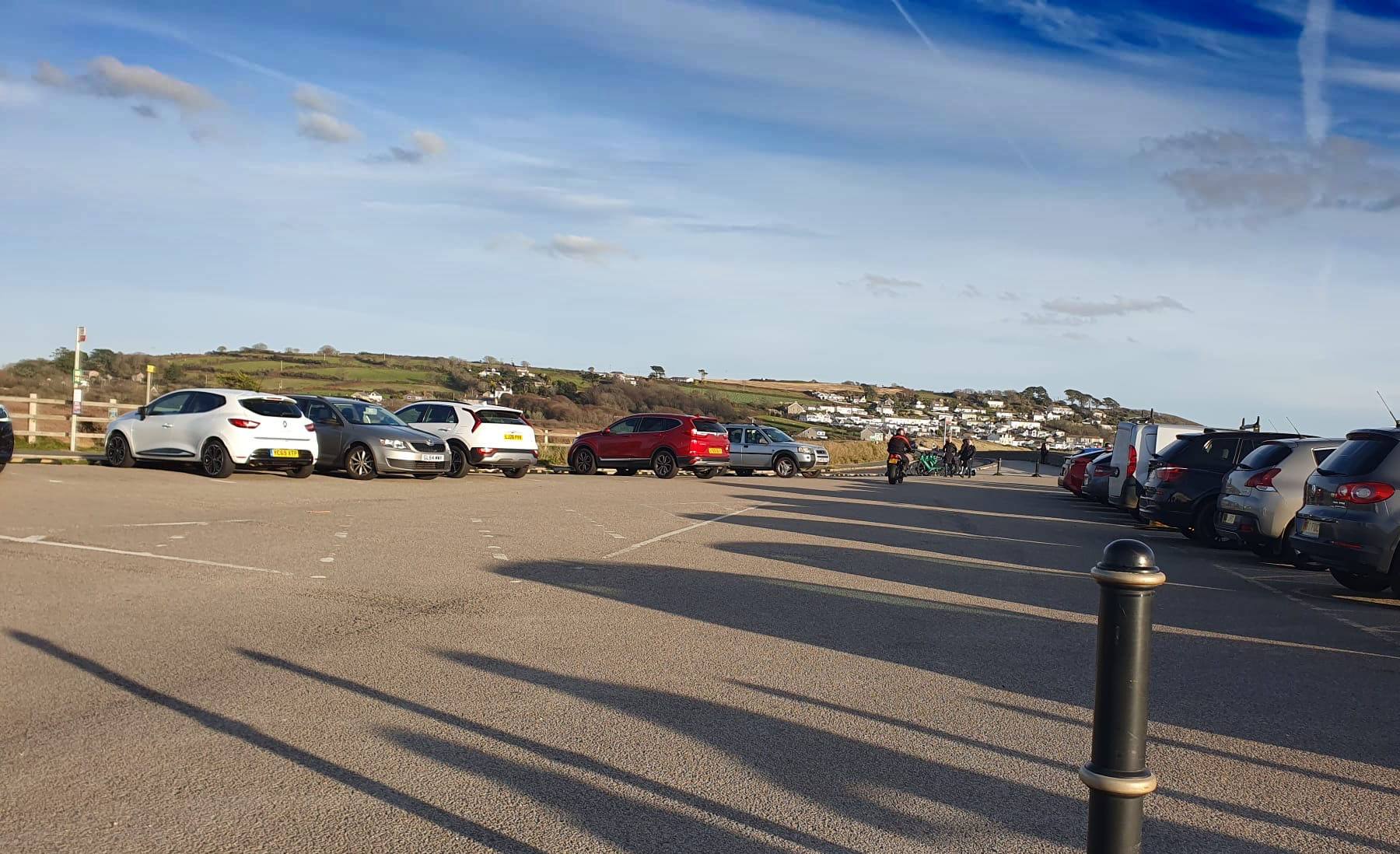
Most of Marazion’s car parks are run by St Aubyn Estates and use number-plate recognition (pay at the machines or by app). The St Michael’s Mount & Long Stay Marazion car park – known locally as Folly Field (satnav TR17 0EG) – is the best for the Mount and the beach, with toilets, a play area and refreshments; in busy periods an overflow car park opens opposite. The two Slipway short-stay car parks beside the Godolphin have a three-hour maximum. Cornwall Council’s Marazion Station long-stay car park (TR17 0AA) is by the marsh, about 15–20 minutes’ walk from the town. On-street parking is very limited.
Electric vehicle charging:
Public chargers around Marazion and Penzance change often – the nearest large sites are at the Long Rock supermarkets. Check the live map before you travel.
Bus & Train
Marazion no longer has its own station – the nearest are Penzance (about three miles) and St Erth, both on the main line from London Paddington. Bus U4 runs regularly between Penzance bus station and Marazion (about 25 minutes; stops at the playground and the Square) and on to Helston and Falmouth; bus 15 links Marazion with St Erth station and Hayle, and bus 2/2A with Helston and Porthleven. In summer the open-top Land’s End Coaster also calls. Check timetables before you travel.
Facilities & Supermarkets
Marazion has small shops, galleries, a museum, public toilets at Folly Field and in the Square, and cycle racks at Folly Field and next to the Slipway car park. The nearest supermarkets are at Long Rock and Eastern Green, between Marazion and Penzance:
- Morrisons – Long Rock, Penzance TR20 8HT
- Sainsbury’s – Eastern Green, Penzance TR18 3AP
- Tesco – Branwell Lane, Penzance TR18 3DU
Cafés & Restaurants
West End, the Square and Fore Street have cafés, tea rooms, a fudge shop, restaurants and traditional pubs, including The King’s Arms in the Square. On the seafront, The Godolphin has a bar, restaurant and terrace facing the Mount. On St Michael’s Mount there are the Island Café and a restaurant by the harbour (seasonal, opening with the island).
Health
Marazion Surgery, Gwallon Lane, Marazion TR17 0HW (01736 710505). West Cornwall Hospital, Penzance, has an Urgent Treatment Centre, and the nearest A&E is the Royal Cornwall Hospital, Truro. Call NHS 111 for urgent advice and 999 in an emergency – ask for the Coastguard if someone is in trouble at sea or cut off by the tide.
Disabled Access
Folly Field car park and the seafront are level, with views of the Mount and the beach. Beach wheelchairs (sand chairs) have been available to borrow in Marazion – ask locally before you visit. The causeway is uneven and not suitable for wheelchairs, and the paths up to the castle on the Mount are steep and cobbled; the harbour area is the most accessible part of the island. Marazion Surgery has step-free access and a disabled toilet.
Vets & Dogs
Vets near Marazion: Mounts Bay Veterinary Centre, Long Rock Industrial Estate, TR20 8HX; Vets4Pets, inside Pets at Home, Eastern Green, Penzance TR18 3AP; and Rosevean Veterinary Practice, Coombe Road, Penzance TR18 3HU. Dogs are banned from the main beach 10am–6pm in July and August, are restricted on St Michael’s Mount in the main season, and must be on a lead at Marazion Marsh.
National Trust & English Heritage
The National Trust owns St Michael’s Mount, where National Trust members get free entry to the castle and garden (booking required). Other National Trust places nearby include Godolphin, near Helston, and the gardens of Trengwainton near Penzance.
Attractions
St Michael’s Mount, Marazion Marsh and Marazion Museum in the town, with Penzance’s galleries and Jubilee Pool, the Minack Theatre and Land’s End all within easy reach.
STAY & EXPLORE IN MARAZION
Nearby Towns & Villages
St Michael’s Mount
Official Information
FAMILY HOLIDAYS & SHORT BREAKS IN MARAZION
Family holidays in Marazion are hard to beat – a safe, sandy, lifeguarded beach on the doorstep, rock pools at low tide, the adventure of walking across the sea to a castle on an island, and birds and wildlife on the marsh just along the road. Penzance, St Ives, Land’s End and the Minack Theatre are all easy days out.
Browse Marazion holiday cottages for self-catering homes in and around the town, many with views of the Mount, or holidays and short breaks in Marazion for every type of accommodation.
Short breaks in Marazion are good value outside the school holidays – a spring weekend for the birds and the Mount’s opening season, an autumn break with quiet beaches and the starlings over the marsh, or a winter escape with bracing walks along Mount’s Bay. Booking direct with the owner means no agency fees.
↑ Back to topFREQUENTLY ASKED QUESTIONS ABOUT MARAZION & ST MICHAEL’S MOUNT
Marazion is a small town on the shore of Mount’s Bay in west Cornwall, about three miles east of Penzance. It faces St Michael’s Mount, which lies about 400 yards offshore and is linked to the town by a tidal causeway.
At low tide you can walk across the cobbled causeway from Marazion Beach, which takes around 10 to 15 minutes. The causeway is usually open for around two hours either side of low tide, but the times change daily, so check the causeway times on the St Michael’s Mount website. When the tide covers the causeway, small boats carry visitors across during the main season.
Yes – castle and garden tickets should be booked online in advance. National Trust members get free entry but still need to book. Walking across the causeway and visiting the harbour village is free.
Yes. Marazion Beach is a long, sheltered, south-facing sandy beach with RNLI lifeguards in the summer season, rock pools at low tide, parking right behind the beach at Folly Field, toilets, a play area and the shops and cafés of the town close by.
Dogs are not allowed on the main beach between 10am and 6pm from 1 July to 31 August. Outside those hours, and for the rest of the year, dogs are welcome. Dogs are restricted on St Michael’s Mount during the main season and must be kept on a lead at Marazion Marsh.
Marazion Marsh is an RSPB nature reserve just west of Marazion, with Cornwall’s largest reedbed. It is a Site of Special Scientific Interest and a Special Protection Area for bittern and aquatic warbler, and is famous for starling murmurations at dusk in late autumn and winter. It is free to visit.
Parts of the dunes have been fenced so that they can recover, as part of the Making Space for Sand project run with volunteers from the Mount’s Bay Marine Group. The dunes are a home for wildflowers, insects and reptiles and a natural flood defence for the town, so please keep to the paths.
The St Michael’s Mount and Long Stay Marazion car park, known as Folly Field (satnav TR17 0EG), is the best for the Mount and the beach, with an overflow car park opposite in busy periods. There are short-stay car parks by the Slipway with a three-hour maximum, and Cornwall Council’s Marazion Station car park by the marsh.
The name comes from the Cornish for the town’s medieval markets – Marghas Byghan, ’the little market’, and Marghas Yow, ’the Thursday market’, which also gave the old name Market Jew. Neither name has any connection with a Jewish community. Marazion is one of Cornwall’s oldest chartered towns, with a charter of incorporation from Elizabeth I in 1595.