Penryn, Cornwall – Historic Market Town at the Head of the Penryn River
Penryn & the Penryn River
Cornwall Online | Mid Cornwall Towns and Villages | Truro | Feock | Devoran | Restronguet Creek | Mylor | Flushing | Penryn | Falmouth | The Roseland Peninsula | St Mawes | St Anthony Head | St Just in Roseland | Portscatho | Gerrans | Philleigh | Ruan Lanihorne | Tregony | Veryan | Portloe | Portholland | Gorran Haven | Mevagissey | The Lost Gardens of Heligan | St Austell | Charlestown | Fowey | Golant | Lostwithiel | The Lizard Peninsula
On This Page
- Holidays in Penryn
- Best Time to Visit
- The Town Centre & Museum
- The Penryn Campus
- The Penryn River & Quays
- Glasney College
- History of Penryn
- Key Buildings
- Notable People
- Walks from Penryn
- Things to Do
- Local Events
- Places near Penryn
- Visitor Information
- Stay & Explore
- Family Holidays & Short Breaks
- Frequently Asked Questions
Penryn at a Glance
One of Cornwall’s oldest towns, at the head of the Penryn River on the edge of Falmouth. Founded by the Bishops of Exeter in 1216, with a charter of 1236. Medieval street plan, the Grade II* Town Hall and free Penryn Museum, Glasney College (1265–1548), the parish church of St Gluvias and the old granite quays. Home of the Penryn Campus, shared by the University of Exeter and Falmouth University. Railway station on the Maritime Line between Truro and Falmouth.
HOLIDAYS IN PENRYN
Penryn is one of the oldest towns in Cornwall, standing on a ridge at the head of the Penryn River, where it opens out towards Falmouth harbour and the Carrick Roads. Its name comes from the Cornish Pennrynn, meaning ‘promontory’, and the old town still follows the line of that promontory, with narrow streets running down the hill to the waterside.
The town was founded by the Bishops of Exeter in 1216 and received its Charter of Incorporation in 1236 – centuries before Falmouth existed. In the Middle Ages it was the main port on the river and the home of Glasney College, one of the great centres of learning and of the Cornish language in medieval Cornwall.
Penryn is a real working town rather than a tourist resort, and that is a large part of its charm. Its historic centre is a conservation area full of listed buildings, from Georgian town houses to the 17th-century Town Hall with its clock tower, where the free Penryn Museum tells the town’s story. Independent shops, cafés and pubs line Higher and Lower Market Street, and there are galleries and studios down by the river.
Up the hill is the Penryn Campus, shared by the University of Exeter and Falmouth University, which has brought thousands of students and a lively creative and scientific community to the town since 2004.
Penryn makes a good-value, well-connected base for exploring the Fal. Falmouth’s beaches, Pendennis Castle and the National Maritime Museum Cornwall are just down the road, trains run to Truro and Falmouth, and the creeks of Flushing and Mylor are close by.
For somewhere to stay, see Penryn holiday cottages and holidays and short breaks in Penryn.
Best Time to Visit Penryn
Spring is lovely, with the bluebells at Enys Gardens just outside the town in early May. Summer brings Falmouth Week and the boating season on the river, and is the best time to use Penryn as a base for the beaches. September has the Awenek heritage festival at Enys, and autumn and winter are quieter for exploring the old town and museum – though the town is busiest with students in term time.
Penryn’s car parks are small; on busy days it is easier to come by train or bus, or to walk in from Falmouth.
↑ Back to topTHE TOWN CENTRE & MUSEUM
The heart of Penryn is the long street that runs along the ridge – Broad Street, Higher Market Street and Lower Market Street – with St Thomas Street and Bohill dropping down towards the river. The street plan here has hardly changed since the Middle Ages, when the houses and shops stood at the front of long, narrow medieval plots called burgage strips, and the town centre is one of the most complete historic townscapes in Cornwall.
In the middle of the market place, on a narrow island between Higher and Lower Market Street, stands Penryn Town Hall. It began in the 17th century as an open market hall, and was extended and remodelled in 1839, when the granite clock tower with its domed lead roof and weather vane was added. It stands on the site of the pre-Reformation chapel of St Mary, and Historic England lists it Grade II* as an exceptionally well-preserved example of its type in Cornwall. Beside it is a granite wheel-headed Celtic cross, possibly pre-Conquest in date.
The ground floor of the Town Hall houses the Penryn Museum, run by volunteers, with old photographs, oral histories, everyday objects and a fire engine from the 1860s telling the story of the town. Entry is free; opening is usually on weekday mornings and early afternoons, so check before you visit. The Town Council meets upstairs, and its offices are at Penryn Library in St Thomas Street.
↑ Back to top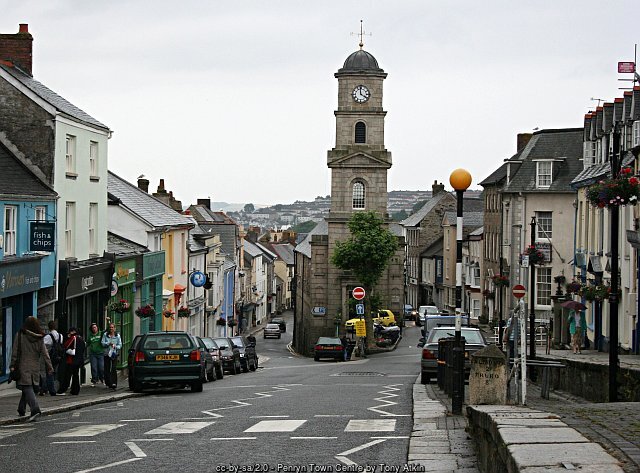
Penryn Town Hall & Museum
Built: 17th-century market hall, remodelled 1839
Clock tower: 1839
Listed: Grade II*
Museum: ground floor – free entry
Address: Higher Market Street, Penryn TR10 8LT
THE PENRYN CAMPUS
On the hill above the town is the Penryn Campus, shared by the University of Exeter and Falmouth University – an arrangement unusual in British higher education. Its shared buildings and services are run by Falmouth Exeter Plus. Around 6,000 students study here, and the campus has transformed Penryn’s economy and brought a young, creative feel to the town.
At its centre is Tremough House, built in 1703 by John Worth. Over the centuries it was a family home and a boarding school for boys, and from 1943 to 1998 it was Tremough Convent School, run by the order of Les Filles de la Croix, which educated girls aged 3 to 18. The estate was bought for the Combined Universities in Cornwall project, and the new campus opened for the 2004/05 academic year as Tremough Campus. It took the name Penryn Campus in July 2013. The convent’s chapel is now a lecture theatre that keeps many of its original features.
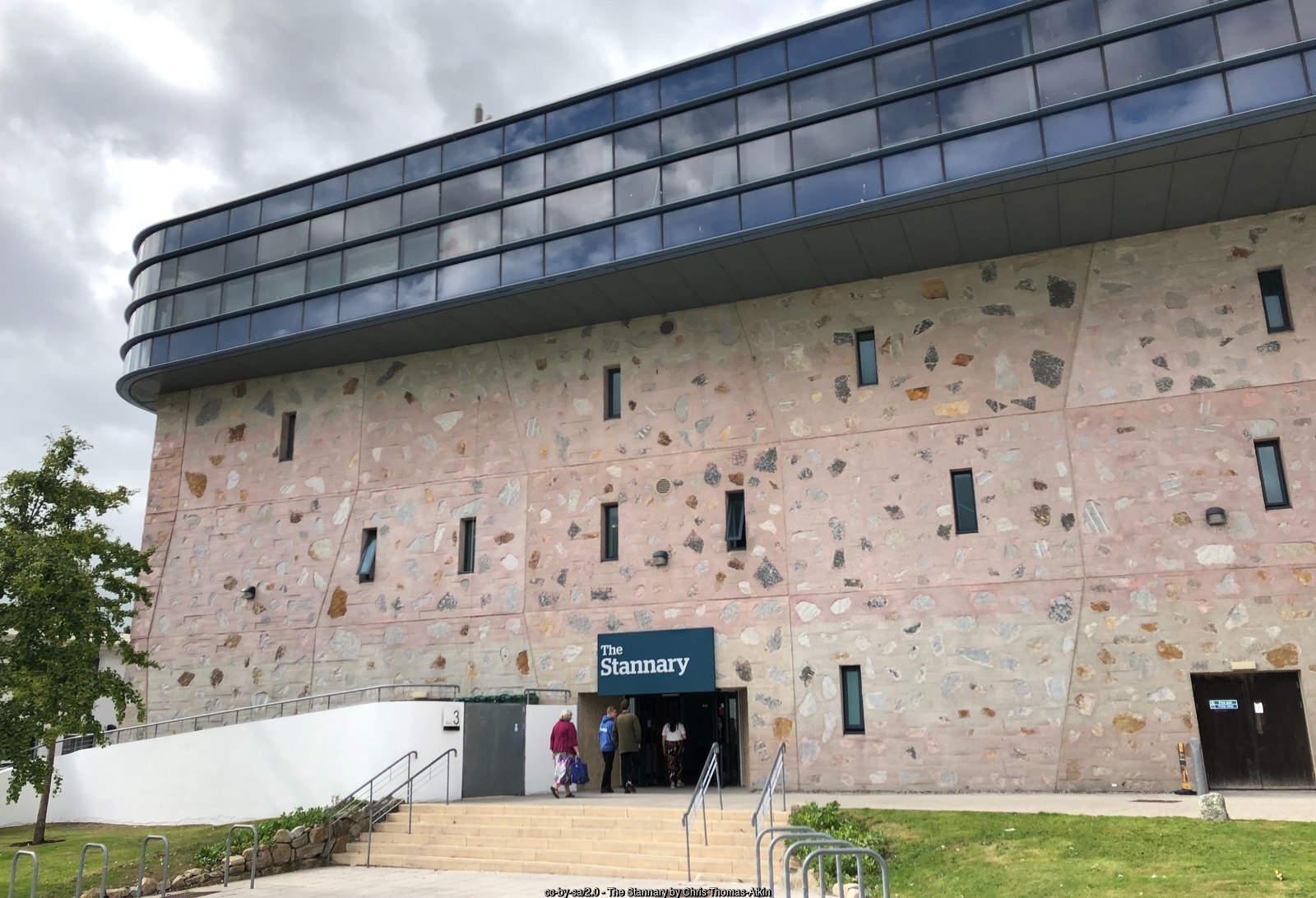
The campus is home to Falmouth University’s creative and design courses and, for the University of Exeter, the Camborne School of Mines – founded in 1888 and moved here from Camborne in 2004 – the Centre for Ecology and Conservation, the Environment and Sustainability Institute and the Institute of Cornish Studies. Set in about 100 acres of landscaped grounds overlooking the Fal estuary, it has won Green Flag Awards for its parkland. Campus life centres on the Stannary, with its restaurant, cafés and student bar, beside the 24-hour learning hub known as the Exchange.
The campus is about a mile from the town centre. Buses U1, U2 and U4 stop on campus, and Penryn station is about a 15-minute walk away.
↑ Back to topPenryn Campus
Universities: University of Exeter and Falmouth University
Opened: 2004 (as Tremough Campus)
Renamed: Penryn Campus, July 2013
Historic house: Tremough House, 1703
Students: around 6,000
Includes: Camborne School of Mines (founded 1888)
Address: Penryn Campus, Penryn TR10 9FE
THE PENRYN RIVER & QUAYS
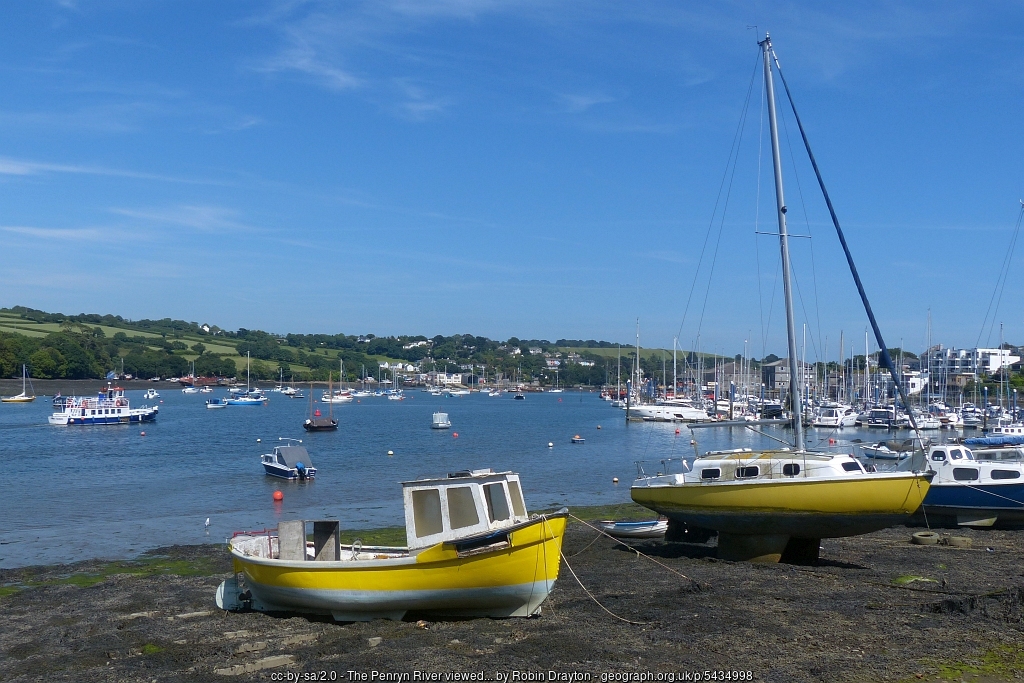
Penryn grew up as a port at the head of the Penryn River, the sheltered creek that runs down past Ponsharden and Flushing to Falmouth harbour. In the 15th century it was a port of some significance, shipping tin and later granite, and its Exchequer Quay, built between the late 17th and early 18th centuries, still survives below the town, with its walls listed Grade II. When the Custom House moved down river to the new town of Falmouth in the 1650s, Penryn’s own trade carried on, and in the 18th century the waterside was lined with coal yards, warehouses, quays and chandlers’ shops.
In the 19th century Penryn became famous for granite. In 1840 John Freeman of the London stone firm W. & J. Freeman moved to Penryn and bought up quarries at Mabe and Constantine. Dressed granite was shipped from the firm’s quays at Penryn for buildings, bridges, docks and monuments across Britain and abroad, and the business ran until 1965. Freeman’s Wharf is still known by its name today.
Today the river is used by boatyards, marinas and pleasure craft. Down on Commercial Road, Jubilee Wharf (completed in 2007) is a striking eco-building by the architect Bill Dunster of ZEDfactory, with wind turbines on its roofs, workshops, studios, flats, a café and a nursery – it won a Housing Design Award for future-proof design in 2007. Further down the river at Ponsharden are a large car park, Falmouth Marina and the shops at the Ponsharden roundabout.
↑ Back to topThe Penryn River
Runs: from Penryn past Ponsharden and Flushing to Falmouth harbour
Exchequer Quay: late 17th–early 18th century, Grade II
Granite: shipped by W. & J. Freeman from 1840 to 1965
Jubilee Wharf: eco-building completed 2007
GLASNEY COLLEGE
In 1265 Bishop Walter Bronescombe of Exeter founded a collegiate church at Glasney, beside the river below the town, to extend the church’s influence in the far west of his diocese. Glasney College grew into one of the most important religious institutions in medieval Cornwall and a centre of learning. The great Cornish-language mystery plays known as the Ordinalia are believed to have been written by members of the college, and Penryn and its neighbourhood are mentioned in them.
After the Reformation, Glasney was dissolved and demolished in 1548, in the reign of Edward VI. Its loss is often counted among the causes of the Prayer Book Rebellion of 1549, when Cornishmen rose against the new English prayer book. Much of the college’s stone was taken for buildings in the town, and today only a fragment of wall survives off Glasney Terrace, listed Grade II. A memorial to the Prayer Book Rebellion stands near the site.
↑ Back to topGlasney College
Founded: 1265 by Bishop Walter Bronescombe
Known for: learning and the Cornish language; probable home of the Ordinalia plays
Dissolved: 1548
Remains: a fragment of wall off Glasney Terrace, Grade II
HISTORY OF PENRYN
The Bishops of Exeter, lords of the manor, founded the town of Penryn in 1216 beside the ancient parish church of St Gluvias, and its Charter of Incorporation was granted in 1236, later confirmed by Bishop Walter Bronescombe. In the 1250s Henry III granted a weekly market, and the founding of Glasney College in 1265 made the town a centre of church life and learning.
The dissolution of Glasney in 1548 and the defeat of the Prayer Book Rebellion the following year were a turning point for the town. From 1554 Penryn sent two members to Parliament, and in 1621 it received a royal charter as a borough – partly, it is said, in a bid by the Crown to cure the town of piracy, as at least three of its mayors were convicted of piracy between 1550 and 1650.
Penryn’s trade carried on through the 17th and 18th centuries, with tin, granite, coal and timber passing over its quays, while the new town of Falmouth grew up down river. The railway arrived on 24 August 1863, and in the 19th century the granite trade made Penryn known around the world.
In the 20th century the borough was enlarged in 1934 to take in St Gluvias, and the granite works and quays declined. The opening of the university campus at Tremough in 2004, the new passing loop at Penryn station in 2009 that doubled the train service, and the eco-building at Jubilee Wharf brought new life to the town, which celebrated its 800th anniversary in 2016.
↑ Back to topPenryn – key dates
1216 – town founded by the Bishops of Exeter
1236 – Charter of Incorporation
1265 – Glasney College founded
1548 – Glasney dissolved
1549 – Prayer Book Rebellion
1621 – royal charter as a borough
1839 – Town Hall remodelled, clock tower added
1840 – Freeman’s granite business comes to Penryn
1863 – railway opens
2004 – Tremough (Penryn) Campus opens
2009 – half-hourly trains begin
2016 – 800th anniversary
Key Buildings
- Penryn Town Hall and Museum, Higher Market Street – 17th-century market hall, remodelled in 1839 with its clock tower; Grade II*. See the town centre above.
- Church of St Gluvias, Church Hill – the parish church, with a 15th-century granite west tower; the rest was rebuilt in 1883 by J. P. St Aubyn. It contains the brass of Thomas Kyllygrewe of about 1485. Grade II*.
- Glasney College remains, off Glasney Terrace – the last fragment of the collegiate church founded in 1265; Grade II.
- Exchequer Quay – the old town quay of the late 17th and early 18th centuries; Grade II.
- Tremough House, Penryn Campus – the mansion of 1703 at the heart of the university campus.
- Jubilee Wharf, Commercial Road – the award-winning eco-building of 2007 by Bill Dunster of ZEDfactory.
NOTABLE PEOPLE
- Walter Bronescombe (d. 1280) – Bishop of Exeter, who confirmed Penryn’s charter and founded Glasney College in 1265.
- Thomas Pellow (born about 1704) – the Penryn boy who was captured by Barbary corsairs at the age of eleven and spent 23 years as a slave in Morocco before escaping home to Penryn. His account, The History of the Long Captivity and Adventures of Thomas Pellow, was published around 1740 and inspired Giles Milton’s book White Gold.
- Jonathan Hornblower (1753–1815) – the steam engineer, a plumber and brazier of Penryn, who patented the compound steam engine in 1781. He died in Penryn and is buried in St Gluvias churchyard.
- John Freeman – of the stone merchants W. & J. Freeman, who moved to Penryn in 1840 and built up the granite business that shipped Cornish granite around the world.
WALKS FROM PENRYN
The best way to see Penryn is on foot. A walk along the ridge from Broad Street through Higher and Lower Market Street, past the Town Hall, takes in most of the old town, with lanes and steps leading down to the river, Exchequer Quay and Jubilee Wharf. Climb Church Hill to St Gluvias church, or follow Glasney Terrace to the remains of Glasney College.
From the riverside you can walk on to Ponsharden and into Falmouth, about two miles away, or head out to Enys Gardens and the creeks towards Mylor and Flushing. The grounds of the Penryn Campus also make a pleasant walk.
↑ Back to topTHINGS TO DO IN AND AROUND PENRYN
Penryn is a place to explore slowly – its historic streets, independent shops and cafés, and its riverside. It is also an ideal base for days out across the Falmouth area, with trains and buses on the doorstep.
- Visit Penryn Museum in the Town Hall – free entry.
- Walk the old town – Broad Street, Higher and Lower Market Street and the lanes down to the river.
- See St Gluvias church and the remains of Glasney College.
- Explore the Penryn Campus and the grounds of Tremough House.
- See the bluebells at Enys Gardens in early May – open April to September.
- Head into Falmouth for Pendennis Castle, the National Maritime Museum Cornwall and the beaches – Falmouth.
- Take the ferry from Falmouth to Flushing or St Mawes.
- Take the train to Truro and its cathedral.
- Visit the gardens of the Helford – Glendurgan and Trebah.
LOCAL EVENTS
- Bluebell Week at Enys Gardens (early May) – the famous bluebell meadow at Enys, just outside Penryn.
- Falmouth International Sea Shanty Festival (June) – see Falmouth.
- Falmouth Week (August) – one of Cornwall’s biggest sailing regattas.
- Awenek! The Great Cornish Heritage Festival (September) – a family day of Cornish heritage, crafts, music and living history at Enys Gardens, run by the Cornwall Heritage Trust.
- Christmas in Penryn (December) – Christmas lights and events in the town centre.
Dates change from year to year – check Penryn Town Council, Enys Gardens and local noticeboards for this year’s events.
↑ Back to topPLACES NEAR PENRYN
- Falmouth – Pendennis Castle, the National Maritime Museum Cornwall and the beaches, about two miles away.
- Flushing – the waterside village across the Penryn River.
- Mylor – Mylor Bridge and the yacht harbour at Mylor Churchtown.
- Restronguet Creek and Devoran – creeks, quays and the Pandora Inn.
- Truro – Cornwall’s cathedral city, about nine miles away by road or 20 minutes by train.
- Enys Gardens – historic gardens a couple of miles north of the town.
VISITOR INFORMATION
Parking & EV Charging
Cornwall Council car parks in Penryn: Commercial Road (long stay, TR10 8AQ), and Exchequer Quay (TR10 8LS) and Saracen (TR10 8LW), both short stay. Spaces are limited – on busy days it is easier to arrive by train or bus. There is also parking at Penryn station.
Electric vehicle charging:
Public chargers in and around Penryn and Falmouth change often – check the live map before you travel.
Bus & Train
Penryn station is on the Maritime Line between Truro and Falmouth, with trains every half hour Monday to Saturday daytime and hourly at other times. Buses U1 (Falmouth – Penryn – Penryn Campus – Truro), U2 (to Redruth) and U4 (to Helston and Penzance) run through the town. Check timetables before you travel.
Facilities & Supermarkets
Penryn has independent shops, banks and cash machines, a post office, a library (St Thomas Street) and a museum. Supermarkets:
- Asda – Jennings Road, Penryn TR10 9LY
- Lidl – Falmouth Road, Ponsharden, Penryn TR10 8AB
- Sainsbury’s – Ponsharden, Falmouth TR11 2RZ
- SPAR – Lower Market Street, Penryn TR10 8BG
Cafés & Restaurants
Higher and Lower Market Street and Broad Street have independent cafés, bakeries, takeaways and traditional pubs, and there is a café at Jubilee Wharf by the river. The Penryn Campus has its own cafés and bars, and Falmouth’s restaurants are a few minutes away.
Health
Penryn Surgery, Saracen Way, Penryn TR10 8HX (01326 372502), with Hendra’s pharmacy on the same site. Falmouth Community Hospital has a Minor Injury Unit, and the nearest A&E is the Royal Cornwall Hospital, Truro. Call NHS 111 for urgent advice and 999 in an emergency.
Disabled Access
The main street along the ridge is fairly level, but the lanes down to the river and up to St Gluvias church are steep. Penryn station has step-free access to its platform. The Penryn Surgery has disabled parking and an accessible toilet.
Vets & Dogs
Vets in Penryn: Rosemullion Veterinary Practice, Parc Briwer, TR10 8LF; Cornish Paws Veterinary Practice, Kernick Road, TR10 8NT; and Vets4Pets, inside Pets at Home, Ponsharden roundabout, TR10 8AB. Enys Gardens is dog-friendly.
National Trust & English Heritage
English Heritage cares for Pendennis Castle in Falmouth and St Mawes Castle. The National Trust cares for Glendurgan Garden on the Helford and Trelissick on the Fal.
Attractions
Penryn Museum in the town, Enys Gardens just outside, and castles, museums and gardens around Falmouth and the Helford.
STAY & EXPLORE IN PENRYN
Nearby Towns & Villages
Local Attractions
Official Information
FAMILY HOLIDAYS & SHORT BREAKS IN PENRYN
Family holidays in Penryn combine one of Cornwall’s most historic towns with easy access to everything the Falmouth area offers – the beaches at Gyllyngvase and Swanpool, Pendennis Castle, the National Maritime Museum Cornwall, boat trips on the Fal and gardens on the Helford, all close by and many reachable by train or bus.
Browse Penryn holiday cottages for self-catering homes in and around the town, or holidays and short breaks in Penryn for every type of accommodation.
Short breaks in Penryn are good value all year – a spring weekend for the bluebells at Enys, an autumn break exploring the old town and museum, or a stay in the summer holidays when the students are away. Booking direct with the owner means no agency fees.
↑ Back to topFREQUENTLY ASKED QUESTIONS ABOUT PENRYN
Penryn is a town at the head of the Penryn River in west Cornwall, on the edge of Falmouth and about two miles from Falmouth town centre. Truro is about nine miles to the north-east.
Penryn is one of the oldest towns in Cornwall. It was founded by the Bishops of Exeter in 1216 and received its Charter of Incorporation in 1236. It celebrated its 800th anniversary in 2016.
The Penryn Campus is a university campus on the hill above the town, shared by the University of Exeter and Falmouth University. It opened in 2004 as Tremough Campus, around the historic Tremough House of 1703, and is home to the Camborne School of Mines and around 6,000 students.
Yes. Penryn Museum, on the ground floor of the Town Hall in Higher Market Street, is free to visit. It is run by volunteers and usually opens on weekday mornings and early afternoons, so check before you visit.
Glasney College was a collegiate church founded in Penryn in 1265 by Bishop Walter Bronescombe of Exeter. It was a centre of learning and of the Cornish language, and the Cornish mystery plays known as the Ordinalia are believed to have been written there. It was dissolved and demolished in 1548.
Yes. Penryn station is on the Maritime Line between Truro and Falmouth. Trains run every half hour Monday to Saturday daytime and hourly at other times.
Cornwall Council has a long-stay car park on Commercial Road and short-stay car parks at Exchequer Quay and Saracen. There is also parking at Penryn station. Spaces are limited, so on busy days it is easier to arrive by train or bus.
Yes. Penryn is a historic, good-value base with a railway station and frequent buses, close to Falmouth’s beaches, Pendennis Castle and the National Maritime Museum Cornwall, the ferries on the Fal and the gardens of the Helford.
Cornwall Online | Mid Cornwall Towns and Villages | Truro | Feock | Devoran | Restronguet Creek | Mylor | Flushing | Penryn | Falmouth | The Roseland Peninsula | St Mawes | St Anthony Head | St Just in Roseland | Portscatho | Gerrans | Philleigh | Ruan Lanihorne | Tregony | Veryan | Portloe | Portholland | Gorran Haven | Mevagissey | The Lost Gardens of Heligan | St Austell | Charlestown | Fowey | Golant | Lostwithiel | The Lizard Peninsula