Golant, Cornwall – Riverside Village on the River Fowey
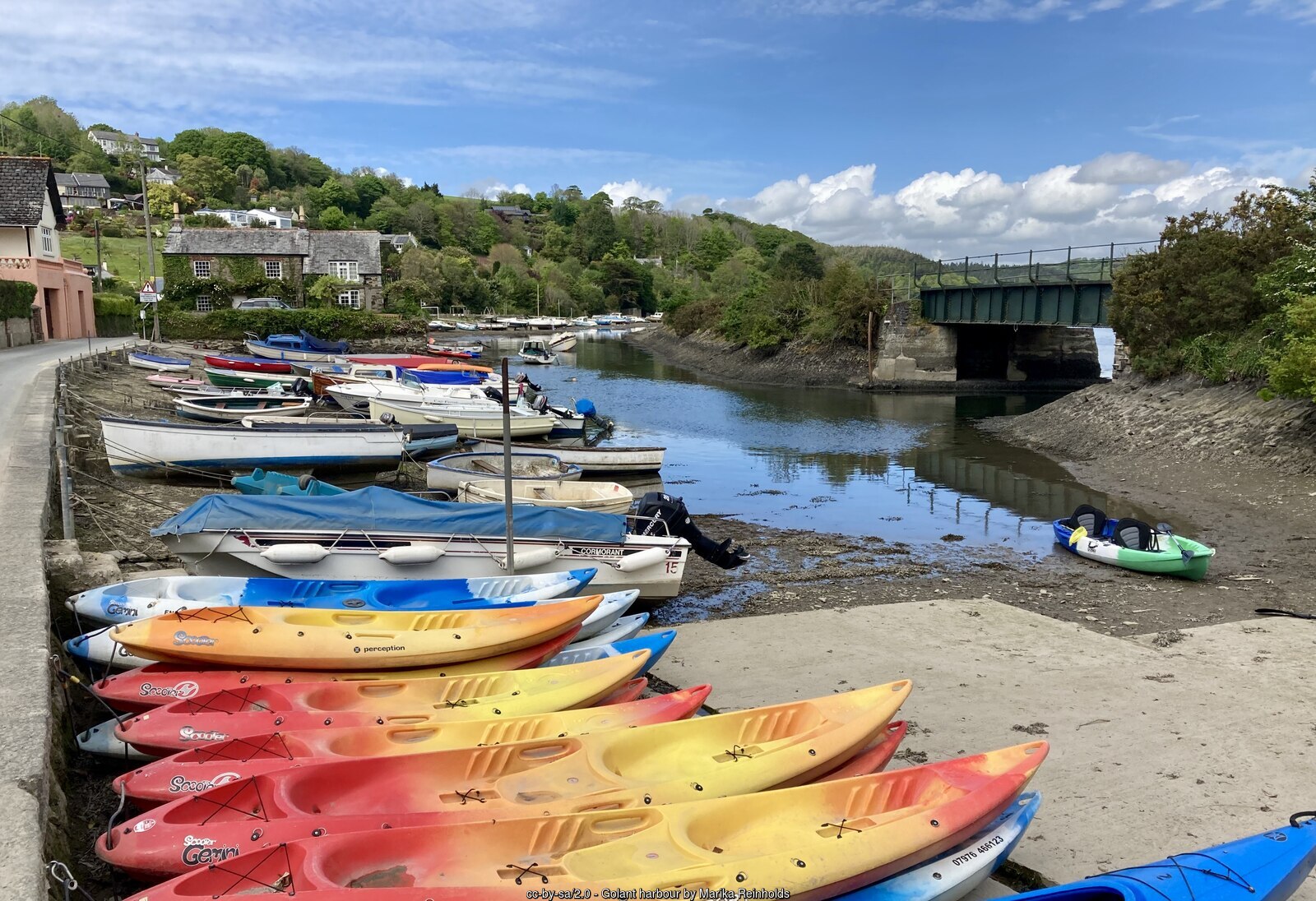
Golant & the River Fowey
Cornwall Online | South East Cornwall Towns and Villages | Looe | Talland Bay | Polperro | Polruan | Fowey | Golant | Lostwithiel | Mevagissey | Whitsand Bay & The Rame Peninsula | Kingsand | Cawsand | Mount Edgcumbe Country Park | Torpoint | St Germans | Saltash | Liskeard | Siblyback Lake - Water Park | Minions - Hurlers - Bodmin Moor | St Neot | St Cleer | Callington | Gunnislake | Calstock | Cardinham Woods - Walking & Cycle Trails | Launceston |
On This Page
- Holidays in Golant
- Best Time to Visit
- The River Fowey & Golant Harbour
- St Sampson’s Church & Holy Well
- Castle Dore & Tristan and Iseult
- Things to Do in Golant
- History of Golant
- Key Buildings & Landmarks
- Notable People
- Local Events
- Places near Golant
- Visitor Information
- Stay & Explore near Golant
- Family Holidays & Short Breaks
- Frequently Asked Questions
HOLIDAYS IN GOLANT
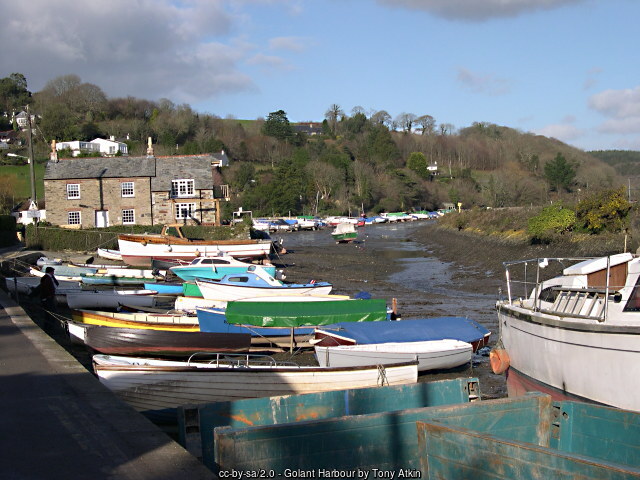
Golant is a small, peaceful village on the west bank of the River Fowey, about two miles upriver from Fowey and four miles below Lostwithiel. Its cottages climb the steep, wooded bank above the river, and life here still revolves around boats, the tide and the water – the village has its own rowing and canoe clubs, a riverside pub and a sheltered harbour full of small craft.
The village’s Cornish name is Golnans, and it lies in the parish of St Sampson. At its heart is the Grade I listed church of St Sampson, consecrated in 1509, with a medieval holy well beside its porch – one of the most atmospheric small churches in Cornwall.
Golant is also steeped in legend. On the hill above the village is Castle Dore, an Iron Age hillfort traditionally said to have been the court of King Mark of Cornwall, and the story of Tristan and Iseult has long been linked with the church and the river here.
For walkers, Golant is a stop on the Saints’ Way, the long-distance path that crosses Cornwall from Padstow to Fowey, and the river itself is perfect for exploring by kayak or paddleboard. The village green, with a children’s playground beside it, makes a lovely picnic spot, and at very low tides a small sandy beach appears below the village.
At the water’s edge, the Fisherman’s Arms is the village pub, looking out across the river. At the biggest spring tides the river rises over the road in front of it – one of the sights of Golant, so check the tide tables if you are parking nearby.
Golant makes a quiet base for exploring Mid and South East Cornwall. Fowey, with its harbour, ferries and Daphne du Maurier connections, is a few minutes away, and Lostwithiel, Restormel Castle, Lanhydrock and the Eden Project are all within easy reach.
Accommodation includes cottages, B&Bs and riverside houses – see Golant holiday cottages and holidays and short breaks in Golant.
Best Time to Visit Golant
Spring and early summer bring bluebells and wild garlic to the riverside woods, calm water for kayaking and the Fowey Festival of Arts and Literature downriver. Summer is the liveliest time, with the village carnival, flotillas on the river and Fowey Regatta in August.
Autumn and winter are quiet and beautiful, with wading birds on the mudflats, walks along the Saints’ Way and the village’s winter boat lights on the water. Golant is never really busy, so it is a good choice when the coast is crowded.
↑ Back to top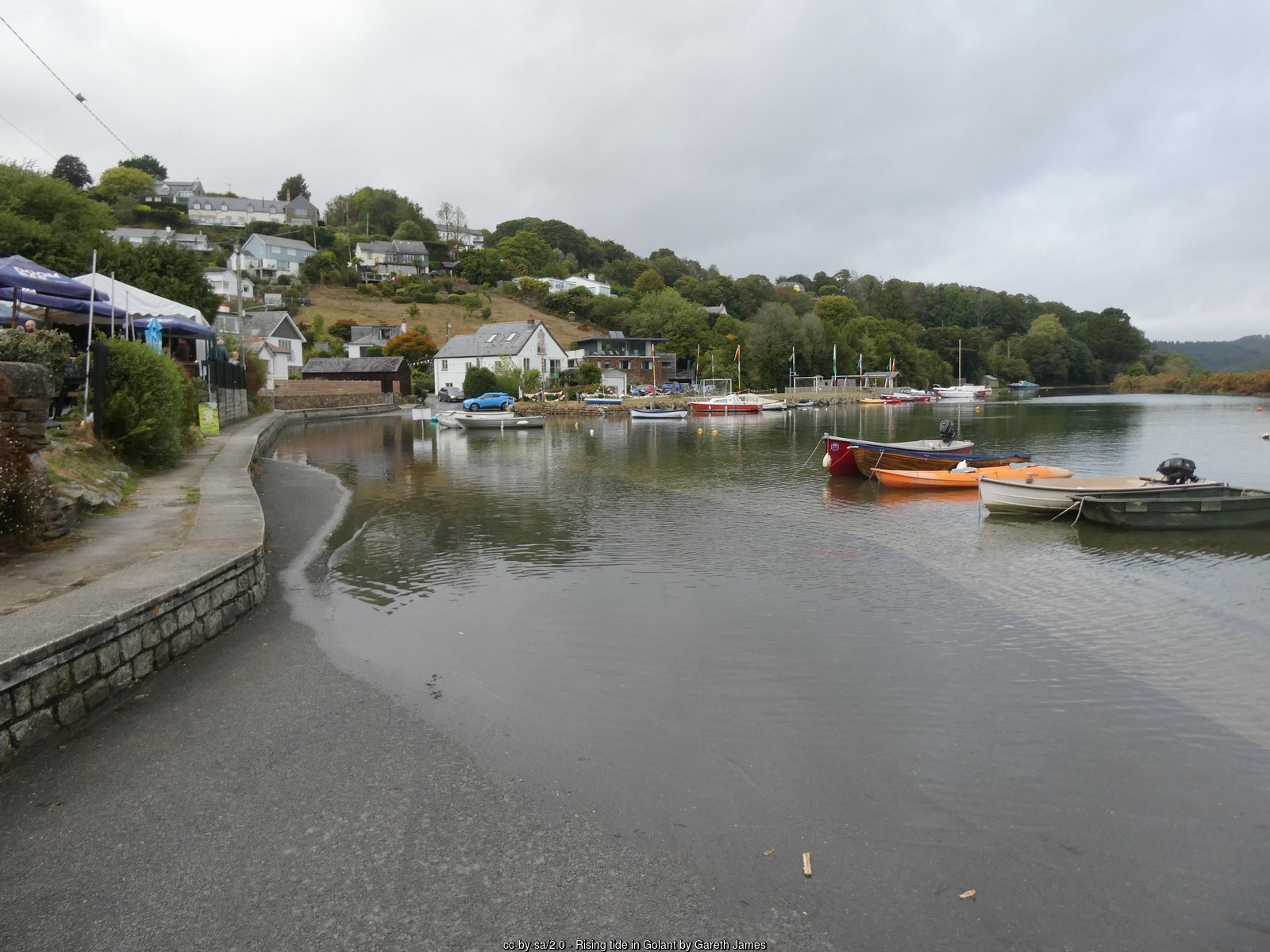
THE RIVER FOWEY & GOLANT HARBOUR
The River Fowey is tidal all the way up to Lostwithiel, and for centuries it was the main highway of this part of Cornwall. Ships carried tin, copper, limestone and manure to and from the riverside quays, and there was once a well-used ford across the river near Golant.
In 1869 a railway was built along the west bank from Lostwithiel to Fowey, to carry iron ore and later china clay to the deep-water jetties below the town. Its embankment cut off Golant Pill from the main river, creating the sheltered harbour where the village’s boats now lie. The line still carries china clay trains to Fowey Docks, but passenger services ended in 1965, when Golant Halt closed; the site of the halt is now the riverside car park.
Today the river is a place for leisure. Encounter Cornwall, based in the village, runs guided kayak trips on the estuary, where you may see egrets, herons and sometimes a seal, and the Fowey River Canoe Club and Castledore Rowing Club are based on the waterside. With your own boat or kayak, you can explore upriver to Lostwithiel and the creek at Lerryn, or down to Fowey – always plan around the tide.
The river is also said to be one of the inspirations for Kenneth Grahame’s The Wind in the Willows. Grahame was married in Fowey in 1899 and spent many holidays boating on the estuary, and a boating trip from Fowey upriver past Golant is said to have fed into his river stories.
↑ Back to topGolant at a glance
Where: west bank of the River Fowey, PL23
Distances: Fowey approx. 2 miles, Lostwithiel approx. 4 miles
Pub: the Fisherman’s Arms, by the river
On the water: kayak trips, canoe and rowing clubs
Walking: the Saints’ Way passes through the village
Tides: the highest tides flood the riverside road
ST SAMPSON’S CHURCH & HOLY WELL
The church of St Sampson stands above the village on Church Hill. A chapel here is first recorded in 1281, when it belonged to Tywardreath Priory; it was largely rebuilt in the late 15th century and consecrated as a church in its own right in 1509. The building is listed Grade I, and Simon Jenkins included it in England’s Thousand Best Churches.
Beside the south porch is the holy well, enclosed in a small medieval wellhouse and reached through a rough granite archway – one of the few holy wells in Cornwall entered from a church porch. Inside, look for the late medieval bench ends reused to make the pulpit and reading desk, the inscriptions in the nave roof recording the craft guilds that paid for it, and fragments of 15th-century glass in the chancel, thought to show St Sampson and St Anthony.
The church was repaired in 1842, the south porch was built in 1856, and the tower and west end were restored in 1891. There is a ring of five bells. The church is open daily and still holds regular services.
St Sampson was a 6th-century Welsh monk, educated under St Illtud, who travelled through Cornwall on his way to Brittany, where he founded the monastery of Dol and became its bishop. Local tradition says he stayed at Golant and lived in a cell beside the holy well.
↑ Back to top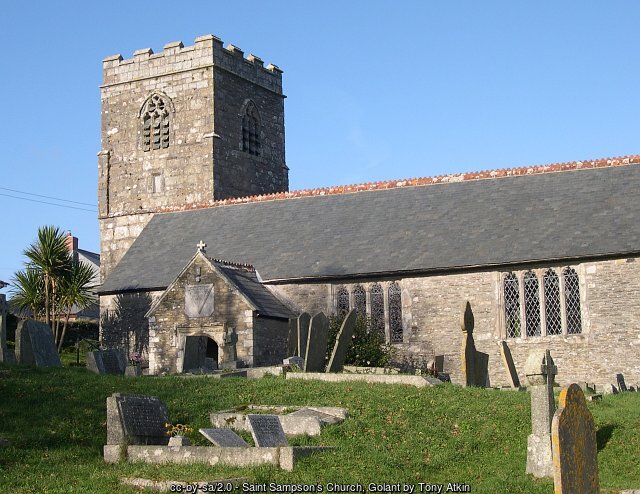
CASTLE DORE & THE LEGEND OF TRISTAN AND ISEULT
On the hilltop above Golant is Castle Dore, a small Iron Age hillfort with two rings of banks and ditches, probably occupied from around the 4th century BC until the 1st century BC. It was excavated by Ralegh Radford in 1936 and 1937, and tradition has long made it the court of King Mark of Cornwall.
That tradition comes from the Tristan Stone, a 6th-century inscribed granite pillar that once stood near Castle Dore and now stands beside the road into Fowey. Its Latin inscription is usually read as recording “Drustanus, son of Cunomorus” – names that have been linked with Tristan and with King Mark.
In the legend, Tristan, Mark’s nephew, was sent to Ireland to bring back the princess Iseult as his uncle’s bride, and on the voyage home the two fell in love. Their tragic story ends in Brittany, where Tristan, wounded and dying, waited for the ship bringing Iseult – white sails if she was aboard, black if not. Told the sails were black, he died, and Iseult died beside him. In the 12th-century poem by Béroul, Iseult gives a rich robe to the church of St Samson, which has long been identified with Golant.
The hillfort has a darker history too. In the English Civil War, at the end of August 1644, the Parliamentarian army of the Earl of Essex, trapped between Lostwithiel and Fowey by the Royalists, made its last stand here; Essex escaped by boat to Plymouth and his infantry surrendered days later. King Charles I is said to have camped at Castle Dore, and cannonballs and musket balls are still found in the fields around Golant.
The story inspired the novel Castle Dor, begun by Sir Arthur Quiller-Couch and completed by Daphne du Maurier after his death, which retells the legend in 19th-century Cornwall around Castle Dore, Golant and the River Fowey.
↑ Back to topCastle Dore – at a glance
Type: Iron Age hillfort (scheduled monument)
Date: c.4th–1st century BC
Excavated: 1936–37 by Ralegh Radford
Legend: seat of King Mark of Cornwall
1644: last stand of Essex’s army
Nearby: the Tristan Stone, on the road into Fowey
THINGS TO DO IN GOLANT
Golant is a village for slowing down – for watching the tide come in from the pub, paddling up a quiet creek or walking an ancient path between churches and holy wells.
For families, a guided kayak trip, a picnic on the village green and playground, and a day out at Fowey’s beaches or the Eden Project are all close by. On rainy days, Lostwithiel’s museum and antique shops, Lanhydrock House and the Eden Project’s biomes are all within a short drive.
For walkers, the Saints’ Way leads south to Fowey along the river and north towards Lanlivery and Helman Tor. Here are some of the best things to do in and around Golant.
- Kayak on the River Fowey with a guided trip from the village.
- Visit St Sampson’s Church and its holy well.
- Walk the Saints’ Way from Golant to Fowey.
- Watch the tide from the Fisherman’s Arms by the river.
- Walk around Fowey and the Gribbin – Fowey to Gribbin Head walk.
- Explore Fowey, its harbour, ferries and beaches – Fowey guide and Fowey beaches.
- Visit Restormel Castle above Lostwithiel – Restormel Castle.
- Spend a day at Lanhydrock – Lanhydrock House & Garden.
- Visit the Eden Project – Eden Project.
- Take a boat trip upriver to Lostwithiel and Lerryn, or down to Fowey.
- Hire a self-drive boat in Fowey and explore the river – Fowey River Hire.
HISTORY OF GOLANT
People have lived around Golant for well over two thousand years: the Iron Age hillfort of Castle Dore stands on the hill above, and from the early Christian period the route now followed by the Saints’ Way carried travellers between the north and south coasts of Cornwall. A chapel at Golant is recorded in 1281, belonging to Tywardreath Priory, and the village became a parish in its own right when the rebuilt church was consecrated in 1509.
The river shaped Golant’s history. Its quays traded in tin, copper, limestone and manure, and in 1644 the surrounding fields saw the end of the Civil War campaign around Lostwithiel and Fowey. The arrival of the railway in 1869 cut off Golant Pill and turned it into the village harbour, and from 1896 to 1965 the village had its own station, Golant Halt.
In more recent times, the Sawmills recording studio, set up in 1974 in a 17th-century water mill on a creek near Golant, became famous as the place where bands including Oasis, The Stone Roses and The Verve recorded. Today Golant is a small community of around 220 people, with an active village life centred on the church, the pub, the village hall and the river.
↑ Back to topGolant – key dates
c.4th–1st century BC – Castle Dore hillfort occupied
6th century – St Sampson; the Tristan Stone
1281 – chapel recorded, belonging to Tywardreath Priory
1509 – rebuilt church consecrated
1644 – Essex’s army defeated at Castle Dore
1869 – railway from Lostwithiel to Fowey opened
1896–1965 – Golant Halt open
1936–37 – Castle Dore excavated
1974 – Sawmills studio founded
1986 – Saints’ Way opened
KEY BUILDINGS & LANDMARKS
- St Sampson’s Church – Grade I listed, rebuilt in the late 15th century and consecrated in 1509, with its south porch of 1856 and tower restored in 1891.
- The holy well – the medieval wellhouse beside the church porch, traditionally linked with St Sampson.
- Castle Dore – the Iron Age hillfort above the village, traditional seat of King Mark.
- The Fisherman’s Arms – the village pub on the riverside road, cut off by the highest tides.
- Golant Pill – the sheltered harbour created when the Lostwithiel to Fowey railway was built in 1869.
- Penquite – the country house above the river, once home of Colonel John Whitehead Peard, “Garibaldi’s Englishman”.

NOTABLE PEOPLE CONNECTED WITH GOLANT
- St Sampson (6th century) – the Welsh monk and later bishop of Dol in Brittany, to whom Golant’s church is dedicated, who is said to have stayed here on his way to Brittany.
- John Whitehead Peard (1811–1880) – the soldier known as “Garibaldi’s Englishman”, who fought with Garibaldi in Italy and lived at Penquite, near Golant; Garibaldi is said to have stayed with him there.
- Sir Arthur Quiller-Couch (1863–1944) and Daphne du Maurier (1907–1989) – the Fowey writers whose novel Castle Dor, begun by “Q” and finished by du Maurier, is set around Castle Dore, Golant and the River Fowey.
- Annabel Vernon – the Olympic silver medal-winning rower, who was a member of Castle Dore Rowing Club at Golant.
LOCAL EVENTS IN GOLANT
For a small village, Golant has a busy calendar, much of it centred on the river, the village green and the church.
- Wassailing (New Year’s Day) – a traditional start to the village year.
- Easter Fun Days (Easter) – an egg hunt and family celebrations.
- Boatwatch Flotillas (June and August) – boats gather on the river.
- Produce and Craft Show and Sea Sunday at St Sampson’s (July).
- Golant Carnival and Madness in the Pill (August) – carnival on the village green, and high-tide fun in the harbour.
- Winter Boatlights and Christmas fair (winter) – illuminated boats on the river and festive events.
- Nearby: the Fowey Festival of Arts and Literature (May) and Fowey Royal Regatta (August).
Dates change from year to year – check the village website or our Cornwall events guide for current dates.
↑ Back to top
PLACES NEAR GOLANT
- Fowey – the historic harbour town at the river mouth, about 2 miles south.
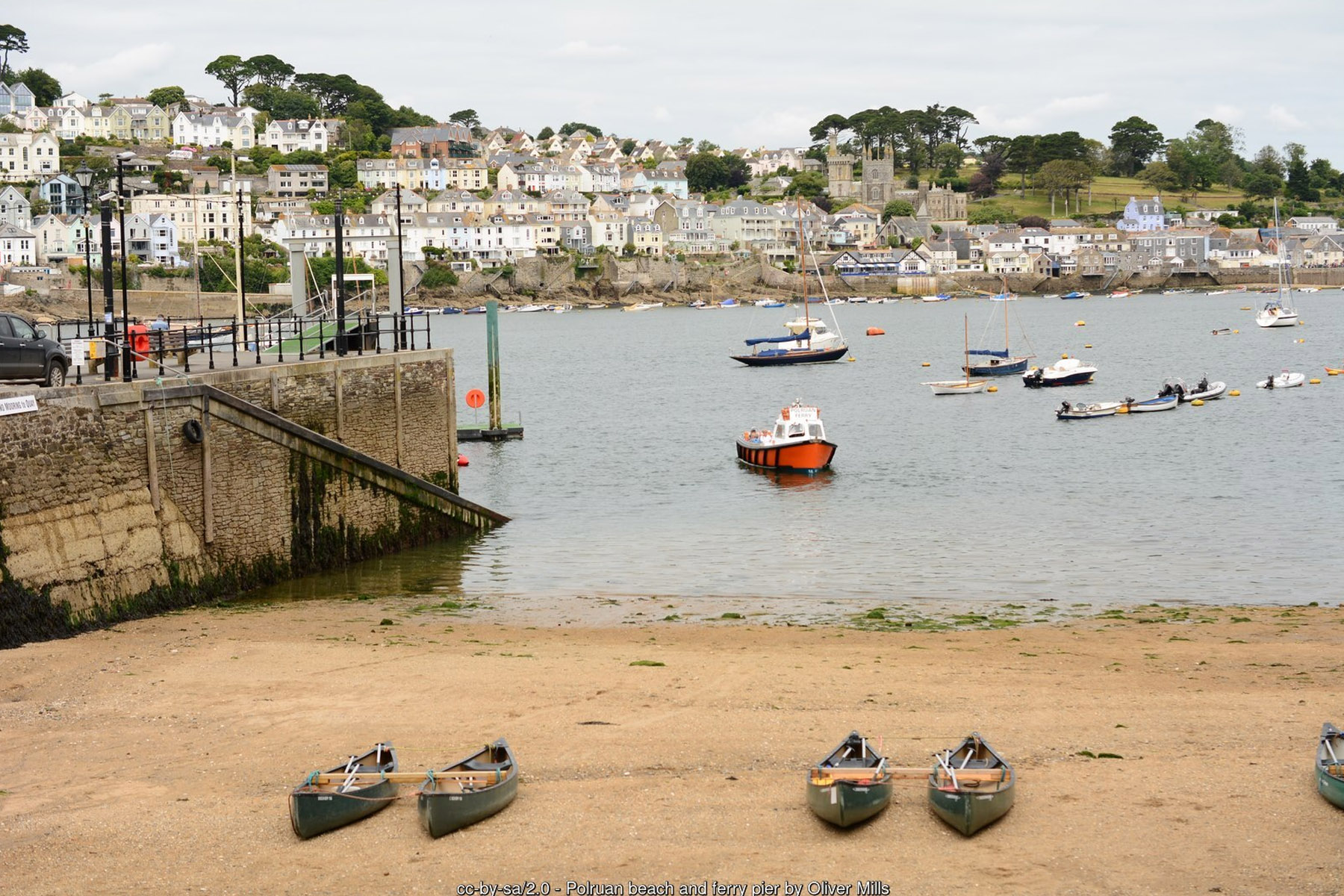
- Polruan – the village across the harbour from Fowey, reached by passenger ferry.
- Lostwithiel – the old stannary town, with Restormel Castle, about 4 miles north.
- Charlestown – the Georgian port on St Austell Bay, about 7 miles west.
- Mevagissey – the fishing harbour south of St Austell.
VISITOR INFORMATION
Parking & EV Charging
There is a small car park by the river on the site of the old Golant Halt. Golant is reached by narrow, steep lanes, and the very highest tides flood the riverside road by the Fisherman’s Arms – check tide times before parking near the water. In Fowey, the Main Car Park and Caffa Mill car park are the largest. Check parking signs for charges and Blue Badge rules.
Electric vehicle charging:
- Main Car Park, Fowey – slow chargers (Evolt), PL23 1HA
- Caffa Mill Car Park, Fowey – slow chargers (Evolt), PL23 1DF
Bus & Train
Go Cornwall Bus routes 24 and 24A between St Austell and Fowey stop at Castledore, by the Golant turning on the main road – a walk of about a mile down to the village. The nearest railway stations are Par and Lostwithiel, on the main line between Penzance and Plymouth. Check timetables before you travel.
Facilities & Supermarkets
Golant has a pub, a village hall, a church, a children’s playground on the village green and a riverside kayak centre, but no shop. The nearest supermarkets are in Fowey and Lostwithiel, with larger stores in St Austell:
- Co-op – Polvillion Road, Fowey PL23 1HJ
- Co-op – Quay Street, Lostwithiel PL22 0BS
Cafés & Restaurants
The Fisherman’s Arms on the riverside is the village pub, with river views, food and regular events. There is a café at the riverside kayak centre, and a wide choice of pubs, cafés and restaurants in Fowey and Lostwithiel, a few minutes’ drive away.
Health
The nearest GP is Fowey River Practice, Rawlings Lane, Fowey PL23 1DT. The nearest Minor Injury Unit is at St Austell Community Hospital, Porthpean Road, St Austell PL26 6AA. Call NHS 111 for urgent advice and 999 in an emergency – ask for the Coastguard on the river or the coast. The nearest A&E is the Royal Cornwall Hospital, Truro.
Disabled Access
Golant is built on a steep riverbank, and the lane up to the church on Church Hill is a steep climb. The riverside road past the harbour and the Fisherman’s Arms is level, with parking close by, and gives easy views of the river – but it floods at the very highest tides. The Saints’ Way and the woodland paths are rough and uneven.
Vets & Dogs
The nearest vet is Pelyn Vets (Kernow Veterinary Group), Edgecumbe Road, Lostwithiel PL22 0DZ – use the RCVS directory for out-of-hours care. Golant is a good place for dog walks along the river and the Saints’ Way; some Fowey beaches have seasonal dog restrictions, so check the signs.
National Trust & English Heritage
The National Trust cares for much of the coast around Fowey, including the Gribbin headland and Hall Walk, and for Lanhydrock near Bodmin. English Heritage cares for Restormel Castle above Lostwithiel and St Catherine’s Castle at Fowey.
Attractions
The river, the church and Castle Dore on the doorstep, with Fowey, Lostwithiel, the Eden Project and the Lost Gardens of Heligan within easy reach.
STAY & EXPLORE NEAR GOLANT
Local Attractions
Official Information
FAMILY HOLIDAYS & SHORT BREAKS IN GOLANT
Family holidays in Golant are all about the river – kayaking with a guide, crabbing and boat-watching from the harbour wall, picnics on the village green and walks along the Saints’ Way. Fowey’s beaches, ferries and harbour are a few minutes away, and the Eden Project is an easy day out.
Golant holiday cottages range from traditional cottages above the harbour to larger riverside houses with views down the estuary. Many have parking, and some are dog-friendly – ideal for exploring the river, the woods and the south coast.
Golant is also a lovely choice for a short break or weekend away, especially in spring and autumn, when the river is peaceful and the pub fire is lit. Booking direct with the owner means no agency fees.
Browse Golant holiday cottages, or holidays and short breaks in Golant for every type of accommodation – all listed on Cornwall Online by their owners.
↑ Back to topFREQUENTLY ASKED QUESTIONS ABOUT GOLANT
Golant is a small village on the west bank of the River Fowey in south Cornwall, about two miles north of Fowey and four miles south of Lostwithiel, in the parish of St Sampson.
Golant is a quiet riverside village. Visitors come to kayak on the River Fowey, visit St Sampson’s Church and its holy well, walk the Saints’ Way, see Castle Dore and enjoy the river views from the Fisherman’s Arms.
Yes. The Fisherman’s Arms stands on the riverside road, looking across the River Fowey. At the very highest tides the river rises over the road in front of the pub.
Yes, at the very highest spring tides, above about five metres, the river covers the riverside road in front of the Fisherman’s Arms. Check tide times before parking near the water.
St Sampson’s is a Grade I listed church, rebuilt in the late 15th century and consecrated in 1509, with a medieval holy well beside its porch. It is dedicated to St Sampson, a 6th-century Welsh monk who became bishop of Dol in Brittany.
Castle Dore is an Iron Age hillfort on the hill above Golant. Tradition makes it the court of King Mark of Cornwall in the legend of Tristan and Iseult, and it was the scene of the defeat of the Earl of Essex’s Parliamentarian army in 1644.
Yes. The Saints’ Way, a long-distance path of about 29 miles across Cornwall from Padstow to Fowey, passes through Golant and its church on the eastern route via Lanlivery.
Yes. Encounter Cornwall, based in Golant, runs guided kayak trips on the River Fowey, and the village also has a canoe club and a rowing club. Always plan trips around the tide.
Go Cornwall Bus routes 24 and 24A between St Austell and Fowey stop at Castledore, by the Golant turning, about a mile above the village. The nearest railway stations are Par and Lostwithiel.
Cornwall Online | South East Cornwall Towns and Villages | Looe | Talland Bay | Polperro | Polruan | Fowey | Golant | Lostwithiel | Mevagissey | Whitsand Bay & The Rame Peninsula | Kingsand | Cawsand | Mount Edgcumbe Country Park | Torpoint | St Germans | Saltash | Liskeard | Siblyback Lake - Water Park | Minions - Hurlers - Bodmin Moor | St Neot | St Cleer | Callington | Gunnislake | Calstock | Cardinham Woods - Walking & Cycle Trails | Launceston |