Bedruthan Steps & Carnewas – Cornwall’s Great Sea Stacks
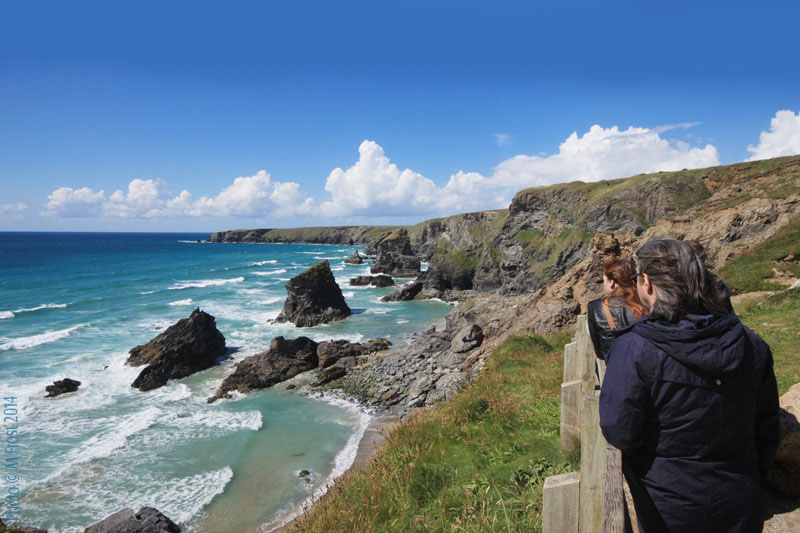
Carnewas & Bedruthan Steps (National Trust)
Perranporth | Holywell Bay | Crantock Bay | Newquay | Porth | Mawgan Porth | Bedruthan Steps & Carnewas (NT) | Porthcothan Bay | Treyarnon Bay | Constantine Bay | Harlyn Bay | Trevone | Padstow | Wadebridge | The Camel Estuary - Camel Cycle Trail | Daymer Bay | Rock | Polzeath | Port Isaac | Bodmin |
On This Page
- Visiting Bedruthan Steps
- Best Time to Visit
- The Sea Stacks
- Bedruthan Beach & the Steps
- Carnewas: Viewpoint, Tea-room & Shop
- Walks & the Coast Path
- Things to Do Nearby
- History & Legends
- Places near Bedruthan Steps
- Visitor Information
- Stay & Explore
- Holidays near Bedruthan Steps
- Frequently Asked Questions
VISITING BEDRUTHAN STEPS
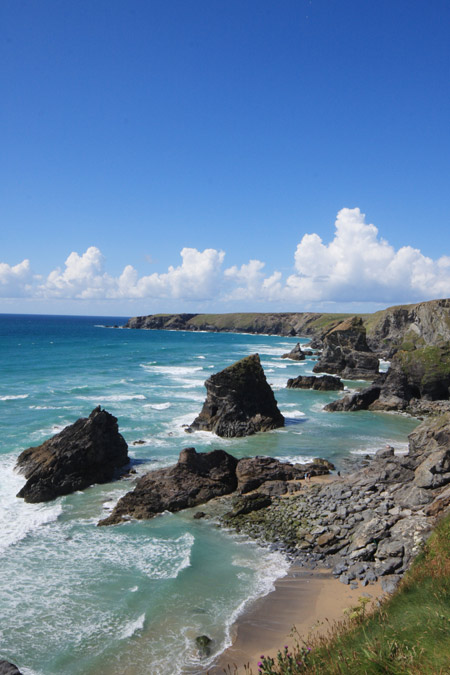
Bedruthan Steps is one of the most spectacular sights on the Cornish coast – a line of great rock stacks rising from a long sandy beach below high, wildflower-covered cliffs. It lies on the North Cornwall coast in the parish of St Eval, between Mawgan Porth and Porthcothan, about seven miles north of Newquay and eight miles from Padstow.
The best views are from Carnewas, the clifftop above the southern end of the beach, cared for by the National Trust. From the car park, a short, level path leads to a viewpoint looking straight along the line of stacks to Park Head, and the South West Coast Path runs along the cliffs in both directions.
Please note: there is currently no access to Bedruthan beach. The steps down the cliff have been closed since a rock fall in 2019, followed by a further cliff fall in 2021, and there is no safe alternative route. The stacks are best enjoyed from the clifftop – and the view is the reason most people come.
At Carnewas there is a National Trust car park and shop, toilets, and a popular tea-room and garden in the old mine buildings. For somewhere to stay nearby, see Mawgan Porth holiday cottages and holiday cottages around Constantine Bay and Porthcothan.
Best Time to Visit Bedruthan Steps
Bedruthan is magnificent at any time of year. Late spring and early summer bring sea pinks, squill and other wildflowers to the clifftops, and low tide shows the full sweep of sand around the stacks. On a sunny day the sea below turns a brilliant turquoise.
Evenings are lovely for sunsets along the coast, and in winter the Atlantic swell breaks over the stacks in spectacular fashion. The clifftop paths are open from dawn to dusk all year; the tea-room and shop have shorter hours in winter.
↑ Back to top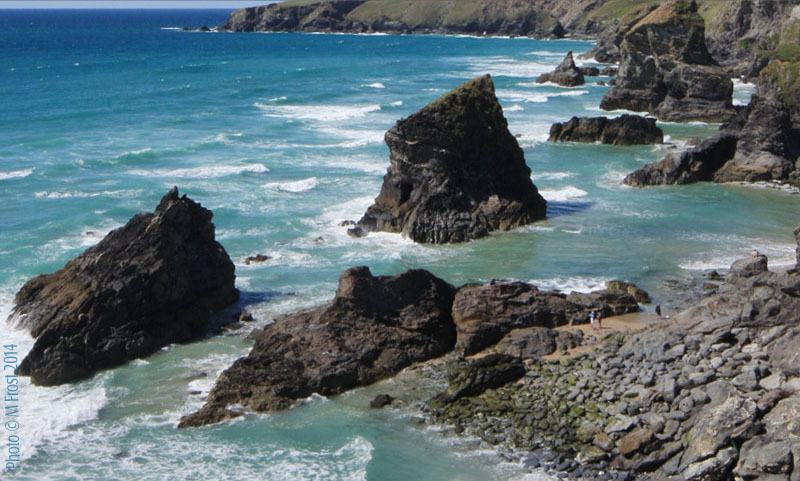
THE SEA STACKS
The stacks of Bedruthan Steps are pillars of slate and sandstone left standing as the sea wore away the softer rock of the cliffs around them. The rocks here belong to the Bedruthan Formation, a series of sandstones, siltstones and mudstones around 380 million years old.
Each stack has its own name. From north to south they are Queen Bess, Samaritan Island, Redcove Island, Pendarves Island and Carnewas Island, with Diggory’s Island further north towards Park Head. Queen Bess Rock was said to look like Queen Elizabeth I in her ruff and skirts – but the “head” was lost to a storm in 1981. Samaritan Island takes its name from the ship Samaritan, wrecked here in October 1846.
Seals can sometimes be seen on the rocks below, and the cliffs are home to seabirds, including fulmars. In spring and summer, the clifftop turf is full of wildflowers.
↑ Back to topBedruthan Steps at a glance
Where: St Eval, between Mawgan Porth and Porthcothan
Car park: National Trust Carnewas, PL27 7UW
Stacks: Queen Bess, Samaritan, Redcove, Pendarves, Carnewas
Beach: no access – steps closed
Viewpoint: level path from the car park
Dogs: welcome on the clifftop, under control
Facilities: toilets, NT shop, tea-room
BEDRUTHAN BEACH & THE STEPS
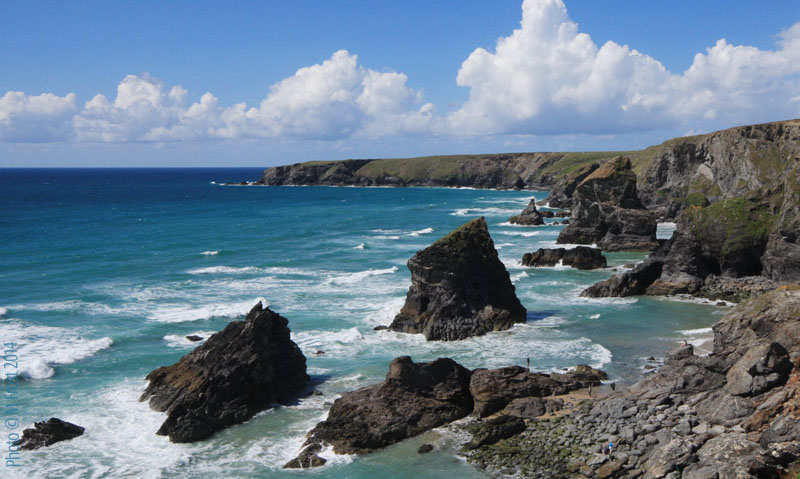
The name Bedruthan Steps may first have belonged not to the stacks but to the steep stairways cut into the cliff, which for generations were the only way down to the beach. A writer in 1910 described rough flights of steps “ancient beyond knowledge”, with crazy iron and timber handrails. Landslides destroyed the old routes in the 1960s and early 1970s, and a new staircase was opened in 1975.
In November 2019 a significant rock fall damaged that staircase, and a further cliff fall above the beach followed in January 2021. The steps remain closed while experts assess whether access can ever be safely reinstated, and there is no other safe route to the beach.
Bedruthan beach is not owned by the National Trust. It is a dangerous place even at the best of times, with rip currents, fast tides that cut off the coves between the stacks, and loose cliffs – swimming here has always been unsafe. The RNLI, the Coastguard and the National Trust all ask visitors not to try to reach the beach by other routes.
↑ Back to topNo beach access: the steps to Bedruthan beach are closed following cliff falls. Please don’t try to climb down. If you see someone in difficulty on the beach or cliffs, call 999 and ask for the Coastguard.
CARNEWAS: VIEWPOINT, TEA-ROOM & SHOP
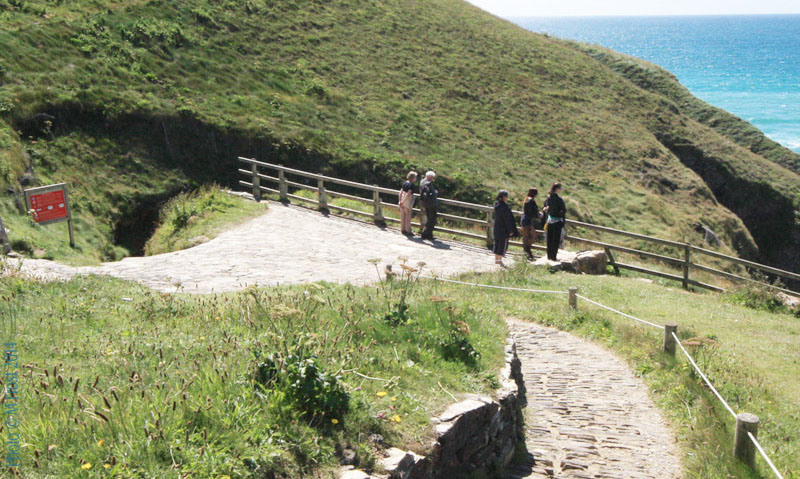
Most visitors start at the National Trust car park at Carnewas, just off the B3276. From here a short path leads out to the clifftop and the coast path, and on down a flight of stone steps to a paved viewing area above the old beach steps, with a superb view along the stacks.
There is a level path with a natural surface from the car park to a clifftop viewpoint, suitable for many wheelchair users and pushchairs, and there are Blue Badge parking bays close by.
The National Trust shop and the Carnewas Tea-room stand in buildings left from Carnewas’ mining past, when iron, copper and lead were worked in the cliffs. The tea-room (run by a tenant, not by the National Trust) is well known for its cream teas and light lunches, served indoors or in the garden with views of the sea. There is a picnic area by the shop, too.
↑ Back to top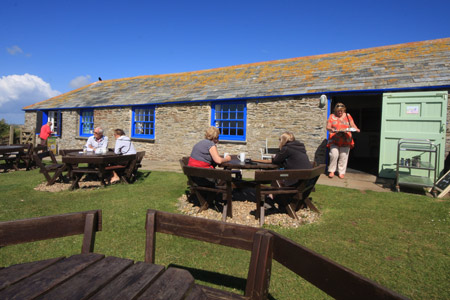
WALKS & THE COAST PATH
The South West Coast Path runs right along the clifftop at Carnewas, and some of the finest coastal walking in Cornwall is on either side. Heading north, the path follows the cliffs above the stacks to Park Head, a National Trust headland with an Iron Age promontory fort, and on past Diggory’s Island and the cove at Porth Mear to Porthcothan.
Heading south, the path passes Carnewas Point and Trenance Point on its way down to the sands of Mawgan Porth – a lovely walk of a couple of miles. Many walkers park at Carnewas, walk one way along the coast and return by bus or inland lanes.
The paths here are on high, often unfenced cliffs. Keep to the path, keep children close and dogs under control, and take care in wet or windy weather.
↑ Back to topTHINGS TO DO NEAR BEDRUTHAN STEPS
Bedruthan Steps is a place to stop, stare and walk – and it is perfectly placed for exploring the beaches of the Seven Bays. On rainy days, Newquay’s indoor attractions and Padstow’s shops and harbour are both a short drive away.
- Take in the view from the clifftop viewpoint at Carnewas.
- Stop for a cream tea at the Carnewas Tea-room.
- Walk the coast path to Park Head and Porthcothan.
- Walk south to Mawgan Porth – Mawgan Porth guide.
- Visit Porthcothan and its stream-split beach – Porthcothan Bay guide.
- Swim in the tidal pool at Treyarnon – Treyarnon Bay guide.
- Watch the surf at Constantine Bay – Constantine Bay guide.
- Spend a day in Newquay – Newquay guide.
- Explore Padstow – Padstow guide.
- Discover more National Trust places – National Trust in Cornwall.
HISTORY & LEGENDS
The name Bedruthan is old – it is recorded as Bodruthyn in 1335, usually explained as “Ruthyn’s dwelling”. The famous story that the stacks were stepping stones for a giant called Bedruthan is much younger: it seems to have been invented in Victorian times to entertain the visitors who came out from Newquay by carriage.
People have lived on this coast for thousands of years. Iron Age promontory forts stand on headlands nearby, including Park Head, and there are Bronze Age burial mounds on the clifftops. In the 19th century the cliffs at Carnewas were mined for iron, copper and lead, and the buildings that now house the shop and tea-room date from those days.
The coast has seen many wrecks. In October 1846 the Samaritan struck the stack that now bears her name, with the loss of nine lives. Her cargo of fine cloth and food washed ashore, to the delight of the local people, and a rhyme of the time said that thanks to the wreck no poor soul would want for a shilling.
As Newquay grew into a resort in the Victorian era, Bedruthan became one of its favourite excursions, and local farmers charged tolls for the carriages crossing their land. Today the clifftops at Carnewas are cared for by the National Trust.
↑ Back to topBedruthan – key dates
Bronze & Iron Age – burial mounds and clifftop forts
1335 – Bedruthan recorded as Bodruthyn
1846 – the Samaritan wrecked on the stacks
19th century – mining at Carnewas; Victorian tourists arrive
1960s–70s – landslides close the old beach steps
1975 – new staircase to the beach opens
1981 – Queen Bess Rock loses its “head”
2019 & 2021 – cliff falls close the beach
PLACES NEAR BEDRUTHAN STEPS
- Mawgan Porth – a sandy surf beach about two miles south.
- Porthcothan – a sandy bay split by a stream, a short way north.
- Treyarnon Bay – a sandy cove with a natural tidal pool.
- Constantine Bay and Harlyn Bay – beaches around Trevose Head.
- Newquay – Cornwall’s surfing capital, about seven miles south.
- Padstow – the harbour town on the Camel Estuary.
The Seven Bays
Trevone, Harlyn, Constantine, Booby’s, Treyarnon, Porthcothan and Mawgan Porth – see all the beaches around Padstow in our Cornwall Beaches guide.
VISITOR INFORMATION
Parking & Getting There
Carnewas is signposted off the B3276 coast road between Newquay and Padstow. The National Trust car park (PL27 7UW) is open dawn to dusk, with no overnight parking. It is free for National Trust members and Blue Badge holders; other visitors pay a day charge, using the JustPark app. A second, privately run car park lies a little to the north.
Bus & Train
The nearest bus stop is by the Bedruthan House Hotel on the B3276, just outside the entrance to the site – Go Cornwall Bus route 56 runs along this road between Newquay and Padstow. The nearest railway station is Newquay. Check timetables before you travel.
Facilities
At Carnewas there are toilets (including an accessible toilet), a National Trust shop, the Carnewas Tea-room and garden, and a picnic area. The shop and tea-room are open daily in the main season, with shorter hours in winter – check before you travel.
Disabled Access
Carnewas has Blue Badge parking (five bays) next to the shop, an accessible toilet, and a level path with a natural surface to a clifftop viewpoint, signed with wheelchair markers. Beyond that, the paths have steps and uneven ground. There is an induction loop in the shop. There is no access to the beach for anyone.
Dogs
Dogs are welcome at Carnewas, under close control – especially near livestock and the cliff edges – and on a lead in the tea-room garden and picnic area. There are dog waste bins at the car park, and water bowls when staff are present.
Safety & Health
Keep to the paths and away from the cliff edges, which are high and unfenced in places. There is no access to Bedruthan beach – don’t try to climb down. Call 999 and ask for the Coastguard in an emergency on the cliffs or the shore, or NHS 111 for urgent advice. The nearest A&E is the Royal Cornwall Hospital, Truro.
STAY & EXPLORE NEAR BEDRUTHAN STEPS
Local Attractions
Walks & Surfing
Official Information
FAMILY HOLIDAYS & SHORT BREAKS AT BEDRUTHAN STEPS
Holidays near Bedruthan Steps put you in the middle of one of Cornwall’s finest stretches of coast – the Seven Bays to the north, Mawgan Porth and Newquay to the south, and the coast path on your doorstep. Families love the beaches at Mawgan Porth, Porthcothan and Treyarnon, all within a few minutes’ drive.
Accommodation nearby ranges from holiday cottages and family houses to hotels and campsites around Mawgan Porth, St Eval and St Merryn. Browse Mawgan Porth holiday cottages, or holidays and short breaks in Mawgan Porth for every type of accommodation.
Spring and autumn are perfect for a short break, when the clifftops are full of wildflowers or the Atlantic is putting on a show. Booking direct with the owner means no agency fees.
↑ Back to topFREQUENTLY ASKED QUESTIONS ABOUT BEDRUTHAN STEPS
Bedruthan Steps is on the North Cornwall coast in the parish of St Eval, between Mawgan Porth and Porthcothan, about seven miles north of Newquay. The National Trust car park at Carnewas is off the B3276, postcode PL27 7UW.
No. The steps down to Bedruthan beach have been closed since a rock fall in 2019, followed by a further cliff fall in 2021, and there is no safe alternative route. The stacks can be enjoyed from the clifftop viewpoints at Carnewas.
Yes. The National Trust car park at Carnewas is open from dawn to dusk. Parking is free for National Trust members and Blue Badge holders, and other visitors pay a day charge using the JustPark app.
Yes. The Carnewas Tea-room, by the National Trust car park, serves cream teas, light lunches and cakes, with a garden overlooking the sea. It is run by a tenant rather than the National Trust, and has shorter hours in winter.
Yes. Dogs are welcome on the clifftops at Carnewas under close control, especially near livestock and cliff edges, and on a lead in the tea-room garden and picnic area.
Partly. There is Blue Badge parking next to the shop, an accessible toilet and a level path with a natural surface to a clifftop viewpoint. Other paths have steps and uneven ground, and there is no access to the beach.
From north to south the main stacks are Queen Bess, Samaritan Island, Redcove Island, Pendarves Island and Carnewas Island, with Diggory’s Island further north. Samaritan Island is named after a ship wrecked there in 1846.
Bedruthan is an old place name, recorded as Bodruthyn in 1335. The ‘steps’ probably first meant the stairways cut into the cliff to reach the beach. The story of a giant called Bedruthan using the stacks as stepping stones seems to have been invented for Victorian tourists.
Perranporth | Holywell Bay | Crantock Bay | Newquay | Porth | Mawgan Porth | Bedruthan Steps & Carnewas (NT) | Porthcothan Bay | Treyarnon Bay | Constantine Bay | Harlyn Bay | Trevone | Padstow | Wadebridge | The Camel Estuary - Camel Cycle Trail | Daymer Bay | Rock | Polzeath | Port Isaac | Bodmin |