Harlyn Bay, Cornwall – Sheltered Sands & Surf near Padstow
Harlyn Bay & Trevose Head
Perranporth | Holywell Bay | Crantock Bay | Newquay | Porth | Mawgan Porth | Bedruthan Steps & Carnewas (NT) | Porthcothan Bay | Treyarnon Bay | Constantine Bay | Harlyn Bay | Trevone | Padstow | Wadebridge | The Camel Estuary - Camel Cycle Trail | Daymer Bay | Rock | Polzeath | Port Isaac | Bodmin |
On This Page
HOLIDAYS IN HARLYN BAY
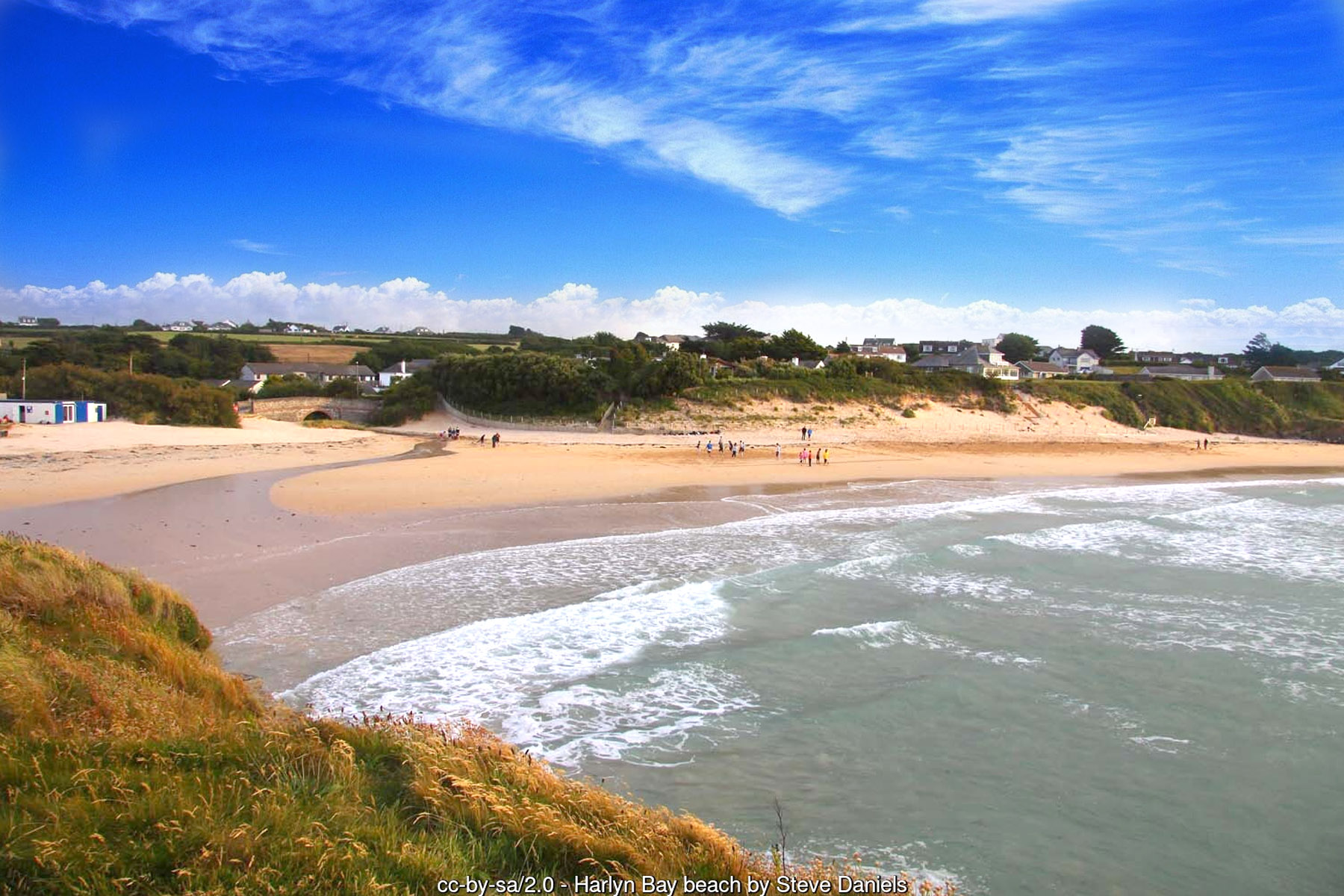
Harlyn Bay is a wide crescent of golden sand on the North Cornwall coast, about three miles west of Padstow and a mile from the village of St Merryn. It sits on the eastern side of Trevose Head, facing north rather than straight into the Atlantic, and that shelter gives it a gentler, more family-friendly character than the big west-facing beaches on the other side of the headland.
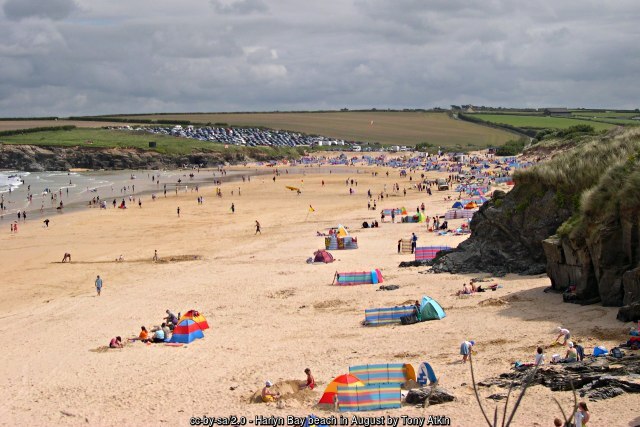
It is one of Cornwall’s best-loved places to learn to surf, with surf schools right on the beach and waves that are often small and friendly. Unlike many beaches nearby, Harlyn keeps a good stretch of sand at high tide, and at low tide the beach is vast, with rock pools at either end.
Behind the beach is a small hamlet of houses, a large car park and cafés, and in the dunes lies one of the most important Iron Age burial sites ever found in Cornwall. Dogs are welcome on the beach all year round.
For somewhere to stay, see holiday cottages around Padstow and Harlyn and Constantine Bay holiday cottages, just over the headland.
Best Time to Visit Harlyn Bay
Summer is the season for surf lessons, lifeguards and long days on the sand – the car park fills by mid-morning on fine days in the school holidays, so arrive early. Spring and autumn are quieter and often have the best surf conditions for improvers.
Because Harlyn faces north, it is often the best surf beach in the area when strong south-westerly winds spoil the waves elsewhere. In winter it makes a lovely, sheltered beach for a dog walk.
↑ Back to top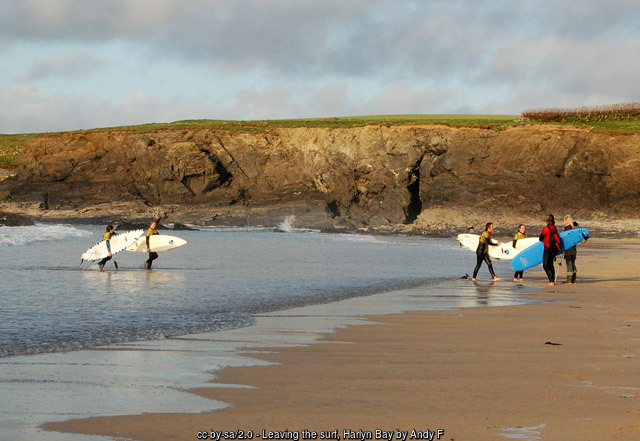
HARLYN BAY BEACH
Harlyn’s sand runs in a broad horseshoe between low cliffs and rocky points, backed by a line of low dunes. A small stream reaches the sea at the eastern corner, near the village. The beach shelves gently, with a mostly sandy bottom, which makes it one of the safer beaches on this coast for children paddling at the water’s edge.
At low tide, explore the rock pools around the edges of the bay, especially towards Cataclews Point at the western end. The dark blue-grey Cataclews stone from here was prized by medieval carvers – look for it in church fonts and carvings in the local churches.
As the tide rises up the steeper top of the beach, a sharp shore break can form, so keep an eye on young children and inexperienced bodyboarders. The beach also has an in-depth page in our Cornwall Beaches guide.
↑ Back to topHarlyn Bay at a glance
Where: Harlyn, St Merryn, near Padstow, PL28 8SB
Beach: golden sand, low dunes, rock pools
Faces: north – sheltered by Trevose Head
Surf: one of Cornwall’s best beginner beaches
Lifeguards: RNLI, in season
Dogs: allowed all year
Parking: large car park behind the beach
LEARNING TO SURF AT HARLYN
Harlyn Bay has been a favourite place to learn to surf for decades. The horseshoe-shaped bay produces small, rolling waves over a sandy bottom, breaking both left and right, and it is sheltered from the prevailing wind. When a south-westerly is blowing onshore at the big west-facing beaches, it blows offshore at Harlyn, cleaning up the waves – so it is often the place to go when everywhere else is blown out.
Surf schools based on the beach offer lessons, board and wetsuit hire, stand-up paddleboarding and kayaking through the season, including the long-established Harlyn Surf School. More experienced surfers often head over the headland to Constantine Bay, which picks up more swell. See our Surfing in Cornwall guide for more.
RNLI lifeguards patrol Harlyn in season. Swim and bodyboard between the red and yellow flags, and surf between the black and white chequered flags. Outside those times there is no lifeguard cover.
↑ Back to topTHE HARLYN BAY IRON AGE CEMETERY
The dunes behind Harlyn Bay hide a remarkable secret. In 1900, a local landowner digging the foundations for a house uncovered a stone-lined grave, or cist, containing a skeleton. Archaeologists from the Royal Institution of Cornwall were called in, and over that summer around a hundred more burials were found.
Digging continued for several years, and eventually around 130 graves were uncovered, most of them stone cists with the bodies laid in a crouched position. Brooches and other grave goods, and later radiocarbon dating, showed that most date from the late Iron Age, around the time of the Roman conquest – making Harlyn one of the most important Iron Age cemeteries in Britain.
Finds from the dig are held by the Royal Cornwall Museum in Truro, and Padstow Museum has material on the excavation. Two Bronze Age gold collars, or lunulae, were also found at Harlyn in 1865, and in 2014 winter storms uncovered yet another ancient stone grave in the dunes.
↑ Back to topThe cemetery at a glance
Found: 1900, in the dunes behind the beach
Graves: around 130 stone cists
Date: mostly late Iron Age
Finds: Royal Cornwall Museum, Truro
Also found: two Bronze Age gold lunulae, 1865
TREVOSE HEAD & THE COAST PATH
The South West Coast Path runs right past Harlyn Bay. Heading west, it passes Mother Ivey’s Bay, a small sandy cove that is home to the Padstow RNLI lifeboat station, and climbs onto Trevose Head, with its lighthouse, first lit in 1847, and views along the coast for miles. From there the path drops down to Booby’s Bay and Constantine Bay.
Heading east, the path follows the cliffs past the Round Hole to Trevone, then on around Stepper Point to Padstow – a superb walk with the Camel Estuary opening up below you.
↑ Back to topTHINGS TO DO AT HARLYN BAY
Harlyn is a beach for families. For children, the gentle sand, rock pools and surf lessons make it ideal, and the beach is big enough never to feel too crowded. On rainy days, Padstow’s shops and museum, and the indoor attractions of Newquay, are a short drive away.
- Learn to surf or paddleboard with a surf school on the beach.
- Go rock pooling towards Cataclews Point at low tide.
- Walk to Trevose Head and its lighthouse.
- See the lifeboat station at Mother Ivey’s Bay.
- Discover the Iron Age cemetery story at Padstow Museum.
- Walk the coast path to Trevone – Trevone guide.
- Visit Constantine Bay for bigger surf – Constantine Bay guide.
- Spend a day in Padstow – Padstow guide.
- Cycle the Camel Trail – Camel Trail.
HISTORY OF HARLYN
People have been coming to Harlyn for thousands of years. Bronze Age gold, and the great Iron Age cemetery in the dunes, show that this sheltered bay was an important place long before Padstow grew into a port.
In more recent centuries Harlyn was a farming and fishing hamlet, with fish cellars for curing pilchards near the beach. The old farmhouse above the bay has been reborn as a country-house hotel and restaurant, The Pig at Harlyn Bay.
Since the 20th century Harlyn has been a classic family holiday beach, and since the surfing boom of the 1960s and 70s one of Cornwall’s favourite places to learn to ride a wave.
↑ Back to topHarlyn – key dates
Bronze Age – gold lunulae buried near the bay
Iron Age – cemetery of stone graves in the dunes
1847 – Trevose Head lighthouse first lit
1865 – gold lunulae found
1900 – the cemetery discovered and excavated
2014 – storms uncover another ancient grave
PLACES NEAR HARLYN BAY
- Trevone – a sandy bay with a tidal pool and the Round Hole, a short way east.
- Constantine Bay – a big west-facing surf beach on the other side of Trevose Head.
- Treyarnon Bay – a sandy cove with a natural tidal pool.
- Porthcothan – a sandy bay split by a stream, further south.
- Padstow – the harbour town on the Camel Estuary, about three miles away.
The Seven Bays
Trevone, Harlyn, Constantine, Booby’s, Treyarnon, Porthcothan and Mawgan Porth – see all the beaches around Padstow in our Cornwall Beaches guide.
VISITOR INFORMATION
Parking & Getting There
Harlyn Bay is signposted off the B3276 Padstow to Newquay road, near St Merryn. A large pay and display car park (PL28 8SB) sits right behind the beach, with level access onto the sand, and an overflow field opens on busy summer days. It can fill by mid-morning in the school holidays.
Bus & Train
Go Cornwall Bus route 56 between Newquay and Padstow runs via Harlyn and Constantine. The nearest railway station is Newquay. Check timetables before you travel.
Facilities
Toilets, including disabled toilets, stand near the car park, along with a café and beach shop. Surf schools on the beach hire out boards and wetsuits. The Pig at Harlyn Bay, a hotel and restaurant, is a short walk away. For supermarkets, head for Padstow.
Disabled Access
Harlyn is one of the most accessible beaches on this coast, with level access from the large car park straight onto the sand, and disabled toilets nearby. A steep sand shelf can form near the top of the beach at high tide. Dedicated Blue Badge bays are not confirmed – check locally.
Dogs on the Beach
Harlyn Bay has no seasonal dog ban – dogs are welcome on the beach all year round. Keep them under control and clear up after them. Note that nearby Trevone does have a summer dog ban.
Safety & Health
Swim between the red and yellow flags when lifeguards are on duty, and check tide times before exploring the rocks. Call 999 in an emergency and ask for the Coastguard at the beach or on the cliffs, or NHS 111 for urgent advice. The nearest A&E is the Royal Cornwall Hospital, Truro.
STAY & EXPLORE NEAR HARLYN BAY
Nearby Towns
Local Attractions
Walks & Surfing
Official Information
FAMILY HOLIDAYS & SHORT BREAKS AT HARLYN BAY
Family holidays at Harlyn Bay are hard to beat – gentle sand for little ones, surf lessons for older children, rock pools to explore and lifeguards in season. With level access from the car park and dogs welcome all year, it is one of the easiest beaches in Cornwall for a family day out.
Harlyn itself is a small hamlet, so most visitors stay in the holiday cottages, caravan parks and campsites around St Merryn, or in nearby Padstow. Browse holiday cottages around Padstow and Harlyn, or holidays and short breaks around Padstow for every type of accommodation.
Spring and autumn are perfect for a short break, when the beach is quiet and the surf schools are still running. Booking direct with the owner means no agency fees.
↑ Back to topFREQUENTLY ASKED QUESTIONS ABOUT HARLYN BAY
Harlyn Bay is on the North Cornwall coast, about three miles west of Padstow and a mile from St Merryn, on the eastern side of Trevose Head. The postcode for the beach car park is PL28 8SB.
Yes. Harlyn Bay is one of Cornwall’s best beaches for beginners, with small, rolling waves over a sandy bottom and surf schools based on the beach. Because it faces north, it is often clean when strong south-westerly winds spoil the surf elsewhere.
Yes. Harlyn Bay has no seasonal dog ban, so dogs are welcome on the beach all year round. Please keep them under control and clear up after them.
Yes. RNLI lifeguards patrol Harlyn Bay in season. Swim and bodyboard between the red and yellow flags, and check the RNLI website for this year’s patrol dates.
Yes. A large pay and display car park sits right behind the beach, with level access onto the sand and an overflow field in summer. It can fill by mid-morning on the busiest days.
In 1900 a stone-lined grave was found while digging house foundations in the dunes behind the beach. Around 130 graves were eventually uncovered, most dating from the late Iron Age, making Harlyn one of the most important Iron Age cemeteries in Britain.
Yes. There is a café and beach shop by the car park, and The Pig at Harlyn Bay hotel and restaurant is a short walk from the beach. Padstow, about three miles away, has a wide choice of restaurants and cafés.
Perranporth | Holywell Bay | Crantock Bay | Newquay | Porth | Mawgan Porth | Bedruthan Steps & Carnewas (NT) | Porthcothan Bay | Treyarnon Bay | Constantine Bay | Harlyn Bay | Trevone | Padstow | Wadebridge | The Camel Estuary - Camel Cycle Trail | Daymer Bay | Rock | Polzeath | Port Isaac | Bodmin |