Harlyn Bay
A Sheltered Bay of Golden Sand and Dunes with an Iron Age Past, Near Padstow
Harlyn Bay, near Padstow, Cornwall, PL28 8SB
Harlyn Bay is a wide, north-facing beach of soft golden sand on Cornwall's Atlantic coast, tucked into the eastern side of Trevose Head about three miles west of Padstow and a mile or so from the village of St Merryn. Because it looks out to the north rather than square into the prevailing south-westerly swell that batters the more exposed beaches either side of it, Harlyn sits in a genuine pocket of shelter, and a broad band of firm sand is exposed here at every state of the tide rather than disappearing under the sea for a few hours either side of high water, as happens at many neighbouring bays. A run of low sand dunes and a scatter of small rocky outcrops back the beach, a large car park sits immediately behind it, and the whole scene has the settled, unhurried feel of a place that has been a family beach for generations - which, as its buried past shows, is something of an understatement.
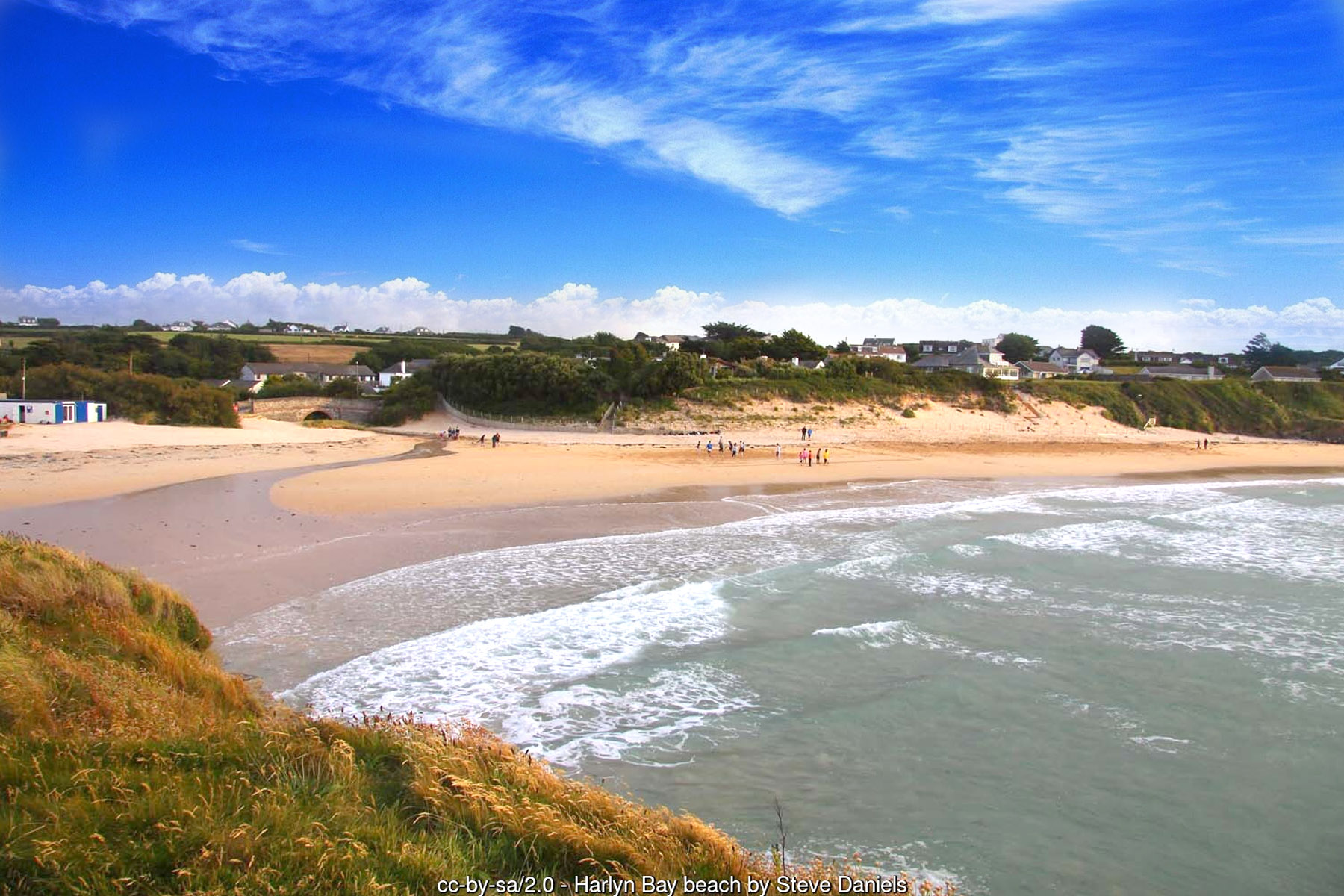
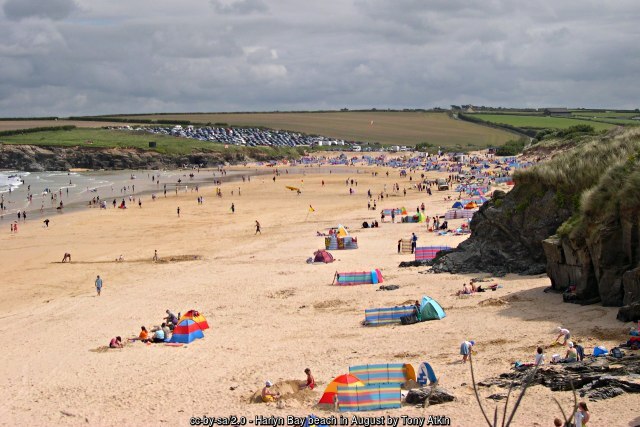
The beach itself is generous by Cornish standards: a crescent of sand running for several hundred metres between low cliffs and rocky points at either end, with a small stream reaching the sea at its south-eastern corner near the village. Rock pools are worth exploring around the margins at low tide, particularly towards Cataclews Point to the north, and the gentle gradient and mostly sandy bed make it one of the more forgiving beaches on this stretch of coast for young children paddling at the water's edge. Walkers can pick up the South West Coast Path directly from the beach, following it north around Trevose Head towards Booby's Bay and Constantine Bay, or south-east towards Mother Ivey's Bay and on to Trevone, and on a clear day the walk up onto Trevose Head itself, with its Victorian lighthouse, gives a genuinely fine view back down over the whole sweep of the bay.
It is those dunes behind the beach that give Harlyn Bay its real claim to national significance, because in 1900 they turned out to be sitting on top of one of the most important Iron Age burial sites ever found in Cornwall. According to the detailed account held by Padstow Museum, a local landowner named Reddie Mallett uncovered a stone-lined grave, or cist, containing human remains while digging house foundations in the dunes that year. Word reached the Royal Institution of Cornwall, which assembled a supervising committee - the antiquarian and writer Sabine Baring-Gould among them - and over the course of that same summer the team excavated around a hundred further burials. Mallett kept digging on his own account for another five years or so, eventually uncovering roughly 130 graves in total, arranged in stone cists and, in places, built around what excavators interpreted as the remains of a circular shrine or mortuary house. Grave goods including brooches originally suggested an Iron Age date spanning roughly 800 BC to AD 43, and more recent radiocarbon dating of skulls held at Padstow Museum has confirmed burials from the late Iron Age, in the first centuries either side of the Roman conquest, alongside a smaller number of early medieval remains from several centuries later - evidence that this stretch of dune was used as a burial ground on and off across a remarkably long span of time.
Mallett went on to open a small private museum on the site to display the finds, and a booklet on the excavations written by the Reverend Robert Ashington Bullen was sold to generations of visitors through the early twentieth century, though - in a gap typical of antiquarian-era digs - no full scientific report of the original excavation was ever formally published. The site museum eventually closed in 1976 and its collection passed into the care of what is now the Royal Cornwall Museum in Truro, while Padstow Museum today holds material relating to the dig and continues to support ongoing research into it. The cemetery was not Harlyn's only significant archaeological find: two Bronze Age gold lunulae - crescent-shaped ornaments thought to have been worn as a kind of ceremonial collar - were recovered from the area as long ago as 1865, and as recently as 2014 winter storms stripped enough sand from the dunes to expose a further stone cist burial, of a woman dated to the Bronze or early Iron Age, a reminder that this coastline is still capable of turning up new discoveries.
Above the modern beach, the old farmhouse that anchored the Hellyar family's landholding here - the same family who have farmed this stretch of coast, and its fish cellars, since around 1800 - has in recent years been reinvented as The Pig at Harlyn Bay, a country-house hotel and restaurant built around kitchen gardens that supply much of its own produce, with a seasonal outdoor Lobster Shed serving simpler food in summer. It sits just back from the beach and makes a pleasant coffee or lunch stop whether or not you are staying, and it is one of relatively few genuinely characterful buildings in a village that otherwise consists largely of holiday houses and stays notably quiet outside the main season.
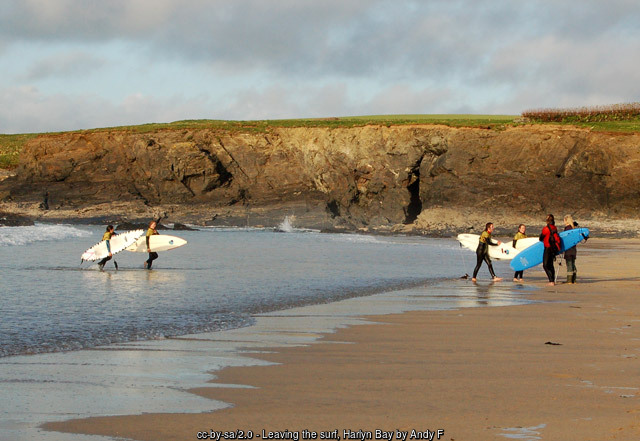
Surfing has been part of Harlyn's identity for a long time, and the beach remains one of Cornwall's most consistently recommended places to learn. Its sheltered, north-facing aspect works in surfers' favour as much as in swimmers': when a south-westerly wind is blowing onshore and ruining conditions at Cornwall's big west-facing breaks, that same wind is blowing offshore at Harlyn, smoothing out the waves rather than chopping them up, so it is often the best - or the only rideable - option on the map on a blustery day. The horseshoe-shaped bay produces both left and right-breaking waves over a mostly sandy bottom, generally gentle enough for complete beginners, and two long-established operations, Harlyn Surf School and Waves Surf School, run lessons, board hire, stand-up paddleboarding and kayaking from the beach through the season. The one hazard worth knowing about is the state of the tide: as the water rises up the beach's steeper upper shelf, it can produce a sudden, sharp shore break that catches out waders and inexperienced bodyboarders, so it pays to keep an eye on conditions rather than assume the whole tide is as gentle as low water usually is.
Visitor Information
Parking
A large pay-and-display car park (PL28 8SB) sits directly behind the beach, giving level, easy access onto the sand, and spills into an adjoining overflow field on busy summer days. It can fill by mid-morning in peak season; the nearest alternative is the National Trust car park at Booby's Bay, around a mile away on foot via Mother Ivey's Bay.
Facilities
Toilets with disabled facilities stand near the car park, along with a café and beach shop. Two surf schools, Harlyn Surf School and Waves Surf School, offer lessons and equipment hire from the beach, and The Pig at Harlyn Bay hotel and restaurant is a short walk away.
Disabled Access
Level, easy access from the large car park directly onto the sand, one of the more accessible beaches on this stretch of coast, though a steep sand shelf can form at high tide. No dedicated Blue Badge bays are confirmed at the pay-and-display car park – check locally before you travel.
Things to Do Nearby
- Learning to surf or paddleboard with one of Harlyn's two long-established surf schools, on a beach reckoned among the best in Cornwall for beginners
- Following the South West Coast Path north around Trevose Head, taking in its Victorian lighthouse and sweeping coastal views
- Trevone Bay, a smaller sandy beach with a striking tidal blowhole a short drive or coast path walk to the south-east
- Constantine Bay, a wide, west-facing surf beach on the far side of Trevose Head, near the National Trust car park at Booby's Bay
- Trevose Head, the National Trust-managed headland separating Harlyn Bay from the west-facing beaches beyond it
- Reading more on the 1900 excavation of the Harlyn Bay Iron Age cemetery via Padstow Museum's account of the dig
- RNLI guidance on lifeguard cover and safety at Harlyn Beach, worth checking before you travel
Places to Stay
Harlyn does not have a dedicated set of holiday accommodation listings of its own on this site - beyond The Pig at Harlyn Bay hotel above the beach, the village is small and largely made up of private holiday homes. The wider Padstow area, of which Harlyn forms part on the Trevose Head side, offers the nearest range of places to stay:
Frequently Asked Questions
Page last updated: 15 September 2026.