Porthcothan Bay
A Wide Sandy Bay Split by a Stream, Backed by Dunes on North Cornwall's Heritage Coast
Porthcothan, near Padstow, Cornwall, PL28 8LW
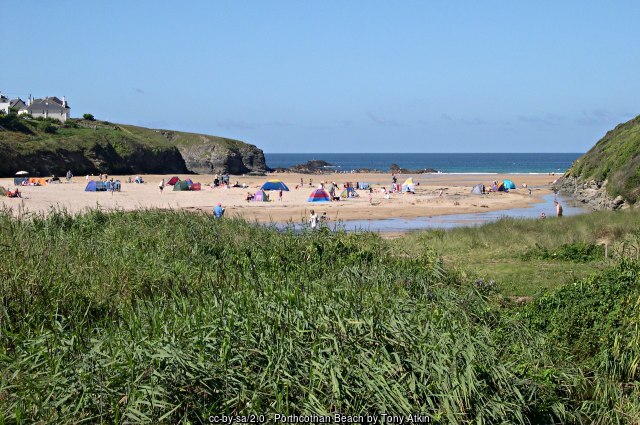
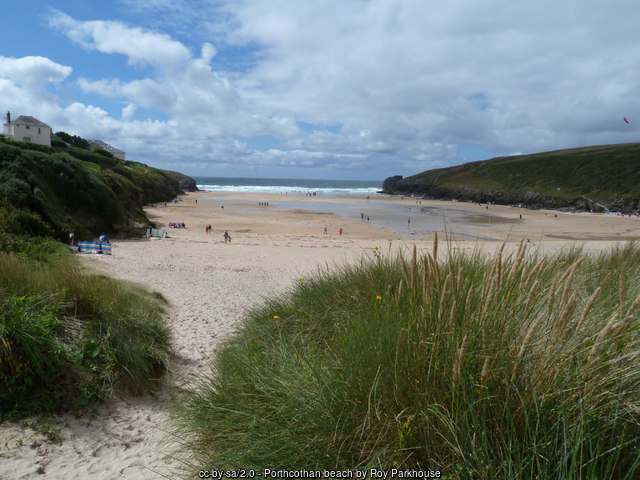
Porthcothan Bay sits on the north Cornwall Heritage Coast within the Cornwall Area of Outstanding Natural Beauty, a little over five miles south of Padstow along a stretch of shoreline that also takes in Trevone, Harlyn, Constantine Bay and Treyarnon before the coast path drops down to Bedruthan Steps and Mawgan Porth further south. The village itself lies within the civil parish of St Eval, a scattering of houses, a beach shop and café clustered around the mouth of a small combe where a stream, rising a short distance inland, threads down through the dunes and out across the sand to the sea. That stream is one of the beach's defining features: it splits the wide sweep of Porthcothan roughly into two, shallow enough for paddling and rock-pooling for younger children, and it is one of the small, distinctive touches that separates this beach from its immediate neighbours along the same coast.
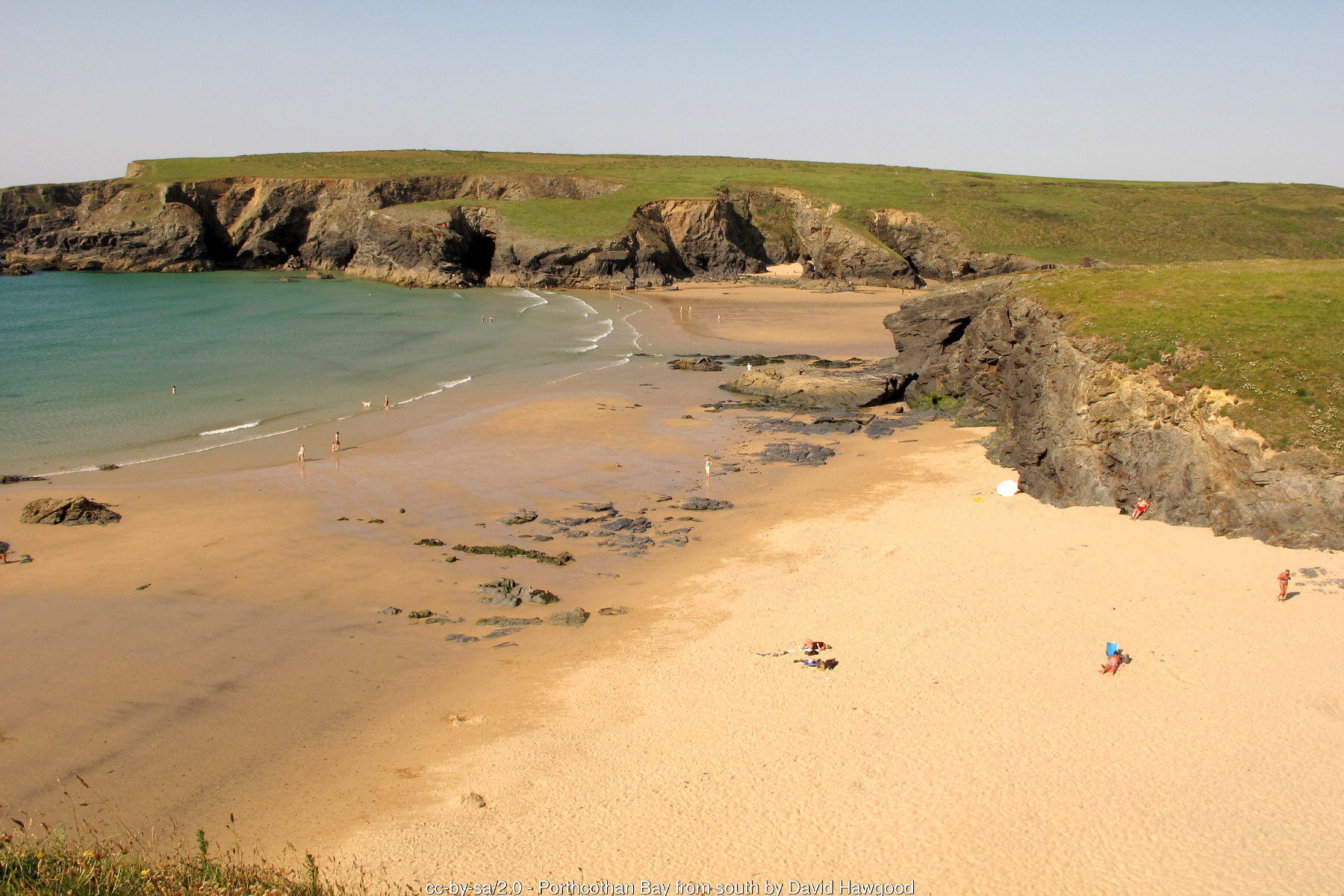
The beach itself is a genuinely large one by the standards of this coastline, a wide bay of pale sand enclosed by craggy, layered headlands at both the northern and southern ends and backed along most of its length by a system of dunes that also shelters the car park and the approach path. At low tide there is a great deal of firm, walkable sand to enjoy, along with rock pools tucked in among the rocky ledges at either end of the bay - worth exploring carefully as the tide drops, since the pools fill in again quickly once the sea turns. High tide tells a rather different story: the sand narrows sharply and, at the very top of a big spring tide, the usable beach can be reduced to little more than a strip in front of the dunes, so a visit timed around the tide table pays off here more than at most beaches nearby. This tidal contrast, together with the stream and the dune backdrop, gives Porthcothan a slightly wilder, more elemental feel than some of its more manicured neighbours further along the bay.
Porthcothan's coastline has also been shaped, quite literally, by the sea in living memory. For generations, a striking natural arch stood at the edge of the bay, known locally as Jan Leverton's Rock and, to some, simply as "the Anchor" for its silhouette. It was one of the most photographed features on this part of the coast, a doughnut-shaped span of layered slate worn through by the sea over a very long time. In January 2014, during one of the most violent runs of Atlantic storms to hit the British coast in living memory - waves reported locally at around thirty feet, with gusts topping seventy miles an hour - the arch was reduced to rubble almost overnight. Local residents at the time described the changed shoreline as looking "like a demolition site," and the loss was felt keenly in the village; the surviving stumps of the arch are still visible at low tide today, a reminder of how quickly this coast can be remade. It is worth noting that Jan Leverton's Rock is a genuinely separate feature from Diggory's Island, one of the family of named offshore stacks - alongside Queen Bess Rock, Pendarves Island, Carnewas Island and the Samaritan - that still stand a few miles south around Carnewas and Bedruthan Steps; the two are sometimes muddled in passing mentions of Cornwall's collapsing coastal arches, but they are different rocks in different places.
The wider bay and its cliffs support a good range of wildlife typical of this exposed, west-facing coast: seabirds working the swell offshore, wildflowers colonising the clifftop turf through spring and summer, and the SSSI-quality of the Heritage Coast reflected in the care Cornwall AONB status affords the whole stretch. The South West Coast Path runs along both flanks of the bay, climbing to genuinely fine viewpoints in either direction - south towards the layered headlands leading to Bedruthan Steps and Mawgan Porth, and north over Treyarnon, Constantine Bay, Harlyn and Trevone towards Stepper Point and the mouth of the Camel Estuary at Padstow. Walkers tackling either stretch should allow a reasonable amount of time, since the path undulates steeply over each headland rather than running level, but the reward on a clear day is some of the most dramatic coastal scenery in Cornwall.
Porthcothan has a quieter social history than some of its more famous neighbours, but a genuine one all the same. Local legend speaks of a large cave some way inland once used for storing smuggled contraband landed on this stretch of coast, a common enough story along the north Cornwall smuggling routes of the eighteenth and nineteenth centuries, though - as with most such legends - the precise details have blurred with retelling over the years. In the twentieth century the village is associated with the science-fiction writer J. D. Beresford, and in more recent decades with the Cornish playwright, actor and fisherman Nick Darke, whose writing and beachcombing on this stretch of coast (chronicled in the documentary film The Wrecking Season) drew directly on the tides, currents and washed-up cargo of beaches very like this one. That combination - a working, weather-shaped coastline that has always given up as much as it has taken - still defines Porthcothan today.
For active visitors, Porthcothan offers dependable, approachable surf: an Atlantic-facing beach break that produces consistent peaks suitable for improving surfers and family lessons alike, with a local surf school operating from the beach through the season and better waves generally found around mid to low tide, when the wider sand gives more room to paddle out and ride in. Stand-up paddleboarding, bodyboarding and rock-pooling are all popular in calmer conditions, and the stream crossing the sand makes a natural, safe spot for younger children to paddle away from the main swell. That said, this remains an open Atlantic beach rather than a sheltered cove, and conditions can change quickly: rip currents and a sometimes sharp shore break have been known to catch swimmers and bodyboarders out even during the lifeguarded season, so sticking to the patrolled area and flags when they are up, and being extra cautious outside the main summer months when no lifeguard is present at all, is sound advice here as on any of this coast's open beaches.
Visitor Information
Parking
A Cornwall Council pay-and-display car park (PL28 8LW) sits among the dunes directly behind the beach, a short walk from the sand. There is some further limited free roadside parking in the village itself, though this fills quickly in the summer season.
Facilities
Public toilets and seasonal outdoor showers stand near the car park, and Porthcothan Bay Stores & Cafe, right by the beach, offers refreshments, snacks and basic essentials for the day.
Disabled Access
Access from the car park crosses level but soft dune paths to reach the sand, which can be heavy going for wheelchairs and pushchairs. No dedicated Blue Badge bays are confirmed at the Cornwall Council car park – check locally before you travel.
Things to Do Nearby
- Explore the rock pools at both ends of Porthcothan Bay at low tide, and see the surviving stumps of the collapsed Jan Leverton's Rock arch
- Treyarnon Bay, the next sandy beach north along this stretch of coast towards Padstow
- Mawgan Porth, a further sandy beach south along the coast path, beyond Bedruthan Steps
- Bedruthan Steps & Carnewas, the National Trust clifftop viewpoint a few miles south, home to the still-standing rock stacks including the real Diggory's Island
- Walking the South West Coast Path from Porthcothan to Mawgan Porth, one of the most dramatic sections of this Heritage Coast
- RNLI guidance on recognising and escaping rip currents, worth reading before swimming at any unpatrolled time at Porthcothan
Places to Stay
There is no dedicated Porthcothan Bay accommodation listing of its own on this site - Porthcothan remains a small village rather than a self-contained resort. The nearest range of places to stay is grouped under the wider Padstow area, a short drive away:
Frequently Asked Questions
Page last updated: 15 September 2026.