Constantine Bay
A Wide Golden Beach of Big Surf and Serious Rip Currents on Trevose Head
Constantine Bay, near Padstow, Cornwall, PL28 8JH
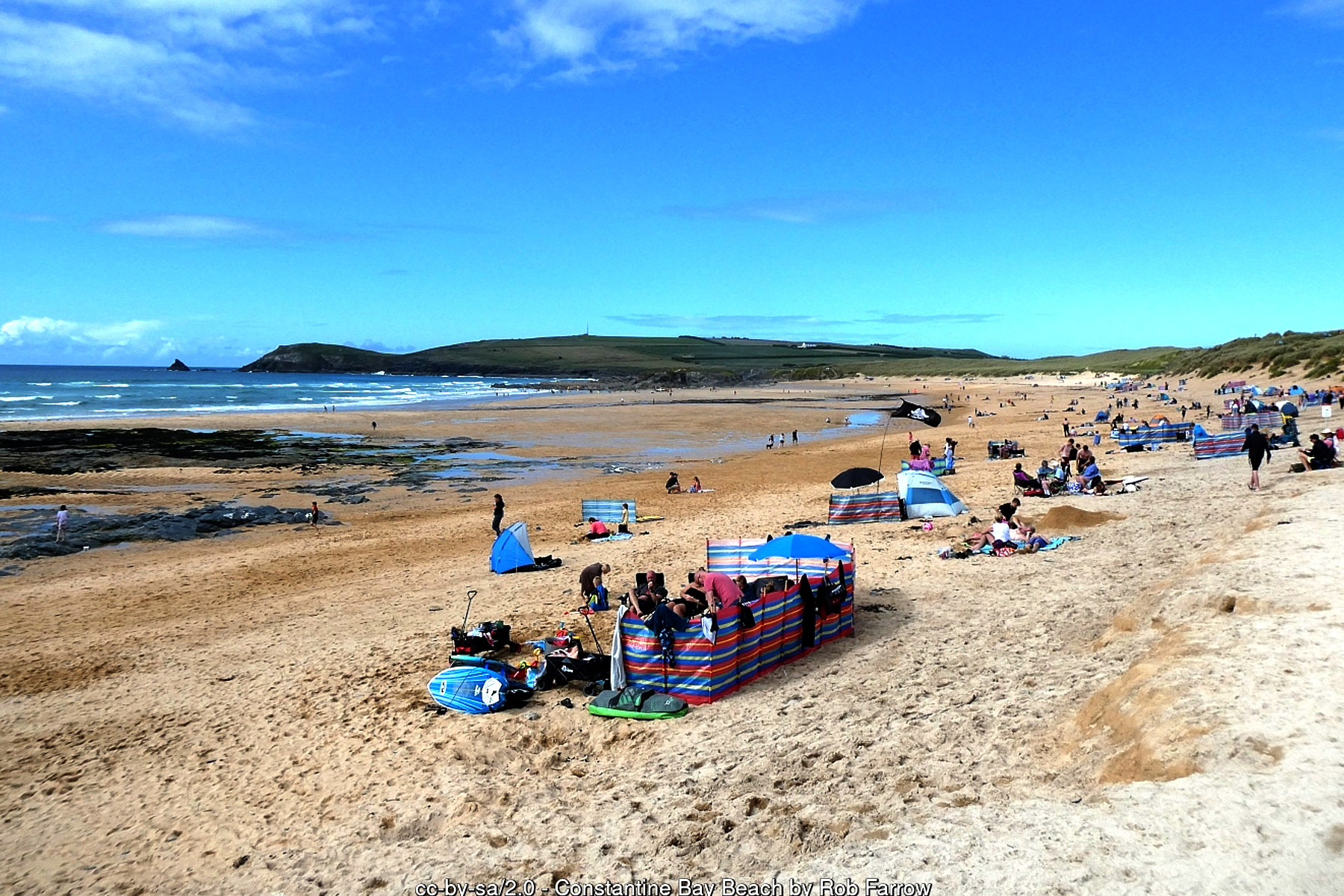
Constantine Bay is a wide, west-facing beach of fine golden sand on Cornwall's Atlantic coast, tucked between Trevose Head and the village of St Merryn, about three miles from Padstow. It takes its name from the sixth-century Cornish saint Constantine, remembered locally in the holy well that still stands, reachable by a public right of way, within the grounds of the golf course that now occupies much of the dune system behind the beach. Unlike the sheltered, north-facing bays a short drive away at Harlyn, Constantine looks squarely out into the Atlantic, and that exposure defines almost everything about it: a beach genuinely loved for its scale, its surf and its wildness, and one that this site has to describe honestly as carrying real, well-documented risk for anyone who underestimates the water.
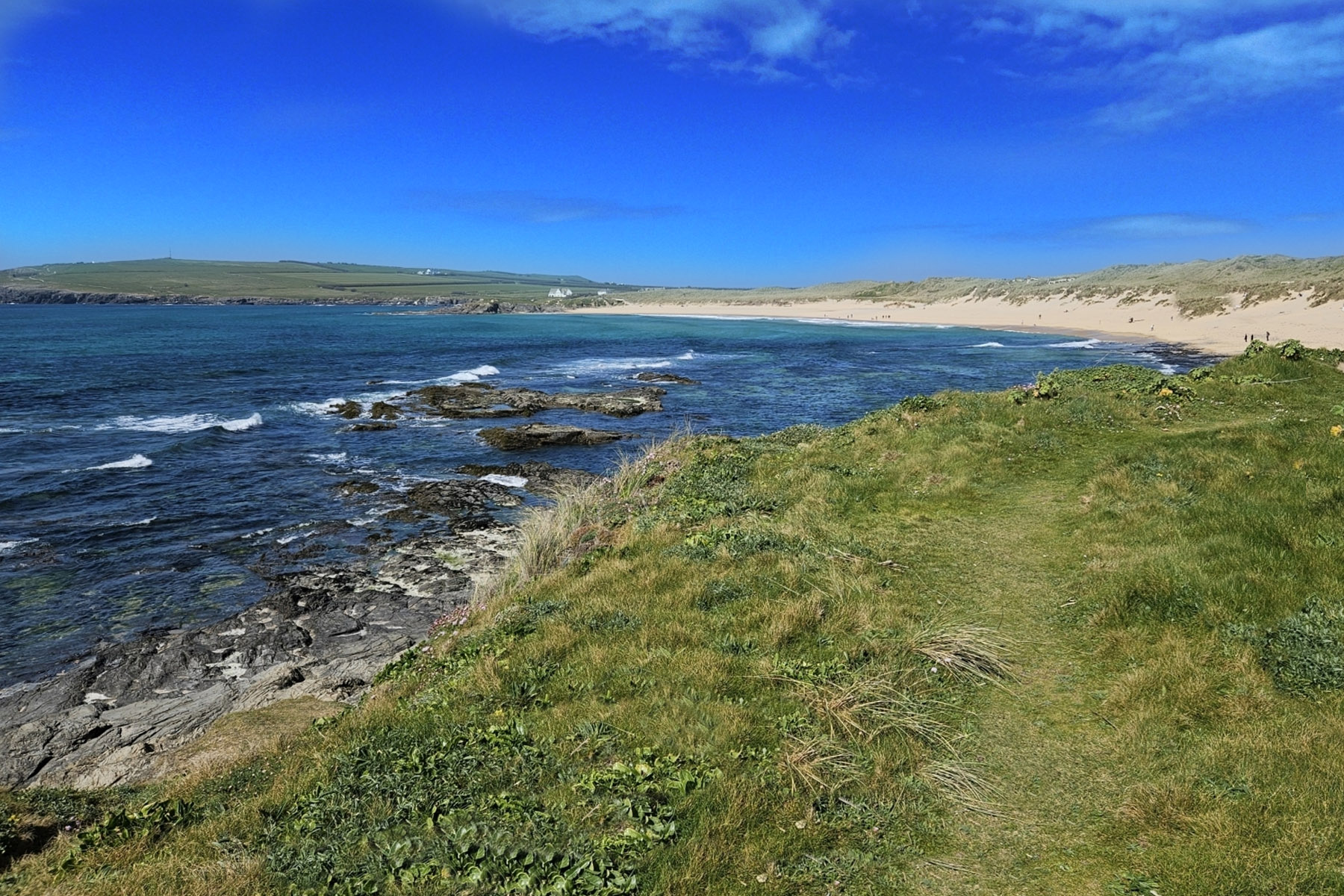
The beach itself runs in a broad, sweeping arc of soft, pale sand, separated from Booby's Bay to the north by a low, thin rocky point that all but disappears at high tide, and backed along its whole length by a large and ecologically significant dune system. Those dunes, together with Trevose Head immediately to the north, are protected as part of the Trevose Head and Constantine Bay Site of Special Scientific Interest, recognised for both their geology and the nationally scarce plant species, including dune fescue, that grow among the marram grass, and the whole area sits within the Cornwall Area of Outstanding Natural Beauty. It is a working landscape as much as a beauty spot: locals once carted sand from the beach by horse to spread as a soil improver on nearby farmland, a practice recorded in local history well into living memory, and the dunes today host one of Cornwall's most historic golf courses rather than sitting entirely undeveloped.
That golf course, Trevose Golf & Country Club, opened in 1925 and quickly built a reputation as a genuine links test set directly into the dunes above the beach, with its Championship Course designed in significant part by Harry Colt, one of the most celebrated golf architects of the early twentieth century. In 1941 the club was bought by a member, John C. Gammon, and it has remained in the same family ever since - his son Peter later added the Headland and Short Courses to widen its appeal beyond serious golfers, and under Nick Gammon's stewardship today it markets itself as one of only a handful of genuinely family-owned golf resorts left in Britain, having marked its centenary in 2025. It has also, over the decades, been a favoured holiday spot for a strikingly consistent cast of British political figures, from Margaret Thatcher through to David Cameron, who returned here on family holidays during and after his time in Downing Street - a small but genuine footnote in the bay's modern history.
Surfing is one of the main reasons people come to Constantine Bay, and it is rated among the better and more consistent breaks on this stretch of North Cornwall coast. A reef at the southern end of the beach produces reliable left-handers, the middle section throws up fast, hollow, "sucky" peaks breaking both ways around high tide, and a rocky point at the northern end, towards Booby's Bay, can produce genuinely high-quality waves from mid to high tide when conditions align. None of this is beginner territory: hidden rocks, a beach that shelves quickly as the tide rises, and the same rip currents that make swimming here hazardous mean Constantine Bay is generally recommended for competent, experienced surfers rather than those just starting out, who are usually steered towards the more forgiving, lifeguarded beaches nearby at Harlyn or Polzeath instead.
It is important to be direct about the water here rather than soften it: Constantine Bay has a long-standing and well-documented reputation for strong rip currents, and this is not a beach where the danger is theoretical or occasional. A detailed scientific case study of the bay published by the coastal research group Science of the Surf examined exactly how its rip currents form - fed by a large tidal range that can exceed six metres on this coast, they tend to switch on abruptly over a narrow window around low to mid tide, as rising water depths allow waves to break across the sandbars and channel fast-moving water seaward through gaps between them - and the same study specifically records that Constantine Bay has produced "mass rescue" events, in which lifeguards have had to pull multiple people from the sea in a short space of time as conditions changed faster than swimmers realised. On the late May bank holiday weekend of 2020, Constantine Bay was one of several North Cornwall beaches, alongside neighbouring Treyarnon Bay, where coastguard and lifeboat crews responded to serious rip-current incidents on the same afternoon, part of a wider spate of emergencies along this coast that day; separately, in August 2026, Constantine RNLI lifeguards and HM Coastguard's Padstow team carried out a race against a fast-moving spring tide to stretcher an injured casualty off the rocks here before the rising water cut off their route. None of this is meant to frighten people away from a beach that, treated with proper respect, is genuinely spectacular - but it is meant to be read and acted on, not skimmed past.
The practical response to that risk is straightforward. RNLI lifeguards patrol Constantine Bay on a seasonal basis, daily from around the first week of May through to late September, with additional weekend cover from Easter to the October half term, and the red-and-yellow-flagged zone they set up shifts from day to day as sandbars and channels move, which is itself a sign of how changeable the rip hazard is here. Swimming outside the flags, or when no lifeguard is on duty at all, is genuinely not advised, the beach's own posted warnings single out the southern end as unsafe for swimming at most states of the tide, and inflatables are best left at home given how quickly a rip or an offshore wind can carry them, and anyone on them, well beyond the surf zone. Taken together with strong currents and a beach that shelves quickly, this is a place where checking the flags and asking the lifeguards, rather than judging the water by eye from the sand, is the only sensible approach.
Immediately to the north, separated from Constantine only by that low rocky point, lies Booby's Bay, itself the site of a striking piece of maritime and wartime history. The SV Carl, a steel-hulled sailing vessel launched at Maryport in 1893 and registered in Hamburg, had been detained at Cardiff in 1914 on suspicion of assisting the German war effort; three years later, in October 1917, while under tow to London to be broken up for scrap, she broke free in a storm and drove ashore on the reef here. Salvage attempts, including some by the Admiralty, failed to refloat her, and the wreck was gradually buried by shifting sand until winter storms in 2014 stripped the beach back and exposed her iron ribs again, to considerable local and national interest. Above the beach, meanwhile, a modest stone building known as Tom Parsons's Hut, now restored and cared for by the National Trust, is named after a real nineteenth-century farmer who lived nearby; later, sensationalised Victorian and Edwardian retellings recast him as a violent "wrecker" who lured ships onto the rocks with false lights and worse, tales in the same romantic tradition that shaped Daphne du Maurier's fiction, but for which no contemporary record of prosecution or conviction actually exists. The more mundane and better-supported truth is that Parsons, like many coastal families of his time, simply gathered what the sea genuinely washed up - salvage rather than sabotage.
The dunes themselves are also the subject of active, publicly funded coastal science. Constantine Bay is one of the study sites for Making Space for Sand, a Defra-funded project delivered by Cornwall Council with the University of Plymouth and Cornwall Wildlife Trust, using CoastSnap community photo-monitoring points, long-running South West Coastal Monitoring survey data stretching back to 2006, and geophysical surveys of subsurface sand depth to understand how the beach and dune system are responding to sea-level rise and reduced sediment supply. Modelling cited by the project suggests the dune line could retreat by as much as 25 metres by 2100 under a high-emissions scenario, and the official Shoreline Management Plan policy for this frontage is deliberately "No Active Intervention" - allowing the dunes to move and evolve naturally rather than hardening them with sea defences, on the basis that a healthy, mobile dune system is itself the best long-term protection this coastline can have.
Visitor Information
Parking
A small car park sits directly behind the beach, with a larger field opened as an overflow car park through the summer season. Both can fill on busy days; an alternative is to park at neighbouring Treyarnon Bay, about a mile away, and walk over via the coast path in around ten minutes.
Facilities
Toilets stand near the beach car park, and a small shop serves the village of Constantine Bay a short walk away. Trevose Golf & Country Club, immediately behind the dunes, has its own clubhouse, restaurant and accommodation for guests.
Disabled Access
A short, sloping path gives wheelchair access from the car park to the beach, one of the more accessible spots on this stretch of coast. No dedicated Blue Badge bays are confirmed – check locally before you travel.
Things to Do Nearby
- Surfing one of North Cornwall's most respected but genuinely serious breaks, best left to competent, experienced surfers
- A round at Trevose Golf & Country Club, the family-owned links resort founded in 1925 directly behind the beach
- Walking the short public path across the golf course to St Constantine's Well, the ancient holy well that gives the bay its name
- Harlyn Bay, a sheltered, north-facing family and beginner surf beach a short drive away on the other side of Trevose Head
- Treyarnon Bay, a neighbouring beach with rock pools and a tidal pool, about a mile south along the coast path
- Trevose Head, the National Trust-managed headland and lighthouse separating Constantine and Harlyn Bays
- RNLI guidance on recognising and escaping rip currents, genuinely worth reading before swimming at Constantine Bay
Places to Stay
Constantine Bay itself is a small settlement built up largely around Trevose Golf & Country Club and a scatter of holiday homes, rather than a resort in its own right. The wider Padstow area, of which Constantine Bay forms part on the Trevose Head side, offers the nearest range of places to stay:
Frequently Asked Questions
Page last updated: 15 September 2026.