Trevone Bay
Golden Sand, a Giant Tidal Pool and a Dramatic Blowhole on Cornwall's Atlantic Coast
Trevone Bay, near Padstow, Cornwall, PL28 8QY
Trevone Bay is a gently shelving beach of golden sand fronting the small village of Trevone, about two miles west of Padstow on Cornwall's north Atlantic coast, with Harlyn Bay and Trevose Head a short distance further on around the coast to the south-west. The bay sits within the civil parish of Padstow, and its Cornish name, Treavon, is generally taken to mean something like "farmstead facing a stone" - an apt description for a stretch of coast whose real character comes from its rock as much as its sand. Officially registered for Blue Flag purposes under the combined name Porthmissen/Trevone, the beach is almost universally known simply as Trevone, and it draws a loyal following of families, surfers and geologists in roughly equal measure, for reasons that become obvious within a few minutes of arriving.
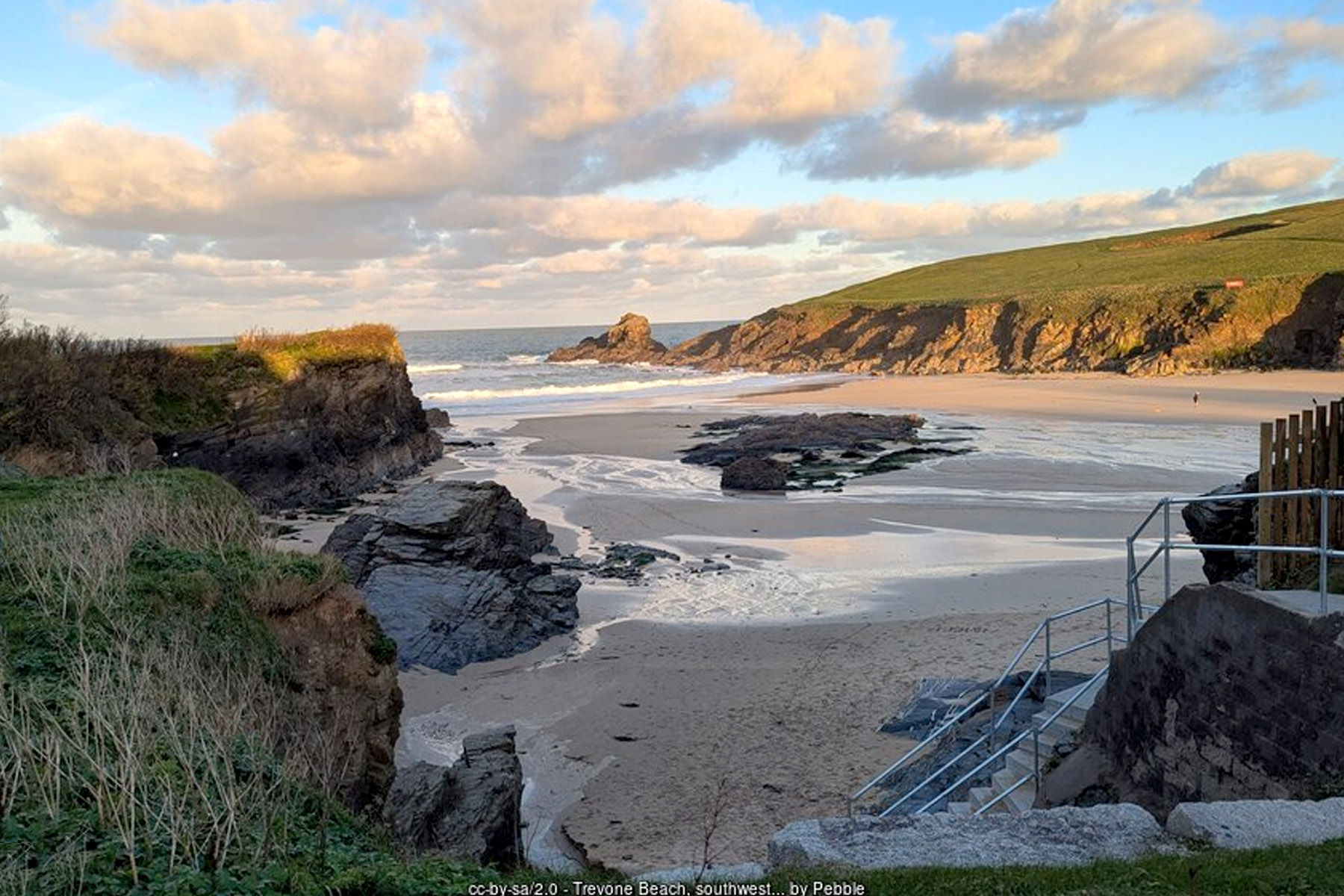
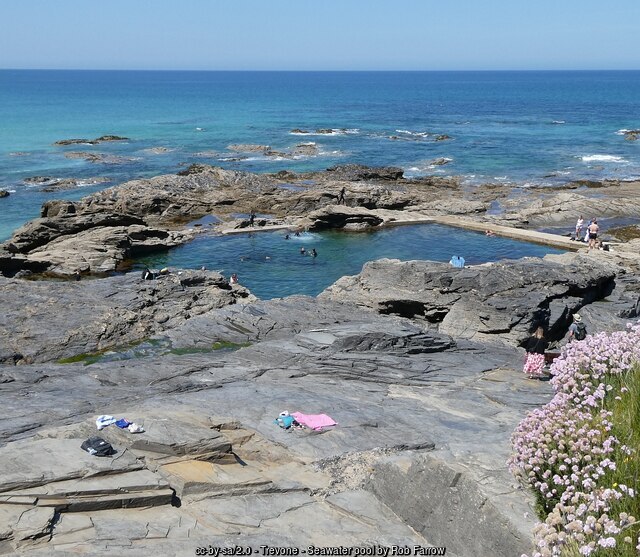
The main beach is bordered by rising cliffs on both sides, with a broad, level expanse of firm golden sand that grows considerably as the tide falls, making low water comfortably the best time to arrive for space to spread out. Immediately alongside it, reached over a low rocky headland, is Rocky Beach - also known locally as Newtrain Bay - a shore of ledges and gullies that fills with rock pools at low tide and is a long-standing favourite for crabbing with children. Its real showpiece, though, is a large natural tidal pool that forms among the rocks as the sea retreats, known to generations of locals as Tinker Bunny's Bathing Pool and reckoned among the biggest tidal pools anywhere on the Cornish coast; unlike a purpose-built lido it has no lifeguard of its own and is entirely a product of the tide, so it is always worth checking that the pool has properly formed and the sea has receded far enough before letting children swim in it unsupervised.
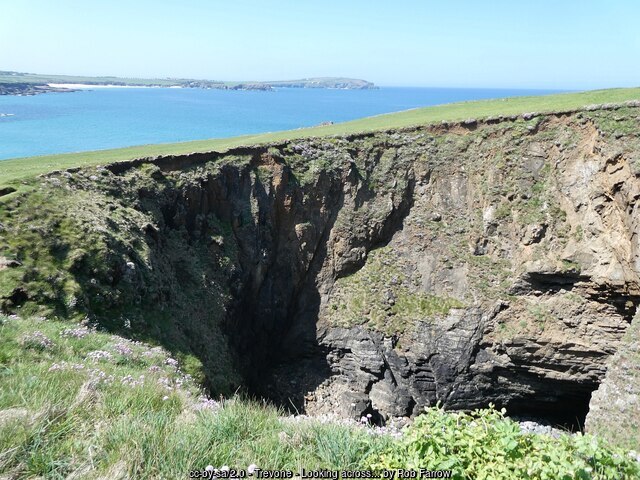
The feature that makes Trevone genuinely unusual, though, lies not on the beach at all but in a sloping clifftop field above its eastern side: the Round Hole, a large, roughly circular shaft dropping around 24 metres (80 feet) to the sea, formed where the roof of an ancient sea cave collapsed inward long ago. Open to the sky and connected to the water by a tunnel at its base, it is a dramatic and genuinely rare thing to stumble across on a coastal walk, and it draws a steady stream of visitors purely to look down into it. It should be treated with real respect rather than as a novelty to climb into: in July 2021, two visitors who climbed down to explore the sea cave at its foot found the return climb far harder than the descent, and were only brought to safety after an extended rescue involving Trevone's own RNLI lifeguards and an inshore lifeboat launched from neighbouring Harlyn Beach. Padstow's lifeguard supervisor noted afterwards that the Round Hole has been the scene of serious falls over the years, and the standing advice from the RNLI is straightforward: admire it from a safe distance back from the unguarded edge, keep dogs on a lead and children close by, and never attempt to climb down into it.
That drama is only part of the reason Trevone Bay has long attracted geologists as well as sightseers. The bay and its surrounding cliffs are protected as a Site of Special Scientific Interest, encompassing four separate Geological Conservation Review sites within a short stretch of coast, and the folded and faulted Devonian-age rocks exposed here are well known enough in academic geology to lend their name to the wider Trevone Basin, a sedimentary basin studied by geologists working on the region's Upper Palaeozoic stratigraphy. Fossil hunters have recorded goniatites - coiled, ammonite-like marine creatures - in the rocks at Pentonwarra Point at the bay's western end, and conodont fossils, the microscopic tooth-like remains of extinct eel-like animals used by geologists the world over to date ancient rock sequences, have been identified in the cliffs at Marble Cliff nearby. None of this needs a geology degree to enjoy: even a casual walk along the clifftop path either side of the bay reveals dramatically buckled and tilted rock strata, a visible reminder of the immense pressures that shaped this coastline hundreds of millions of years ago.
Trevone is also a genuinely well-used surf beach, its west-facing aspect picking up plenty of Atlantic swell to produce a beach break that peaks across sandbanks in the middle of the bay. It tends to work best from around mid-tide, when the banks give surfers and bodyboarders the cleanest shape to ride, while low tide exposes the widest stretch of sand for swimming, paddling and general beach life, and high tide narrows the beach and can bring a sharper shorebreak, so it pays to time a visit around the tide rather than just the weather. Conditions are lively enough on a good day to suit intermediate surfers and bodyboarders more than complete beginners, though a local surf shop in the village hires boards and wetsuits and can advise on the day's conditions, and calmer, smaller days are perfectly manageable for anyone starting out. Behind the beach, the small village of Trevone has grown up largely to serve its visitors without ever feeling overrun: a village shop, a seasonal café and beach shop, a surf shop, the Well Parc Inn as the last of the village's traditional pubs, a village hall that hosts a well-attended summer fete, and St Saviour's Church, a relatively modern building of 1959 built from local sandstone, give it just enough life to feel like a proper place rather than a car park with a view. The village's older buildings are worth a glance too: Trevone House, a symmetrical, mid-nineteenth-century villa of slate-stone rubble with granite quoins and a deep-eaved slate roof set back from the lane, has been Grade II listed since 1988 and is a reminder that Trevone had a settled community here well before the arrival of surfboards and beach shops. Coast path walkers can pick up the South West Coast Path directly from the clifftop above the bay, following it east past Harbour Cove and St George's Well towards Padstow and the Camel Estuary, or west past Round Hole and Newtrain Bay towards Harlyn Bay and Trevose Head, making Trevone a convenient and scenic staging point for exploring this whole stretch of coast on foot rather than only by car.
Practically, Trevone is one of the more straightforward North Cornwall beaches to visit. RNLI lifeguards patrol daily through the main season, from 16 May to 27 September 2026, between 10am and 6pm, and swimmers and bodyboarders are strongly advised to stay within the red and yellow flags while they are on duty - rip currents are a genuine hazard along this stretch of coast, as they are at most open Atlantic beaches, and no flags flying means no lifeguard cover rather than a guarantee of calm water. Two pay-and-display car parks serve the beach, one close to the village shop and a larger overflow field car park a short walk further back, both under private management with camera enforcement in places, so reading the signage properly before you leave the car is worth the extra minute. Dogs are welcome on the beach for most of the year but are restricted between 15 May and 30 September, from 10am to 6pm, in line with the seasonal order that applies to most of Cornwall's principal tourist beaches over the summer months, reverting to unrestricted access for the rest of the year.
Visitor Information
Parking
Two pay-and-display car parks serve the beach (PL28 8QY): one close to the village shop and a larger field car park a short walk further back. Both are privately managed, with camera enforcement in places, so check the signage carefully to make sure any payment covers the right area and duration.
Facilities
Public toilets, a seasonal café and beach shop, and a surf shop offering board and wetsuit hire all serve the beach, with the village shop and the Well Parc Inn pub a short walk away in Trevone itself.
Disabled Access
The two car parks are a short, fairly level walk from the beach, which itself has a broad, level expanse of firm sand at low tide, making it one of the more accessible beaches in the area. No dedicated Blue Badge bays are confirmed at either privately managed car park – check locally before you travel.
Things to Do Nearby
- Viewing the Round Hole collapsed sea cave from the clifftop path above the bay's eastern side - a dramatic sight, best admired from a safe distance
- Rock-pooling and swimming in the large natural tidal pool on Rocky Beach (Newtrain Bay), next to the main sands
- Surfing or bodyboarding the beach break, which generally works best from around mid-tide
- Harlyn Bay, a sheltered, north-facing family and beginner surf beach a short drive or coast path walk to the south-west
- Trevose Head, the National Trust-managed headland and lighthouse a little further along the coast
- Exploring the harbour town of Padstow, about two miles to the east
- RNLI guidance on lifeguard cover and safety at Trevone Beach, worth checking before you travel
Places to Stay
Trevone has a small range of its own holiday accommodation, from self-catering cottages in and around the village to a wider selection of holiday lets in the surrounding Padstow area:
Frequently Asked Questions
Page last updated: 15 September 2026.