Readymoney Cove
Fowey's Own Beach, Beneath a Tudor Castle Guarding the Harbour Mouth
Readymoney Cove, Fowey, Cornwall, PL23 1JD
Readymoney Cove is Fowey's own beach, a small, sheltered crescent of golden sand tucked below wooded slopes barely ten to fifteen minutes' walk south-west of the town's narrow harbourside streets. Framed by low headlands on either side and looking straight out across the mouth of the Fowey estuary, it is overlooked from above by St Catherine's Point and the low grey walls of St Catherine's Castle, a Tudor artillery fort that has watched over this stretch of coast for nearly five hundred years. Popular with families for its gentle, easily supervised waters and with dog walkers for the coast path on its doorstep, Readymoney Cove combines genuine convenience - it is the closest proper sandy beach to Fowey town centre - with a real sense of place, its name most likely a wry, weathered corruption of an old field or landing name rather than any literal reference to money, though its precise origin has never been definitively settled.
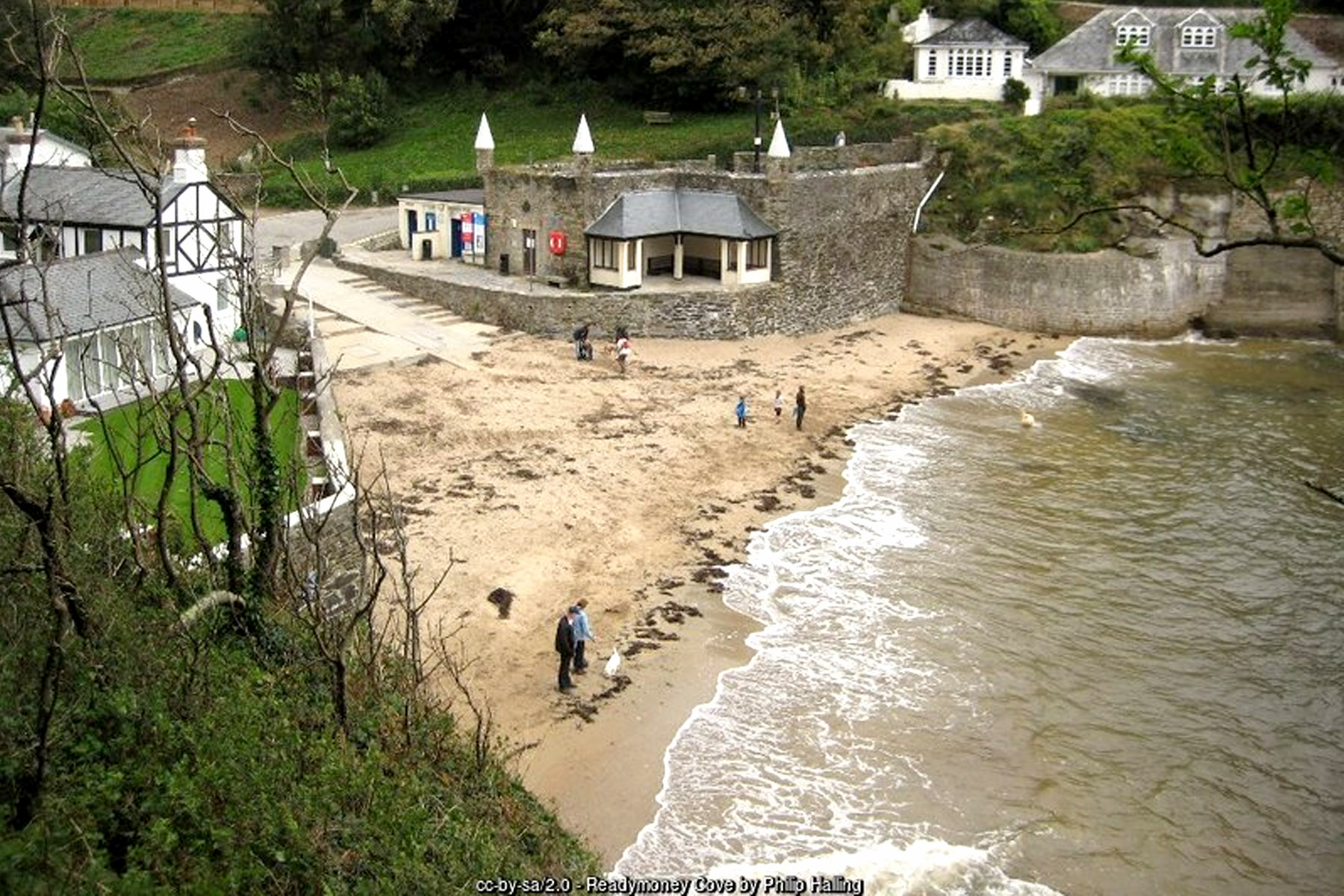
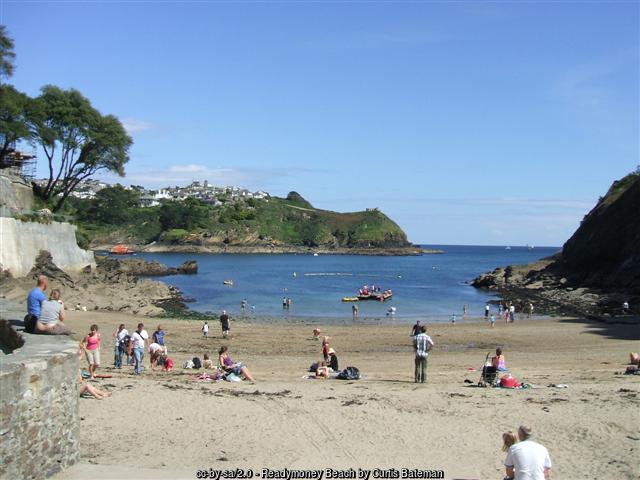
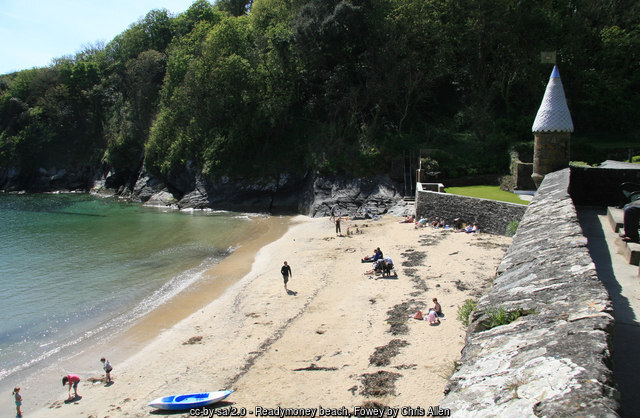
The beach itself is compact but genuinely sandy, shelving gently into calm, well-sheltered water that makes it one of the more reassuring places to swim or paddle with young children anywhere along this stretch of coast, protected as it is from the worst of the Atlantic swell by the bulk of the headland outside the estuary mouth. At low tide a wider strip of firm sand is exposed, backed by a low sea wall and a scatter of rock at each end of the cove, while at high water the beach narrows considerably, so, as with many small Cornish coves, it is worth checking tide times if a full afternoon on the sand is the plan. A short flight of steps and a sloping path lead down from the small car park above, and a coast path continues both towards St Catherine's Castle and, in the other direction, around towards Coombe Hawne and Polridmouth Cove further along the shore.
Above the cove, reached by a short, steepish climb through gorse and low woodland, stands St Catherine's Castle, one of a chain of coastal artillery forts built around 1539 under Henry VIII in response to the invasion fears that followed his break with Rome, when an alliance between France and Spain briefly seemed capable of landing troops almost anywhere along the south coast. Built to cover the narrow harbour entrance alongside a twin blockhouse on the opposite bank at Polruan, the small fort saw genuine action in 1666, during the Second Anglo-Dutch War, when it exchanged fire with a Dutch warship that had ventured close to the harbour mouth. It fell into disuse for long stretches after that, before being refortified in the 1850s as part of the wider Fowey Battery, a Victorian-era response to renewed invasion anxiety focused this time on France under Napoleon III, and pressed into service again in the Second World War, when the Royal Navy used the castle as a control post for a protective minefield laid across the estuary mouth to guard the harbour and its wartime shipping. Today the castle, in the care of English Heritage and free to visit, is a modest but genuinely atmospheric ruin, its gun ports and thick granite walls giving some of the best views anywhere along this coast back across Readymoney Cove and out to sea.
Fowey's long standing as a working port runs through Readymoney Cove's history in other ways too. In the medieval and early modern periods the town's ships and privateers, known collectively as the Fowey Gallants, ranged widely along the Channel and beyond, trading and, when circumstances allowed, raiding, and the sheltered water below the castle would have seen the comings and goings of vessels using the harbour for centuries before the fort itself was built. Much later, in the nineteenth and early twentieth centuries, Fowey grew into one of the busiest china clay ports in the country, with laden ships queuing in the deep-water channel just beyond the cove to load clay brought down by rail and barge from the pits around St Austell - a trade that shaped the town's waterfront and its economy long after sail gave way to steam, and one still visible today in the working wharves further up the estuary.
Readymoney Cove also carries a real literary connection. During the Second World War the novelist Daphne du Maurier, already established as one of the best-selling authors of her generation, lived for a period in a house overlooking the cove, close to the beach and the castle above it, before taking on the long lease at Menabilly - the grander house a little further along the coast that famously inspired Manderley in her 1938 novel Rebecca - in 1943. Du Maurier's decades in and around Fowey left a deep mark on the town, which now hosts an annual literary festival in her honour, and Readymoney Cove's own wartime chapter in her story adds a quiet layer of interest to what is, on the surface, simply a pleasant family beach. In a lighter, more recent echo of Fowey's pull on writers and performers, the actress and comedian Dawn French, a long-time part-time resident of the town, has spoken fondly in interviews of walking this stretch of coast, a small but telling sign of how the same combination of sheltered beach, dramatic castle and easy walk from town continues to draw people to Readymoney Cove today as it has for generations.
Geologically, Readymoney Cove sits within the Dartmouth Group, a sequence of Devonian-age slates and sandstones that runs along much of this stretch of the South Cornwall coast, giving the low cliffs either side of the beach their characteristic grey-brown, sometimes faintly reddish colouring. The sand itself is fine and pale, kept in place by the shelter of the two headlands, and a scatter of rock pools appears at each end of the cove as the tide drops, home to the usual small crabs, blennies and anemones that make a slow low-tide exploration worthwhile for children and adults alike. Birdwatchers using the coast path above the cove regularly spot oystercatchers, cormorants and, further out over the estuary mouth, the occasional passing gannet or shearwater, while the wooded slopes behind the beach shelter a good range of common woodland birds typical of this sheltered, south-facing part of Cornwall.
Practically, a little planning improves a visit to Readymoney Cove considerably. Because the beach narrows noticeably at high water, checking tide times before setting out is worthwhile if the aim is a full afternoon on the sand rather than a shorter visit; a falling or low tide gives by far the most beach to enjoy. The walk up to St Catherine's Castle, though short, is genuinely steep in places, so sturdy footwear is a sensible choice for anyone planning to combine the beach with the climb to the fort. Given its position at a working harbour mouth, boat traffic is a constant background presence at Readymoney Cove, from small sailing dinghies to the occasional larger vessel making for Fowey's deep-water moorings, and swimmers should keep half an eye on the water beyond the cove itself for this reason as much as for any tidal concern.
Visitor Information
Parking
A small car park sits right by the cove, with limited spaces that fill quickly on fine days - Fowey's own town car parks, a short and mostly level walk away, are a reliable back-up when it's full. The lanes down to the cove are narrow, so allow extra time in the height of summer.
Facilities
Public toilets sit close to the beach, and Fowey town, a short walk away, has the full range of cafes, pubs and shops. There is no RNLI lifeguard patrol at Readymoney Cove.
Disabled Access
The path down from the car park involves some steps and a slope, so Readymoney Cove is not fully step-free, though it is more accessible than most beaches in this folder. No dedicated Blue Badge bays are confirmed at the small car park - check current signage on arrival.
Things to Do Nearby
- St Catherine's Castle, the Tudor artillery fort directly above the cove, free to visit and in the care of English Heritage
- Fowey town centre, a short walk away, with its harbour, shops, pubs and the Daphne du Maurier Literary Centre
- Coombe Hawne & Little Coombe Hawne, a quieter pair of coves a short coast path walk further along the shore
- The Hall Walk and Fowey-Polruan passenger ferry, giving fine views back across the estuary from the opposite shore - see Polruan Beaches
- The South West Coast Path, which runs directly past the cove on its way towards Gribbin Head
Places to Stay
Fowey, a short walk from Readymoney Cove, has a good range of places to stay:
Frequently Asked Questions
Page last updated: 16 September 2026.