Back to English Heritage Cornwall
Off Restormel Road, Lostwithiel, Cornwall PL22 0HN | 0370 333 1181
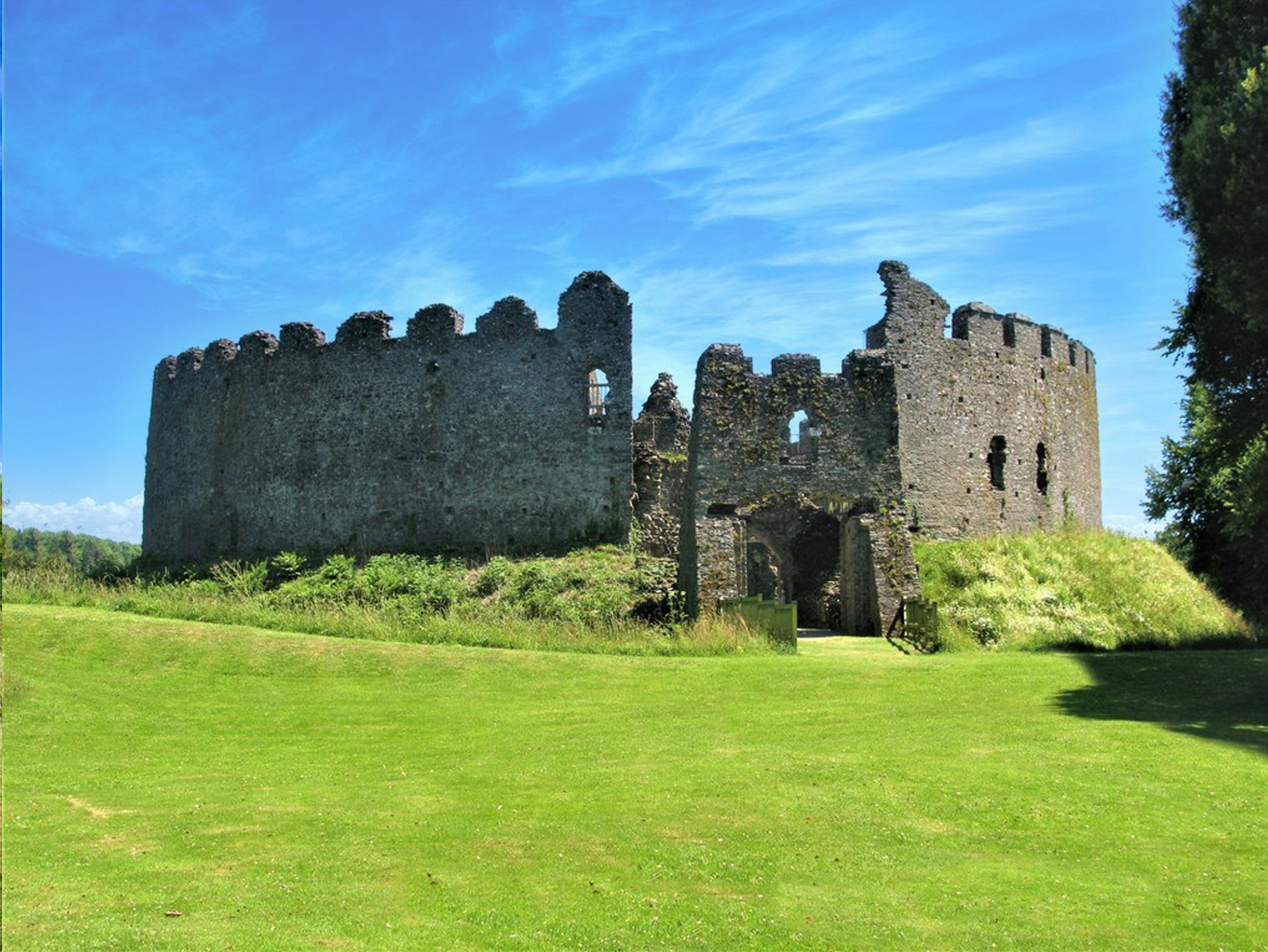
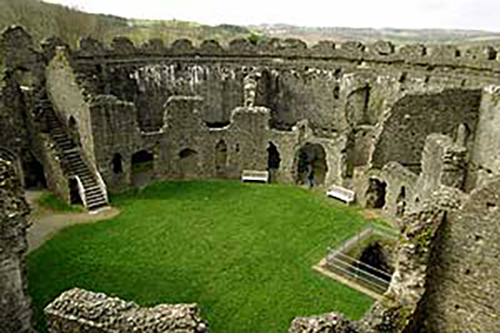
Restormel Castle stands on a steep mound above the River Fowey just outside Lostwithiel, its near-perfect circular curtain wall making it one of the most complete and unusual castle designs surviving anywhere in England. Where most medieval keeps are square, polygonal or irregular, Restormel's builders raised a true circle of stone around the top of an earlier earthwork motte, creating a castle whose plan is as striking from the air today as it would have been to any traveller approaching along the valley below.
The castle passed through the hands of Cornwall's most powerful medieval rulers. Richard, Earl of Cornwall and King of the Romans, acquired it by marriage in 1268, and it was most likely his son Edmund who built the circular keep seen today, completing it around the 1290s. Edmund also moved Cornwall's administrative capital from Launceston to nearby Lostwithiel in the 1280s, cementing Restormel's status as one of the county's most important castles at the height of its medieval significance.
Restormel's golden age came under Edward, the Black Prince, who inherited the castle as Duke of Cornwall in 1337 and invested heavily in its upkeep and surrounding deer park. He is recorded staying at Restormel in the late summer of 1354 and again over the winter of 1362 to 1363, when he celebrated Christmas within its walls — giving the castle a genuine claim to having hosted one of medieval England's most celebrated royal figures.
After the Black Prince's era, Restormel slowly declined alongside the fortunes of Lostwithiel itself, its harbour silting up as tin-mining waste washed downstream. The castle saw brief action in the Civil War in 1644, before being left to the elements for nearly three centuries. English Heritage now cares for the site, and its unusually complete circular plan makes it one of the most rewarding castles in Cornwall to explore on foot, from the battlements walk to the grassy moat below.
Location Map
Visitor Guide
From the free car park, a short path leads to the site entrance, with a set-down point at the base of the path for visitors who need it. The approach up the motte gives an immediate sense of the castle's commanding position above the Fowey valley, and once inside the circular curtain wall, the completeness of the design becomes clear: a full ring of stone enclosing a central courtyard, with the footings of the Black Prince's great hall and other domestic buildings still traceable against the inner wall.
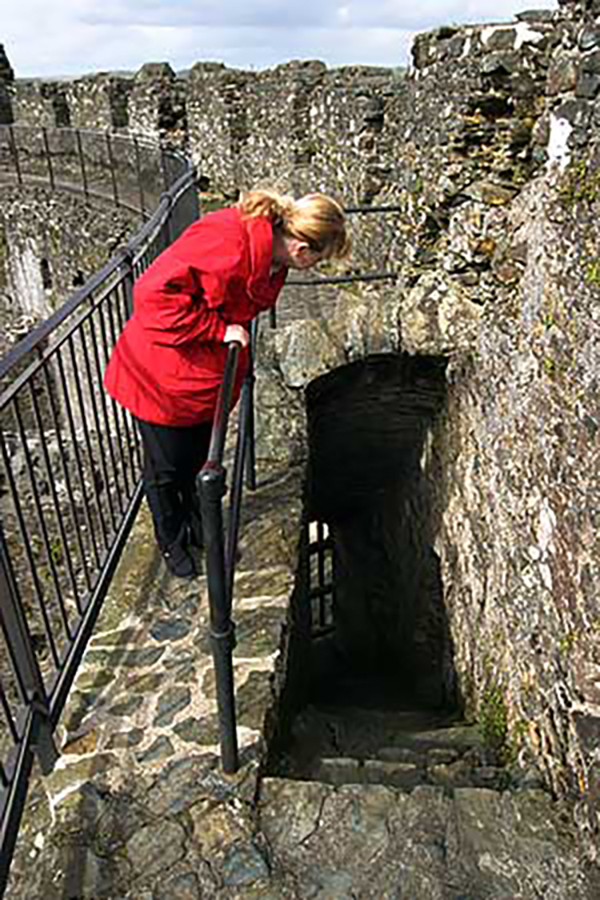
A walkway around the top of the curtain wall, reached by a mixture of wooden and stone steps, lets visitors circle the entire battlements, looking down into the courtyard on one side and out across the wooded Fowey valley on the other. The steps and walkway surfaces vary, so sturdy footwear is worthwhile, and the various rest points dotted around the site make it easy to pause and take in the views at a comfortable pace.
Younger visitors can follow the "World Builder" family trail around the site, while the surrounding grounds and valley offer good opportunities for spotting wildlife, from woodland birds to butterflies in summer. There's no café on site, though a vending machine and the shop provide hot drinks, snacks and ice cream, and picnicking is welcome on the benches and tables scattered around the grounds, many with fine views over the castle and valley below.
Allow around an hour to an hour and a half for a visit, longer if combining it with a walk into Lostwithiel itself, a short drive or an enjoyable riverside walk away. The castle's compact, self-contained design means it rewards unhurried exploration more than a quick stop — the circular plan is best appreciated by walking the full circuit of the battlements rather than viewing it from a single spot.
History
The precise origins of Restormel Castle are uncertain. The archaeologist C. A. Ralegh Radford suggested that Baldwin fitz Turstan, son of the sheriff of Cornwall recorded in the Domesday survey of 1086, may have established an earlier fortification here to guard a crossing point over the River Fowey. An alternative theory places its foundation slightly later, during "the Anarchy," the civil war of King Stephen's reign in the 1140s, a period that saw many private castles thrown up across England. From the mid-12th century, the land and castle were held by the Cardinham family, prominent local lords whose name survives in a nearby parish.
Restormel's transformation into a major Cornish stronghold began in 1268, when Richard, Earl of Cornwall and King of the Romans, acquired it through his marriage connection to the Cardinham heiress. Richard, one of the wealthiest men in 13th-century Europe through his control of Cornwall's tin industry, died only four years later in 1272, and it fell to his son Edmund to develop the castle further. Edmund is thought to have built the near-perfect circular shell keep that still stands today, work apparently complete by the 1290s based on surviving grants and financial accounts from the period. Edmund also moved Cornwall's administrative capital from Launceston to nearby Lostwithiel during the 1280s, a decision that significantly increased Restormel's status as the county's most important castle. When Edmund died childless in 1300, the earldom of Cornwall fell vacant.
The castle's most celebrated period began in March 1337, when Edward III created his son and heir, Edward, Duke of Cornwall — the prince later known to history as the Black Prince — granting him Restormel among extensive Cornish estates. A detailed survey from 1337, known as the "Caption of Seisin," provides the fullest medieval description of the castle, recording inner and outer wards complete with halls, chambers, chapels and stabling. The Black Prince invested heavily in the castle's upkeep, though records show that even more of his resources went into maintaining the boundaries of its surrounding deer park than into the buildings themselves, reflecting the importance of hunting to medieval aristocratic life. He is recorded visiting Restormel in person during August and September 1354, and again over the winter of 1362 to 1363, when he celebrated Christmas at the castle — one of the clearest surviving records of how the site was actually used by its most famous resident.
After the Black Prince's death, Restormel received only sporadic attention, with repairs recorded under Richard II, Henry VI and Edward IV. The castle's fortunes were increasingly tied to those of Lostwithiel itself, whose harbour and river access silted up over the following centuries as waste from Cornwall's expanding tin-mining industry washed downstream, gradually cutting the town off from the coastal trade that had once sustained it. By the 1540s, surveys recorded that only the inner ward of the castle remained habitable, with the outer enclosure "sore defaced." Henry VIII is said to have converted the surrounding royal park into open countryside, and the estate passed into private hands under Sir Richard Pollard.
Restormel's final moment of military significance came during the English Civil War. Parliamentarian forces under the Earl of Essex garrisoned the castle in the summer of 1644, only for the Royalist commander Sir Richard Grenville to capture it on 21 August 1644, finding a garrison of just thirty men within. This proved to be the castle's last active military occupation; in the years that followed, surveyors judged the ruins "not worth the taking down," and Restormel was simply left to decay, its stone slowly reclaimed by ivy and undergrowth over the following two and a half centuries.
By the 19th century, the picturesque ruins had become a popular destination for antiquarian and romantic visitors, including Queen Victoria and Prince Albert, who visited in 1846 during one of their tours of Cornwall. Formal conservation began on 6 March 1925, when the Office of Works took the castle into guardianship, clearing centuries of vegetation and consolidating the surviving masonry for public access. English Heritage has managed Restormel since 1984, and the castle today survives as one of the best-preserved and most architecturally distinctive circular keeps anywhere in England, a rare survival from the height of Cornwall's medieval Earldom.
Important Features
- The circular shell keep: one of the most complete and best-preserved circular castle keeps in England, built by Edmund, Earl of Cornwall, around the 1290s.
- The battlements walk: a full circuit of the curtain wall, reached by wooden and stone steps, with views into the courtyard and out across the Fowey valley.
- The Black Prince's great hall: footings of the hall and domestic buildings used during Edward the Black Prince's recorded visits in 1354 and 1362–63.
- The motte and moat: the earlier earthwork mound and surrounding defensive ditch on which the stone castle was raised.
- The gatehouse and entrance: the main approach into the circular enclosure, little altered since the medieval period.
- The "World Builder" family trail: an activity trail introducing younger visitors to the castle's history.
- The surrounding Fowey valley: woodland and river landscape offering wildlife-spotting opportunities alongside the history.
Visitor Information
Parking
Free parking is available around 70 metres from the site entrance, including two disabled bays.
Facilities
The shop sells English Heritage gifts, toys, books, confectionery, drinks, ice cream, wine and jams. A vending machine offers hot drinks and snacks; there is no traditional café.
Disabled Access
Wheelchair access is available to the admissions point and disabled toilets, with a set-down point at the path's base. Steps on the entrance path mean visitors may wish to call ahead.
- Opening times: daily, 10am–5pm, last entry 4:30pm. Check the official website for any seasonal changes.
- Public transport: the Royal Talbot bus stop in Lostwithiel is around 1.1 miles away, served by service 28/428 from St Austell. Lostwithiel railway station is about 1½ miles from the castle.
- Toilets: separate male, female and disabled toilets, with baby-changing facilities.
- Food and drink: no café; a vending machine offers hot drinks and snacks, and the shop sells ice cream, drinks and confectionery.
- Shop: English Heritage gifts, toys, books, confectionery, drinks, wine and jams.
- Dogs: welcome on short leads.
- Booking: tickets available in advance with a discount for online booking; check current prices on the official website.
- Family facilities: the "World Builder" trail and baby-changing facilities make the site well suited to families.
- Additional access: rest points are located both outside and inside the castle; surfaces include grass, gravel and concrete paths.
- Visit duration: around an hour to an hour and a half, longer if combined with a visit to Lostwithiel.
Things to Do Nearby
Lostwithiel
Below the castle
Cornwall's former medieval capital, with a historic bridge, shops and antique dealers.
Find Out MoreFowey
South of Lostwithiel
A picturesque harbour town on the Fowey estuary, with sailing, shops and cafés.
Find Out MoreLanhydrock
Nr. Bodmin
A grand Victorian country house and gardens in the care of the National Trust.
Find Out MoreLaunceston Castle
North Cornwall
A unique Norman tower-within-a-tower keep, once the gateway fortress of Cornwall.
Find Out MoreSt Catherine's Castle
Fowey
A small Henrician artillery fort guarding the entrance to the Fowey estuary.
Find Out MoreFrequently Asked Questions
Official English Heritage Site
For the latest opening times, admission prices, booking and any event or access changes, check the official English Heritage page for Restormel Castle before you travel.
Explore More Cornwall Heritage
All English Heritage Sites Cornwall Attractions National Trust Cornwall
Page last updated: 25 August 2026.