Gyllyngvase Beach
Falmouth's Favourite Blue Flag Beach
Cliff Road, Falmouth, Cornwall, TR11 4NA Blue Flag 2026
Gyllyngvase - "Gylly" to almost everyone who knows it - is Falmouth's largest and most popular beach, and deservedly its flagship. A generous, south-east-facing crescent of fine golden sand curves round a sheltered bay just a few minutes' walk from the town centre, backed by the sub-tropical planting of Queen Mary Gardens and looking out across Falmouth Bay towards Pendennis Point. Its combination of soft sand, gently shelving, comparatively calm water and genuinely excellent facilities has made it the default family beach for Falmouth for well over a century, and it remains the only one of Falmouth's beaches to hold Blue Flag status for 2026 - none of Castle Beach, Tunnel Beach, Swanpool or Maenporth currently carry a Blue Flag or Seaside Award, which tells you a good deal about how consistently Gyllyngvase performs against the criteria that matter: water quality, safety provision, environmental management and public information.
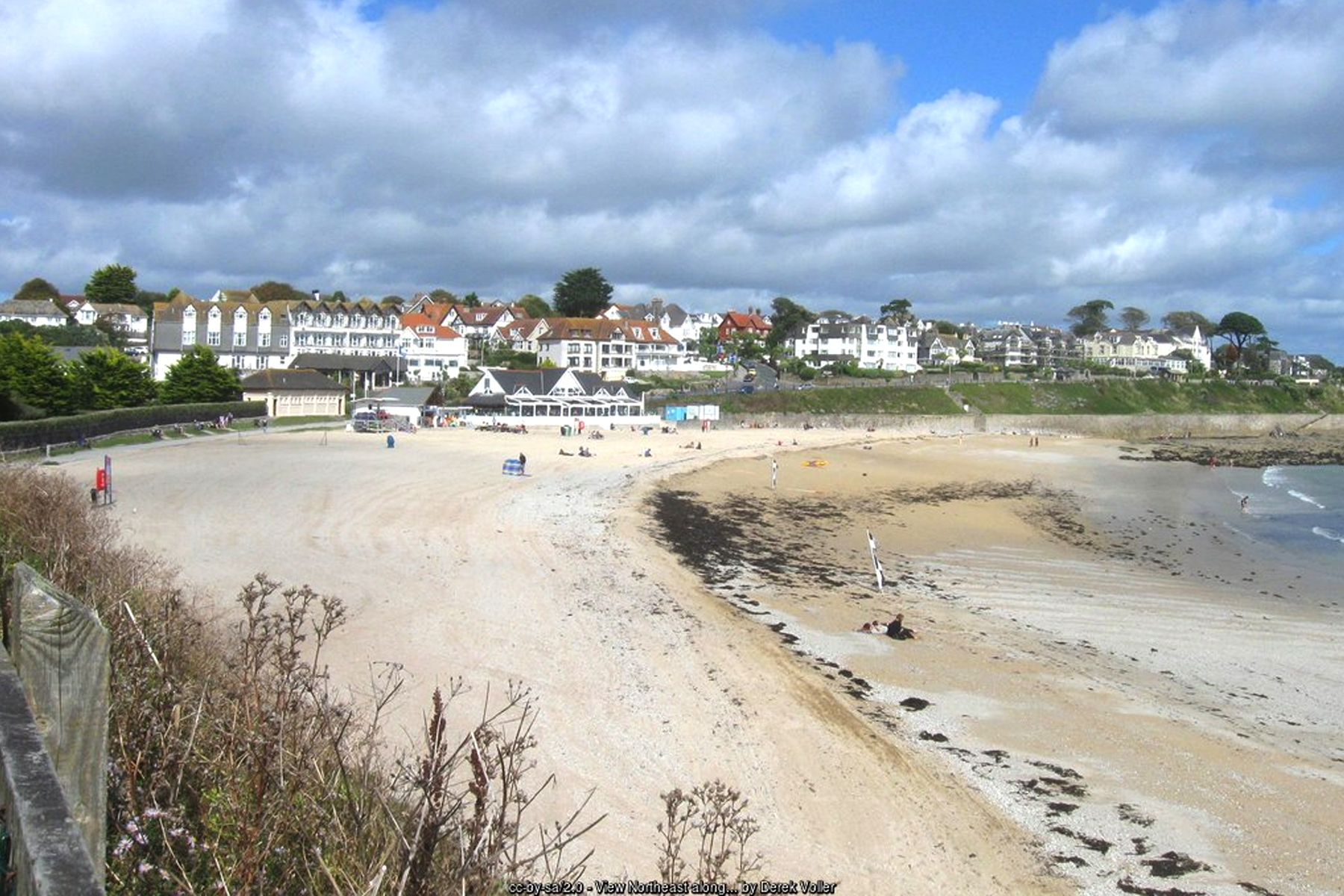
The name comes from the Cornish "An Gilen Vas", meaning roughly "the shallow inlet" - an apt description of the wide, gently sloping bay that still shapes the beach's character today. Gyllyngvase is one of four named strands within easy reach of Falmouth town, sitting between Tunnel Beach and Castle Beach to the north-east, below Pendennis Point, and Swanpool a short walk to the south-west; all four sit along the low, south-facing coastline that separates the mouth of the Fal estuary from the open waters of Falmouth Bay. It is this south-easterly aspect, tucked in behind Pendennis Head, that gives Gyllyngvase much of its shelter from the prevailing south-westerlies, and explains why it has always been regarded as one of the safer, calmer beaches on this stretch of coast rather than a surf destination in its own right.
The beach's transformation into a seaside resort dates to the decades either side of 1900, when the wider Victorian and Edwardian enthusiasm for sea-bathing reached Falmouth and Cliff Road above the beach filled with substantial hotels built to house the new holiday trade. The Bay Hotel operated from 1909 until 1990, and the Palm Beach Hotel from the 1930s until 2007; a fire at the former Falmouth Beach Hotel in April 2012 - serious enough to collapse part of the roof and require some hundred firefighters to bring under control - is a more recent reminder of how much this small stretch of clifftop has seen over the last century. Queen Mary Gardens, immediately behind the beach, has its own well-documented history: laid out on what had been marshy ground at a stream mouth, the land was given for public use by the Earl of Kimberley, and the gardens themselves were funded through the generosity of local philanthropist Agnes Mary Goldman before opening to the public in 1912, named to commemorate the coronation of King George V and Queen Mary the previous year. The gardens' sheltered, beachside microclimate still supports plantings that would struggle further inland - agapanthus, yuccas, eryngiums and aeoniums among a long herbaceous border - and the gardens hold a Green Flag award in their own right, part of Falmouth's regular success in the Britain in Bloom competition.
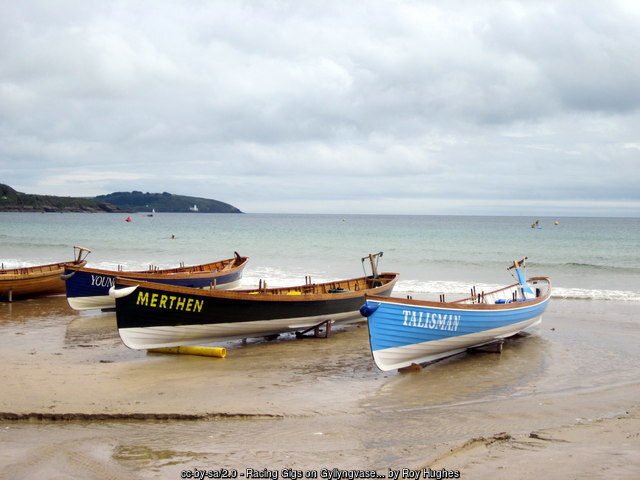
Falmouth's own story reaches much further back, and Gyllyngvase sits within it as a comparatively recent chapter. The town grew up around Carrick Roads, the deep, drowned river valley - or ria - at the mouth of the Fal, long and often described as one of the largest and deepest natural harbours in the world; by one long-standing local claim it ranks third largest globally and the deepest in Europe, a superlative repeated widely enough locally that it is worth treating as a proud civic claim rather than an independently audited fact. That depth and shelter made Falmouth strategically important for centuries. From 1689 until 1851, it was home to the Post Office Packet Service - fast, purpose-built sailing ships that carried Britain's mail, and increasingly its diplomats, specie and news, to Lisbon, the West Indies, North America and beyond. At its height the service ran dozens of ships from the harbour, armed against privateers during the Napoleonic Wars, and Falmouth briefly became one of the most important communication links between Britain and the wider world before steam power and the rise of larger ports elsewhere brought the packet era to a close in the mid-nineteenth century. That maritime identity never really left the town: Falmouth Docks continued (and continues) to build and repair ships long after the packets stopped sailing, the harbour today shelters everything from small yachts to cruise ships and tall ships, and the town's sailing calendar still peaks every August with Falmouth Week, a ten-day festival of bay racing and shoreside entertainment that is one of the largest sailing regattas in the country. The National Maritime Museum Cornwall, overlooking the harbour on Discovery Quay a short distance from Gyllyngvase, tells this whole story in far more depth than a beach page can, and is well worth combining with a day on the sand.
On the beach itself, the calm, sheltered water and gently shelving sand make Gyllyngvase reliably good for swimming, and it has become just as popular for a wider range of watersports: sailing, kayaking and stand-up paddleboarding are all regularly seen in the bay, and watersports hire is available locally for visitors who want to get out on the water without bringing their own kit. Safety cover is correspondingly strong for a beach of this size. RNLI lifeguards patrol daily through the main season - currently 16 May to 27 September 2026, with patrol hours of 10am to 6pm - and the volunteer Gyllyngvase Surf Life Saving Club, founded in 2008 and based on the beach, provides an additional, locally-run layer of water safety and training alongside the RNLI's own seasonal service. As on every lifeguarded beach, the advice is simple and worth repeating: swim between the red and yellow flags when they are flying, and remember that "no flags" means no lifeguard cover, whatever the weather looks like.
Away from the main stretch of open sand, the rocks at the southern end of the beach, towards Swanpool, hold a decent scatter of rock pools that reward a look at low tide - shrimps, small crabs and, according to some accounts, the occasional lobster sheltering in the deeper pools, alongside the usual seaweeds and anemones. Because Gyllyngvase faces south-east into a sheltered bay rather than directly into the Atlantic, it tends to stay calmer and more swimmable across a wider range of conditions than Cornwall's north-coast beaches, though as with any beach on open water, conditions can still change with wind direction and state of tide, and the usual seasonal cautions apply outside lifeguard hours.
Beyond the beach itself, the headland at Pendennis Point just around the corner is one of the best-known seawatching spots on this stretch of coast, and its sightings give a fair sense of what passes offshore from Gyllyngvase too. Grey seals are seen year-round, often hauled out on rocks around Black Rock at the mouth of the estuary; common and bottlenose dolphins turn up unpredictably through the year, sometimes entering the Fal to feed, with harbour porpoise and the occasional Risso's dolphin recorded as well. Basking sharks - Britain's largest fish, filter-feeding on plankton near the surface - are a realistic possibility between May and September in calm conditions, and dedicated wildlife boat trips run from Falmouth harbour specifically in search of dolphins, seals and basking sharks through the summer. Seabirds are a year-round feature regardless of season: cormorants, shags, fulmars, gannets, guillemots and razorbills are all resident, joined in winter by scoter, eider and divers, and in spring and summer by breeding Sandwich terns and passage whimbrel, with strong onshore winds between April and October occasionally pushing shearwaters, petrels and skuas close enough inshore to be picked out from the coast path above the beach.
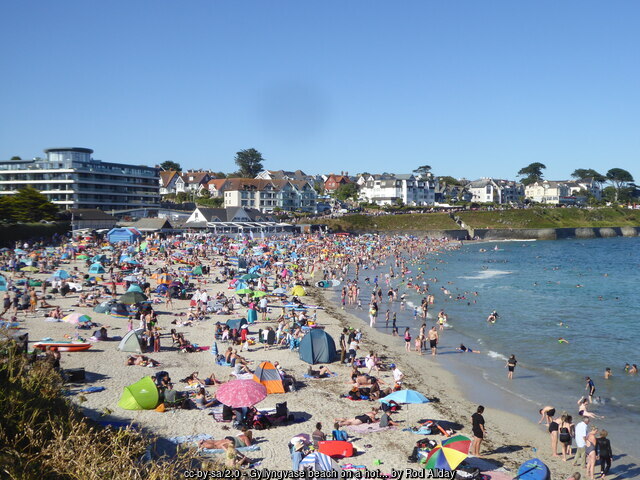
Falmouth's position on the sheltered south coast, wrapped by the Fal estuary and Carrick Roads rather than facing the open Atlantic, gives Gyllyngvase a noticeably milder, more settled microclimate than Cornwall's north-coast resorts - one reason the town has long attracted the exotic gardens that back the beach as well as its steady stream of sea-bathers. Sea temperatures lag the calendar by a month or two, so late summer into early autumn - August through October - are usually the most comfortable months for swimming, while a hardy few keep it up through the winter, with organised cold-water dips around Christmas and New Year a regular fixture on the wider Cornish festive calendar. Peak season is unsurprisingly the school summer holidays and the Falmouth Week regatta fortnight in August, when the beach, car park and town are at their busiest; visitors happy to trade a little warmth for far more space and easier parking often find May, June and September the more rewarding months to get to know Gyllyngvase properly.
Accessibility has had real, sustained attention here rather than being an afterthought. A sloping, step-free path connects the car park directly behind the beach down onto the sand, making Gyllyngvase noticeably easier to reach than several of Falmouth's smaller, more awkwardly-approached coves. A wheelchair-accessible toilet is provided in the toilet block a short distance behind the beach, and a sand chair - a wheeled chair designed to cross soft sand - can be booked for hire locally, extending access onto the beach itself for visitors who would otherwise be limited to the promenade above. Blue Badge parking bays are available in the car park immediately beside the beach, though as with all council-managed parking it is worth checking current provision directly with Cornwall Council before a visit, particularly in peak season when demand for every space, accessible or otherwise, is at its highest.
Gyllyngvase also sits at the centre of some of the best short walking in Falmouth. Heading north-east along the coast path takes you past Tunnel Beach and Castle Beach - both a short walk towards Pendennis Point - and on to Pendennis Castle itself, one of Henry VIII's coastal artillery forts, built from 1540 to guard the harbour mouth and still standing sentinel over the bay today. Head the other way along Cliff Road and the coast path continues south-west to Swanpool, the next beach along, with Maenporth and the wider Helford-facing coastline further beyond that. Princess Pavilion, Falmouth's Edwardian entertainment venue set in its own gardens, sits a short walk inland from the seafront, while Queen Mary Gardens itself, immediately behind Gyllyngvase, makes an easy, level extension to any visit - a genuinely pleasant place to sit with an ice cream after a swim, whatever the tide is doing.
All of which explains why Gyllyngvase has held onto its position as Falmouth's best-loved beach for so long: it does the fundamentals - safe swimming, a genuinely large stretch of good sand, strong facilities and easy access - better and more consistently than any other beach in the town, while sitting close enough to Falmouth's harbour, museums and maritime history to anchor a full day out rather than just an afternoon on the sand. The car park and beach do get busy on fine days through the summer, especially around the Falmouth Week regatta in August, so an early start is worth it in peak season - but for a straightforward, dependable family beach with everything within a few minutes' walk, it is hard to better in this part of Cornwall.
Visitor Information
Parking
Pay-and-display car park directly adjacent to the beach on Cliff Road, around 100m from the sand, plus further parking in the surrounding streets. Arrive early on fine summer days, particularly around Falmouth Week in August, as the car park fills quickly.
Facilities
Public toilets, a beachside cafe, deckchair hire and watersports hire (kayak, SUP and sailing) are all available at the beach. RNLI lifeguards patrol daily from 16 May to 27 September 2026, 10am to 6pm.
Disabled Access
A sloping, step-free path leads from the car park down onto the beach, and a wheelchair-accessible toilet is provided behind the beach. A sand chair can be booked for hire locally. Blue Badge parking bays are available in the adjacent car park - confirm current provision with Cornwall Council before you travel.
Things to Do Nearby
- Tunnel Beach and Castle Beach, both a short walk towards Pendennis Point
- Swanpool, the next beach south along the coast path
- National Maritime Museum Cornwall, overlooking the harbour on Discovery Quay - Falmouth's seafaring history, from the packet ships to today
- Queen Mary Gardens, the sub-tropical gardens immediately behind the beach, and Princess Pavilion, Falmouth's Edwardian entertainment venue a short walk inland
- Pendennis Castle, Henry VIII's harbour-mouth artillery fort above Pendennis Point, a short coastal walk beyond Castle Beach
Places to Stay
Frequently Asked Questions
Page last updated: 10 September 2026.