Castle Beach
Falmouth's Rock-Pooling Beach Below Pendennis Castle
Castle Beach, Cliff Road, Falmouth, Cornwall, TR11 4NZ
Castle Beach is a small, south-facing beach of coarse sand, shingle and rock tucked into the shoreline directly below Pendennis Point, on the southern edge of Falmouth town. It sits in the shadow of Pendennis Castle, the Tudor fortress that has stood guard over the mouth of Carrick Roads since the 1540s, and its position - wedged between the headland and the town - gives it a character quite different from Falmouth's bigger, sandier beaches. There is less open sand here than at Gyllyngvase, its larger neighbour a short walk to the south, and Castle Beach is not really a beach for spreading out a towel and staying all day. What it offers instead is one of the best short stretches of rock pooling on this part of the coast, a sheltered sun-trap feel on a calm day, and a genuinely dramatic backdrop in the castle walls above.
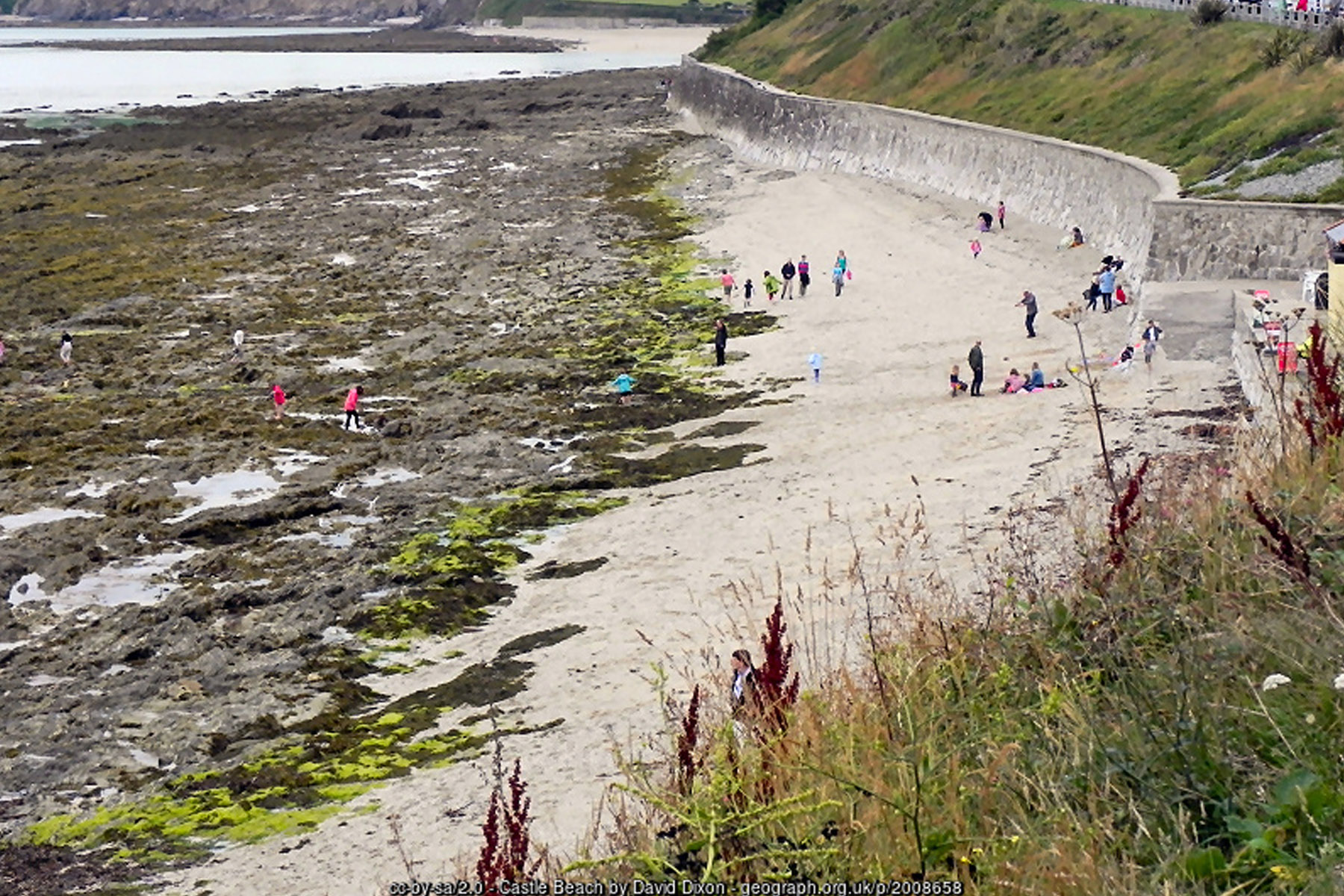
Tide state matters more at Castle Beach than at most Falmouth beaches. It is a narrow strip of shore, and on a rising or high spring tide the sea can push right up to the base of the low cliffs and rock ledges that back it, leaving very little dry sand at all. As the tide falls, though, the beach transforms: a broader band of sand appears, and rocky platforms and pools open up on both the Pendennis Point side and the Gyllyngvase side of the beach. These platforms, cut into the dark Devonian slates and siltstones of the Mylor Slate Formation that underlies much of the Falmouth peninsula, hold water at low tide in shallow, sheltered pools that warm quickly in the sun - ideal conditions for the marine life that has made Castle Beach a well-known rock pooling destination. The rock surfaces are often coated in seaweed and can be slippery underfoot, so sturdy, grippy footwear is worth wearing rather than bare feet or flip-flops.
The rock pools themselves are consistently rich. Regular visitors and organised rock pooling groups record beadlet and gem anemones, rock gobies and pipefish, starfish tucked under ledges, edible crabs, green shore crabs and velvet swimming crabs, squat lobsters near the low-water mark, and mussel beds thick with barnacles. Castle Beach is one of the founding hub sites for the Rock Pool Project, a Cornwall-based marine conservation and education initiative, and it regularly hosts "BioBlitz" citizen-science events where visitors help record species using a smartphone app linked to the naturalist database iNaturalist. For families or anyone with an interest in marine life, timing a visit for an hour either side of low tide is by far the most rewarding approach, and a rising tide should always be respected - the pools that make the beach interesting are also the reason it should never be treated as a place to linger once the sea starts to return.
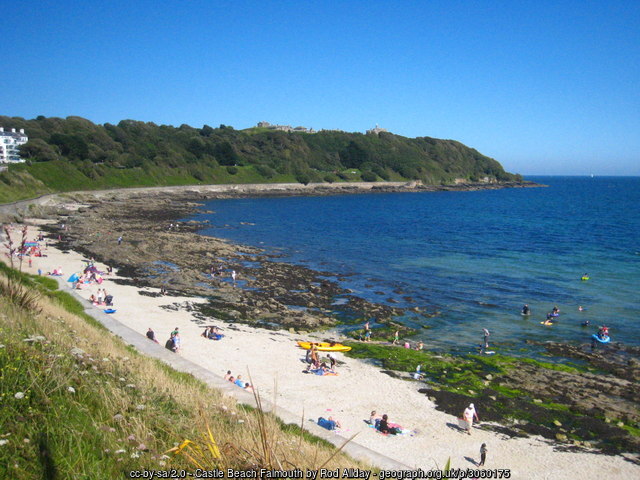
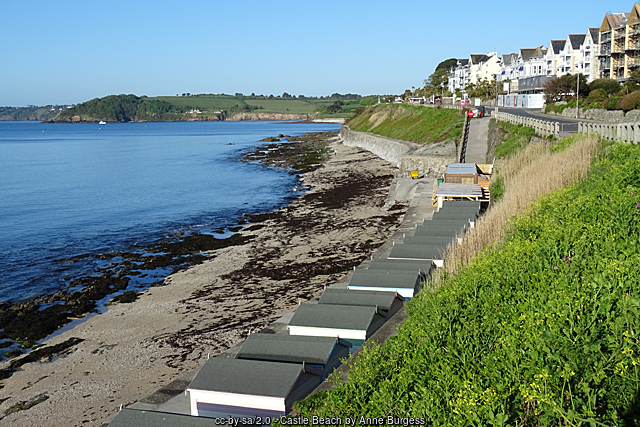
Access to Castle Beach is by steps and a sloped ramp rather than a level path. The main route down is a ramp and flight of steps opposite the Falmouth Hotel on Cliff Road, and there are further sets of steps where Cliff Road meets Castle Drive and again near the beach's public toilets, giving more than one way down depending on where you are coming from. None of these routes is level or step-free, so pushchairs and wheelchairs cannot reach the beach itself, though the ramp does make the descent more manageable than a plain staircase for those who can manage some incline. The steepness and mixed sand-and-rock surface mean sensible shoes matter here as much as for the rock pooling itself.
Facilities are modest but genuinely useful. Public toilets sit above the beach near the top of the access routes, and a small seasonal café operates partway down the ramp, generally open from around Easter through to September, selling drinks, ice creams and light snacks, with deckchairs and bodyboards available to hire and a sundeck for those who want to sit and watch the water. There is no lifeguard cover at Castle Beach at any time of year - the nearest lifeguard patrol in season is at Gyllyngvase Beach, roughly a kilometre away along the coast, and anyone planning to swim should bear that distance in mind, along with the tidal squeeze that can catch out less experienced or less confident swimmers on this stretch of coast.
Dogs are welcome at Castle Beach for most of the year but are restricted, under Cornwall Council's seasonal beach byelaw, between 1 July and 31 August, from 10am to 6pm - the same summer window that applies to nearby Tunnel Beach, Swanpool and Maenporth. Outside those dates and hours dogs are allowed, though owners should keep them under close control given the rocky, uneven ground and the pools themselves, which are best left undisturbed by paws as well as feet. Gyllyngvase, by contrast, carries a longer restricted season (15 May to 30 September) - worth knowing if you are planning which of Falmouth's beaches to visit with a dog at a particular time of year.
Pendennis Castle, immediately above the beach on its headland, was built between 1539 and 1545 on the orders of Henry VIII as one of a chain of coastal artillery forts raised along the south coast of England in response to the threat of invasion from Catholic Europe. Its original circular keep, designed to allow gunfire in every direction from several levels at once, was built as a pair with St Mawes Castle on the opposite shore of the estuary, the two forts together covering the entrance to Carrick Roads, one of the world's largest natural deep-water harbours. Pendennis was substantially enlarged with angled bastions at the end of the sixteenth century in response to the Spanish Armada threat, endured a five-month Royalist siege during the Civil War in 1646 - one of the last Royalist strongholds in England to fall - and was further modernised through the Napoleonic Wars, the Victorian era and both World Wars, serving as an active coastal defence position as late as the Second World War. It is managed today by English Heritage and remains one of the most complete Tudor artillery castles in the country; walking the ramparts gives a clear view straight down onto Castle Beach and the harbour approaches it was built to defend, even though the castle itself has no dedicated page on this site.
Castle Beach's neighbours make it easy to build a longer stretch of coast into a visit. Immediately south, reached via a tunnel cut under the promenade, lies Tunnel Beach, a similarly small and quieter beach; continuing on the same path leads to Gyllyngvase, Falmouth's principal beach, about a kilometre away, with its own wide sands, seafront café and 2026 Blue Flag award - the only one of Falmouth's beaches to hold that status this year, since none currently hold a Seaside Award either. In the other direction, Falmouth's working harbour and the National Maritime Museum Cornwall at Discovery Quay are an easy walk from Castle Beach through the town, with fifteen galleries covering boat design and maritime history, an underwater "Tidal Zone" viewing gallery and a rooftop "Look Out" with harbour views - a good option if the tide is against you or the weather turns.
Falmouth itself grew up around this same deep, sheltered harbour, which by the seventeenth century had made it one of the busiest ports in Britain, home for two centuries to the Packet Service that carried the Royal Mail, and later bullion, news and diplomats, to and from British possessions around the world before the arrival of the railway shifted that trade elsewhere. That maritime history is visible everywhere around Castle Beach, from the castle on the headland to the docks a short walk into town, and gives even a brief visit to this small, tide-dependent beach a genuine sense of place beyond the rock pools themselves.
Visitor Information
Parking
No dedicated car park. Limited on-street parking along Cliff Road and Castle Drive; nearest car parks are at Pendennis Point and Gyllyngvase, both a short walk away.
Facilities
Public toilets above the beach and a seasonal café (Easter-September) partway down the access ramp, with deckchair and bodyboard hire. No lifeguard cover - nearest is at Gyllyngvase, about 1km away.
Disabled Access
Not step-free - access is via a ramp and steps opposite the Falmouth Hotel on Cliff Road, plus further steps at Castle Drive and near the toilets. No Blue Badge provision on the beach itself, as there is no dedicated car park.
Things to Do Nearby
- Tunnel Beach, reached via a tunnel under the promenade, just south
- Gyllyngvase Beach, Falmouth's main beach, about 1km away
- National Maritime Museum Cornwall, Discovery Quay, a short walk into town
- Falmouth Town Guide - shops, restaurants and the harbour
- South West Coast Path Guide - walking routes along this stretch of coast
Places to Stay
Frequently Asked Questions
Page last updated: 10 September 2026.