Back to English Heritage Cornwall
Castle Drive, Falmouth, Cornwall TR11 4LP | 01326 316594
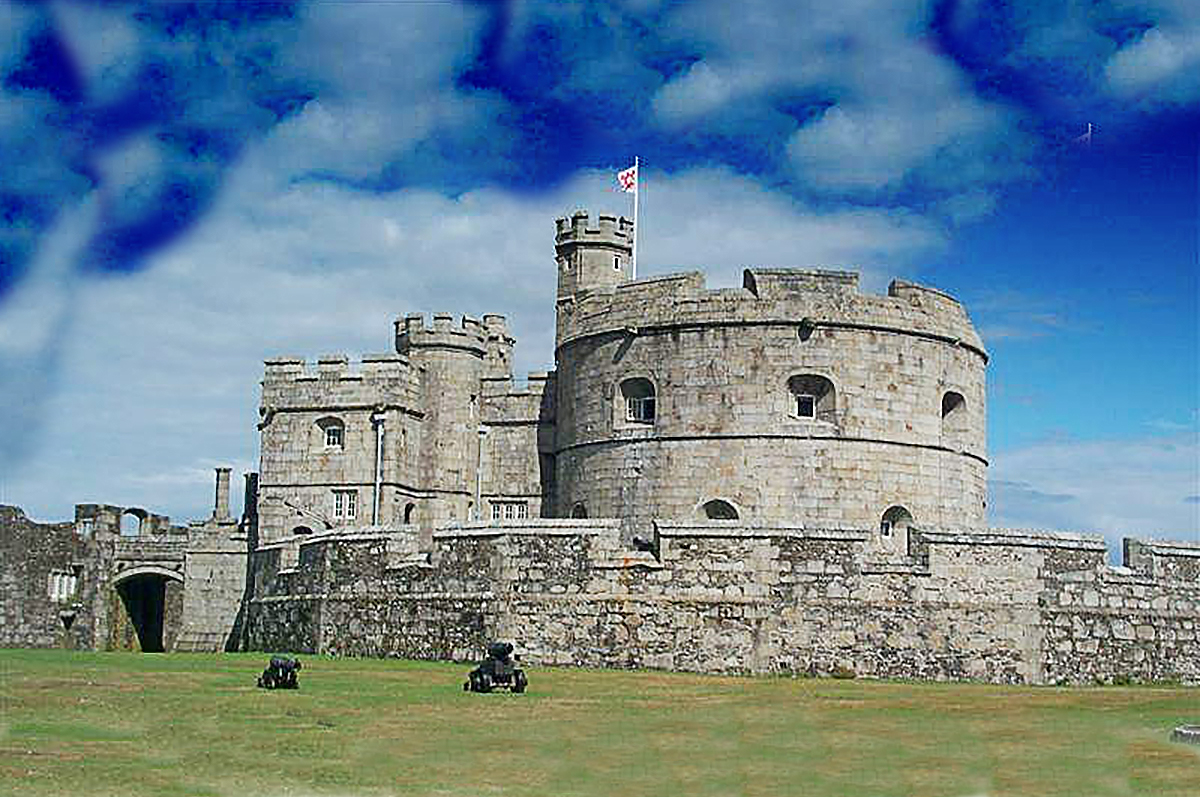
Pendennis Castle is one of Cornwall's great historic fortresses, occupying a commanding headland at the mouth of the River Fal beside Falmouth. Built during the reign of Henry VIII, the castle was created to defend the important anchorage of Carrick Roads against invasion. More than four centuries later it remains a remarkable military landscape, combining a rare Tudor gun tower with Elizabethan earthworks, Georgian and Victorian buildings and extensive 20th-century coastal defences. Today the castle offers an unusually complete story of changing warfare, from the age of cannon and Tudor warships to radar-controlled guns and the Second World War.
For visitors, Pendennis is also an exceptionally scenic place. The castle stands above the sea with wide views across Falmouth Bay, towards St Mawes Castle and along the Cornish coast. The historic buildings are surrounded by lawns and open ground, making this a site that works particularly well for families, while the collections of guns, military buildings and wartime installations give the fortress considerable interest for anyone fascinated by military history. Cared for by English Heritage, Pendennis pairs naturally with a visit to St Mawes Castle just across the water, or with Falmouth's museums and gardens for a fuller day exploring this stretch of the Cornish coast.
Location Map
Visitor Guide
A visit to Pendennis Castle begins with its setting. The headland was chosen because it overlooks Carrick Roads, one of the finest natural harbours on the south coast of Cornwall. From the castle ramparts you can look across the water towards St Mawes, the companion fortress built at the same time, and watch modern ships using the same sheltered waters that made the Fal so strategically valuable to Tudor England. The landscape helps explain the castle better than any map: from this high ground, defenders could observe the sea approaches and protect the anchorage below.
The central attraction is Henry VIII's circular gun tower. Its unusual form was designed for artillery defence, with guns arranged to provide all-round fields of fire. Inside, the thick granite walls, enclosed gun floors, basement rooms and spiral staircase provide a vivid impression of a Tudor artillery fort. The roof gives one of the best viewpoints on the site and demonstrates why Pendennis was positioned here.
The Tudor tower, however, is only the beginning. During the reign of Elizabeth I the castle was incorporated into a much larger fortress with ramparts, bastions and a ditch. Visitors can walk around these defences and see how military engineering developed as the threat of attack changed. The later fortress enclosed the earlier tower and transformed Pendennis from a small gun fort into a major stronghold capable of defending itself against an assault from land as well as ships at sea.
The Royal Artillery Barrack Block is another important part of the visitor experience. The refurbished 1901 barracks contain exhibitions exploring the history of the castle, its soldiers and its relationship with Falmouth and the wider world. The Fortress Falmouth exhibition includes military memorabilia, letters, weapons and material illustrating the lives of the men who worked and trained here. For families, interactive displays and a scale model help turn what might otherwise be a complex military history into something much easier to understand.
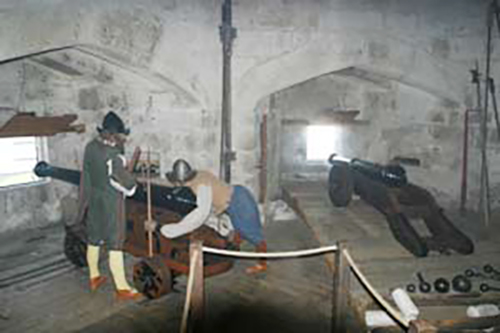
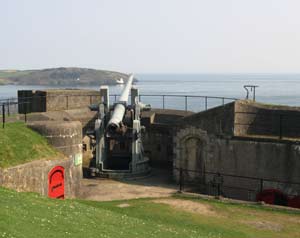
Historic guns are displayed across the site, representing several generations of coastal artillery. The collection helps visitors see the extraordinary technological changes that took place while Pendennis remained in military use. One of the most interesting areas is the Half Moon Battery, where later gun positions were adapted during the 20th century. The Battery Observation Post and other wartime structures demonstrate that Pendennis was still an active part of Britain's coastal defence system during the Second World War.
Families are particularly well served. There are broad lawns for picnics, a children's trail, interactive elements, a small soft-play area and plenty of space to explore. English Heritage also runs talks and seasonal activities. A visit can therefore be as much an outdoor adventure as a history lesson. The castle café, in the Royal Garrison Artillery Barracks, provides refreshments and light meals, while the shop stocks books, gifts and souvenirs connected with the castle, Tudor history and the two world wars. Visitors should allow around two and a half hours for a thorough visit, although those who enjoy military history, photography or the coastal landscape could easily spend longer.
History
Pendennis Castle was built between 1539 and 1545 as part of Henry VIII's programme of national coastal defence, known to historians as the Device Forts. England faced the possibility of invasion from Catholic European powers after the King's break with Rome, and Henry responded by constructing a chain of artillery forts at vulnerable harbours and anchorages along the south coast. The Fal was particularly important because Carrick Roads provided a deep, sheltered anchorage where an enemy fleet could gather before moving inland. Pendennis and St Mawes were therefore designed as complementary forts on opposite sides of the water, their guns able to catch any hostile ship in a crossfire.
The earliest Pendennis fortress was centred on a distinctive circular gun tower. This was an innovative design for its time, intended to allow guns to fire in different directions. The tower contained accommodation and storage as well as gun positions, while a surrounding circular platform, or chemise, provided additional artillery positions. The result was a compact fortification designed around the capabilities of early heavy cannon.
The threat of invasion did not disappear after Henry VIII's death. Pendennis was placed on a stronger footing during the reign of Elizabeth I, particularly as England faced repeated Spanish threats, including the raid on Mount's Bay in 1595. Following a 1597 survey of the defences, the military engineer Paul Ive enclosed the Tudor castle within a substantial pentagonal fortification, with ramparts, a ditch and bastions, completed by around 1600. This was a major change in defensive thinking: the castle now needed to withstand attack from the landward side as well as fire upon ships offshore.
The new fortress was tested dramatically during the English Civil War. In 1646 Pendennis became one of the last Royalist strongholds in the country, second only to Raglan Castle to hold out for the King. A garrison of several hundred Royalist soldiers and supporters, commanded by the elderly Sir John Arundell, held out against Parliamentarian forces for around five months — one of the longest sieges of the entire war. The castle had earlier given sanctuary to Queen Henrietta Maria and the young Prince of Wales, later Charles II, before their escape to France. Eventually, with supplies exhausted and the garrison reduced to eating horse meat, the defenders surrendered on honourable terms.
After the Civil War the fortress remained in military service. The arrival of more powerful artillery required continuing changes to the defences, accommodation and gun positions, and buildings from the late 17th and 18th centuries survive within the walls, including early barrack blocks. Around 1700 the entrance was given a more imposing classical appearance, illustrating how the practical military site was repeatedly modified to reflect changing architectural and defensive requirements. Pendennis also played a role during the Napoleonic Wars, when Cornwall's ports and the Fal anchorage were strategically important, and the castle served as a supply base for British forces operating in the Iberian Peninsula.
The 19th century brought further changes in artillery. Improvements in range, accuracy and explosive power made older defensive arrangements increasingly obsolete. Pendennis Point and the lower batteries were adapted for newer weapons, including quick-firing guns intended to counter fast torpedo boats. The fortress became a layered system in which Tudor masonry existed alongside Victorian and Edwardian artillery positions. During the First World War Pendennis served as the headquarters of the Falmouth defences, controlling coastal artillery around the estuary while the harbour was used by naval vessels, convoys and minesweepers.
In the Second World War Pendennis once again became an active coastal defence headquarters. New guns and protected positions were installed, including 6-inch artillery at Half Moon Battery, while the Battery Observation Post and plotting rooms formed part of a sophisticated fire-control system. Radar and improved communications meant the fortress had evolved from the visual observation of Tudor gunners into a coordinated 20th-century defence installation. Military use continued after 1945, but the role of coastal artillery was eventually ended when the Coast Artillery Branch of the British Army was disbanded in 1956, closing more than four centuries of continuous military service. The castle passed into state guardianship in 1957 and later opened to the public under what is now English Heritage, which identifies Pendennis and its headland as one of England's most complete surviving coastal fortresses.
Important Features
- Henry VIII's circular gun tower: the 16th-century heart of Pendennis and one of the rare centrally planned artillery forts built during Henry VIII's coastal defence programme.
- The chemise: the circular gun platform surrounding the tower, providing additional artillery positions and an all-round field of fire.
- Elizabethan ramparts and bastions: the enlarged fortress of the late 16th century, showing the transition from an early Tudor gun fort to a sophisticated bastioned defence.
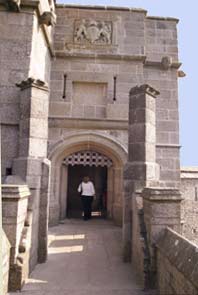
- The Tudor gatehouse: retains evidence of its portcullis, drawbridge and defensive arrangements, alongside decorative Tudor stonework.
- Royal Artillery Barrack Block: the refurbished 1901 building, now home to exhibitions about the fortress, its soldiers and Falmouth's military history.
- Fortress Falmouth exhibition: military objects, letters, weapons and personal stories of the people who served at Pendennis.
- Half Moon Battery and Battery Observation Post: 19th and 20th-century gun positions, part of the WWII fire-control system.
- Little Dennis: a smaller Tudor gun tower at Pendennis Point, probably built around 1539, forming part of the wider defensive landscape.
- Panoramic views: across Falmouth, Carrick Roads, St Mawes and the open sea from the keep and ramparts.
Visitor Information
Parking
The main car park is on Castle Drive, a short walk from the entrance. A 2.1 metre height barrier applies. Limited accessible parking is available inside the castle grounds on a first-come, first-served basis, and there is a drop-off point for visitors with reduced mobility.
Facilities
A tearoom in the Royal Garrison Artillery Barracks serves refreshments and light meals, with gluten-free and dairy-free options. The gift shop sells books, gifts and souvenirs, and there are toilets with baby-changing facilities near the shop and in the Barrack Block. Broad lawns provide plenty of space for picnics.
Disabled Access
The ground floor of the Royal Artillery Barrack Block is wheelchair accessible, with a lift to the first-floor exhibition. The keep itself is reached by steps and a spiral staircase and is not fully wheelchair accessible. Much of the wider headland has uneven ground and steep drops, so contact English Heritage in advance if accessibility is a concern.
- Opening times: English Heritage currently lists Pendennis Castle as open daily, generally 10am–5pm with last entry at 4pm. Seasonal arrangements and events can change, so check the official website before travelling.
- Public transport: the nearest bus stop is on Castle Drive, served by routes including the 67 Coastal Circular and the Falmouth Coaster. Falmouth Docks railway station is about half a mile away, via an uphill walk. English Heritage offers a discount on walk-up admission for visitors arriving by train, bus or bicycle on production of a valid ticket or bike.
- Toilets: available near the shop and in the Royal Artillery Barrack Block, including an accessible toilet and baby-changing facilities.
- Food and drink: the tearoom in the Royal Garrison Artillery Barracks serves refreshments and light meals made with local Cornish ingredients, with gluten-free and dairy-free options.
- Shop: the gift shop stocks books, gifts and souvenirs connected to Tudor history, the castle and the two World Wars.
- Dogs: welcome on leads across the site, including in most buildings; dog bowls are available and the café has outdoor seating.
- Booking: Pendennis is not a timed-entry site, so walk-up admission is available. English Heritage recommends booking online in advance where possible, for the best price and guaranteed entry at busy times.
- Family facilities: pushchairs are permitted, though some areas involve steps and uneven ground. There's a small soft-play area, a family trail and interactive displays for children.
- Additional access: assistance dogs are welcome. Braille and large-print information is available, induction loops are fitted at reception, the shop and tearoom tills, and the Discovery Centre includes tactile exhibits.
- Visit duration: English Heritage suggests allowing around two and a half hours for a thorough visit; military history enthusiasts and photographers often stay longer.
Things to Do Nearby
St Mawes Castle
St Mawes, across Carrick Roads
Pendennis's sister Tudor fort, reachable by passenger ferry from Falmouth — a natural pairing for a two-castle day out.
Find Out MoreNational Maritime Museum Cornwall
Falmouth
An award-winning museum on Falmouth's waterfront with one of the UK's finest small-boat collections.
Find Out MoreGlendurgan Garden
Mawnan Smith, nr. Falmouth
A National Trust sub-tropical valley garden with a famous cherry-laurel maze, a short drive from Falmouth.
Find Out MoreTrebah Garden
Mawnan Smith, nr. Falmouth
A dramatic ravine garden running down to a private beach on the Helford River, neighbouring Glendurgan.
Find Out MoreFalmouth Town & Harbour
Falmouth
Cornwall's sailing capital, with independent shops, galleries and beaches a short walk from the castle.
Find Out MoreFrequently Asked Questions
Official English Heritage Site
For the latest opening times, admission prices and any event or access changes, check the official English Heritage page for Pendennis Castle before you travel.
Explore More Cornwall Heritage
All English Heritage Sites Cornwall Attractions National Trust Cornwall
Page last updated: 24 August 2026.