Perranuthnoe
A Sand-and-Rock Cove in Mount's Bay, with an Old Inn, a Beach Cafe and Coast Path Walks to Cudden Point
Perranuthnoe, Penzance, Cornwall, TR20 9NE
Perranuthnoe is a small, south-west facing beach of sand and rock tucked into the eastern curve of Mount's Bay, roughly two miles from Marazion and about four miles from Penzance, at OS grid reference SW 5401 2922. It sits directly below the village that shares its name, a scatter of cottages and farmhouses reached down a narrow lane off the coast road between Penzance and Helston, and it has managed to stay a good deal quieter than its famous neighbour across the bay, even though the view from its sand takes in exactly the same skyline: St Michael's Mount rising from the water to the west, with Penzance and the arc of the bay beyond it. Locally the beach has long been known as Perran Sands, and some older maps and guidebooks still use that name, though it is Perranuthnoe - after the parish and the medieval church of St Piran that stands a short walk up the hill - that has stuck as the everyday name for the cove.
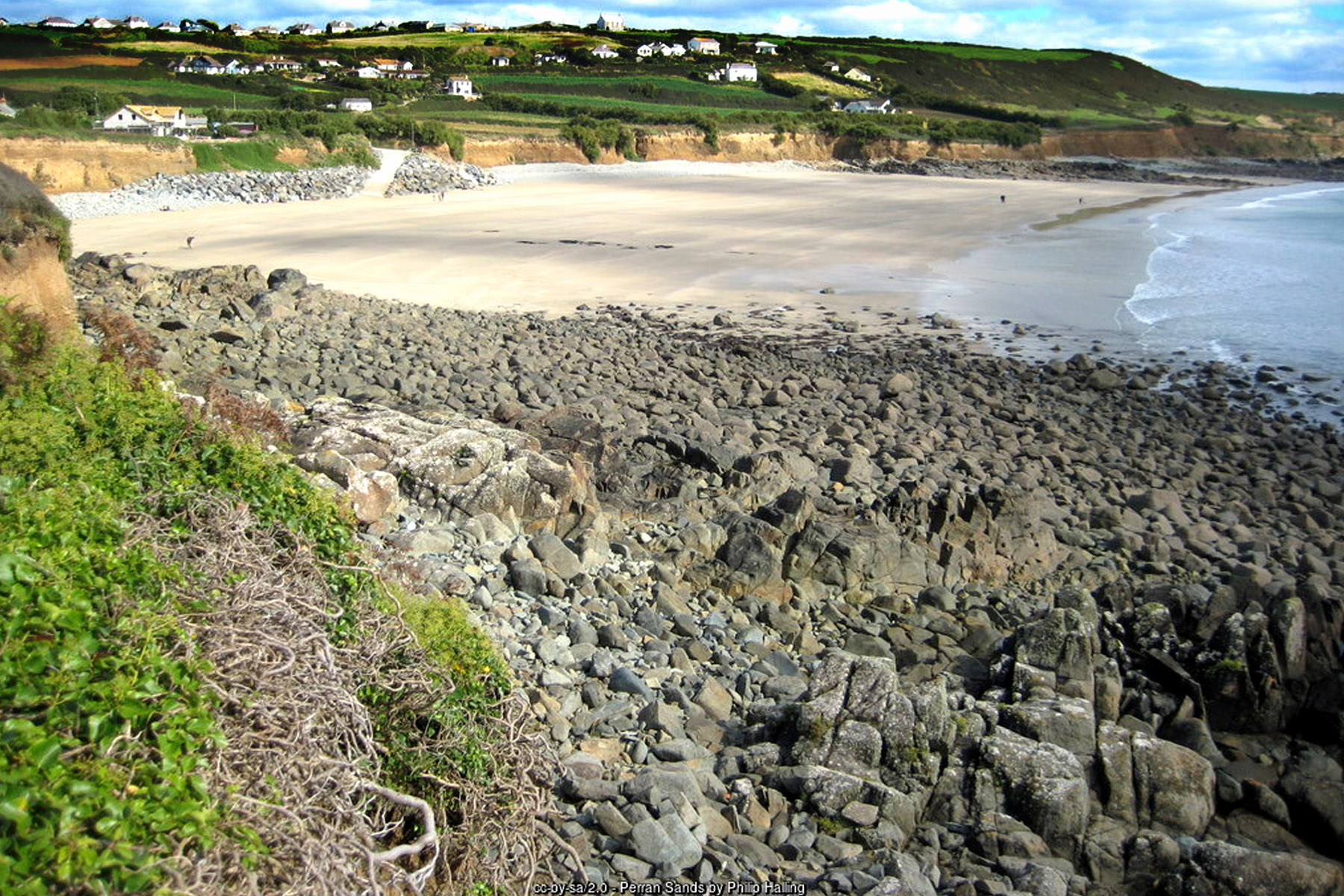
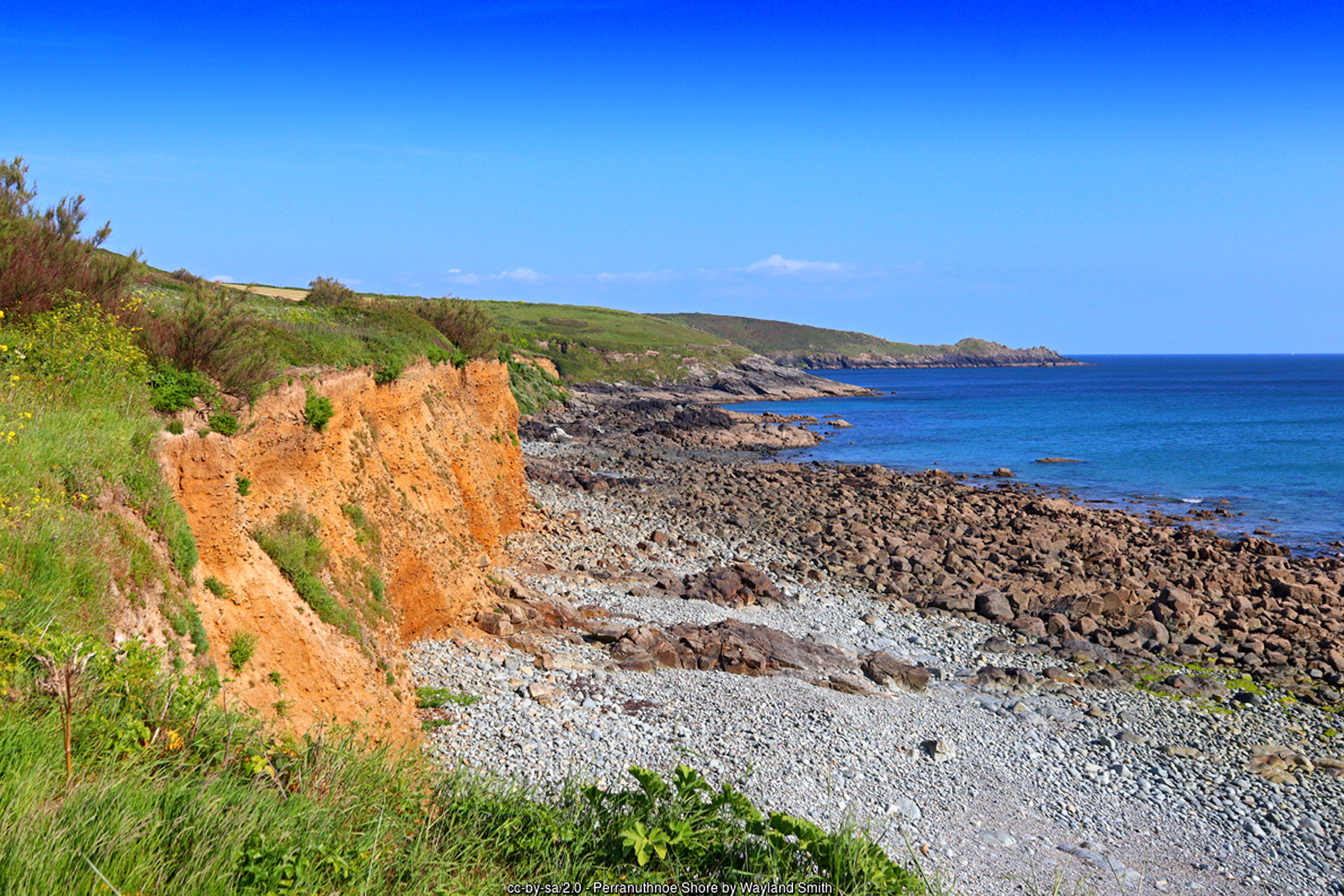
The beach itself changes shape a great deal with the tide. At low water a broad, gently sloping expanse of sand is uncovered - well over 300 metres of it in summer - running out towards flat rocky ledges at either end that are good for rockpooling, with shrimps, small crabs and anemones tucked into the shallower pools for children willing to look closely. At high tide the sea pushes right up against the low, ochre-red cliffs behind, leaving only a narrow strip of shingle and rock, and in winter, when storms strip away much of the sand that summer builds back up, the beach can look a good deal barer and more elemental than its gentle summer self. That tidal swing means Perranuthnoe rewards a bit of planning: turning up around mid-tide on a falling tide generally gives the best of both worlds, sand to spread out on and rocks still worth poking about in. The cliffs themselves are soft and prone to erosion, so it is sensible to keep clear of their base and to avoid exploring any cave-like recesses at their foot, and to watch for the two old mine adits visible in the rock nearby, quiet reminders that this stretch of coast, like so much of West Cornwall, was once worked for tin and copper before the last local mine closed around the turn of the twentieth century.
The village above the beach is genuinely old. It appears in the Domesday Book of 1086 under the name Odenol, and the name shifted through the centuries - Hutheno by 1235, Udno through the fourteenth century, Uthnoe-veor by 1839 - before settling into its modern form. The parish church, dedicated to St Piran and St Michael and one of only three Cornish churches to carry St Piran's name, is first recorded in 1348 although its earliest known rector was appointed in 1277; it still holds a Norman font from the church's earliest phase, transepts added in the fourteenth century, and an unbuttressed three-stage tower raised around 1500. One of its rectors, Michael Tregury, went on to become chaplain to Henry VI and later Archbishop of Dublin. The building has been restored more than once since, including major work in the 1920s, and a carved granite figure of St James the Great, rescued from a demolished medieval chapel at nearby Goldsithney, now stands built into its south wall - a small but telling piece of the way this coastline has recycled its own history.
No visit to Perranuthnoe is complete without a look at the Victoria Inn, which sits at the top of the village and markets itself, with good reason, as one of the oldest inns in Cornwall - parts of the building are said to date from the twelfth century, and its thick walls and low beamed ceilings certainly feel the part. It has picked up a Taste of the West Gold Award for its food, built around a daily-changing menu of local produce, and it welcomes dogs into its bar and garden, which matters on a coast where a good pub after a walk is half the point of the walk. The inn stands only a minute or so from the South West Coast Path and looks out, from its higher ground, towards St Michael's Mount - a fitting spot to end an afternoon on the beach below. Down by the sand itself, the more informal Cabin Beach Cafe does the daytime trade, serving coffee, breakfasts, cakes and light lunches with a view straight out over the cove, and by night it turns into the Tipsy Crab Bistro, with a short menu built around Cornish seafood. Both the inn and the cafe are open year-round and both count regular coast-path walkers among their steadiest customers, tucked as they are on the path roughly midway between Marazion and Prussia Cove.
That path is one of the best reasons to linger here rather than just visiting the beach and moving on. The South West Coast Path runs directly through Perranuthnoe, and heading east from the beach it climbs onto Cudden Point, a rugged, gorse-covered headland cared for by the National Trust that juts out into Mount's Bay between Perranuthnoe and Prussia Cove. It is a genuinely wild-feeling stretch of coast for somewhere so close to Penzance, with choughs - the red-billed crow that is Cornwall's heraldic bird - known to nest along this section, and sweeping views back across the bay to the Mount and on towards the Lizard on a clear day. The point has its share of maritime history and legend too: a barque called the Saluto was wrecked here in December 1911, and older local folklore tells of a sunken vessel somewhere off the headland said to have gone down carrying a silver table. From Cudden Point the path drops down into Prussia Cove, the tucked-away inlet made famous by the eighteenth-century smuggler John Carter, self-styled "King of Prussia," whose gang ran contraband ashore here in defiance of the excise men for years - a walk of a couple of miles each way that turns a beach visit into a proper half-day out. In the other direction, the path leads west towards Marazion, keeping the Mount in view for almost the whole way.
Perranuthnoe also has a modest reputation among surfers, picking up a workable beach break on the right swell and tide, and it is popular enough with locals in the quieter winter months when the crowds have gone but the waves keep coming. It is not, and does not claim to be, a beach with a lifeguard service every day of the summer - cover here has varied from year to year rather than being guaranteed, so it pays to check current signage or the RNLI's beach information before swimming, and basic safety equipment is kept at the top of the slipway regardless. Cornwall Council's official list of Blue Flag and Seaside Award beaches for the 2026 season does not include Perranuthnoe, so it holds neither award at present, though its relative quiet, its rockpools and its unbroken sightline to St Michael's Mount make it one of the more rewarding smaller beaches in this part of Mount's Bay for exactly that reason - it has never really been built up as a big commercial beach resort, and the village behind it, the old inn and the cafe on the cliff have kept it feeling like a genuine Cornish cove rather than a car park with sand attached.
The parish beyond the immediate seafront is worth a mention too, since it explains why Perranuthnoe feels as settled and lived-in as it does rather than existing purely for summer visitors. The civil parish also takes in the neighbouring settlements of Goldsithney, Perran Downs and part of Rosudgeon, and at the 2011 census it had a combined population of just over two thousand people; farming, along with a fair number of holiday lets and second homes, still shapes the lanes behind the beach as much as tourism does. That mix of working parish and quiet holiday cove is part of what makes Perranuthnoe feel different from some of the more thoroughly geared-up beaches elsewhere in Mount's Bay: there is no amusement arcade, no row of gift shops, and nothing much to do here beyond the beach, the pub, the cafe and the coast path in either direction - which, for a good many visitors who already know Marazion or Penzance well, turns out to be exactly the point of coming.
Visitor Information
Parking
A small car park sits a short walk from the beach, with a field sometimes opened as overflow parking on busy summer days; space is limited and fills quickly in fine weather. Some further roadside parking can be found on the village hill.
Facilities
Public toilets are located near the car park. The Cabin Beach Cafe overlooks the sand for daytime refreshments and evening dining as the Tipsy Crab Bistro, and the historic Victoria Inn is a short walk up in the village. Lifeguard cover is not guaranteed - check locally before swimming.
Disabled Access
A short road from the car park leads to steps and a slipway giving fairly straightforward access to the beach for less mobile visitors, though the sand itself is uneven in places. Blue Badge holders should confirm current parking provision with Cornwall Council before travelling.
Things to Do Nearby
- Marazion Beach, around two miles west along the bay, with St Michael's Mount and its tidal causeway
- Prussia Cove, the former smugglers' haven a couple of miles east along the coast path, beyond Cudden Point
- St Michael's Mount, the National Trust castle and gardens visible from the beach across Mount's Bay
- Cudden Point, the National Trust headland between Perranuthnoe and Prussia Cove, good for coastal walking and birdwatching
- The South West Coast Path, which runs directly through the village linking Perranuthnoe to Marazion and Prussia Cove
Places to Stay
Perranuthnoe itself has no dedicated accommodation listings on this site. The nearest dedicated hub for places to stay is Marazion, a short drive or a coast-path walk away, which offers a good range of self-catering cottages and holiday accommodation within easy reach of Perranuthnoe, Cudden Point and the rest of Mount's Bay.
Frequently Asked Questions
Page last updated: 14 September 2026.