Kenneggy Sands
A Secluded Tidal Beach Hidden Between Prussia Cove and Praa Sands
Nr Rosudgeon, Cornwall, TR20 9AU
Kenneggy Sands is one of the quietest and least developed beaches anywhere in Mount's Bay, a genuinely secluded stretch of golden sand tucked into the coastline between Prussia Cove to the west and Praa Sands to the east, close to the hamlets of Kenneggy and Kenneggy Downs in the parish of Breage. Kenneggy itself takes its name from the Cornish "keunegi", meaning reed beds, and the beach that shares the name is exactly the kind of spot the description suggests: a hidden pocket of shore with no road down to it, no sign pointing the way, and no crowd once you arrive. The beach sits at roughly OS grid reference SW 5620 2818, backed by heath and wildflower-covered cliffs that rise steeply above a shoreline broken up by rocky outcrops, with farmland dipping down almost to the cliff edge on the land side. It is this combination - real seclusion, a proper wild-Cornwall setting, and an access route that keeps the casual day-tripper away - that has earned Kenneggy Sands a quiet reputation among locals and coast path walkers as one of West Penwith's genuine "secret" beaches. Inland, the two small hamlets that share its name, Higher Kenneggy and Lower Kenneggy, sit either side of the lane leading down towards the coast, with Kenneggy Downs a little further north on the old road between Penzance and Helston - a reminder that this is farmland and coastal heath rather than a resort, and that the beach below has never had any tourist infrastructure built up around it.
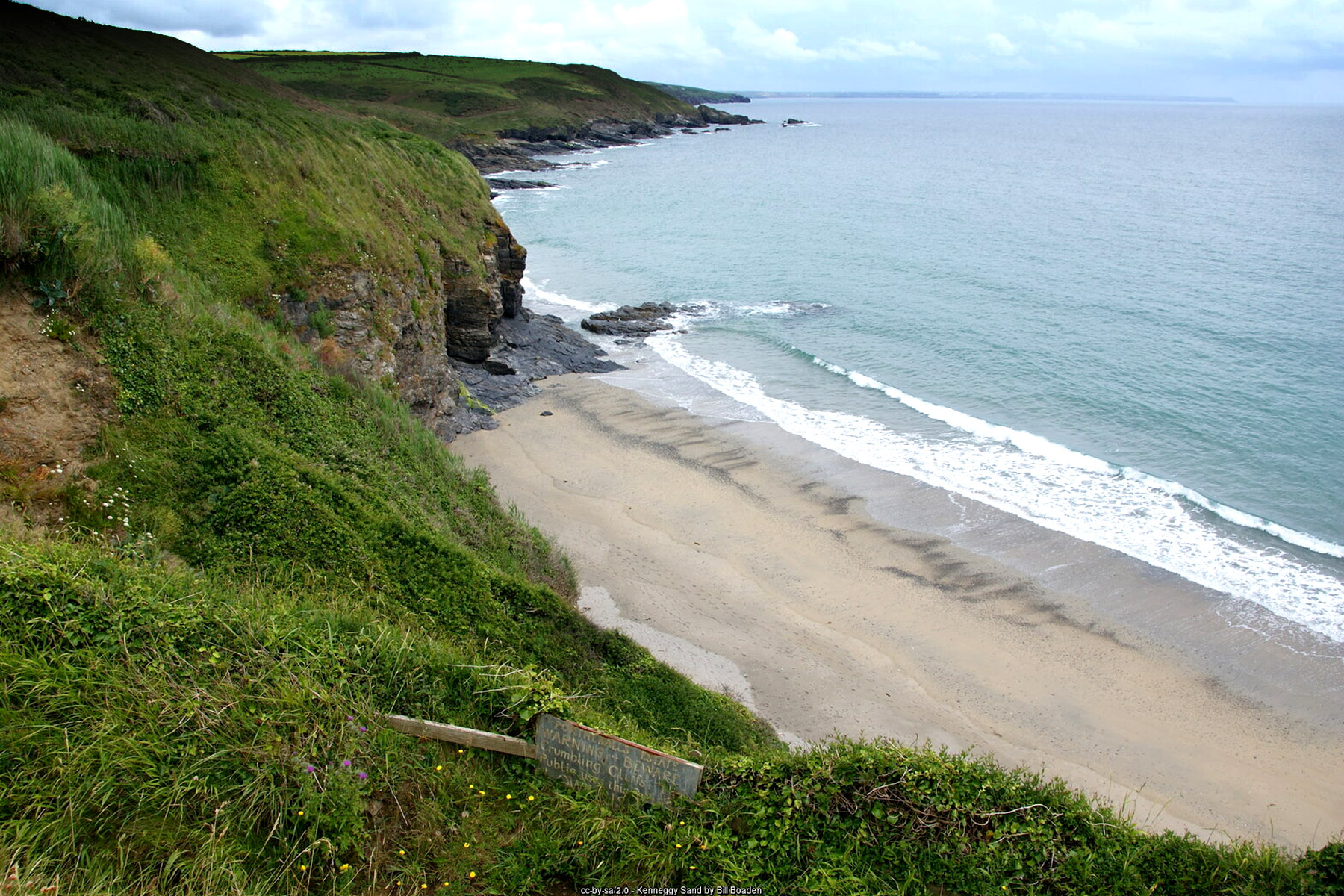
That seclusion comes with a genuine trade-off, and this page is written to be honest about it rather than gloss over it. There is no formal path down to Kenneggy Sands. The usual approach is to walk the South West Coast Path from the car park area above Prussia Cove or from Praa Sands, a walk of roughly ten to twenty minutes depending on the direction, and then descend to the sand itself by scrambling over rocks from the Prussia Cove side, close to Coules Cove, at low tide. A rope once helped with the final, steepest part of the descent, but years of coastal erosion have removed it, and current accounts from regular visitors confirm that the old rope-and-scramble route has effectively been replaced by a longer rock traverse with nothing fixed in place to hold on to. Whichever way you approach, expect uneven, often wet and slippery rock underfoot, a proper scramble rather than a stroll, and a route that demands sturdy footwear, care, and a reasonable level of fitness and confidence on rough coastal terrain.
Because of that access route, Kenneggy Sands is not a beach for everyone, and it is worth saying so plainly. It is not suitable for pushchairs or wheelchairs, and anyone with limited mobility, poor balance, or a fear of exposed rock scrambling should think carefully before attempting the descent, since the return climb is, if anything, the harder part of the trip. Families with very young children will generally be better served by one of the more accessible beaches nearby, such as Praa Sands a short distance to the east. Kenneggy Sands instead rewards experienced coastal walkers, wild swimmers comfortable making their own safety judgements, and anyone simply looking for a quiet spot away from Cornwall's busier honeypot beaches - provided they come properly prepared and treat the access route with the respect it deserves.
The tide is the other defining feature of a visit here, and it cannot be treated as an afterthought. Kenneggy Sands is a genuinely tidal beach: a broad expanse of flat sand is exposed at low water, but that sand narrows quickly as the tide floods in and the beach becomes largely or completely covered at high tide, with no safe way up the surrounding cliffs once the sea has closed in. There is no lifeguard cover of any kind at Kenneggy Sands, so visitors are entirely responsible for checking tide times before setting out and for leaving in good time - ideally well before the tide turns rather than cutting it fine. Anyone planning to swim should also bear in mind that, with no patrol and no flags, conditions and currents need to be judged for yourself on the day.
The immediate approach from Prussia Cove passes close to Coules Cove, part of the wider Prussia Cove area long associated with Cornwall's smuggling history - bricked-up cellars once used to store contraband are still visible near here, a legacy of the notorious Carter brothers, who ran a smuggling operation from this stretch of coast in the eighteenth century and gave Prussia Cove itself its name. That history is covered in full on our separate Prussia Cove page; at Kenneggy Sands it is simply a reminder that this whole corner of Mount's Bay has always been a place people came to keep out of sight, long before it became a beach walkers seek out for the same reason.
Once you are down on the sand, Kenneggy Sands has a gentler character than its access route might suggest: a south-facing bay of pale golden sand framed by rock, with cliffs rising behind that are thick with heath and coastal wildflowers through spring and summer, and views out across the widest part of Mount's Bay. Visitors who make the effort tend to report having the beach entirely to themselves, a rarity within easy striking distance of far busier beaches like Praa Sands and Marazion, and it is this sense of having found somewhere genuinely undeveloped and untouched, rather than any particular facility or feature, that is Kenneggy Sands' real appeal.
The coast path itself makes a good day out even without descending to the beach. A waymarked circular walk of around 4.8 miles, starting from the Praa Sands car park, follows the coast path out past Hoe Point and Kenneggy Sands before turning inland across Greenberry Downs, an area of heathland dotted with the remains of nineteenth-century tin and copper workings, including the former Wheal Grylls mine, which was at its most productive in the early 1870s. The route also passes St Germoe's Church, a twelfth-century foundation with the unusual medieval structure known as St Germoe's Chair standing in its churchyard, before looping back to Praa Sands - a good option for anyone who would rather admire Kenneggy Sands from above than attempt the scramble down to it.
To the east, beyond Praa Sands, the coast path reaches Rinsey Head, where the National Trust owns and manages a stretch of dramatic clifftop coastline with its own small car park (donations welcome). The unmistakable ruin of Wheal Prosper engine house stands right on the cliff edge here, the surviving pumping engine house of a short-lived tin and copper mine that operated only from 1860 to 1866 before it was abandoned; the National Trust consolidated the remaining stonework in 1970-71 to preserve it as a landmark on this stretch of coast. It is one of the most photographed engine houses in Cornwall precisely because of its setting, perched above the sea with views back across Mount's Bay towards the Lizard, and it makes a natural extension to a day spent exploring the wilder, less developed beaches of this coastline, Kenneggy Sands among them. The Trust-managed cliffs around Rinsey are also good ground for spotting Cornish choughs and peregrine falcons overhead, with porpoises, dolphins and occasionally basking sharks reported offshore in summer; as at Kenneggy Sands, there are no toilets or refreshments on site, with the nearest facilities at Porthleven or Praa Sands.
Visitor Information
Parking
There is no car park at Kenneggy Sands itself. The nearest options are a small car park near Bessy's Cove/Prussia Cove or the pay car park at Praa Sands, both involving a coast path walk of ten minutes or more before the final rocky descent to the sand.
Facilities
None at the beach - no toilets, café, shop or lifeguard cover of any kind. The nearest facilities are in Praa Sands and Prussia Cove, both a walk away along the coast path. Bring everything you need with you.
Disabled Access
Kenneggy Sands is not accessible for wheelchair users, pushchairs or anyone with limited mobility. The only way down is a rough, unsurfaced coast path followed by a rock scramble, with no formal steps, ramp or handrail, and there is no Blue Badge parking provision at or near the beach.
Things to Do Nearby
- Prussia Cove, the neighbouring cove with its smuggling history and the walking route most commonly used to reach Kenneggy Sands
- Praa Sands, the nearest fully accessible family beach, with car parking, shops and cafés
- Rinsey Head and the ruined Wheal Prosper engine house, a National Trust-owned clifftop a little further east above Praa Sands, with its own small car park and dramatic views back across Mount's Bay
- Kenneggy & Greenberry Downs circular walk, a waymarked 4.8-mile route on the South West Coast Path taking in Hoe Point, old mine workings and St Germoe's Church
Places to Stay
Kenneggy Sands has no dedicated accommodation of its own - there is nowhere to stay at the beach, and no holiday listings specific to it on this site. The nearest established base is Praa Sands, a short drive or coast path walk to the east, which offers a good range of self-catering and holiday accommodation within easy reach of Kenneggy Sands, Prussia Cove and Rinsey.
Frequently Asked Questions
Page last updated: 14 September 2026.