Lamorna Cove
Granite Quarry Cove of the Newlyn School Artists
Lamorna Cove, near Penzance, Land's End Area, Cornwall, TR19 6XH
Lamorna Cove sits at the seaward end of a steep, wooded valley on the south coast of the Penwith peninsula, about four miles south of Penzance, within the Cornwall Area of Outstanding Natural Beauty. It is a small, dramatic cove rather than a conventional sandy beach: granite boulders crowd its margins, a working harbour and quay occupy its centre, and sand is only properly revealed as the tide falls. The cove is bounded to the east by the dark headland of Carn-du, known locally as Black Rock, and to the west by Lamorna Point, and it faces south-east into a setting that even by the standards of this coastline is unusually scenic - steep granite cliffs, a tumbling stream reaching the sea beside the harbour wall, and a valley behind that is still thickly wooded, an increasingly rare sight on this largely open, wind-scoured peninsula. That granite is no coincidence: Lamorna sits within the Land's End granite pluton, the same ancient igneous mass that underlies most of the Penwith peninsula and gives this whole corner of Cornwall its characteristic tors, boulder-strewn cliffs and pale, weather-resistant building stone, the very qualities that made the valley worth quarrying in the first place. Few coves of this size anywhere in Cornwall can claim quite so much packed into so small a space: a genuinely significant chapter of Victorian civil engineering, and one of the most important artists' colonies the county has ever produced.
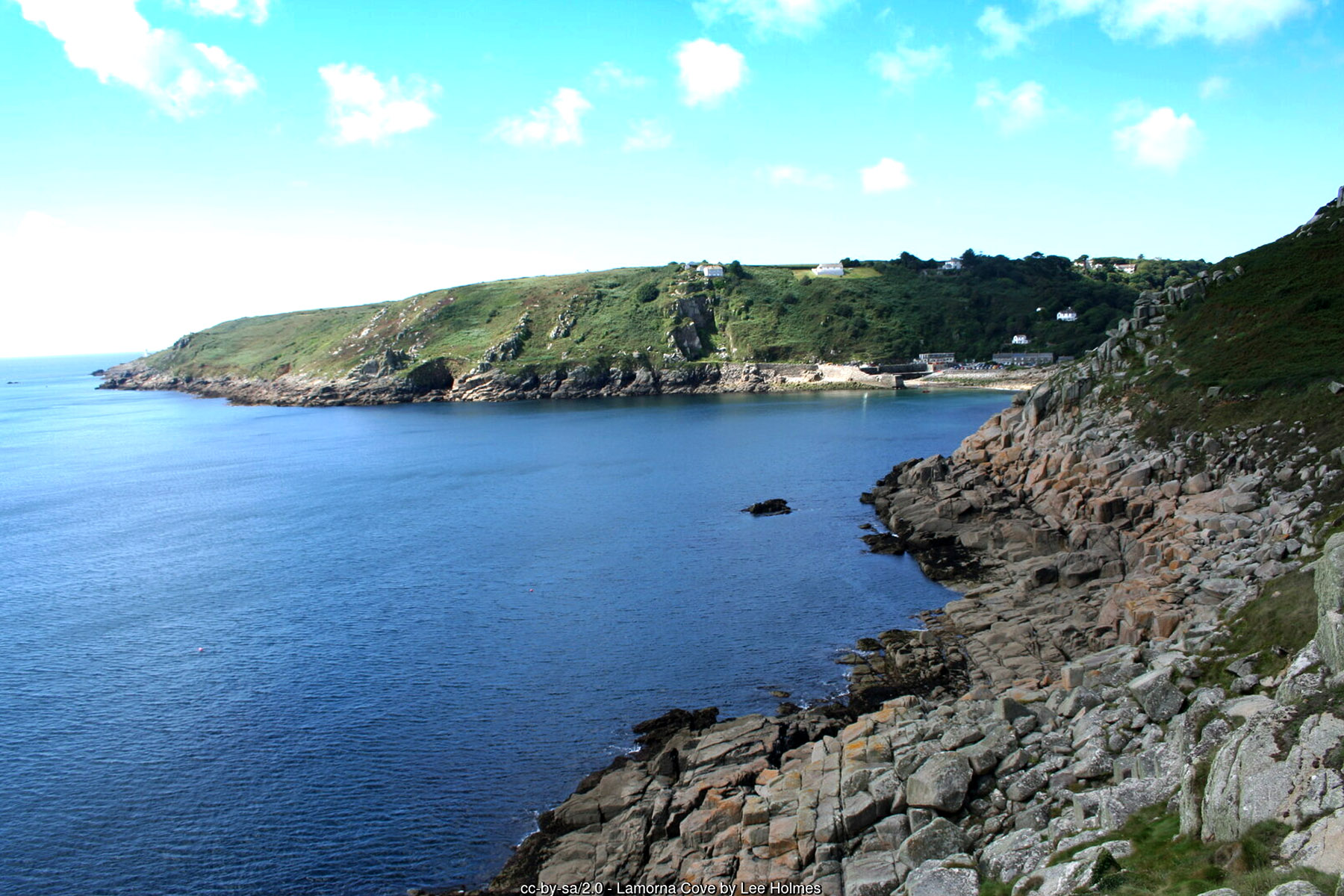
The cove's present appearance owes almost everything to an industry that has long since stopped but whose evidence is everywhere in the granite underfoot. In 1849 John Freeman opened quarries here on land belonging to the St Aubyn family, and Lamorna granite was worked continuously until 1911, more than sixty years of quarrying that left the valley's lower slopes scarred with workings and the cove itself equipped with a proper harbour for shipping the stone out. What is easy to miss, standing on the quay today, is quite how significant that stone became: Lamorna granite went into the Admiralty Pier at Dover, into the Thames Embankment in London, into Portland Breakwater on the Dorset coast, and - perhaps most remarkably for a quarry serving a small Cornish cove - into two of the most exposed lighthouses ever built off the British coast, the Bishop Rock Lighthouse and the Wolf Rock Lighthouse, both of which stand on isolated rocks in open Atlantic water off Land's End and were among the most demanding engineering projects of their age. A quarry of this size, in a cove this modest, contributing stone to structures of that scale and difficulty is a genuinely unusual piece of engineering heritage, and it is worth pausing on the quay to consider that the granite blocks under your feet may be cousins of the stone standing in some of the most storm-battered lighthouses in the world.
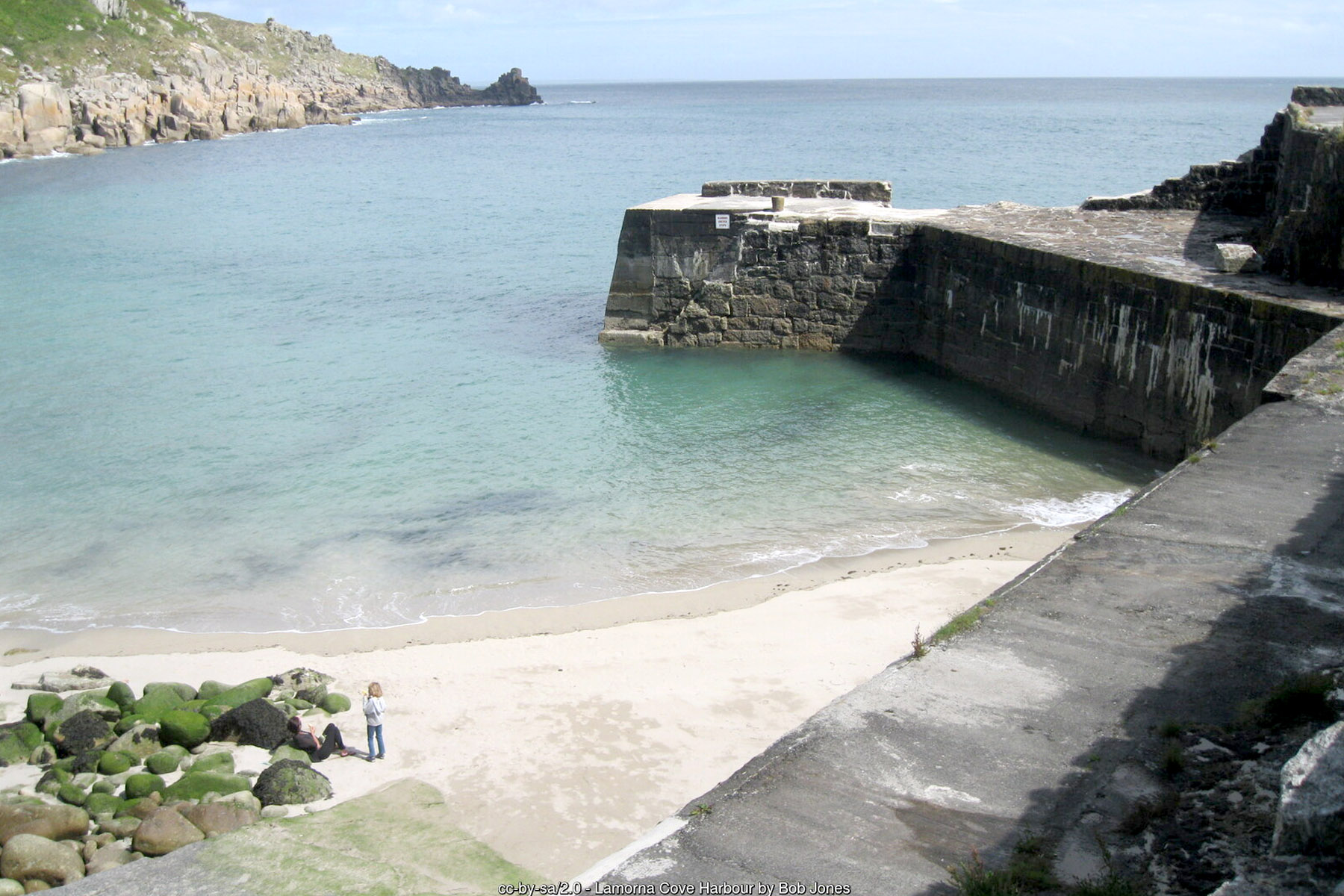
Getting that stone to market shaped the cove as much as the quarrying itself. In the industry's earlier years, granite was shipped directly out of Lamorna via an iron pier built for the purpose, allowing vessels to load close to the workings rather than relying on cart tracks over difficult ground. As the industry matured, logistics shifted increasingly to road transport, with stone hauled out through Newlyn rather than loaded straight from the cove, a change that reflects the wider nineteenth-century move from small coastal shipping points towards better road and rail connections even in Cornwall's remotest corners. Not every venture here succeeded: a second quarry on the western side of the cove was abandoned as a failure, its granite found to contain too high a proportion of quartz to be commercially workable, a reminder that even a well-established quarrying valley like Lamorna's could not guarantee good stone from every seam. The late-nineteenth-century quay that served the surviving quarries, built to withstand a genuinely exposed stretch of coast, still stands at the heart of the cove today and is now a Grade II listed structure in its own right, as much a monument to Lamorna's industrial past as any inland ruin.
By the time the quarries were winding down in the early twentieth century, Lamorna had already begun acquiring a very different kind of reputation. The valley became a genuine satellite of the Newlyn School, the colony of plein-air painters who had settled around Newlyn's fishing harbour from the 1880s onwards, drawn to Cornwall's distinctive quality of light and its ready-made subject matter of working boats, fisherfolk and dramatic coastal scenery. Lamorna's own artistic identity crystallised around Samuel John Birch, who took up residence in the valley in 1908 and became so closely associated with the place that he was known ever after as "Lamorna" Birch, the valley itself taking its informal artistic nickname from him rather than the other way around. He was joined over the following years by other major figures of the Cornish art world, including the sporting and equestrian painter Alfred Munnings, and Laura and Harold Knight, whose work in and around Lamorna and Newlyn helped define an entire era of British painting. For a cove this size to have hosted painters of that stature, working within sight of the same granite quay that had shipped stone to Dover and the Bishop Rock, is a striking juxtaposition of industrial and artistic heritage rarely found together so completely.
That artistic colony has continued to resonate well beyond its own lifetime. Jonathan Smith's 1998 novel "Summer in February" drew directly on the Lamorna art colony and its personalities, and the book was adapted into a 2013 film of the same name, bringing the valley's Edwardian-era artistic world to a much wider audience more than a century after Birch first settled here. The Lamorna Arts Festival, launched in 2009, continues that thread in the present day, celebrating the valley's artistic heritage with exhibitions and events that draw on the same landscape and light that first attracted the Newlyn School painters over a hundred years earlier. Few small Cornish coves can point to a living festival tradition so directly rooted in their own nineteenth-century history.
Lamorna's list of notable connections does not end with the painters. Derek and Jean Tangye farmed nearby at Minack - not to be confused with the well-known open-air Minack Theatre near Porthcurno further along the coast, an entirely different "Minack" - and Derek Tangye's popular "Minack Chronicles" book series drew on their life in this corner of Penwith, introducing generations of readers to the landscape around Lamorna and the neighbouring coves. The actor Robert Newton, best remembered for his swaggering screen performances as Long John Silver, was educated in the area and, fittingly for a man so associated with the sea, had his ashes scattered in the waters of Lamorna Cove itself. The valley's dramatic, isolated scenery has also drawn film-makers: Lamorna appeared as a filming location in Sam Peckinpah's controversial 1971 thriller "Straw Dogs", and the cove's atmospheric reputation is further reflected in its literary afterlife, having inspired the title of Martha Grimes' crime novel "The Lamorna Wink". Taken together, this is an unusually dense cluster of artistic, literary and cinematic associations for a cove that most visitors reach simply by following a quiet valley road down from the coast path.
For visitors today, Lamorna Cove remains a genuinely practical place to stop as well as a historically rich one. Parking is available directly adjacent to the harbour, saving the long walks-in required at many of the more remote coves further along the Land's End coast, and there are public toilets and refreshments close to the water, making it a comfortable base for a few hours even outside the height of summer. Dogs are allowed at the cove, and the South West Coast Path passes directly through, giving walkers an easy launching point for excursions in either direction: west towards the sheltered fishing cove of Penberth, or east towards the harbour towns of Mousehole and Newlyn, both within comfortable walking or driving distance and worth the detour for their own working-harbour atmosphere. The cove's south-east-facing aspect gives it a degree of shelter from the prevailing south-westerlies that batter more exposed stretches of this coast, and on a calm day the combination of granite boulders, clear water and the old quarrying quay makes for some of the most striking coastal scenery anywhere in the Land's End Area.
What sand there is at Lamorna appears only as the tide retreats, tucked among the boulders rather than forming the open sweep found at beaches like Sennen or Porthcurno further along this stretch of coast, so this is a cove better suited to rock pooling, gentle exploring and appreciating the setting than to a conventional sandy beach day. Among the boulders and rock pools at low tide, the usual cast of sheltered Cornish shoreline life can be found - shore crabs, anemones and small fish - while the cliffs and coast path above the cove are good ground for spotting choughs, the red-billed, red-legged crow that has become something of an emblem of the Cornish coast after returning to breed here in the early 2000s following a long absence, along with the peregrines, gulls and other seabirds typical of this stretch of the Penwith coastline. There is no RNLI lifeguard patrol here, and as with most of the smaller coves along this coastline, visitors should take sensible care on the wet granite around the harbour and keep an eye on the state of the tide before venturing far among the rocks.
As the final and easternmost beach in Cornwall Online's Land's End Area guide, closest of them all to Mousehole and Penzance, Lamorna makes a fitting conclusion to the folder. It is a cove where Cornwall's industrial past - quarried granite that helped build some of the most exposed lighthouses in Britain, shipped out through a harbour that still stands as a listed monument in its own right - sits directly alongside one of the county's richest artistic legacies, all within a landscape still dramatic and largely unchanged since Birch, Munnings and the Knights first set up their easels here well over a century ago. Few short stretches of the South West Coast Path pack in quite so much: working harbour heritage, wild granite scenery, a still-active arts festival tradition, and a genuine web of literary and cinematic connections, from the Tangyes' Minack Chronicles to Peckinpah's "Straw Dogs", all converging on a cove barely large enough to hold a handful of boats at its quay.
Visitor Information
Parking
Parking is available directly adjacent to the harbour at Lamorna Cove, making this one of the more straightforward coves to reach in the Land's End Area.
Facilities
Public toilets and refreshments are available at the cove. Further shops, pubs and services can be found nearby in Mousehole and Newlyn.
Disabled Access
Parking right beside the harbour makes the quay and its immediate surroundings reasonably accessible, though the boulder-strewn cove itself and the sand exposed at low tide are uneven underfoot. No dedicated Blue Badge bays are confirmed - check current signage on arrival.
Things to Do Nearby
- Penberth Cove, a sheltered working fishing cove a short distance west along the coast path
- The Lamorna granite quarry remains, best explored on foot via the coast path through the wooded valley behind the cove
- Mousehole and Newlyn, the nearest harbour towns eastward, both within easy reach by car or on foot
Places to Stay
Lamorna Cove has its own dedicated accommodation listings, the closest genuine hub to the cove:
Frequently Asked Questions
Page last updated: 17 September 2026