Penberth Cove
A Living, Working Cornish Fishing Hamlet
Penberth Cove, near St Buryan, Land's End Area, Cornwall, TR19 6HJ
Penberth Cove is one of the last genuinely traditional fishing coves left anywhere in Cornwall, a tiny, granite-walled hamlet where a small handful of local fishermen still make their living from the sea today, much as their families have for generations. Tucked into a narrow valley near St Buryan in the Land's End Area, Penberth has no shop, no beach café, and almost none of the trappings that mark out Cornwall's more visited coves - and it is precisely that absence, combined with a working slipway that is still used every day, that gives Penberth its unusual, lived-in atmosphere. Owned and managed by the National Trust, the cove has been protected from development for decades, and the huddle of stone cottages, fish cellars and boat sheds around its small beach looks, in large part, much as it would have done a century or more ago.
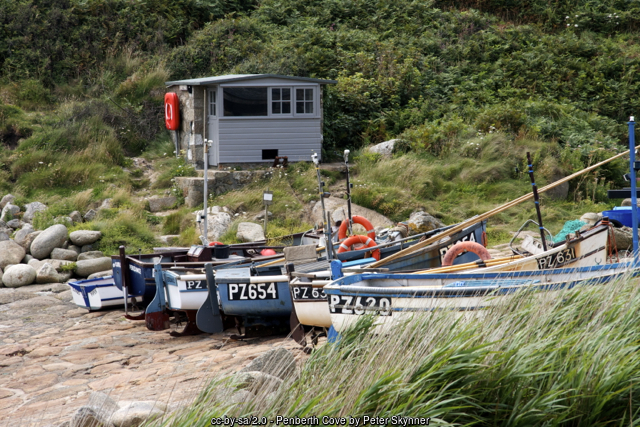
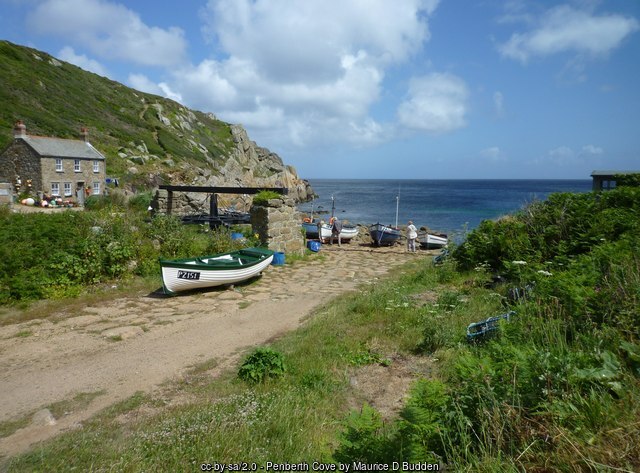
The heart of Penberth is its working slipway, a steep, cobbled ramp running down into the cove where the local fishing boats are hauled clear of the water between trips. Rather than a modern winch or a tractor, the boats are still hauled up using traditional wooden capstans - simple, sturdy, rope-and-drum mechanisms turned by hand or with the help of a small motor, largely unchanged in design from those used by generations of Penberth fishermen before. Seeing these capstans and the slipway in daily use, rather than preserved behind glass as a museum piece, is a genuinely rare thing on the Cornish coast today, and it is the single detail that visitors and photographers come to Penberth for above all else. Dogs are welcome on the coast path through and around the cove, but are not permitted on the slipway itself or on the fish-landing areas at the back of the beach, out of respect for the working fishermen and their gear.
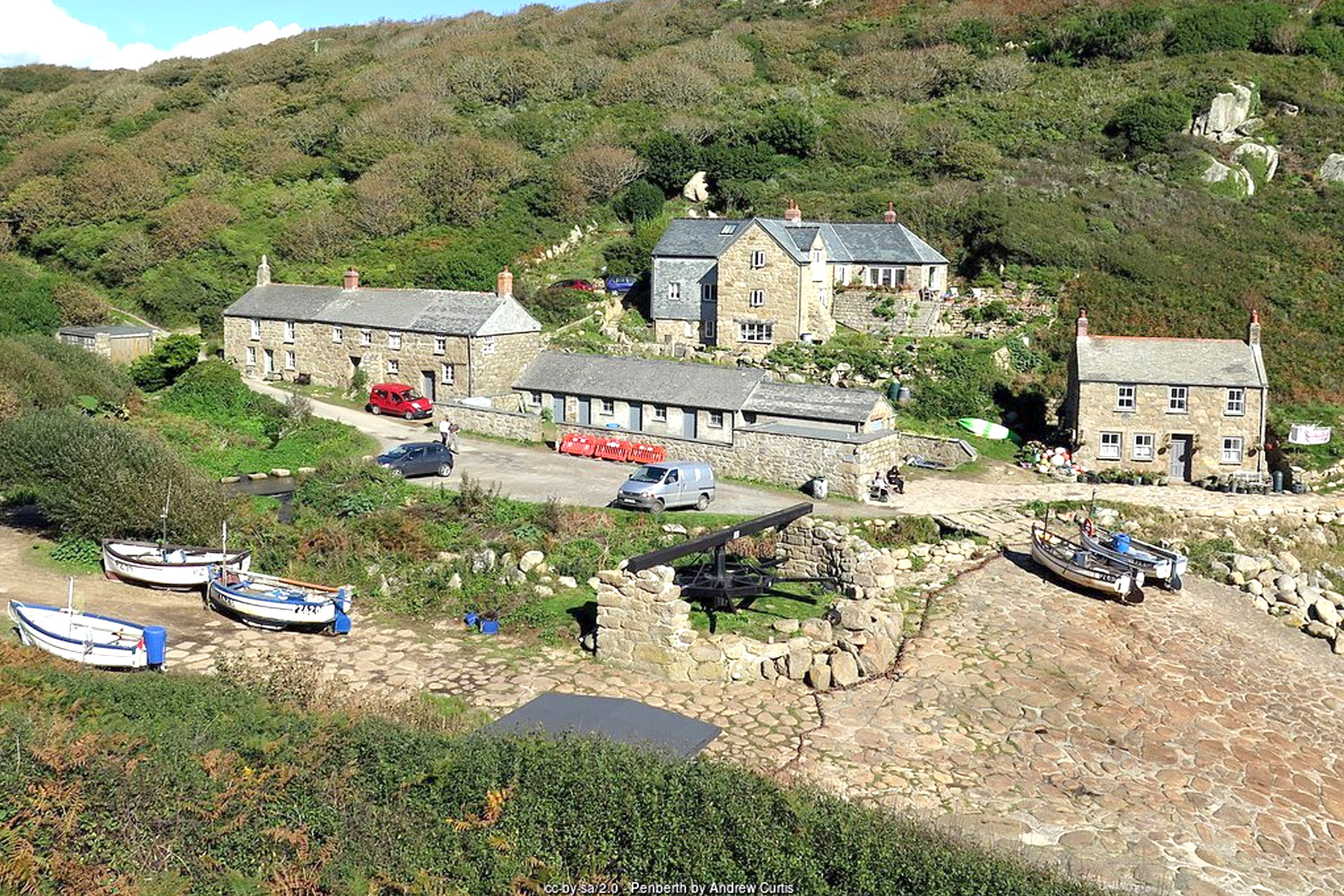
Penberth's history as a working fishing settlement stretches back centuries, and it was once a significant centre for pilchard fishing, part of the huge seasonal shoals that sustained much of west Cornwall's coastal economy from the medieval period right through to the early twentieth century. Pilchards landed at Penberth were historically pressed on site to extract their oil - a valuable by-product used for lighting and other purposes - before the fish themselves were salted and preserved in what is still known locally as the "Big Cellar," a substantial stone-built store at the back of the cove that once formed the practical heart of the pilchard-curing operation here. Cellars of this kind, purpose-built for pressing and preserving the pilchard catch, are a defining feature of west Cornwall's historic fishing coves, and Penberth's own example is a well-preserved reminder of just how central this single fishery once was to daily life along this stretch of coast.
Fishing was never the whole of Penberth's economy, however. In the nineteenth and early twentieth centuries the sheltered, south-facing valley behind the cove also supported a notable cut-flower growing industry, taking advantage of Cornwall's mild microclimate to produce early spring blooms - narcissi and violets among them - that were cut, bunched and sent up to London by train from Penzance, arriving in the capital's markets weeks ahead of flowers grown further north or east. That trade, like much of Cornwall's early flower-growing industry, brought a welcome second income to fishing families through the leaner winter months, and traces of the old flower fields can still be made out in the terraced ground above the cove. The community's social calendar had its own fixture too: the first Penberth regatta was held in 1881, a day of sporting and festive events on and around the water that reflected the tight-knit character of a hamlet where fishing families, flower growers and their neighbours all lived and worked within sight of the same small beach.
Penberth Cove itself is small and shingle-backed rather than a broad sandy beach, tucked at the base of steep valley sides that funnel a freshwater stream down to the sea alongside the slipway. Swimming is possible here at high tide, when the water fills the sheltered cove and the shingle gives way to enough sea for a proper dip, though conditions are best judged on arrival rather than assumed, since this remains a working beach with boats, moorings and fishing gear sharing the same small space. There is no RNLI lifeguard patrol at Penberth, and no formal wheelchair access down into the cove - the approach from the car park is along a narrow, uneven lane and coast path, so visitors with mobility needs should be aware of the terrain before setting out. A small car park sits a short walk above the cove, with public toilets nearby, roughly 200 yards before the beach itself; there is no café or shop at Penberth, so it is worth bringing food and drink for the visit.
In more recent years, Penberth's unspoilt, timeless appearance has brought it a different kind of recognition: the cove has become a popular filming location, and it gained particularly wide attention for appearing in the BBC television series Poldark, whose producers made extensive use of west Cornwall's unaltered coastal villages to stand in for the show's eighteenth-century setting. For many visitors today, that association is their first introduction to Penberth, though the cove's working slipway and resident fishing boats give it a far more enduring claim to authenticity than any television credit - this is a place that still does, in miniature, exactly what it has always done, rather than one dressed up to look the part.
The South West Coast Path runs directly through Penberth, following the stream down into the cove before climbing away again on the far side, and the cove makes a natural stopping point on some of the finest coastal walking in the Land's End Area. Heading west, the path continues on towards Porthcurno and the clifftop above Pedn Vounder, both within an easy walk; heading east, it runs on towards Lamorna Cove and, beyond that, eventually to Mousehole, a walk of around half a day for those covering the fuller stretch. Along the way the path passes through classic west Cornwall cliff scenery - granite outcrops, gorse and heather moorland, and small, secluded coves largely unreachable by road - making Penberth as much a highlight for coast-path walkers passing through as it is a destination in its own right for those who come specifically to see its working slipway and capstans.
Penberth's protection from development owes a great deal to the National Trust, which acquired the cove and much of the surrounding coastline as part of Enterprise Neptune, the ambitious fundraising campaign launched in 1965 to buy up and safeguard stretches of unspoilt British coast before postwar development could reach them. Land's End's granite cliffs, with their combination of dramatic scenery and small working communities like Penberth, were an early and significant target of that campaign, and the Trust's continued ownership here is a large part of why the cove still looks and functions much as it always has, rather than having been given over to holiday lets, car parks or visitor infrastructure. The cottages clustered around the cove remain a mix of working fishing families' homes and Trust-let properties, and the whole hamlet is managed with a light touch that prioritises the ongoing fishing operation over tourism.
The cliffs either side of Penberth are also worth watching for wildlife. This stretch of the far west Cornish coast was at the centre of one of British conservation's genuine good-news stories when Cornish choughs - the red-billed, red-legged crow that appears on Cornwall's own coat of arms and was long considered locally extinct - naturally recolonised the cliffs around the Lizard and Land's End in 2001 and 2002 after an absence of several decades, and their distinctive calls can now sometimes be heard along the cliffs around Penberth and neighbouring Treen. Grey seals are also occasionally seen fishing or hauled out on the rocks around the cove's mouth, part of a healthy population found along much of this granite coastline, and always best watched from a respectful distance rather than approached. St Buryan itself, the parish within which Penberth sits, has its own deep history quite apart from the coast: the village is home to St Buryan's, a handsome medieval church that was for centuries one of only a small number of collegiate churches in Cornwall, traditionally said to have been founded by King Athelstan in the tenth century after his conquest of the Isles of Scilly, and its tall granite tower remains a landmark visible for miles across the surrounding farmland - a reminder that this quiet corner of the Land's End peninsula has been settled and valued for a very long time indeed, long before Penberth's fishing boats and capstans became a draw in their own right.
Visitor Information
Parking
A small car park sits a short walk above the cove, roughly 200 yards from the beach itself. There is no parking down at the cove, which remains a working fishing beach.
Facilities
Public toilets are located near the car park (TR19 6HJ). There is no beach café or shop at Penberth - bring your own food and drink. Dogs are welcome on the coast path but not on the slipway or fish-landing areas.
Disabled Access
There is no formal wheelchair access to Penberth Cove - the approach is along a narrow lane and coast path with uneven, sloping ground. No dedicated Blue Badge bays are confirmed at the car park - check current signage on arrival.
Things to Do Nearby
- Pedn Vounder, a short walk west along the coast path, one of Cornwall's most spectacular beaches
- Lamorna Cove, a further working cove along the coast path to the east
- South West Coast Path, which runs directly through Penberth on its way between Porthcurno and Mousehole
Places to Stay
Penberth sits within St Buryan parish, the closest genuine accommodation hub to the cove:
Frequently Asked Questions
Page last updated: 17 September 2026