Porthgwarra
An Unspoilt Cove of Hand-Carved Tunnels and Seawatching Cliffs
Porthgwarra, near St Levan, Land's End Area, Cornwall, TR19 6JR
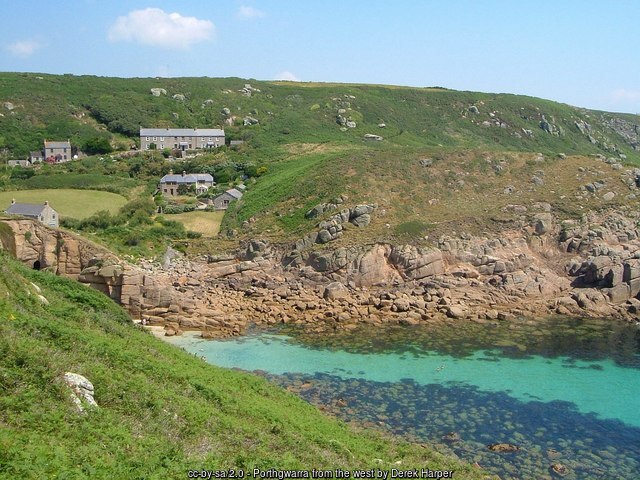
Porthgwarra is a small, sheltered cove near the hamlet of St Levan, on the far western tip of Cornwall a short drive south of Land's End itself. It is reached along the A30 towards Land's End, then the B3315 before Porthcurno, before turning down a narrow, winding lane that drops through the tiny hamlet of Polgigga to the cove below - a route that discourages passing traffic and helps keep Porthgwarra feeling like a genuinely low-key, characterful corner of Cornwall rather than a stop on the main tourist circuit. That character is a large part of the cove's appeal: unlike many of Cornwall's better-known beaches, Porthgwarra has resisted much in the way of development, and a visit here still feels like arriving somewhere quietly working rather than somewhere built purely for visitors.
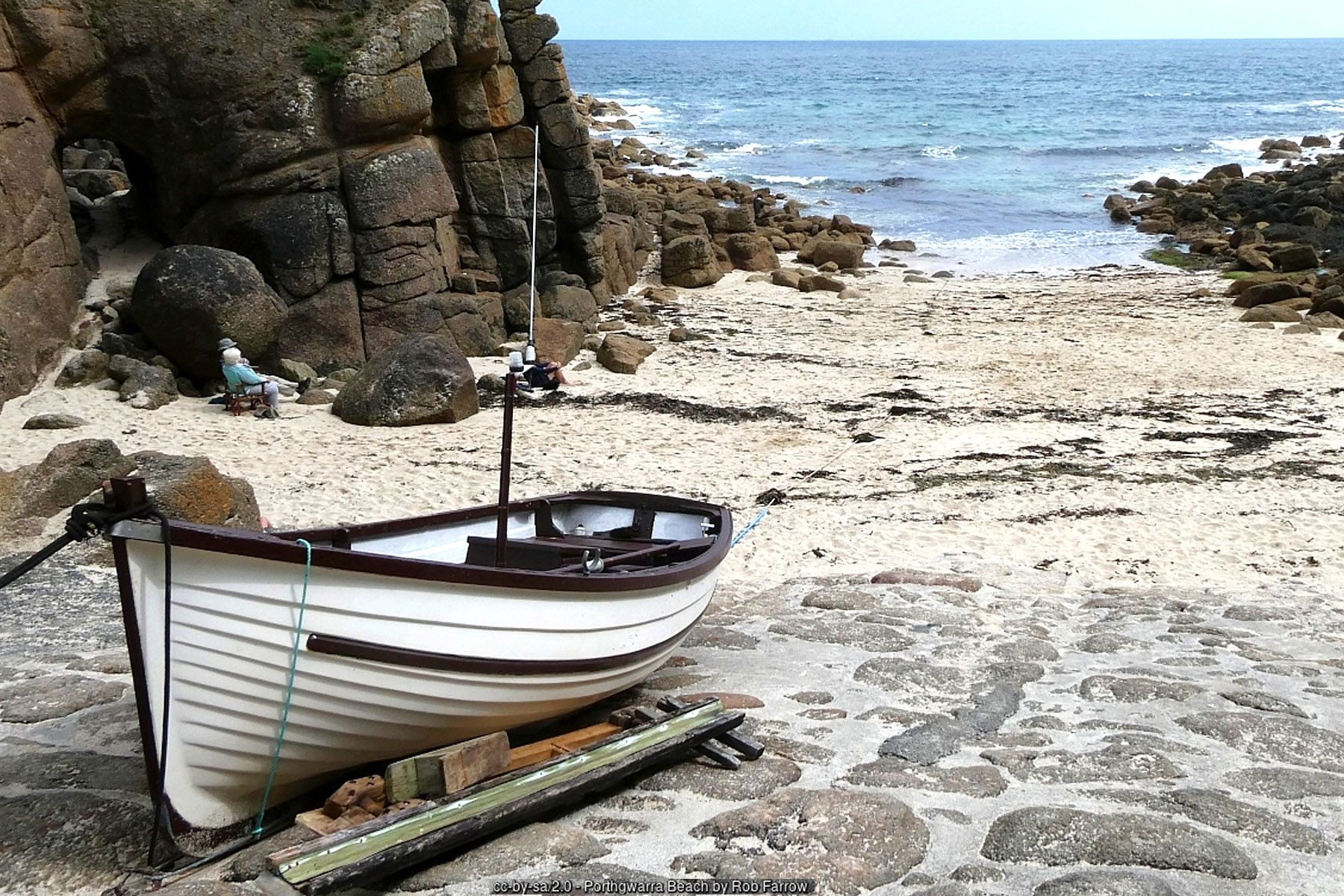
Despite its remote, unspoilt feel, Porthgwarra is well provided for by the standards of Cornwall's smaller coves. A reasonable-sized car park sits just above the beach, free for the first thirty minutes and reasonably priced thereafter, making it entirely practical for a short stop as well as a full day out. Public toilets, a red telephone box - now something of a period curiosity in its own right - and a small shop and café with outdoor seating complete the cove's facilities, giving visitors somewhere to get a cup of tea or an ice cream with a sea view without in any way disturbing the wider sense that Porthgwarra remains, at heart, a working Cornish cove rather than a resort.
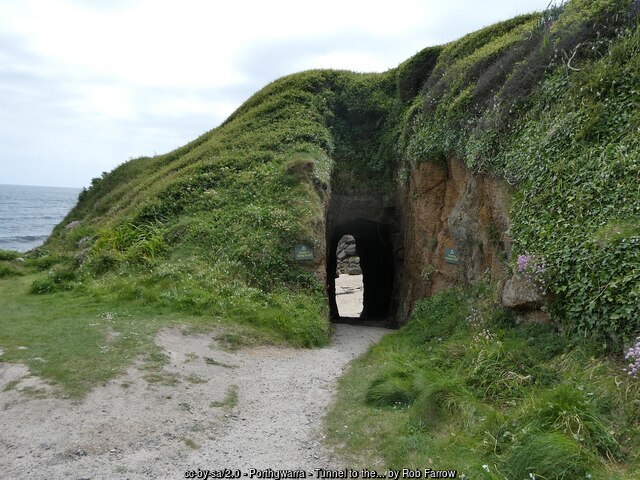
The cove's most distinctive and unusual feature is its pair of hand-carved granite tunnels, cut directly through the cliffs by local miners during the 1880s. These were not built for show: they served a genuinely practical dual purpose for the small fishing and farming community here, giving direct access down to the shore for the collection of seaweed - long used in West Cornwall as a fertiliser for the thin coastal soil - and providing tidal storage pits cut into the rock where fishermen could keep their catch fresh, submerged by the sea at high tide, until it could be sold or carried away. The tunnels remain fully walkable today, cool, damp, and running with the unmistakable smell of the sea, and walking through one to emerge onto the slipway beyond is one of the small, memorable experiences that sets a visit to Porthgwarra apart from an ordinary beach trip.
Porthgwarra's setting - a narrow, steep-sided cove with a stone slipway used for generations to launch small boats - gives it real shelter from the prevailing weather, though visitors should be aware that currents beyond the immediate shelter of the cove can be strong, and there is no RNLI lifeguard service here. Anyone venturing further out to swim should do so with real caution, keeping close to shore and being mindful of the tide, while the sheltered inner cove itself remains a popular and generally calmer spot for a paddle or a swim close to the slipway on a settled day.
In recent years, Porthgwarra has found an unexpected second life as a genuine filming location for the television series Poldark, whose sweeping Cornish landscapes drew audiences and location-hunters from around the world. The cove itself appears in the series, most memorably as the setting for one of its most talked-about and widely remembered scenes - a swimming sequence watched from the cliffs above that became, for many viewers, one of the defining images of the show's Cornish setting. Fans of the series regularly make the trip specifically to stand where those scenes were filmed, and the cove's combination of dramatic cliffs, a sheltered slipway and genuinely unspoilt surroundings explains exactly why the location scouts chose it.
Beyond its television fame, Porthgwarra has a long-standing reputation among a rather different community: birdwatchers. The cove and the cliffs around it are recognised as one of Cornwall's best-known seawatching points, a place where migrating seabirds - shearwaters, skuas, petrels and a wide range of other pelagic species - pass close inshore in numbers during spring and, especially, autumn passage, as the Land's End peninsula funnels birds moving along this stretch of the Atlantic coast. On a good day with the right wind direction, experienced birdwatchers can be found stationed on the cliffs above the cove for hours at a stretch, and Porthgwarra's name is well known well beyond Cornwall in birding circles for exactly this reason.
The cove also sits directly on the South West Coast Path, making it a natural stopping point for walkers tackling this dramatic stretch of coastline between Land's End and Porthcurno. The path north leads towards Nanjizal and on to Land's End itself, while the route south continues towards Porthchapel, the Minack Theatre and Porthcurno, taking in some of the most rugged and rewarding clifftop scenery anywhere in Cornwall. That short stretch south towards the Minack is itself one of the most photographed sections of the entire South West Coast Path, and many visitors combine a morning at Porthgwarra with an afternoon at the open-air theatre carved into the cliffs above Porthcurno, a natural pairing of two of this coast's most distinctive attractions.
Porthgwarra's seawatching reputation deserves a closer look, since it is genuinely one of the reasons serious birdwatchers travel long distances specifically to stand on these cliffs. During the right conditions in autumn, typically a good westerly or southwesterly blow pushing birds in close to shore, species such as Cory's shearwater, Balearic shearwater, great and Arctic skuas, and a wide range of other pelagic seabirds can pass the headland in genuinely large numbers within a single watch, sightings that would otherwise require a boat trip far out to sea. The cove's position at the very tip of the Land's End peninsula, jutting further into the Atlantic than almost anywhere else in mainland Britain, is exactly what makes it such an effective natural vantage point, and a loose but dedicated community of birdwatchers can often be found here through the autumn passage season, sharing sightings and equipment with the same easy informality that characterises the cove itself.
Like much of this stretch of coast, Porthgwarra's history is bound up with small-scale fishing and crofting rather than any grander industry - a scatter of cottages, the old fish cellar and the hand-cut tunnels are the visible legacy of a community that worked this shoreline for generations before tourism and, more recently, television brought wider attention to the cove. That modest, unpolished working history is part of what gives Porthgwarra its particular charm today: nothing here was built for visitors first, which is precisely why it still feels genuine when they arrive.
The cove takes its name from the Cornish "porth," meaning cove or harbour, a naming pattern repeated up and down this coast at Porthcurno, Porthchapel and Porthleven among many others, each describing a small, sheltered landing rather than a grand harbour in the conventional sense. St Levan parish itself, within which Porthgwarra sits, takes its name from the sixth-century Cornish saint Selevan, traditionally said to have lived as a hermit close to the coast here, and the parish church a short distance inland retains a genuinely ancient, low-key character in keeping with the cove below it. The granite that frames Porthgwarra's slipway and tunnels is the same Land's End batholith found the length of this peninsula, weathered here into the low, tumbled cliffs and rock ledges that shelter the cove from the worst of the prevailing Atlantic swell, and it is that shelter, as much as anything, that has allowed a small settlement to work this shoreline for so many generations where a more exposed cove could not.
Combined with its tunnels, its Poldark connection, its seawatching reputation and its genuinely unspoilt, low-key character, Porthgwarra offers a rare thing on the Cornish coast: a beach that feels discovered rather than packaged, well worth the drive down that narrow lane through Polgigga to reach it.
Visitor Information
Parking
A reasonable-sized car park sits just above the beach, free for the first 30 minutes and reasonably priced thereafter - a practical option for both a short stop and a full day out.
Facilities
Public toilets, a red telephone box and a small shop and café with outdoor seating are all at the cove. Hand-carved granite tunnels lead down to the slipway and shore.
Disabled Access
The car park is close to the cove, but the approach down to the slipway and shore is steep and uneven in places. No dedicated Blue Badge bays are confirmed - check current signage on arrival.
Things to Do Nearby
- Nanjizal (Mill Bay), a wild, road-free beach reached along the coast path to the north
- Porthchapel, a quieter beach further along the coast path towards the Minack Theatre and Porthcurno
- The South West Coast Path around Porthgwarra, one of Cornwall's best-known seawatching points for migrating seabirds
Places to Stay
Porthgwarra has its own dedicated accommodation listings:
Frequently Asked Questions
Page last updated: 17 September 2026