Nanjizal (Mill Bay)
A Wild, Road-Free Cove Beneath the Song of the Sea
Nanjizal (Mill Bay), near Land's End, St Levan, Cornwall, TR19 7AR
Nanjizal, more often known locally as Mill Bay, lies about a mile southeast of Land's End in the civil parish of St Levan, and is one of the wildest and least accessible beaches anywhere on the Cornish mainland. There is no road to it at all, and no car park anywhere near the sand - the only way in is on foot, along the South West Coast Path, either from the Land's End visitor complex to the north or from the tiny cove of Porthgwarra to the south, each route taking roughly twenty to thirty minutes over genuinely dramatic clifftop walking. That total absence of vehicle access, unusual even by the standards of Cornwall's more remote coves, is precisely what has kept Nanjizal as close to untouched as any beach in the county: no shop, no café, no toilets, no deckchairs for hire, nothing beyond sand, rock and the open Atlantic.
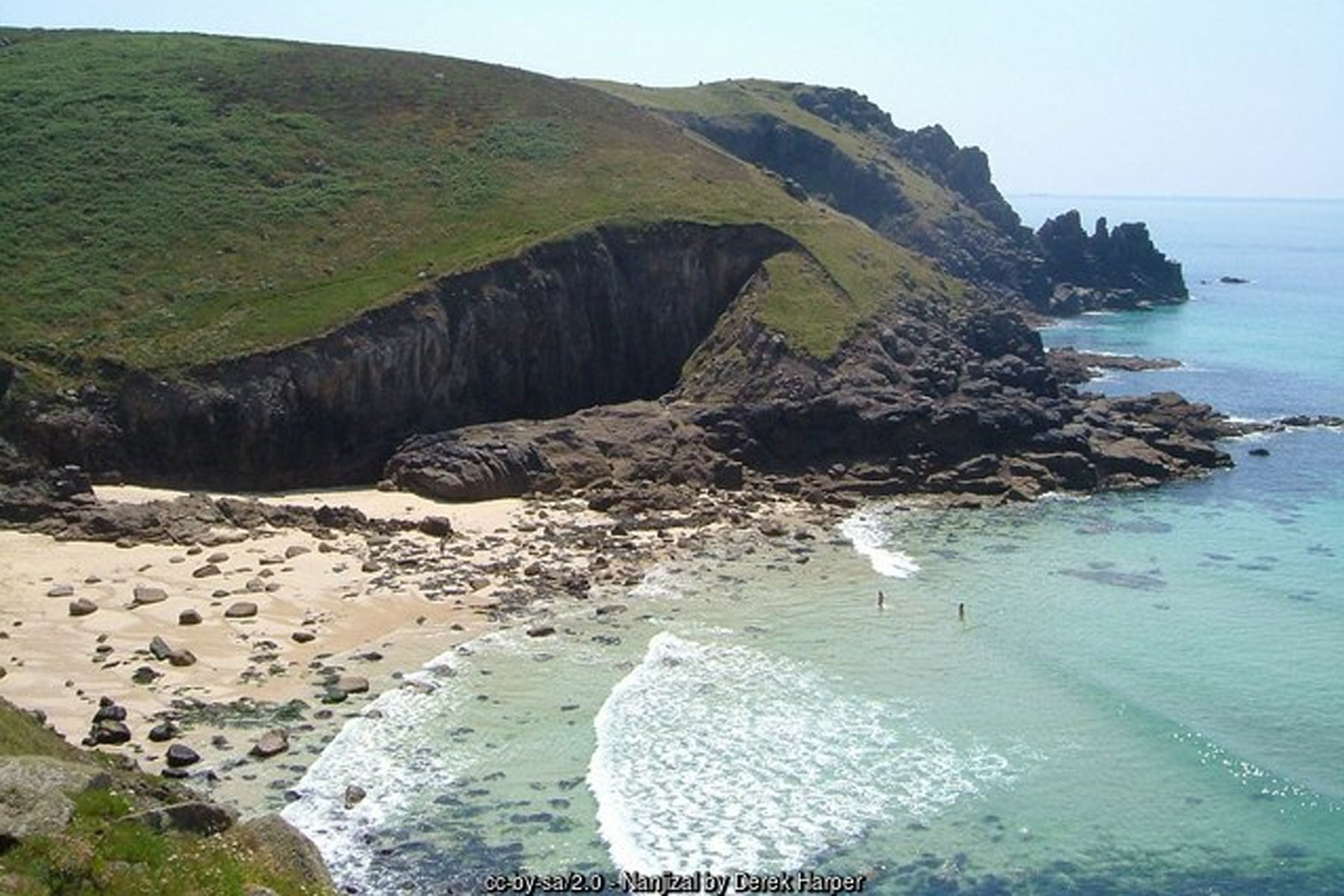
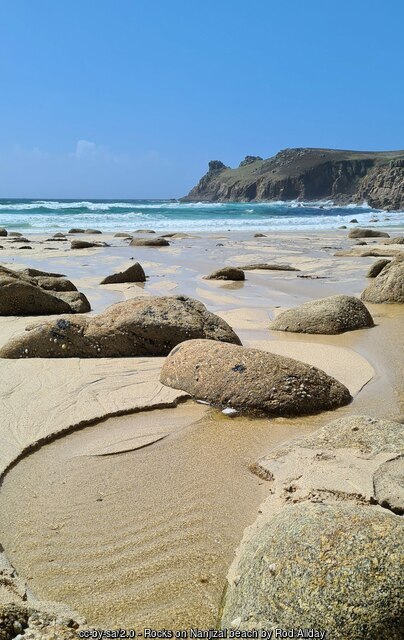
The beach itself faces almost due west into the full force of the Atlantic, and its character shifts noticeably with the tides and with the season: at some states of tide a broad expanse of pale sand is exposed, while after winter storms the same stretch can be scoured back to boulders and shingle, with the sand only slowly rebuilding over the calmer months that follow. This is a beach that genuinely looks different from one visit to the next, which is part of its appeal to the photographers, walkers and wild-swimmers who make the walk in specifically to see it. The bay is bounded to the north by Carn Boel and Trevilley Cliff, and to the south by Carn Lês Boel and Higher Bosistow Cliff, both stretches of rugged granite headland typical of the far western tip of Cornwall, and both offering superb, largely empty coast path walking in their own right.
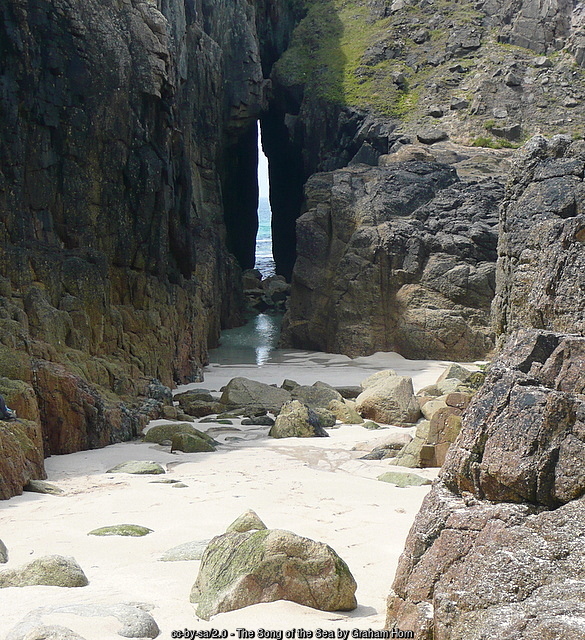
At the southern end of the beach is Nanjizal's single most distinctive feature: Zawn Pyg, Cornish for "pointed chasm," better known to most visitors simply as the Song of the Sea. Here the relentless action of the Atlantic has worn a tall, narrow passageway clean through the granite cliff, creating a natural rock arch that frames the sea beyond and fills, at the right state of tide, with the low, resonant boom of waves working their way through the confined space - the sound that gives the feature its name. It is one of the most photographed natural rock formations on this entire stretch of coast, drawing walkers and photographers who will happily make the twenty-minute walk from Land's End for this feature alone, and it rewards a visit at different states of tide and light, since the arch's appearance and the sound of the sea moving through it both change considerably between calm and rough conditions.
Nanjizal's rock pools are a quieter but equally rewarding draw, particularly for anyone interested in coastal wildlife rather than simply sand and sunbathing. Two named pools, Big and Little Muzzan, sit among the rocks towards the beach's margins and support a genuinely rich variety of sea anemones and seaweed, the product of a west-facing, wave-exposed shoreline that brings a good range of species within reach of a rock-pooling family at low tide. The wider hinterland behind the beach, taking in the cliffs and maritime heath of Carn Boel, Trevilley Cliff, Carn Lês Boel and Higher Bosistow Cliff, is recognised as a Site of Special Scientific Interest, protected for its granite cliff vegetation and heathland rather than for the beach itself - a reminder that Nanjizal's setting is every bit as significant, ecologically, as its sand.
That same stretch of coast has long been of interest to ornithologists. The area around Nanjizal is monitored by the West Cornwall Ringing Group, part of the informal but rigorous network of birdwatchers who record migrant species passing along the far western tip of Cornwall each spring and autumn, when the peninsula acts as a natural funnel for birds moving along the Atlantic coastline. The area's standing among British birdwatchers was underlined in 2008, when an alder flycatcher, a small North American songbird blown badly off course on its migration, was recorded here - the first confirmed record of the species anywhere in Britain, a genuinely rare event that drew birdwatchers from across the country to this otherwise little-visited cove.
Nanjizal also has a small but genuine footnote in television history. In June 1966, the beach was used as a filming location for "The Smugglers," a Doctor Who serial from the show's third season, its rugged, isolated coastline standing in for the smuggling-era Cornish coast the story required - a fitting role, given how little the setting itself has changed in the intervening decades. It is a minor detail set against the beach's geology and wildlife, but one that regularly surprises visitors who stumble across it while researching the walk.
Because Nanjizal has no facilities of any kind and no lifeguard cover, a visit here calls for a degree of self-sufficiency uncommon on Cornwall's more developed beaches. There is nowhere to buy food, water or sun cream, no toilets, and no one on hand in an emergency beyond whoever else happens to be walking the coast path that day - visitors should carry everything they need for the round trip, including plenty of water for the return climb, and check the tide and weather before setting out, since the sand can be largely covered at high tide and the walk back involves genuine clifftop terrain rather than a level path. The beach can also have strong currents, so swimming should be approached with real caution and only by confident, experienced sea swimmers comfortable with an unpatrolled Atlantic-facing bay.
The name Nanjizal is thought to derive from Cornish, and the more commonly used local alternative, Mill Bay, points to a small stream that runs down the valley behind the beach to meet the sea - the remains of an old mill once stood along its course, put to use grinding corn for the scattered farms of this thinly populated corner of St Levan parish, long before the coast path brought today's walkers and photographers this way. That same stream still cuts a fresh-water channel across the sand on its way to the Atlantic, adding a further small point of interest for children exploring the beach at low tide, and its valley gives the walk down from the coast path a brief change of pace, from open clifftop to a more sheltered, vegetated combe before the final descent to the shore.
Geologically, Nanjizal sits within the granite that forms the westernmost tip of the Cornish peninsula, part of the same Land's End granite intrusion responsible for the area's characteristically rugged, weathered tors and cliffs. It is this hard granite, rather than the softer slates found elsewhere along the Cornish coast, that has allowed the sea to carve such a clean, precise feature as the Song of the Sea arch, and the same rock gives the surrounding cliffs their pale, lichen-flecked colour and their tendency to break into the large, rounded boulders scattered across the upper beach. The maritime heath above the cliffs, part of the SSSI designation covering this stretch, is at its best in late summer, when drifts of purple heather and pink thrift add real colour to what is, for the rest of the year, a starker, more elemental landscape of rock, grass and sea. Choughs, the red-billed, red-legged crow that is something of an unofficial emblem of Cornwall and only returned to breed in the county in 2001 after a long absence, are occasionally seen working the cliffs along this stretch, alongside the more familiar fulmars and gulls that nest on the ledges above the beach.
For all that, Nanjizal repays the effort of reaching it more generously than almost anywhere else on the Land's End coast. The walk in from either direction is itself one of the highlights - dramatic clifftop views, genuine solitude even in peak summer, and a real sense of arriving somewhere that has resisted the car park and gift shop treatment given to Land's End itself just up the coast. Combined with the Song of the Sea arch, the Big and Little Muzzan rock pools, and a wider setting rich enough in wildlife to have delivered a first-for-Britain bird record, Nanjizal stands as one of the most rewarding wild beaches anywhere in Cornwall for anyone prepared to walk to find it.
Visitor Information
Parking
There is no parking at Nanjizal itself. Use the car parks at Land's End or at Porthgwarra and walk in along the South West Coast Path, around twenty to thirty minutes either way.
Facilities
None at all at the beach. The nearest shops, toilets and refreshments are at the Land's End visitor complex or at Porthgwarra's small café - bring everything you need for the walk and the visit.
Disabled Access
Not accessible for wheelchairs or pushchairs. The only approach is a clifftop coast path walk of around a mile from Land's End or Porthgwarra, with no vehicle access and no Blue Badge provision of any kind.
Things to Do Nearby
- Whitesand Bay & Sennen Cove, a wide sandy surf beach a little further north around Land's End
- Porthgwarra, a sheltered cove reached along the coast path to the south, with a small café and free car park
- The South West Coast Path around Land's End, linking Nanjizal to both neighbouring beaches along dramatic clifftop walking
Places to Stay
Nanjizal has no accommodation of its own; Sennen is the closest genuine accommodation hub for this stretch of the Land's End coast:
Frequently Asked Questions
Page last updated: 17 September 2026