Portheras Cove
Unspoilt White Sand Beneath the Tin Coast
Portheras Cove, near Pendeen, Land's End Area, Cornwall, TR19
Portheras Cove is a small, genuinely unspoilt beach of fine white sand on Cornwall's north coast, tucked below the cliffs a short distance from the mining village of Pendeen. Facing north-west into the Atlantic, it sits within the stretch of coastline between St Just and Pendeen widely known as the "Tin Coast" - a landscape shaped as much by two centuries of hard-rock mining as by the sea itself, and now protected as part of the Cornwall and West Devon Mining Landscape UNESCO World Heritage Site. Unlike the region's larger, better-known beaches, Portheras Cove has deliberately been left without facilities of any kind: no shop, no cafe, no toilets, and no dedicated car park. What it offers instead is a genuinely quiet stretch of sand, dramatic granite cliffs on either side, and a setting that feels remote even though the village of Pendeen is barely a mile away.
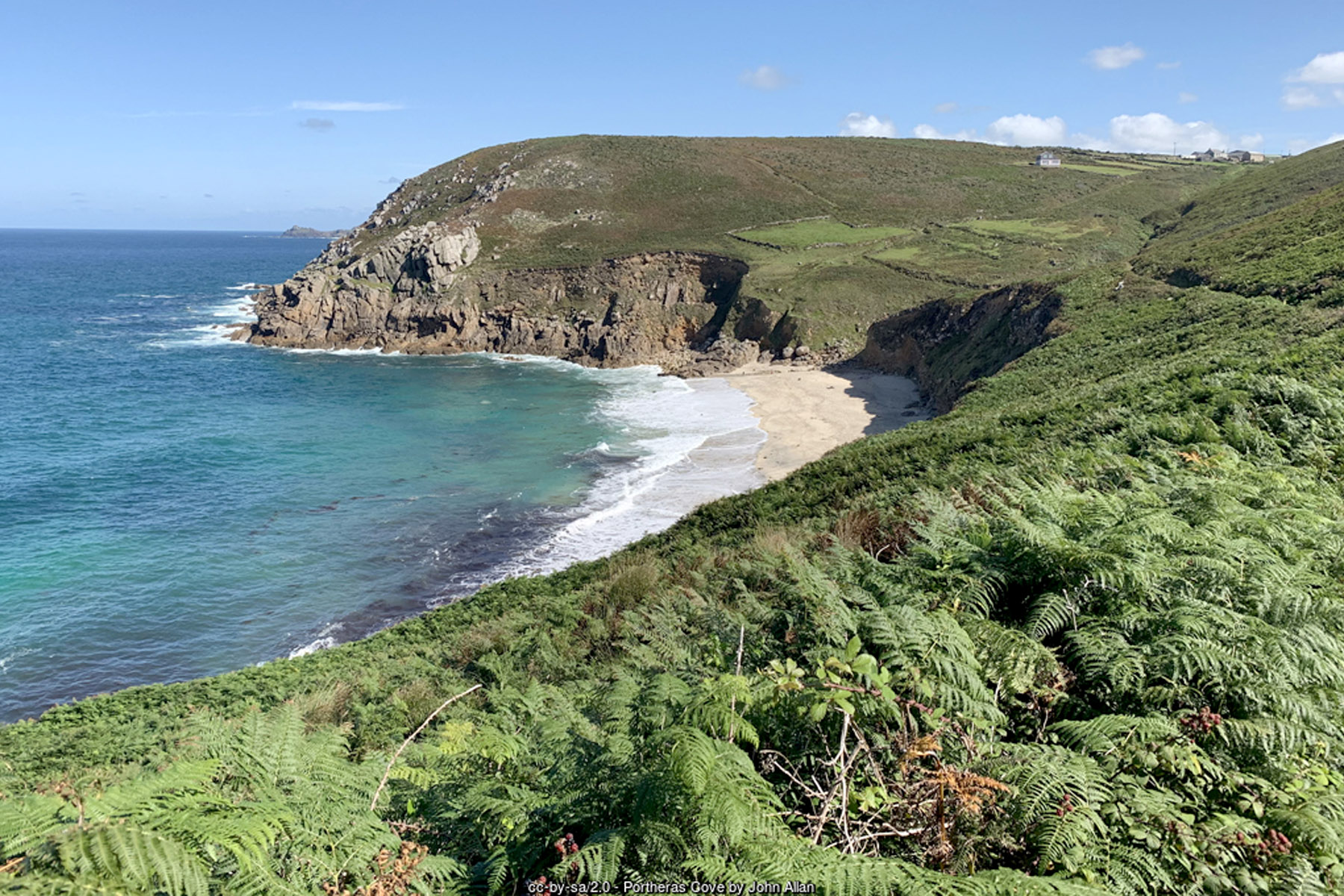
Reaching the beach takes a little more effort than at most Cornish resort beaches, which is precisely why it has stayed so quiet. There is no dedicated car park at Portheras Cove itself; visitors instead leave their car on the coast road near Pendeen and walk down to the beach along a footpath that drops through the small valley behind it, a walk of perhaps fifteen to twenty minutes depending on where parking is found. The absence of a formal car park, combined with the lack of any facilities at the beach, means Portheras Cove sees a fraction of the visitors of somewhere like Sennen Cove or Whitesand Bay further along the coast, even in high summer - a genuine trade-off for anyone willing to make the walk.
One quirk of Portheras Cove that every visitor should know about before arriving is the presence of sharp metal fragments embedded in parts of the sand, the legacy of a wreck that was deliberately dynamited here at some point in the past. The exact circumstances - the identity of the vessel, and precisely when the wreck was broken up - are not well documented, and rather than repeat unverified detail, it is enough to say that this stretch of coast has a long history of shipping casualties, and that some wrecks along the north Cornish coast were, at various times, deliberately dismantled or dispersed with explosives, whether for safety, salvage, or simply to clear a hazard from the shore. Whatever the precise history, the practical upshot for today's visitor is straightforward: fragments of metal remain scattered through parts of the sand, and sturdy footwear is strongly advised rather than going barefoot, particularly for children.
The beach itself is framed by granite cliffs typical of this stretch of the Penwith peninsula, part of the same granite pluton that underlies Land's End and much of West Cornwall. Millions of years of weathering by wind, rain and salt spray have carved the rock into the rounded, sometimes castellated forms familiar along this coast, and the same granite that shapes the cliffs also carried the mineral-rich lodes of tin and copper that drew miners to this coastline in the first place. Quartz veins threaded through the granite, often carrying cassiterite (tin ore) and copper minerals, are the reason this small stretch of the Cornish coast became one of the most intensively mined landscapes in the world during the eighteenth and nineteenth centuries, its geology and its industrial history inseparable from one another.
That mining history is impossible to miss on the approach to Portheras Cove, even though the beach itself has no mine workings directly on it. The surrounding cliffs and clifftop fields are dotted with engine houses, chimney stacks and shaft caps, remnants of a period when this coastline supported dozens of working mines. The closest and best known are Geevor Tin Mine, now a mining heritage museum and one of the largest preserved mine sites in the country, and Levant Mine and Beam Engine, a National Trust property famous both for its beam engine - the oldest of its kind in Cornwall still turned by steam - and for the tragic Levant Man Engine disaster of 1919, in which thirty-one miners died when the mechanical lift used to move men in and out of the mine failed. Both sites lie within a short drive of Pendeen and form part of the same UNESCO World Heritage Site that recognises this coast's global importance to the industrial history of mining.
Above the cove, on the approach from Pendeen, stands Pendeen Lighthouse, also known as Pendeen Watch, built in 1900 to warn shipping away from the dangerous reefs and rocky outcrops that lie off this stretch of coast - a stretch that had claimed numerous vessels before the light was built. Automated since the 1990s, it remains a working aid to navigation and a distinctive landmark visible from the coast path as it runs along the clifftop above Portheras Cove, a reminder that the same wild, exposed coastline that gives the beach its dramatic setting has also made it a genuinely hazardous one for shipping over the centuries.
At low tide, the rocks at either end of Portheras Cove open up into a good stretch of rockpooling, one of the beach's main attractions given its lack of any other facilities. Typical of this granite coast, the pools hold shore crabs, anemones, small fish and a variety of seaweed, rewarding an unhurried exploration as the tide drops. The wider area is also worth watching for wildlife beyond the rockpools: grey seals are occasionally seen off this stretch of coast, and choughs - the red-billed crow that is Cornwall's emblematic bird and which has recolonised the county's cliffs in recent decades after a long absence - are sometimes spotted along the cliffs of the Tin Coast, alongside more common gulls, fulmars and other seabirds nesting on the ledges above the beach.
The South West Coast Path runs along the clifftop directly above Portheras Cove, linking it in one direction towards Pendeen and on to the Tin Coast's mining heritage sites, and in the other direction south towards St Just and the coves of Cot Valley and Priest's Cove near Cape Cornwall - a genuinely scenic stretch of coast path walking that takes in some of the most dramatic mining-and-sea scenery anywhere in Cornwall. Given the lack of facilities at Portheras Cove itself, many visitors treat it as one stop on a longer coastal walk rather than a destination in its own right, though the beach rewards a dedicated visit too, particularly outside the busiest summer weeks when its quietness is most apparent.
There is no RNLI lifeguard patrol at Portheras Cove, and as with any unpatrolled north-coast beach, visitors should treat the sea with respect - currents and swell here can be stronger than the sheltered appearance of the cove might suggest, particularly on a rising tide or in any kind of onshore wind. No dog restrictions are signposted at the beach, but as at any unpatrolled, undeveloped cove, dogs should be kept under close control, not least given the metal fragments scattered through parts of the sand. Taken together, Portheras Cove is not a beach for those wanting facilities, sun loungers or a beach shop - it is a beach for those who want a genuinely quiet stretch of white sand, a proper walk to reach it, and a setting shaped as much by Cornwall's mining past as by the sea in front of it.
Visitor Information
Parking
There is no dedicated car park at Portheras Cove. Park on the coast road near Pendeen and follow the footpath down through the valley to the beach, a walk of around fifteen to twenty minutes.
Facilities
No facilities of any kind at the beach - no toilets, shop or refreshments. The nearest shops, pubs and services are in Pendeen village. Sturdy footwear is recommended due to metal fragments in the sand.
Disabled Access
Access is on foot only, via an unsurfaced footpath down through the valley, and is not suitable for wheelchairs or pushchairs. No car park exists at the beach, so no Blue Badge provision applies here.
Things to Do Nearby
- Cot Valley & Priest's Cove, near Cape Cornwall, a scenic South West Coast Path walk to the south
- Pendeen Lighthouse (Pendeen Watch), a working lighthouse above the coast just north of the cove
- The Tin Coast mining heritage sites around Pendeen, including Geevor Tin Mine and the National Trust's Levant Mine and Beam Engine, part of the Cornwall and West Devon Mining Landscape UNESCO World Heritage Site
Places to Stay
There is no dedicated accommodation hub specifically for Pendeen; the general Land's End Area hub is the nearest genuine match for this part of the coast:
Frequently Asked Questions
Page last updated: 17 September 2026