Whitesand Bay, Sennen Cove
Golden Sands and a Working Fishing Village Near Land's End
Seaside Award (2026)Whitesand Bay, Sennen Cove, Land's End Area, Cornwall, TR19 7DF Seaside Award (2026)
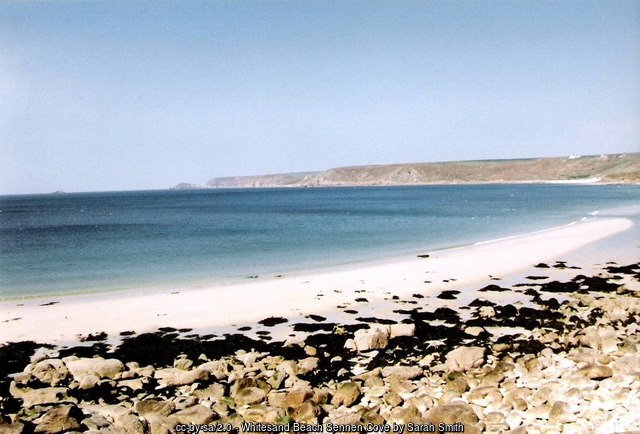
Whitesand Bay is the broad, west-facing sweep of golden sand that fronts the fishing village of Sennen Cove, on the very western tip of Cornwall close to Land's End. Roughly a mile long, running between the headlands of Pedn-mên-du and Aire Point, it is one of the most complete beaches in Cornwall for a day out - proper sand backed by a real working village rather than a purpose-built resort, with rocks emerging at its margins as the tide falls. It is worth being clear from the outset that this is a genuinely different beach from Whitsand Bay near Looe and the Rame Peninsula, at the opposite end of Cornwall on the south coast: the two names are near-identical on the page but describe unrelated stretches of coast more than seventy miles apart, and the spelling difference - Whitesand here, Whitsand there - is the only reliable way to tell which one a piece of writing is actually describing. Locally, this beach and the village behind it are usually just called Sennen Cove, with "Whitesand Bay" used more for the beach itself and the wider bay it sits in.
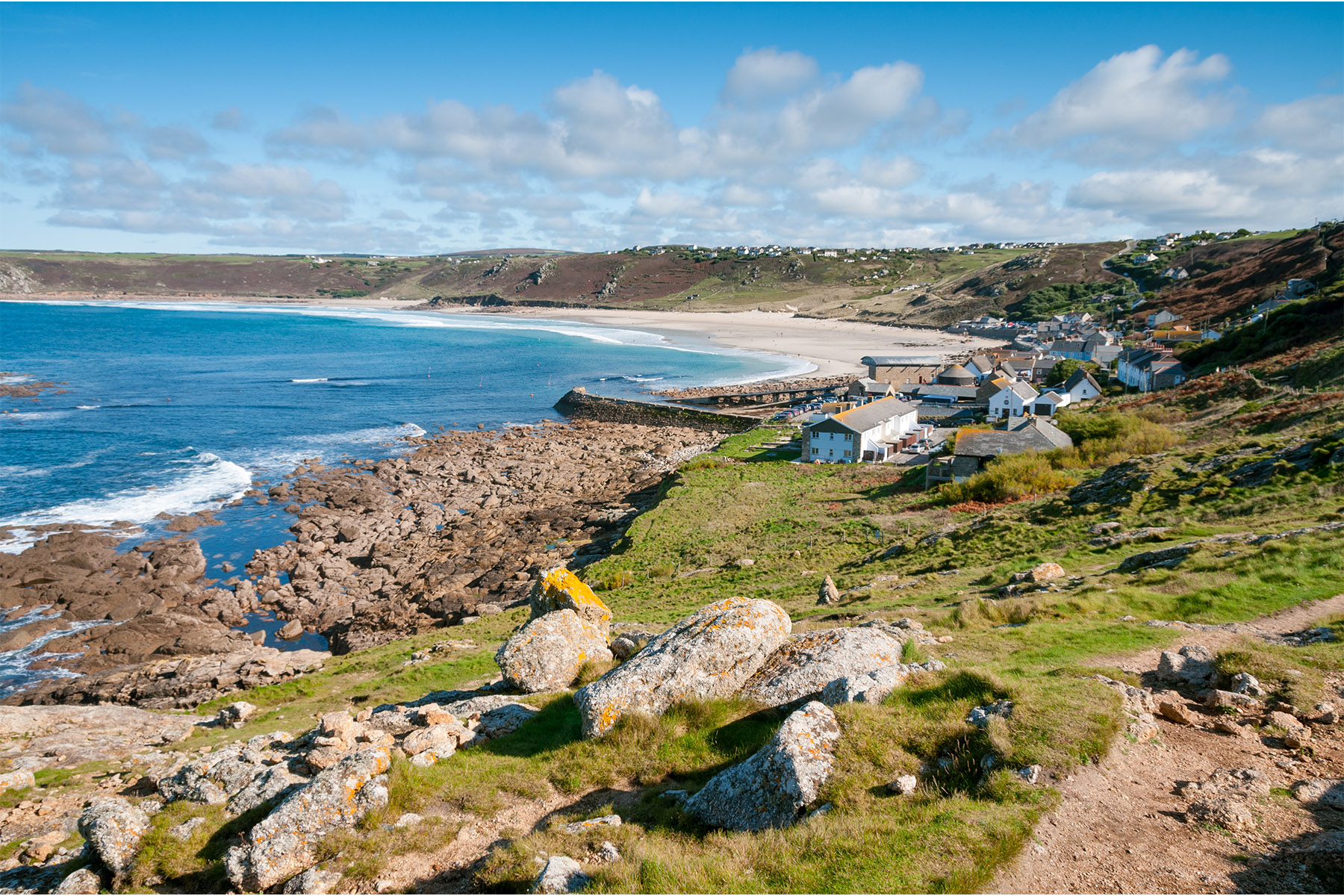
Facilities here are good by the standards of this remote corner of Cornwall: a car park directly behind the beach, public toilets, and a run of cafés, pubs and shops in the village immediately above the sand, including several outlets renting boards and wetsuits for the beach's well-established surf schools. RNLI lifeguards are on duty at Sennen through the main season, broadly the same May-to-September stretch of the year as at neighbouring Gwynver, and their beach is generally the calmer, more sheltered half of the wider bay - a genuine contrast with Gwynver's bigger, more committing surf a short walk to the north. Dogs are traditionally kept off the main beach through the Easter-to-October holiday season, in line with the seasonal restrictions applied at many of Cornwall's busier beaches, though visitors planning a trip around a specific date should check the current year's exact signage locally rather than rely on the traditional pattern alone, since some Cornish councils and parishes have adjusted their exact date ranges in recent years.
At the far southern end of the beach, towards Aire Point, there is an informal, unofficial area used by naturists, a long-standing but low-key arrangement rather than a designated or signed facility. Surfing is one of Sennen's defining attractions in its own right: the beach is highly regarded as one of Cornwall's most reliable and popular surf breaks, consistent enough to have supported several established surf schools for decades, and gentle enough in its southern reaches to make it a genuinely good place to learn - a useful contrast with the more serious, experienced-surfer waves at Gwynver just around the point.
Above the beach, the RNLI's Sennen Cove Lifeboat Station is one of the village's oldest and most important institutions, founded in 1853 in direct response to a specific tragedy: two years earlier, in 1851, the brig New Commercial had been wrecked on the Brisons rocks just offshore, and a single wave swept eight men into the sea, seven of whom drowned within sight of the coast. The station's first lifeboat was a 25-foot Peake-class self-righting pulling and sailing boat, in service from 1853 to 1864, and the station has operated continuously ever since, moving to motor power in 1922 with the arrival of its first motorised lifeboat, The Newbons. Today the station operates a Tamar-class all-weather lifeboat, City of London III, in service since 2010, alongside a smaller D-class inshore lifeboat. Its volunteer crews have earned RNLI medals for service over more than a century and a half, including recognised rescues such as the 1868 rescue of a survivor from the wreck of the Devon, the 1962 rescue connected to the French trawler Jeanne Gougy, and the 1981 rescue of seven people from the Tungufoss. The station's boathouse has masonry walls dating from 1929, with the current metal roof added in 2001, and it remains, as it has been for over 170 years, a genuinely working lifeboat station rather than a museum piece.
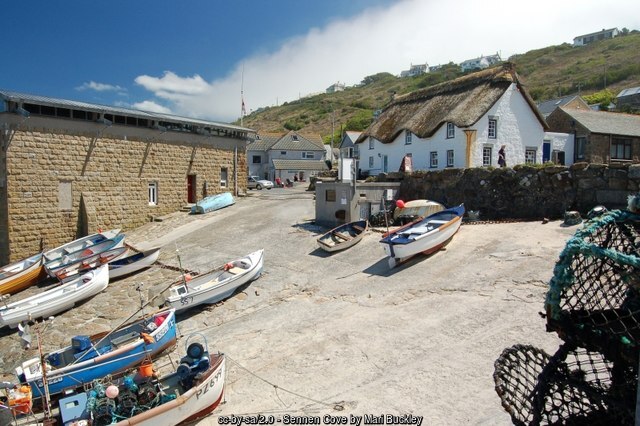
Sennen Cove itself is a proper working fishing village rather than a resort built around a beach, and that history is still visible in the small harbour, the granite cottages climbing the hill behind it, and the breakwater built in 1908 to shelter the fishing fleet. For centuries this was one of Cornwall's most important seine fisheries, a method of fishing using large nets to encircle shoals of fish close to shore, and catches here were genuinely enormous in their day - Edwardian-era hauls are recorded reaching some 12,000 mullet in a single catch, and seining continued as a working practice into the later twentieth century, with a catch of 1,200 stone recorded as late as March 1977. A small fishing fleet of around half a dozen boats still works from behind the breakwater today. The restored Roundhouse on the harbourside, originally built as a capstan house for hauling the seine boats up the beach, now operates as a gallery and shop, one of several small businesses that keep the working character of the cove alongside its tourist trade. Sennen also has a genuine claim to telecommunications history: in 1881 the cable ship Faraday landed the eastern end of the transatlantic "Direct American" cable here, connecting Cornwall to Sable Island off Canada, and submarine cables still come ashore in the area today.
The beach itself is framed by two granite headlands, Pedn-mên-du to the north (Cornish for "black stone headland," the point separating Whitesand Bay proper from Gwynver) and Aire Point to the south, both typical of the hard, weather-resistant granite that shapes so much of the Penwith coastline. As the tide falls, rocky ledges and gullies appear at both ends of the bay, adding rock-pooling interest to what is otherwise a long, open run of sand, while the central stretch in front of the village stays sandy right down to the low-water mark. Looking north along the sand at low tide, the beach runs without a real break into Gwynver, and walking that connection - tide and time permitting - is one of the more rewarding short walks available directly from the village, taking in both the busier, more sheltered character of Sennen's own sand and the wilder, more exposed water that has made Gwynver's reputation among surfers.
Land's End itself, the famous headland marking the westernmost point of mainland England, sits less than two miles south of Sennen Cove around the coast path, close enough that many visitors combine the two in a single day. The bay has its own small footnote in national history, too: Whitesand Bay is recorded as the landing point of the pretender Perkin Warbeck in September 1497, during the Second Cornish Uprising, when he came ashore here before marching inland towards Bodmin and, ultimately, Exeter. Whitesand Bay currently holds a 2026 Seaside Award, one of only five Cornish beaches to do so this year, recognition of its water quality and beach management that sits alongside - though is a different scheme from - the more widely known Blue Flag standard.
The dune system backing the bay covers around 38 hectares and has its own small piece of natural history: it is home to Britain's only known population of the shield bug Geotomus punctulatus, first recorded here in 1864 and still found nowhere else in the country, a reminder that even a beach best known for surf and sand supports a genuinely distinct patch of coastal habitat. Between the working harbour, the surf, the lifeboat station's long history and the sheer scale of the sand itself, Whitesand Bay earns its reputation as one of the more complete beach destinations in West Cornwall - somewhere that rewards a full day rather than a quick stop on the way to Land's End.
Visitor Information
Parking
A car park sits directly behind the beach in Sennen Cove village, with further roadside and clifftop parking nearby at busy times.
Facilities
Public toilets, cafés, pubs and shops in the village, plus several surf schools and board/wetsuit hire outlets right by the beach.
Disabled Access
Access is straightforward compared with most Land's End-area beaches, with level ground from the car park onto the sand. No dedicated Blue Badge bays are confirmed - check current signage on arrival.
Things to Do Nearby
- Gwynver Beach, joined to Whitesand Bay at low tide and known for bigger, more powerful surf
- Nanjizal (Mill Bay), a quieter cove further along the coast towards Land's End
- Land's End itself, the westernmost point of mainland England, less than two miles south around the coast path
Places to Stay
Sennen has its own dedicated accommodation hub, the closest to the beach:
Frequently Asked Questions
Page last updated: 17 September 2026