Porthcurno
White Sand, Turquoise Water and a Hidden Telegraph History
Porthcurno, Land's End Area, Cornwall, TR19 6JX
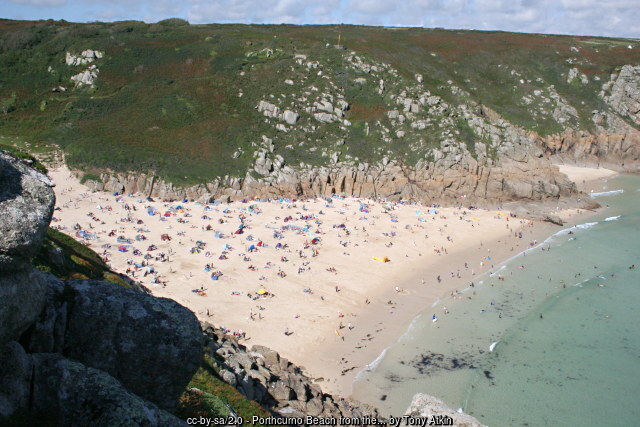
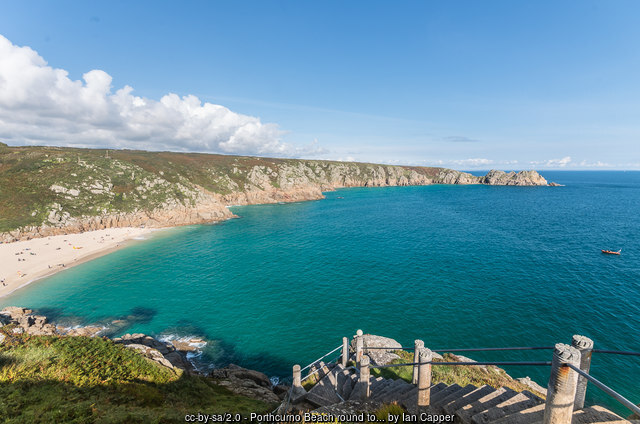
Porthcurno is a lovely south-east facing beach of fine white sand and turquoise water, set within a deep, dramatic valley on the Land's End peninsula, and regularly rated among the very best beaches in Cornwall and in Britain as a whole. Its combination of pale sand, clear, sheltered water and towering granite cliffs on either side gives it a genuinely exotic feel that would not look out of place much further south, and it draws visitors from across the world - not only for its beauty, but for a history that makes it one of the most quietly remarkable places on the entire Cornish coast.
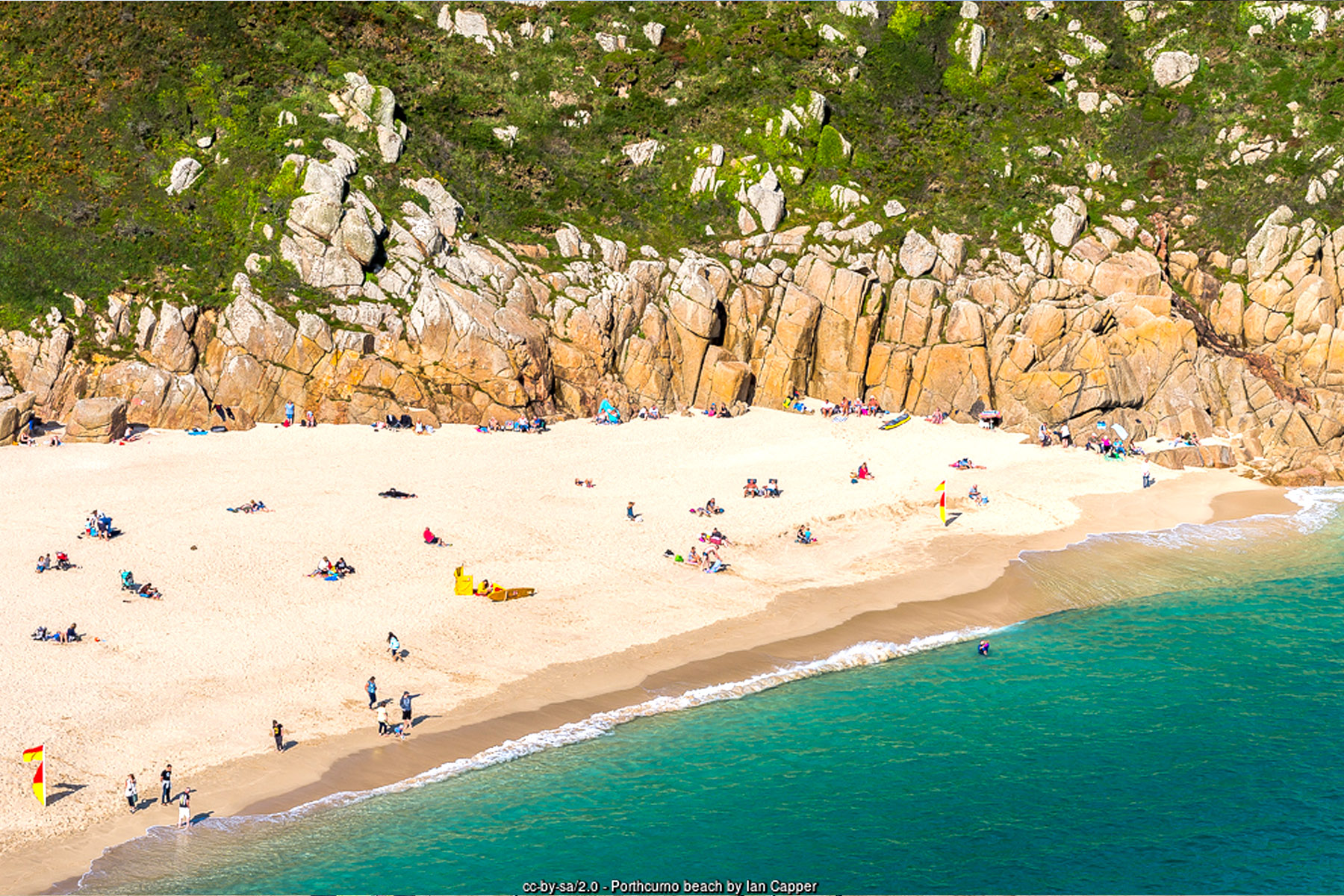
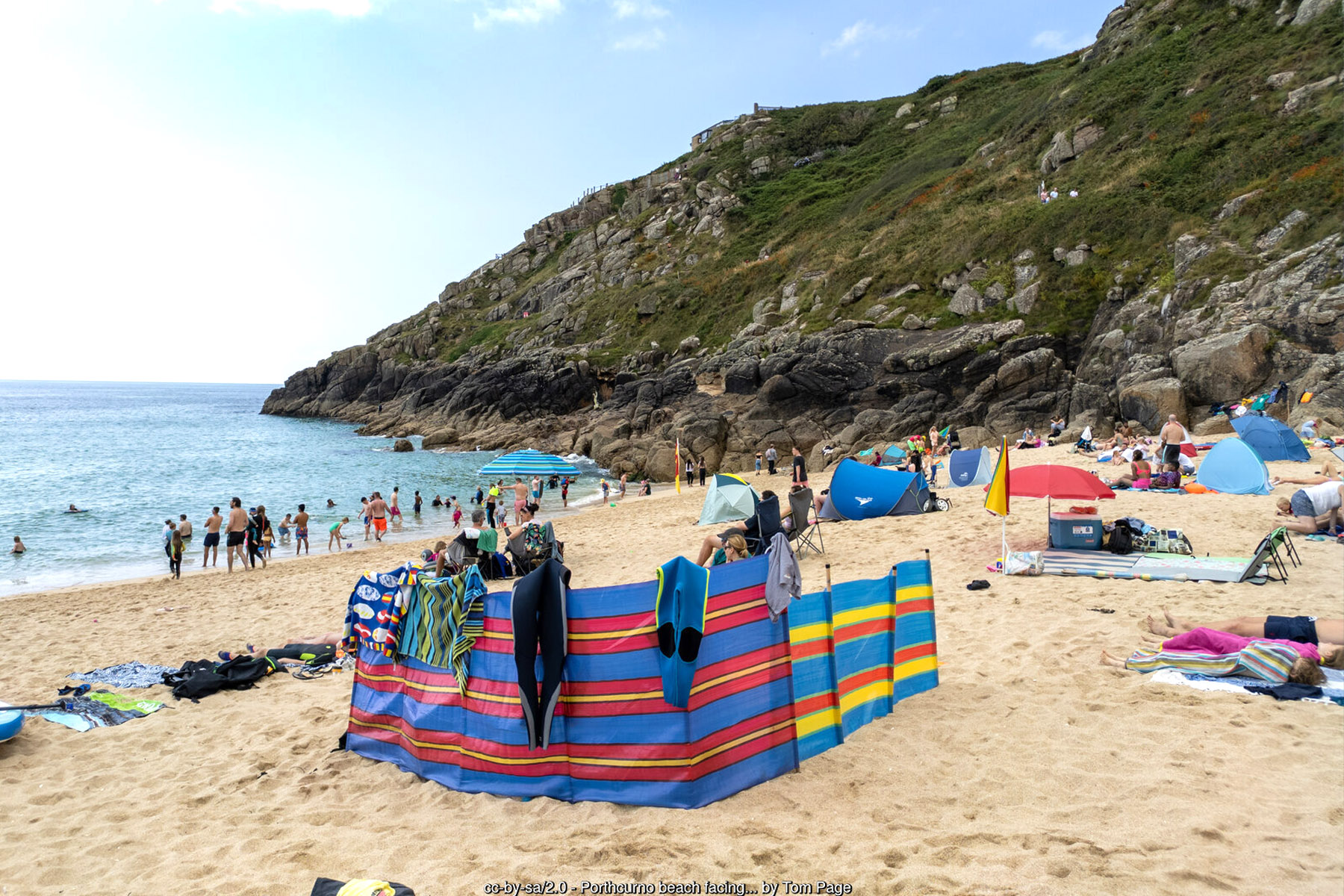
The beach itself is well equipped for a full day out. A car park sits at the top of the valley, a short walk from the sand, with toilets and refreshments available nearby, and an RNLI lifeguard patrol operates through the main summer season, giving Porthcurno one of the more reassuring safety setups among the smaller coves of the Land's End area (exact patrol dates vary from year to year, so it is worth checking current signage or the RNLI's own listings before visiting outside peak summer). A small flight of steps leads directly down to the beach from the car park, and there is also a gentler, unmade path down the valley that most visitors manage without difficulty, though it remains a natural, uneven surface rather than a fully accessible route. Dogs are not permitted on the beach between Easter and October, the same seasonal pattern followed at most beaches along this stretch of coast, though it is worth checking exact current dates locally since these can shift slightly from year to year.
What sets Porthcurno apart from every other beach on this list, however, is what lies beneath the valley behind it. In 1870, Porthcurno was chosen as the landing point for Britain's first submarine telegraph cable to India, a remarkable feat of Victorian engineering that connected London to Bombay by wire for the first time, cutting communication times between Britain and India from months to hours. The choice of this quiet Cornish valley was no accident: its sheltered position and firm underlying rock made it an ideal, secure landing site for the delicate submarine cables snaking out across the Atlantic and beyond. From that single 1870 connection, Porthcurno grew steadily over the following decades into something extraordinary - by the early twentieth century, it had become the largest and most important telegraph station anywhere in the world, sitting at the very hub of a vast network of cables radiating out across the British Empire, carrying messages between Britain and its colonies and trading posts on every inhabited continent.
That strategic importance did not go unnoticed. With the Second World War threatening the security of a communications hub so vital to Britain's war effort, secret underground tunnels were cut directly into the granite hillside above the beach, a huge engineering undertaking designed to protect the cable station's delicate apparatus from bombing raids and the very real threat of invasion. Workers and engineers carried on their vital work below ground, safely inside the hillside, for the remainder of the war, keeping Britain's global communications running even as the coast above them remained on high alert. It is a remarkable, little-known chapter of wartime history, hidden away beneath a beach that, to the casual visitor arriving for a swim, gives almost no clue to what lies within the cliff behind it.
That history is preserved today at PK Porthcurno, Museum of Global Communications, housed partly within those very same wartime tunnels and formerly known as the Porthcurno Telegraph Museum. It is genuinely one of the most distinctive heritage attractions anywhere in Cornwall, telling the story of the cable station's rise from a single Victorian landing point to the nerve centre of a worldwide communications network, and of the training school that operated here for decades afterwards, teaching generations of telegraph and cable engineers who went on to work all over the world. Walking through the same tunnels that once protected the apparatus that kept an empire connected is an experience unlike anything else on the Cornish coast, and the museum sits just a short walk up from the beach itself, making it an easy and genuinely worthwhile addition to a day at Porthcurno.
Beyond the cable station and its wartime tunnels, Porthcurno's telegraph history left another lasting mark on the valley: the Cable and Wireless training college, which operated here from the 1920s through to 1993, teaching generations of telegraph and cable engineers, many of them sent from Britain's overseas territories and Commonwealth partners to train alongside British recruits before being posted to cable stations around the globe. For much of the twentieth century, this small, remote Cornish valley was genuinely one of the best-connected places on earth, a status reflected in the museum's own name today - PK was the telegraphic shorthand code once used for Porthcurno itself, chosen by cable operators to keep messages short, and revived as the museum's name when it reopened after a major redevelopment in the early 2020s. Displays inside cover the original Victorian cable-landing apparatus, a reconstructed wartime operations room within the tunnels themselves, and the wider story of undersea cables that, in an updated form, still carry the vast majority of the world's international internet traffic today - making Porthcurno's own history a surprisingly direct ancestor of the modern connected world.
The valley's other great landmark, the open-air Minack Theatre, looks down over this same stretch of coast from the clifftop above neighbouring Porthchapel, a short walk along the coast path to the west. Built from 1932 onwards by Rowena Cade, largely with her own hands, out of granite and rock cut from the cliff itself, the Minack remains a fully working theatre today, staging an annual summer season of plays and musicals against a backdrop of sea and sky. Many visitors combine a swim at Porthcurno with the short coastal walk up to the theatre and on to Porthchapel beyond, taking in three of the most distinctive spots on this whole stretch of coast in a single outing.
Geologically, Porthcurno sits within the granite that forms the spine of the Land's End peninsula, and the valley's steep, dramatic sides are a product of that same hard rock resisting millions of years of erosion by the sea. The fine, pale sand for which the beach is so well known is partly a product of that granite's slow breakdown, and partly the result of a particularly rich concentration of comminuted shell fragments, giving the sand its distinctive whiteness and the shallow water its characteristic turquoise clarity on a sunny day - a combination that has led more than one visitor and guidebook to compare Porthcurno's colours to a Caribbean beach rather than a Cornish one. The surrounding cliffs and valley sides are managed in part by the National Trust, helping to keep this dramatic setting free of development and much as it would have appeared to the Victorian engineers who first landed their cable here a century and a half ago.
Swimming conditions at Porthcurno are generally good in settled weather, with the beach's sheltered, south-east facing position offering some protection from the prevailing south-westerly swell that can make other beaches on this coast rougher going. That said, conditions can change quickly, and the presence of an RNLI lifeguard patrol through the summer season is a genuine asset here compared with several of the Land's End area's smaller, unpatrolled coves - swimmers visiting outside the patrolled season, or outside the flagged areas when it is in operation, should take the same sensible precautions as at any unguarded Cornish beach.
Walkers based at Porthcurno have excellent options in both directions along the South West Coast Path. To the west, the path climbs past the Minack Theatre and on to Porthchapel, before continuing towards Porthgwarra and eventually Land's End itself, a stretch that takes in some of the most dramatic clifftop scenery on the entire peninsula. To the east, the path leads towards Treen, Logan Rock and the wild, cliff-backed sands of Pedn Vounder, one of Cornwall's most striking - and most physically demanding to reach - beaches, reached via a steep and, in places, informal scramble down the cliff. Both directions reward walkers with sweeping views back over Porthcurno's pale crescent of sand and the deep blue water offshore, and the surrounding cliffs are good territory for spotting choughs, now a regular sight along this part of the coast after their reintroduction and natural recolonisation of West Cornwall in recent decades, as well as fulmars and other seabirds nesting on the more sheltered ledges.
The clifftop above Treen, reached on that eastward walk towards Pedn Vounder, carries its own layer of much older history in the form of Treryn Dinas, an Iron Age cliff castle whose earthwork ramparts still cut across the headland, and the famous Logan Rock, a huge, naturally balanced granite boulder that can - with effort - be rocked gently back and forth, though it no longer moves as freely as it once did after a notorious incident in 1824, when a young naval officer and his men dislodged it from its natural pivot point and were subsequently ordered to winch it back into place at their own expense. It is a fittingly eccentric piece of local history for a stretch of coast that, just a mile or so back along the path, hides one of the most technologically significant valleys in the world beneath its own beach.
Porthcurno's sheltered, south-east facing valley also gives it a slightly gentler microclimate than many of the more exposed beaches further along the Land's End peninsula, keeping it a viable option even when a stiffer onshore wind has picked up elsewhere on the coast. Combined with its fine white sand, clear water and genuinely spectacular setting, this has helped cement Porthcurno's reputation as one of the standout beaches not just in Cornwall but in Britain as a whole - a reputation that, unusually for a beach this beautiful, it shares equally with the remarkable, largely hidden story of global communication running through the cliffs immediately behind the sand.
Taken together, Porthcurno offers a rare combination even by Cornwall's high standards: a beach beautiful enough to be ranked among the very best in Britain purely on its own merits, paired with a genuinely extraordinary hidden history running through the granite behind it, and two of the most distinctive neighbouring attractions on the entire Cornish coast - the Minack Theatre above Porthchapel to the west, and Pedn Vounder's wilder sands a little further along the coast to the east - within easy reach for anyone making a full day of this remarkable stretch of the Land's End peninsula.
Visitor Information
Parking
A car park sits at the top of the valley, a short walk from the beach. There is no parking directly on the sand.
Facilities
Toilets and refreshments are available near the car park, and PK Porthcurno museum and the Minack Theatre, both a short walk away, have their own cafes.
Disabled Access
A small flight of steps leads to the beach, and an unmade but gently sloping path also runs down the valley, though it remains an uneven natural surface. No dedicated Blue Badge bays are confirmed - check current signage at the car park on arrival.
Things to Do Nearby
- Porthchapel, a secluded cove just along the coast path, overlooked by the clifftop Minack Theatre
- PK Porthcurno, Museum of Global Communications, telling the story of the cable station and its wartime tunnels, a short walk from the beach
- Pedn Vounder, a wilder, more remote stretch of sand a little further along the coast path to the east
Places to Stay
Porthcurno has its own dedicated accommodation hub:
Frequently Asked Questions
Page last updated: 17 September 2026