Mousehole Harbour Beach
A Small Sandy Harbour in One of Cornwall's Most Picturesque Villages
Mousehole Harbour Beach, Mousehole, near Penzance, Cornwall, TR19 6PL
Mousehole (pronounced "Mowzel") sits about two and a half miles south of Penzance on the shore of Mount's Bay, beyond Newlyn on the road and coast path towards Lamorna. Widely regarded as one of the most picturesque villages in Cornwall, it is built tightly around a small stone harbour, with granite cottages, narrow lanes and net lofts crowding right down to the water. Its beach is modest by Cornish standards - two small patches of sand, one on each side of the harbour entrance - but the setting, tucked inside one of the oldest working quays in the county, makes it a genuinely different kind of beach visit from anywhere else covered in this Penzance folder. The village itself is small - 697 residents at the 2011 Census - but its reputation, and the number of visitors it draws through the summer and again at Christmas, is out of all proportion to its size.
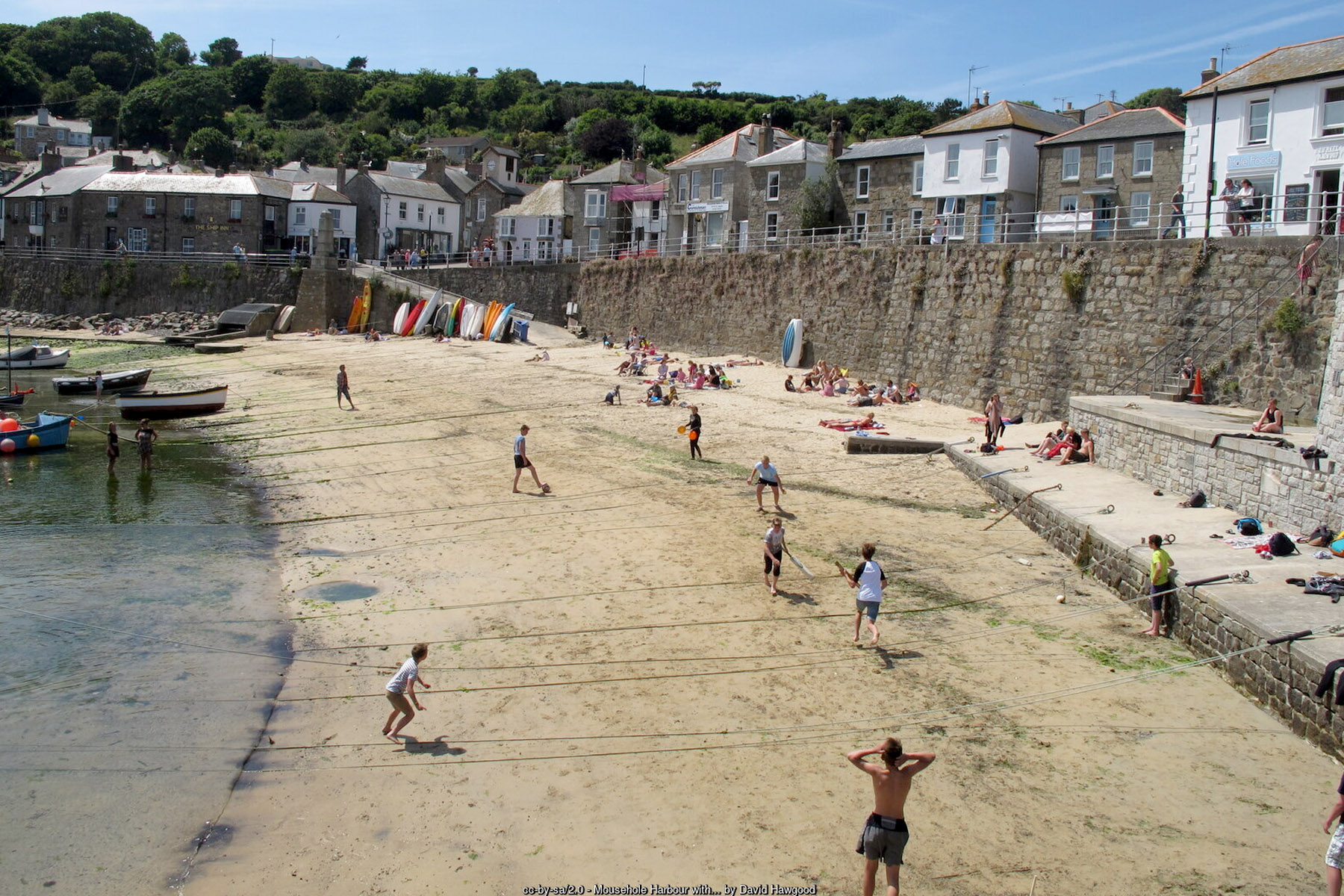
The sand itself is periodically topped up and cleaned, and is fully covered at high water, so a visit needs to be timed around the tide. Once exposed, the two areas are sheltered almost completely from any swell by the harbour walls - "there is never more than a ripple here" is how one local guide puts it - which makes the water genuinely safe for family paddling and swimming when the sand is showing, without the open-sea conditions found at Penzance's other beaches. There is no RNLI lifeguard cover at Mousehole. Access to the sand is down one of two slipways: a steeper slip on the main beach side, or an easier route via the car park for anyone with limited mobility. A small tidal bathing pool lies just north of the village, and a rockier, pebbly stretch with rock pools runs towards Newlyn near the Old Coastguard Hotel - useful alternatives either side of the main harbour sand.
One important difference from most Cornish beaches: dogs are not permitted on Mousehole's beach, at any time of year. This is a working harbour first and a beach second, and the no-dogs rule applies to the sand and to the fish-landing quay ends specifically. Dogs on a lead are welcome elsewhere around the harbour and village, with owners expected to manage their behaviour and clear up after them - it is simply the beach itself, rather than the whole village, that is off-limits.
The harbour that shelters the beach is itself one of the village's main attractions. Quay portions here are thought to date to the 14th century, making it possibly the oldest quay in Cornwall still in everyday use, and it remains a genuinely working harbour for small fishing boats and pleasure craft rather than a purely ornamental one. The quays have uneven, cobbled surfaces and real trip hazards underfoot, and in rough weather the Harbour Master can close sections with gates and suspend parking - seas are known to break directly over the harbour walls in bad conditions, so this is not a place to treat casually when a storm is forecast. Moorings should never be touched without permission from their owners. A working fleet of small fishing boats still lands here alongside pleasure craft and visiting yachts, and in season local operators run short boat trips out into Mount's Bay, weather permitting, giving a different view of the harbour and St Clement's Isle from the water.
Mousehole's own history goes back further than the harbour walls. The settlement appears in records from around 1267 under the name Porth Enys, "port of the island" - a reference to St Clement's Isle, the small rocky islet around 350 metres offshore that once held a medieval chapel and can still be seen from the beach today. The name "Mousehole" itself is first recorded in 1283, and by the 14th century the village had grown into a major pilchard-fishing port, with a fleet that for a time genuinely outgrew those of its now much larger neighbours, Newlyn and Penzance.
That prosperity made Mousehole a target. On 23 July 1595, four Spanish galleys under the command of Carlos de Amésquita landed roughly 400 armed men on the coast nearby and attacked the village, burning almost every building to the ground during the raid - part of a wider, little-remembered Spanish assault on West Cornwall during the closing years of the Anglo-Spanish War. Squire Jenkyn Keigwin was killed defending his own home during the attack, and that house, rebuilt and still known as the Keigwin Arms, is the only building in the village recorded as having survived the fires - a plaque on its wall still marks where he died. It stands today as Mousehole's oldest surviving building and one of the more tangible reminders anywhere in Cornwall of a raid that is often overshadowed, in the national memory, by the Spanish Armada seven years earlier.
The Keigwin Arms has a second, gentler claim to fame: it was a regular haunt of Dolly Pentreath (1692-1777), traditionally remembered as the last native speaker of the Cornish language. Pentreath is often described as a Mousehole fishwife, though she was strictly born in the neighbouring parish of Paul, which historically included Mousehole within its boundaries - a distinction local historians are careful to note even as the wider association with the village has stuck. A monument to her stands in Paul churchyard, a short walk up the hill from the harbour.
Mousehole's best-known modern association is a far more sombre one. On the night of 19 December 1981, the village's lifeboat, the Solomon Browne, put to sea in hurricane-force winds to attempt a rescue of the crew and passengers of the coaster Union Star, disabled and drifting onto the rocks near Lamorna. All eight of the Mousehole men aboard the lifeboat were lost, alongside all those they were trying to save, in one of the defining tragedies of RNLI history. Every year since, the village has switched off its famous Christmas harbour lights on the evening of 19 December in remembrance, before relighting them - a quiet, deeply felt local tradition that visitors to Mousehole at that time of year will still see observed today.
Those Christmas lights are, in ordinary years, exactly what Mousehole is most famous for: a spectacular, village-wide display strung across the harbour and reflected in the water, drawing visitors from well beyond Cornwall every December. The season builds to Tom Bawcock's Eve on 23 December, a local festival said to commemorate a 16th-century fisherman who braved a terrible storm to save the starving village with a catch of fish, traditionally marked today with stargazy pie - a mixed fish, egg and potato pie famous for the fish heads left poking up through its pastry crust. The story has also passed into a well-loved piece of modern folklore, "The Mousehole Cat," a children's book that retells the legend and is widely sold in the village's shops.
For visitors today, the village around the beach is well provided with pubs, cafés, galleries and small shops, almost all clustered within a few minutes' walk of the harbour, and the South West Coast Path runs straight through, linking Mousehole on foot to Newlyn and Penzance in one direction and Lamorna Cove in the other. Notable past residents include the 17th-century Cornish-language scholar John Keigwin, Methodist diarist William Carvosso, artist Jack Pender, Admiral Sir Caspar John and children's illustrator Michelle Cartlidge - one more thread in a village that, for its size, has left an outsized mark on Cornish history, language, art and maritime memory alike.
Visitor Information
Parking
Two pay-and-display car parks are run by Mousehole Harbour Authority - North Quay (year-round) and South Quay (upper area closed over winter for boat storage), with an attendant on site Easter to October. Space is limited, and the village is genuinely easier to reach on foot, by bike or by First Bus from Penzance and Newlyn.
Facilities
Public toilets are at North Quay (year-round, disabled access) and South Quay/Gurnick Street (March to September, plus over Christmas). Pubs, cafés, galleries and shops are dotted throughout the village. There is no RNLI lifeguard patrol at Mousehole.
Disabled Access
The quays are cobbled and uneven underfoot. The car park route down to the beach is the easier of the two slipway approaches for anyone with limited mobility, and North Quay's toilets have disabled access. Dogs, including assistance dogs, are not permitted on the beach itself.
Things to Do Nearby
- Wherrytown Beach, on the Penzance side of Newlyn, a short drive or coast path walk away
- Lamorna Cove, a working fishing cove reached on foot via the coast path or a short drive
- St Clement's Isle, the small offshore islet visible from the harbour, once home to a medieval chapel
- Newlyn Harbour, Cornwall's largest fishing port, a short walk or drive north
- Penlee House Gallery & Museum, Morrab Road, Penzance
Places to Stay
Frequently Asked Questions
Page last updated: 18 September 2026.