Eastern Green Beach
Quiet Sand and Gently Shelving, Safe Swimming on Penzance's Eastern Shore
Eastern Green, Penzance, Cornwall, TR18 3DU
Eastern Green is the quiet, unshowy stretch of sand that curves away from Penzance town centre on the eastern side of the harbour, running from Station Rocks - the rocky shore right beside Penzance railway station - around the shallow sweep of Mount's Bay towards Long Rock. It is not a beach that sets out to impress: there is no beach café, no watersports centre, no crowd of deckchairs, and precious little in the way of formal facilities. What it offers instead is exactly the kind of low-key, local beach that Penzance residents use on an ordinary Tuesday evening rather than the one visitors photograph for a postcard - a long, gently sloping run of sand within easy walking distance of the town, the station and the bus station, with none of the parking stress that comes with Cornwall's more famous coves.
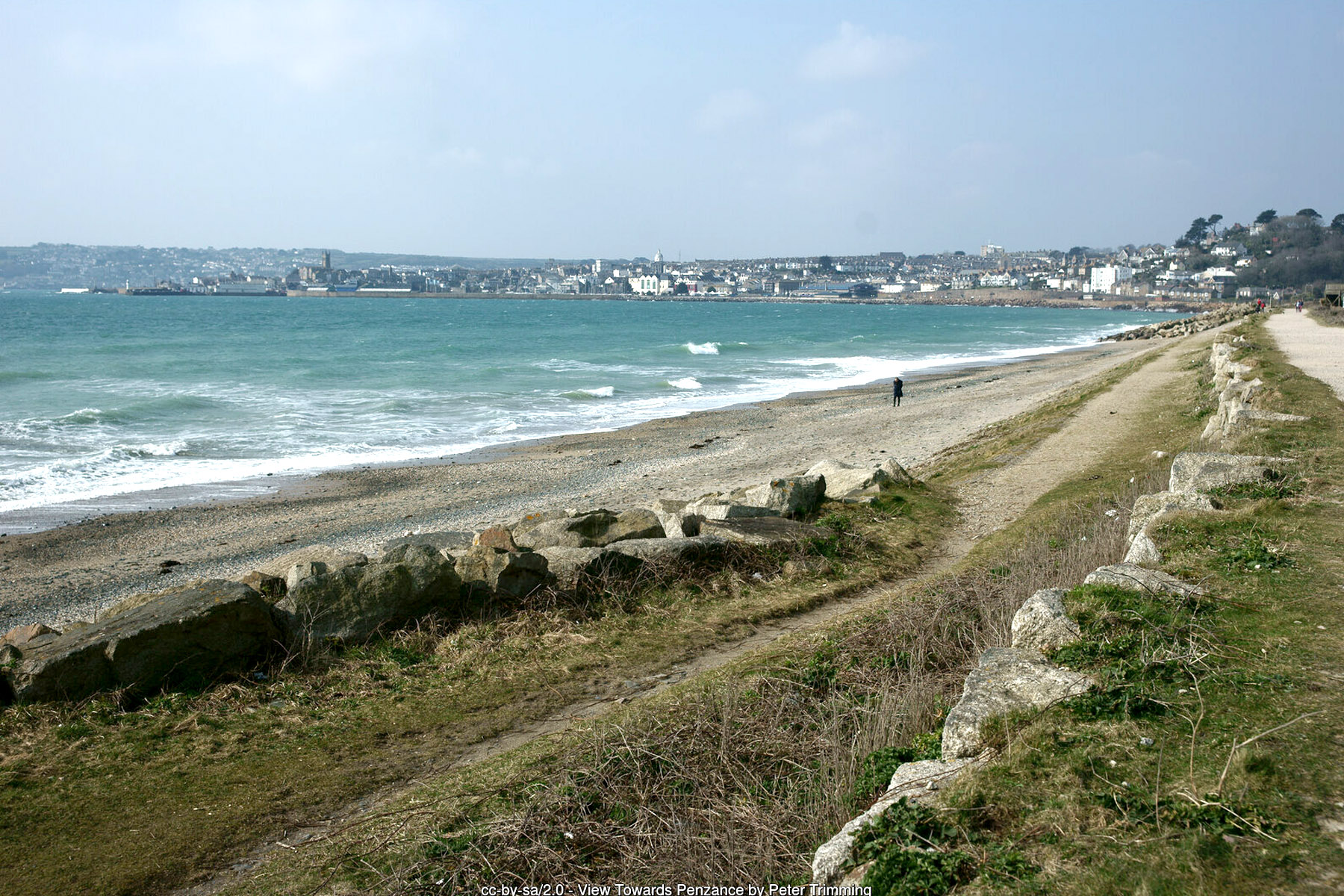
The beach takes its name from the open land that once stood here rather than from any obvious feature of the sand itself. Through the Georgian and Victorian eras, Eastern Green was exactly what its name describes: open grassland on the edge of town, used - among other things - for exercising horses, long before the railway or any significant housing reached this side of Penzance. That rural fringe has since been built over and around, and Eastern Green today reads as a mixed area of housing and light industry that also functions as one of the main entry points into Penzance and West Penwith from the east, with the beach itself tucked in below the road and railway as a quieter, unofficial amenity for the streets around it rather than a headline attraction in its own right. It remains a genuinely popular stretch for a walk, a run or a dog walk precisely because of that everyday, unmanicured character - the South West Coast Path runs along this shore too, carrying walkers, joggers and cyclists past the beach year-round, with clear views out across Mount's Bay to St Michael's Mount, and on a calm summer evening the chance of watching the Scillonian ferry make her way in from the Isles of Scilly to dock at Penzance harbour.
Getting to the sand itself takes a small amount of local knowledge, which is part of why Eastern Green stays as quiet as it does. The two usual approaches are a footpath from Penzance bus station, or a route across a railway bridge that carries pedestrians over the tracks and down onto the beach - both a short walk from the town centre, station and main shopping streets, rather than a drive-up, park-and-unload arrangement. That railway bridge is no coincidence: the Great Western Railway mainline runs directly along the back of the beach at Eastern Green, on its final approach into Penzance station, and it is the same stretch of line that continues on past Long Rock - where Penzance's railway depot now stands - towards Marazion and St Erth. The line reached Penzance in March 1852, when the West Cornwall Railway opened the original station as the terminus of its route from Redruth, at that stage built to the narrower gauge the company had chosen for its Cornish line. Broad gauge trains did not reach Penzance until 1866, when the line was relaid to mixed gauge and a locomotive named Lance hauled the first broad-gauge train into the town carrying dignitaries from Truro - part of the slow, expensive business of stitching Cornwall's early independent railways into the wider Great Western network. Penzance station itself was built hard against the sea, with the harbour on one side and high ground cut into on the other, and that same coast-hugging alignment carries the line out along Eastern Green and Long Rock on an exposed sea wall, a route so close to the water that storm damage to the line here still makes the national news in the roughest winters. For anyone walking the beach today, the trains rattling along the low embankment behind the sand are as much a part of Eastern Green's identity as the sand itself.
What genuinely marks Eastern Green out, though, is a change that most visitors walking the beach today would never guess at: for a long stretch of the twentieth century, this part of Mount's Bay was regarded as one of the most polluted stretches of coast in Cornwall. Untreated or barely treated sewage from Penzance and the surrounding area was discharged close to shore, at a time when coastal sewage treatment across much of the South West was rudimentary at best, and a beach as sheltered and shallow as Eastern Green - where water takes a long time to flush and mix with the open sea - would have borne the consequences more than most. That changed through South West Water's Clean Sweep programme, one of the largest single environmental investment schemes ever undertaken by a UK water company. Launched in 1992, not long after water privatisation, Clean Sweep ran for roughly two decades and channelled something in the region of £2 billion into rebuilding the South West's coastal sewage infrastructure: closing around 250 crude, untreated sewage outfalls that had simply released waste at or near the shoreline, and completing a further 140 related projects to build or upgrade treatment works so that waste water was properly treated before release, rather than piped straight into the sea. Penzance's own sewage treatment works received its upgrade under the programme in 1996, and by the time Clean Sweep's final scheme was completed in 2011, the investment had improved bathing water quality at some 144 beaches and bathing sites across the South West of England. Eastern Green is a direct beneficiary of that huge, unglamorous piece of infrastructure work: a beach once written off as too polluted to enjoy is now a place where you can quite happily let a dog paddle or a child play in the shallows, part of the same water-quality transformation that turned Cornwall's bathing beaches from a genuine public health concern into one of the county's proudest modern success stories.
None of that changes what kind of beach Eastern Green actually is day to day: a plain, honest stretch of sand rather than a resort. There is no lifeguard cover here, so it suits confident swimmers and families keeping a close eye on children rather than anyone wanting the reassurance of an RNLI patrol, and there are no cafés, shops or beach huts at the beach itself - anything you need is a short walk back into Penzance town. What Eastern Green does have, and what quietly makes it one of the more reassuring beaches to swim from in the area, is its shape underwater: the sand shelves extremely gradually, so gradually that you can walk out something like half a mile before the water reaches much depth at all. Combined with the shelter Mount's Bay itself provides from the worst of the Atlantic swell that batters Cornwall's north coast, that gentle underwater gradient is why Eastern Green has a reputation as one of the safer beaches in the Penzance area for a paddle or a swim, even without a lifeguard on duty. Dogs are welcome here all year round too, with none of the seasonal summer bans that apply on many of Cornwall's more heavily promoted beaches - one more reason Eastern Green functions as a genuine local beach, used by dog walkers, joggers and residents on a daily basis rather than only on a handful of peak summer weekends.
Eastern Green does not currently hold Blue Flag or Seaside Award status, and realistically it is not competing for either - those awards tend to sit with beaches that carry full seasonal facilities, lifeguard cover and formal amenity management, which was never really the point of this stretch of sand. Its real value is as the easy, walkable, dog-friendly beach for anyone staying in or passing through Penzance itself: somewhere to stretch your legs along the coast path from the station, let a dog off the lead outside the summer restriction season that applies elsewhere, or simply watch the tide come in across Mount's Bay towards St Michael's Mount without needing to find - or pay for - a parking space first. Combined with its quietly remarkable water-quality turnaround, Eastern Green is a good example of a beach whose modern character has been shaped as much by unglamorous public investment as by geography: a safe, gently shelving shoreline that, within living memory, most people in Penzance would have thought twice about swimming from at all.
Visitor Information
Parking
There is no dedicated car park at Eastern Green itself - it is a beach reached on foot rather than driven straight to. The nearest option is one of Penzance's town-centre pay-and-display car parks, from where it's roughly a 5-minute walk down to the sand via the footpath from the bus station or across the railway bridge.
Facilities
A quiet, low-key beach with no facilities on site and no lifeguard cover. Cafés, shops and toilets are all a short walk away in Penzance town centre, close to the railway and bus stations.
Disabled Access
Access is via a footpath from the bus station or a pedestrian railway bridge, rather than a level drive-up approach, so it is not the easiest beach in the area for wheelchairs or limited mobility. Blue Badge holders have no dedicated bay at the beach itself and should use the nearest town-centre car park instead.
Things to Do Nearby
- Wherrytown, the westernmost beach in this stretch, towards Newlyn
- Penzance Promenade Beach, the town's main flagship beach along the seafront
- Battery Rocks, below the harbour beside Jubilee Pool
- Long Rock, the next beach on towards Marazion
- Mousehole, a picturesque fishing village with its own small harbour beach, a few miles west via Newlyn
- Penlee House Gallery & Museum, Penzance's art gallery and local history museum, a short walk into town
Places to Stay
Frequently Asked Questions
Page last updated: 11 September 2026.