Battery Rocks
Penzance's Year-Round Sea-Swimming Steps Beside Jubilee Pool
Battery Rocks, Battery Road, Penzance, Cornwall, TR18 4AR
Battery Rocks is the short, rocky stretch of Penzance's harbourside shoreline that sits directly below the harbour wall, immediately east of the town's promenade and wrapped around the seaward side of Jubilee Pool. It is not, in the usual sense, a sand beach at all: rather than a stretch of open shore to walk out onto, Battery Rocks is a low outcrop of shoreline rock, fenced by a set of stone and concrete steps with handrails that lead straight down off the road and into the deep water of Mount's Bay. That simple arrangement - steps into the sea, with no tide table required to use them - has made Battery Rocks one of the most quietly important little patches of coastline in Penzance, used every single day of the year by swimmers for whom the rest of the town's beaches are, for one reason or another, either too far out or too tidal to bother with.
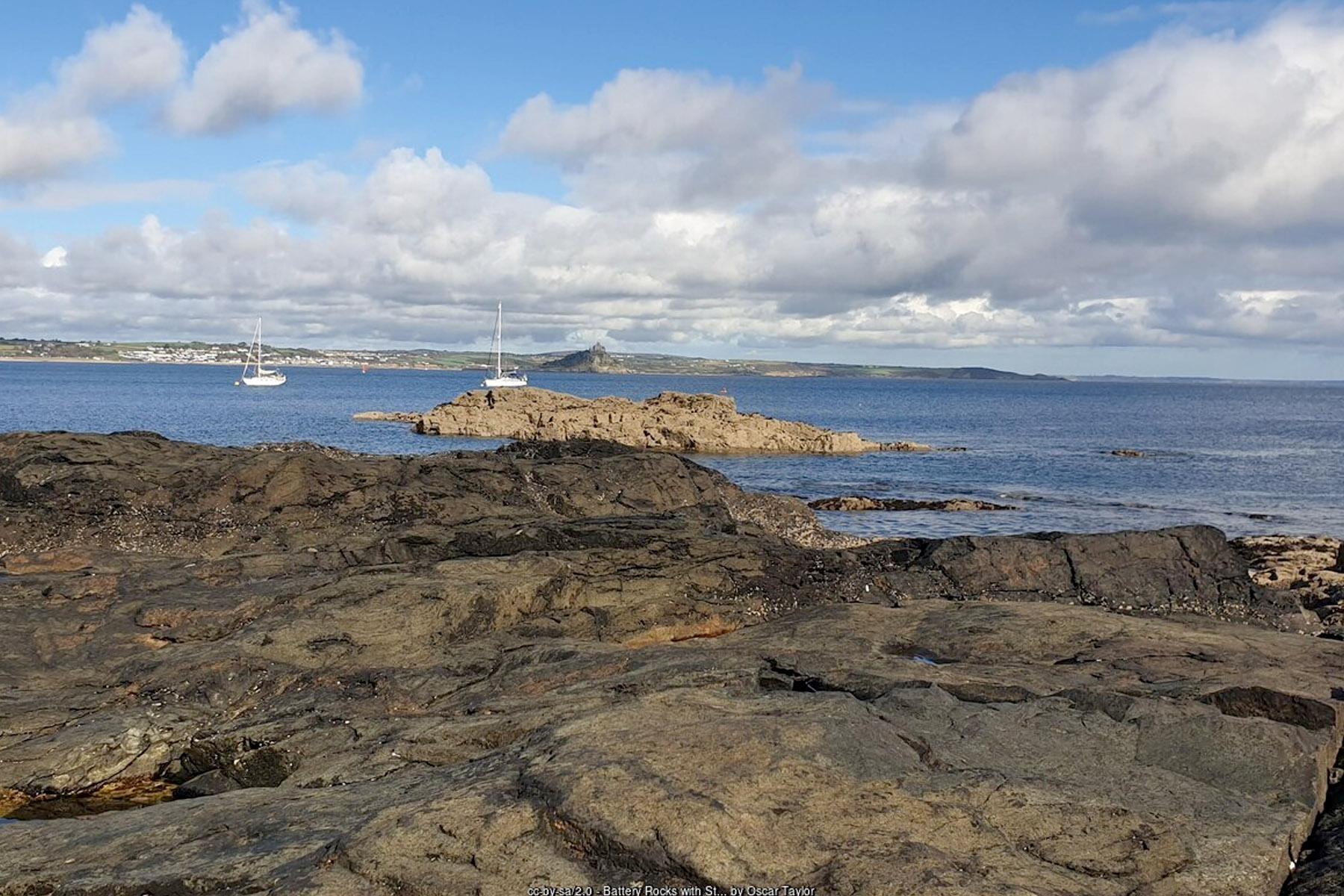
Like its immediate neighbour along the seafront, Penzance Promenade Beach, Battery Rocks is tidal-dependent if what you are after is a conventional beach experience: at lower tides a modest strip of sand and shingle is uncovered along parts of the shore here, giving room to sit or potter about among the rock pools, while at higher tides the water comes right up against the rocks and the steps become the only practical way into the sea. This is precisely why the site matters so much to local swimmers - the steps themselves are usable at virtually any state of the tide, meaning a dip at Battery Rocks does not need to be planned around tide times in the way a stretch of open sand does. The trade-off is that this is very much a swimming and rock-pooling spot rather than a place to unroll a beach towel for the day; anyone wanting sand should walk the short distance along the prom towards Penzance Promenade Beach or further still to Eastern Green.
The name Battery Rocks is a genuine piece of eighteenth-century military history rather than a picturesque label. In 1740, with Britain at war with Spain and the threat of French naval action also weighing on coastal towns, Penzance's Borough council petitioned central government for protection, and a gun battery was duly installed on the rocks here to help guard the approach to the harbour and the bay beyond. That battery remained an active feature of the site for well over a century, and the guns were not finally removed until 1880. The local historian Craig Weatherhill has gone further, suggesting that the site's defensive significance may stretch back a good deal earlier still: a 1595 account by the commander of a raiding Spanish fleet, which attacked and burned Penzance and several neighbouring villages that July, appears to describe his men capturing "the piece of artillery that was in the fort" defending the town - quite possibly this same spot on the rocks below the harbour, a century and a half before the battery that gave it its modern name. The site's military connections did not end there either: during the Second World War, the road and pool area at Battery Rocks was fenced off entirely and pressed into service as an anti-aircraft battery position, manned by the Army and the Home Guard, watching the same stretch of sky and sea that the eighteenth-century guns had once covered.
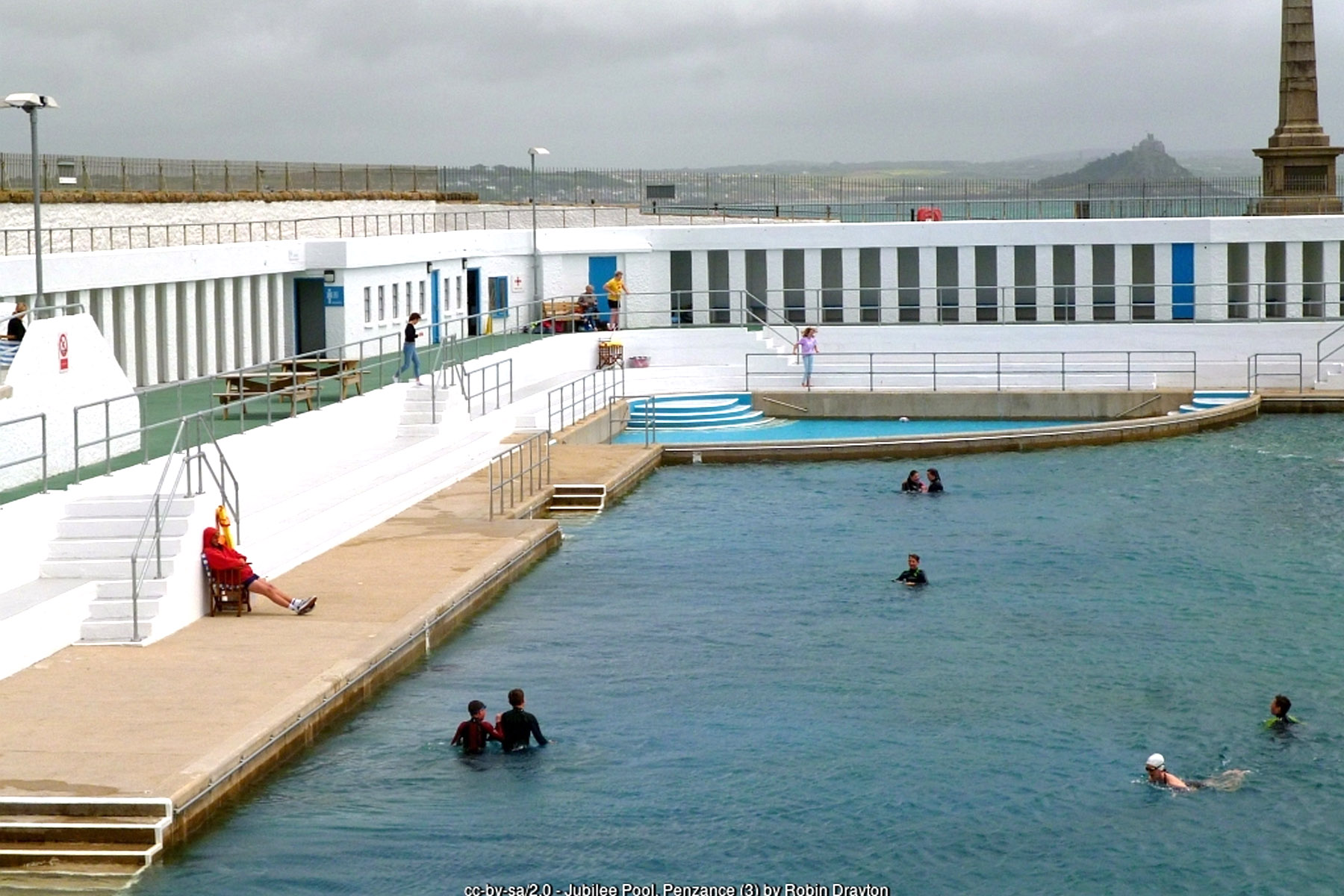
Sitting right on top of Battery Rocks, built out onto the rock itself and jutting into the sea, is Jubilee Pool - one of Cornwall's best-loved pieces of seaside architecture and reason enough on its own for many visitors to make the trip down to this part of the harbour. The pool opened in May 1935, commissioned to mark the Silver Jubilee of King George V and designed by Captain F. Latham, the Borough Engineer, in a strikingly confident Art Deco style: a great white triangular lido, its clean geometric lines a world away from the granite and slate of the older town around it, holding a vast semi-tidal saltwater swimming pool that is topped up and partly refreshed by the sea at every high tide. It was an immediate sensation when it opened and has remained a Penzance landmark ever since, earning Grade II listed status in recognition of its architectural importance. Like much of the coast here, the pool has taken a battering from Atlantic storms over the decades, and by the early 2010s it had suffered serious storm damage and years of accumulated deterioration that left its future in doubt. A major restoration project costing £2.94 million was carried out and completed in 2016, repairing the structure and reopening the pool to a new generation of visitors; today it operates with a café, and in recent years part of the pool has also incorporated a geothermally heated section, adding a warm-water option alongside the bracing open sea just a few steps away on the rocks outside its walls.
That combination - a heated lido on one side of the wall, open Atlantic sea on the other - sums up why Battery Rocks has such a devoted following among Penzance's swimming community. Sea swimming from the rocks here is not a recent wellness trend but a long-documented local habit: newspaper accounts from as far back as 1881 already describe winter bathers using the rocks below the harbour, and that tradition has simply continued, more or less unbroken, in the century and a half since. Regulars swim from the steps at Battery Rocks every single day of the year, whatever the season, valuing the site precisely because the deep water and sheltered position within Mount's Bay make it usable even when conditions elsewhere along the coast are too rough. The bay itself offers a degree of natural shelter that more exposed north-coast beaches simply cannot match, and while Battery Rocks is not immune to swell and can be genuinely unpleasant in strong onshore weather, on an ordinary day it is markedly calmer than the open sea beyond the harbour arms.
None of this means the site is risk-free, and it should be treated with the same respect as any piece of natural rocky shoreline. There is no lifeguard cover at Battery Rocks at any time of year, so anyone swimming here does so entirely at their own judgement and risk. The steps and the surrounding rock platform are frequently coated in algae and seaweed, and become notably slippery when wet - a real hazard both for swimmers getting in and out of the water and for anyone simply exploring the rocks at low tide. Barnacles cover much of the exposed rock too, sharp enough to cause a nasty cut to bare feet or hands, so sturdy water shoes are well worth wearing rather than going in barefoot. Cold-water shock is also a genuine consideration outside the summer months, particularly for anyone unused to open-water swimming; regular Battery Rocks swimmers tend to acclimatise gradually and know their own limits, which is worth bearing in mind before joining them on a whim in January.
Getting to Battery Rocks is straightforward. There are a handful of roadside parking spaces directly alongside Jubilee Pool on Battery Road, though these are limited and fill quickly, especially in summer or whenever the pool itself is busy. A larger pay-and-display car park sits just across the road next to St Anthony's Gardens, a short and level walk from the rocks, and is the more reliable option if the roadside spaces are already taken. There are no facilities directly on the rocks themselves - no toilets, no kiosk, nothing beyond the steps and the sea - but Jubilee Pool's café is right next door for refreshments, public toilets can be found nearby in the harbour area, and Penzance's harbourside streets, particularly Quay Street and the Barbican, are lined with pubs and cafés only a few minutes' walk away. Dogs are welcome at Battery Rocks all year round, with no seasonal restriction of the kind that applies at some other Cornish beaches, though owners should keep dogs under close control on the rocks given the drop into deep water at the steps.
Visitor Information
Parking
A few roadside spaces directly beside Jubilee Pool on Battery Road, plus a larger pay-and-display car park across the road next to St Anthony's Gardens, a short walk from the rocks.
Facilities
No facilities directly on the rocks. Jubilee Pool's café is right next door, public toilets are nearby in the harbour area, and pubs and cafés line Quay Street and the Barbican close by. No lifeguard cover at any time of year.
Disabled Access
Battery Rocks itself is reached only via steps down from the road into the water, and is not step-free. The roadside area and pay-and-display car park at St Anthony's Gardens include designated Blue Badge bays close to Jubilee Pool.
Things to Do Nearby
- Wherrytown, the westernmost of Penzance's seafront beaches, towards Newlyn
- Penzance Promenade Beach, the town's main beach, just along the seafront
- Eastern Green, curving east from Station Rocks
- Long Rock, the easternmost beach in the bay, towards Marazion
- Mousehole, a picturesque fishing village with its own small harbour beach, a few miles west via Newlyn
- Penlee House Gallery & Museum, Morrab Road, a short walk into town
Places to Stay
Frequently Asked Questions
Page last updated: 11 September 2026.