Penzance Promenade Beach
The Town's Main Seafront Beach, Beneath Cornwall's Only Victorian Promenade
The Promenade, Penzance, Cornwall, TR18 4NP
Penzance Promenade Beach is the town's main seafront beach and, fittingly, the flagship of Penzance's own short run of shore - a mostly shingle strand with a scattering of sand patches, running for around a mile beneath the sea wall between Wherrytown and the harbour at Battery Rocks. It is only really a beach at all from mid to low tide; as the water drops, the exposed rocks along its length reveal themselves as some of the better rock-pooling and snorkelling ground in this part of Mount's Bay, while at high water the sea sits hard against the promenade's granite kerb with barely a strip of shingle showing. What the beach may lack in soft golden sand it more than makes up for in setting: this is Penzance's front room, backed for its entire length by the town's celebrated Victorian seafront, and looking out across the wide sweep of Mount's Bay to St Michael's Mount and, on a clear day, all the way round to the Lizard peninsula.
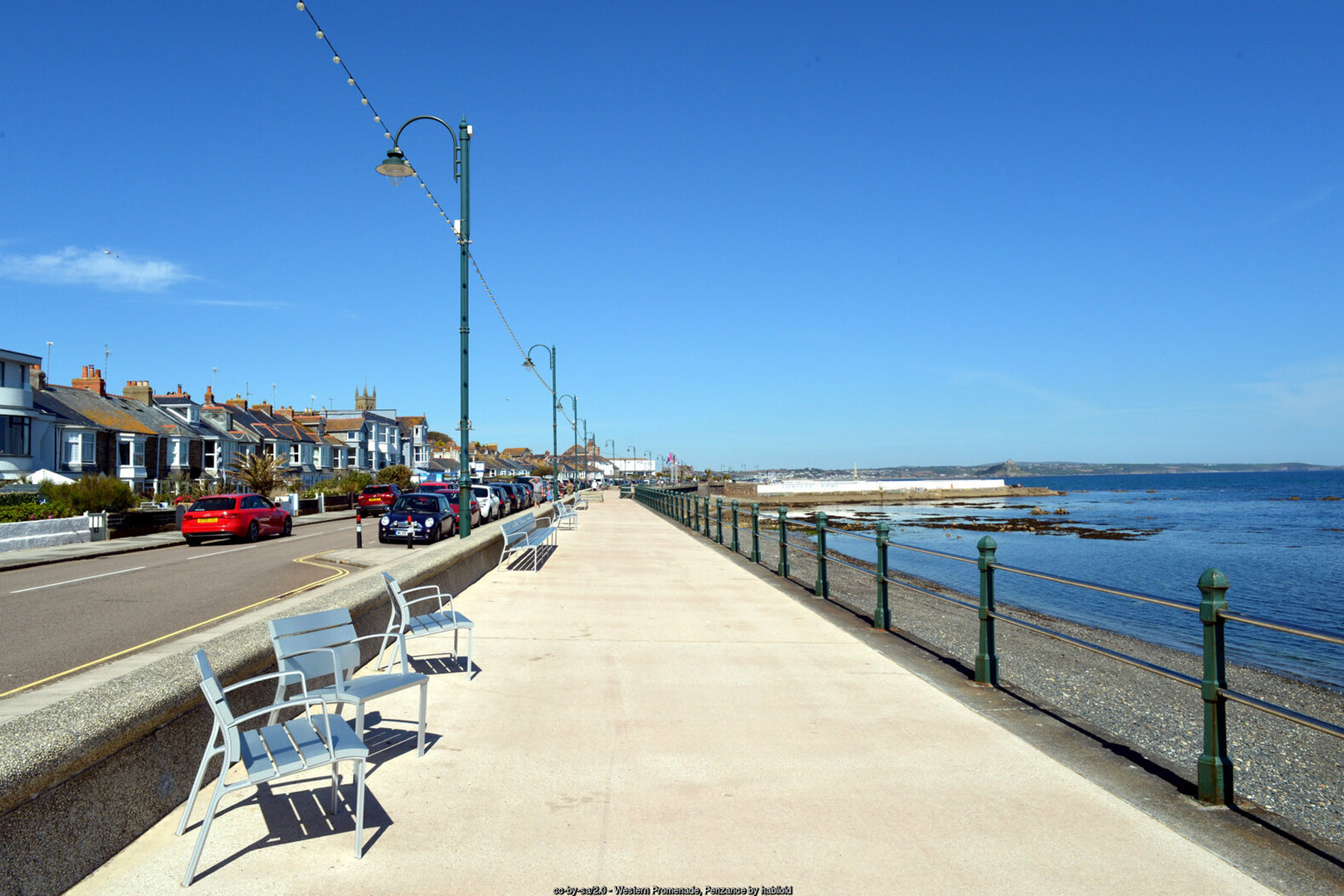
The Promenade itself is the reason this beach is worth a page of its own rather than a footnote to the town's harbour. Penzance Town Council describes it, without much argument from anyone else, as "the only Victorian promenade in Cornwall" - and its origins do indeed reach back further than most seafronts on this coast. The Marine Esplanade, as it was first known, was laid out in 1844, close to a decade before the railway itself reached the town: the West Cornwall Railway opened its terminus at Penzance in March 1852, and through running to London followed in 1859 once Brunel's Royal Albert Bridge finally linked Cornwall to the rest of the national network at Saltash. Once that connection was in place, the Promenade's role changed quickly and permanently: what had been a working shoreline tied to fishing and small-scale trade became, in the space of a generation or two, the setting for a seaside resort, a shift that - as local historians researching the seafront's history have noted - came at some cost to the fishing industry that had shaped the town for centuries before. The Promenade's transformation into a genuine resort seafront gathered pace through the second half of the nineteenth century: Alexandra Road, designed by the architect John Matthews and linking the Promenade back up towards Alverton, was formally opened by the Prince of Wales in 1865, and the Mount's Bay Hotel and Queen's Hotel both went up along the seafront in that same decade to house the new wave of railway-borne visitors - the Queen's Hotel, in its Italianate splendour, remains one of the most recognisable buildings on the whole Promenade today.
The decades either side of 1900 filled in most of the rest of the Promenade's Victorian and Edwardian character. Alexandra Grounds, the public gardens set back from the seafront, opened in July 1903 and had gained a bowling green and tennis court by the 1920s; a bandstand was built on the Promenade opposite the Queen's Hotel in 1905, giving the seafront a fixed venue for the brass bands and concert parties that were a staple of Edwardian seaside life. The Pavilion followed in 1911, opening with a roof garden and cafe before expanding into a fuller restaurant, theatre and ballroom that became, by most accounts, the centre of nightlife on the Promenade for much of the twentieth century - it kept up concert parties even through the Second World War, before later life saw it converted into an amusement arcade and restaurant, a use that (in spirit if not in the same building throughout) continues on the seafront today. It was this same late-Victorian Promenade, busy with strolling holidaymakers under grey Cornish skies, that caught the eye of the Irish painter Norman Garstin in 1889: his painting "The Rain It Raineth Every Day" captures the Promenade's crowds, wet pavements and soft coastal light so precisely that it has become one of the defining images of Victorian Penzance, and it now hangs a short walk away in Penlee House Gallery & Museum - well worth combining with a visit to the beach itself, not least to see the very spot you have just been standing on rendered in oils well over a century ago.
The Promenade's modern history has been shaped as much by the sea it sits beside as by the town behind it. Severe storms in the winter of 2013-14 caused serious damage along this stretch of coast, hurling boulders from the rock-armour sea defence up onto the walkway itself and smashing paving slabs, railings and sections of concrete along the way. Cormac, Cornwall Council's own highways and infrastructure contractor, completed emergency repairs to the Newlyn Green section of the seafront within five months, pouring some 2,000 cubic metres of marine concrete to rebuild the damaged sea wall in time for the August 2014 Newlyn Fish Festival, and a further phase of repairs in 2015 saw around 280 giant granite boulders repositioned along the Promenade's lower tier to reinforce its defences. That storm damage was ultimately the trigger for a much larger regeneration of the whole seafront, completed in September 2021 - timed, rather neatly, to be ready for that year's Tour of Britain cycle race, whose Grand Depart started from the Promenade. The scheme resurfaced some 6,500 square metres of walkway with around 1,400 cubic metres of specially formulated marine concrete, and added a distinctive local touch in the process: brass inlay designs taken directly from local schoolchildren's drawings, along with decorative footprints in the new concrete depicting dance steps, swimmers and phases of the moon. Eighteen new flagpoles, sculptural concrete pebble seats and aluminium benches were installed as part of the same £1.4 million scheme, with Penzance Town Council itself contributing £65,800 towards the flagpoles, benches and seating - though it is Cornwall Council, not the town council, that owns and maintains the Promenade day to day.
All of that investment sits directly above the beach described here, and it shows in how the seafront looks and feels today. The full Promenade runs for roughly two and a half miles in total, from Jubilee Pool and Battery Rocks in the east all the way round to Newlyn in the west, but it is the central mile or so - broadly the stretch between Wherrytown and the harbour - that fronts this shingle-and-sand beach directly, with the walkway, sea wall and rock armour running the whole way. At the harbour end, just beyond this beach, the Art Deco Jubilee Pool sits on Battery Rocks - a striking 1935 lido that is very much worth a visit in its own right, and one with a far longer story than fits on this page; the full history of the pool and the rocks around it belongs on Cornwall Online's own Battery Rocks page, which this one is happy to defer to rather than repeat. What belongs here instead is the seafront as most visitors actually experience it: an amusement arcade, a run of hotels and guest houses in Victorian and Edwardian buildings that line the landward side of the Promenade almost without a break, cafes and restaurants making the most of the sea view, and - since the 2021 regeneration - new benches, pebble seating and play parks that have made the whole stretch noticeably more comfortable to linger on than it was a decade ago.
Practically speaking, this is a beach for a walk, a paddle at low water and a spot of rock-pooling rather than a lie-on-the-sand day out, and it suits that role well. There is no lifeguard cover here at any time of year, so visitors exploring the exposed rocks at low tide should take the usual sensible precautions and keep an eye on the state of the tide rather than relying on any patrol. Dogs are welcome for most of the year but are subject to a seasonal restriction on the section of shore between Wherrytown and Battery Rocks - which takes in this beach in full - with no dogs permitted between 10am and 6pm from 1 July to 31 August, Cornwall Council's own beach byelaw list confirms; outside those dates and hours, dogs can be walked here as freely as anywhere else on the seafront. Neither this beach nor any other in the immediate Penzance area currently holds Blue Flag or Seaside Award status - Cornwall Council's official list for the 2026 season includes none of the town's beaches - which is worth stating plainly rather than leaving visitors to assume otherwise, even though the Promenade's genuine appeal, as this page has tried to show, lies well beyond any award scheme.
Parking is straightforward if not abundant directly on the seafront itself: a limited number of free bays run along the Promenade, and pay-and-display car parks sit at either end - towards Wherrytown to the west, and towards the harbour and Battery Rocks to the east - both an easy walk from any point along this stretch of beach. The flat, level surface of the Promenade itself, freshly resurfaced in the 2021 regeneration, makes for very easy walking and wheeling along the top of the seafront, whatever the state of the tide below; reaching the shingle and rocks themselves involves steps or slipways at intervals along the wall, so anyone wanting to get down onto the beach proper rather than just walk above it should expect a less level final stretch.
The Promenade also makes a natural starting point for exploring the rest of this working stretch of Mount's Bay. Follow the seafront west past Wherrytown and the walk continues on into Newlyn, Cornwall's largest fishing port and, on many counts, one of the most important in England - it regularly competes with Brixham for that title, and its harbour of working luggers and trawlers is a striking contrast to the leisure-focused Promenade you have just left behind. Turn the other way, past Battery Rocks and the harbour, and Penzance's own working quay is where the Scillonian III ferry departs for the Isles of Scilly through the summer season, a reminder that this seafront has never been purely ornamental - fishing, shipping and travel have run alongside its holiday trade since the Promenade was first built.
Taken together, Penzance Promenade Beach earns its place as the flagship of this stretch of coast not through soft sand or a lifeguard flag, but through sheer setting and continuity: a beach that has sat beneath the same celebrated Victorian seafront for well over a century and a half, watched the town's fishing trade give way to its holiday trade and back again in part, weathered real storm damage and been rebuilt more handsomely than before, and still delivers, on any clear day, one of the best panoramic views in West Cornwall - out across Mount's Bay to St Michael's Mount and round to the distant line of the Lizard. It sits at the centre of Penzance's own run of beaches, an easy walk from Wherrytown to the west, Battery Rocks and Jubilee Pool just beyond the harbour, and Eastern Green and Long Rock curving away towards Marazion to the east - each worth its own visit, but none quite replacing the Promenade itself as the place most people picture when they think of a day at the beach in Penzance.
Visitor Information
Parking
A limited number of free parking bays run along the Promenade itself, with pay-and-display car parks at either end of the seafront - towards Wherrytown to the west and towards the harbour and Battery Rocks to the east - both within easy walking distance of the beach.
Facilities
No lifeguard cover along this beach at any time of year. The seafront above has an amusement arcade, cafes and restaurants, plus benches, pebble seating and play parks added during the Promenade's 2021 regeneration.
Disabled Access
The Promenade itself is a flat, hard-surfaced walkway, resurfaced in 2021 and easy for wheelchairs and pushchairs along its whole length; reaching the shingle and rocks below involves steps or slipways at intervals. Blue Badge parking is available in the pay-and-display car parks at either end of the Promenade - confirm current provision with Cornwall Council before you travel.
Things to Do Nearby
- Wherrytown, the next beach west towards Newlyn
- Battery Rocks, just beyond the harbour, beside the Art Deco Jubilee Pool
- Eastern Green, curving east from Station Rocks
- Long Rock, the easternmost beach in Penzance, towards Marazion
- Mousehole, a picturesque fishing village with its own small harbour beach, a few miles west via Newlyn
- Penlee House Gallery & Museum, a short walk from the seafront, home to Norman Garstin's 1889 Promenade painting "The Rain It Raineth Every Day"
Places to Stay
Frequently Asked Questions
Page last updated: 11 September 2026.