Portscatho
A Working Fishing Harbour Beach on the Roseland Peninsula
Portscatho Harbour Beach, Portscatho, Roseland Peninsula, Cornwall, TR2
Portscatho is a small, still-working fishing village tucked into the eastern shore of the Roseland Peninsula, its slipway and huddle of stone and colour-washed cottages opening directly onto a sheltered harbour beach of golden sand and shingle. Unlike many of Cornwall's harbour villages, which have long since traded their working boats for holiday moorings, Portscatho has kept a genuine fishing fleet putting out from its beach to this day, setting pots for crab and lobster and netting for the bay's seasonal catch - a living link to a maritime history that stretches back several centuries and gives the village a lived-in, unpolished character that sits comfortably alongside its obvious appeal to visitors.
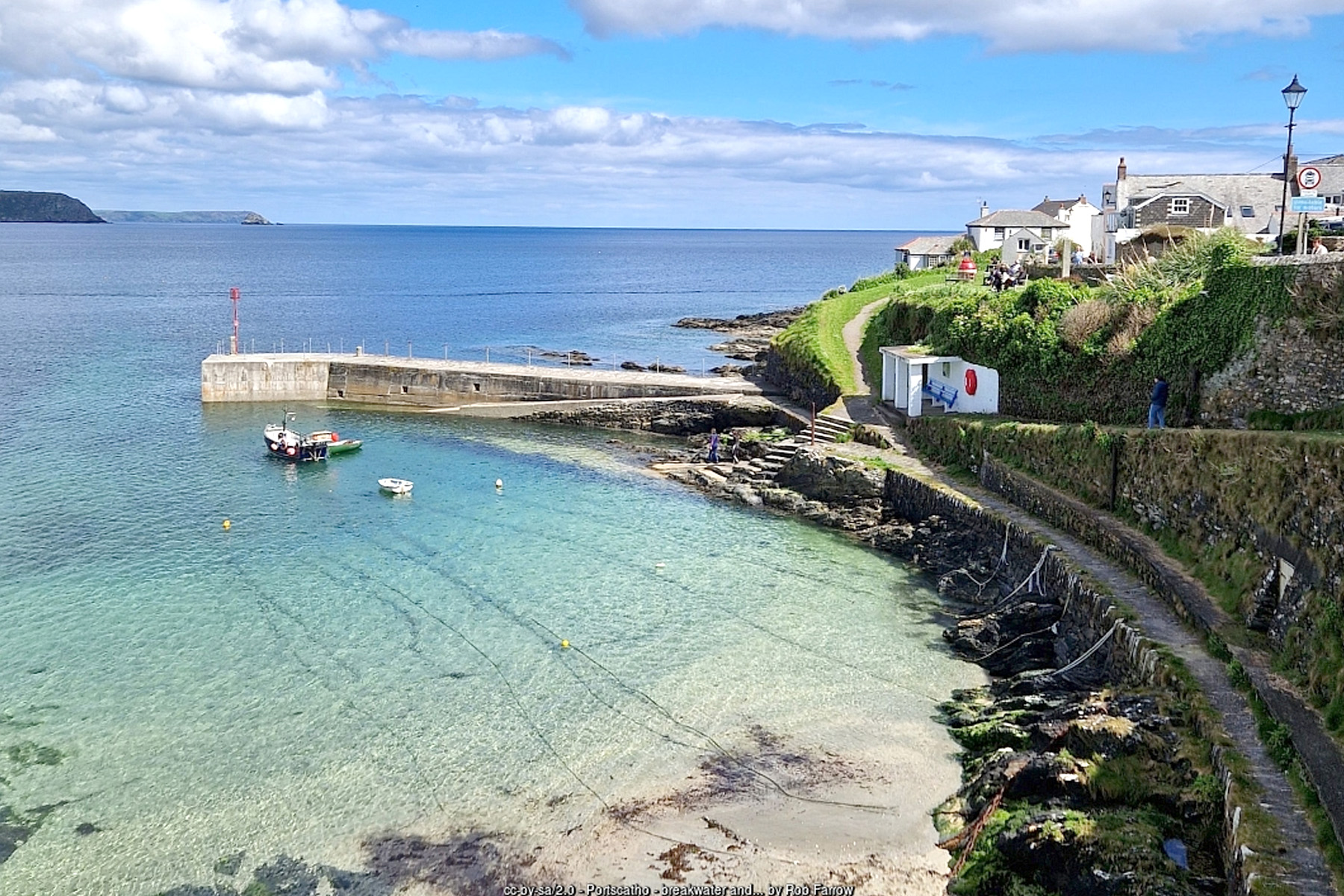
That maritime history runs deep. Through the 1700s and into the 1800s, Portscatho's sheltered position on Gerrans Bay made it an ideal base for the great Cornish pilchard fishery, when huge shoals of pilchards were driven inshore each summer and autumn and caught by seine netting - a method in which a "huer" stationed on the cliffs above the village would spot the approaching shoal by the reddish stain it left on the water and cry the shout of "Hevva!" to send the boats out. Portscatho and the neighbouring villages of the Roseland were, for a period, among the busiest pilchard stations on this stretch of coast, curing and pressing the catch for export before the industry declined through the late nineteenth and early twentieth centuries as the great shoals became less reliable and overseas markets contracted. The beach and harbour visitors see today, still busy with small working boats, are a direct continuation of that fishing tradition rather than a period piece kept for effect.
Portscatho sits within the civil parish of Gerrans, and the two settlements - Portscatho on the shore, Gerrans a short walk inland - are so closely linked that many visitors treat them as a single place. Gerrans itself carries an older and rather more romantic history than its modest size suggests: local tradition, recorded as far back as the Elizabethan antiquary William Camden, holds that the parish takes its name from Gerennius (or Geraint), a semi-legendary king of Cornwall said to have been buried nearby beneath Carne Beacon, a prominent Bronze Age round barrow that still stands above the coast a little further along the peninsula. Whatever the truth of the legend, Gerrans' parish church, with its distinctive pyramidal spire visible for miles around, remains a genuine and worthwhile short detour from the beach, and the association with a semi-mythical Cornish king gives this quiet corner of the Roseland a depth of story well beyond its size.
The beach itself is a modest, sheltered strip of sand giving way to shingle and rock as the tide drops, curved neatly around the harbour and protected from the worst of the swell by the shape of the bay and the headlands to either side. It is a genuinely pleasant spot for a swim or a paddle at most states of the tide, and the harbour itself, with fishing boats drawn up on the sand or moored just offshore, is as picturesque a working scene as anywhere on the Roseland. Rock pools around the harbour margins and along the low-tide foreshore reward a bit of exploring, and the gently shelving sand makes this an easy, family-friendly beach for those happy with a small-scale, village setting rather than an open expanse of dunes.
Geologically, this stretch of coast belongs to what geologists call the Gramscatho Group, a thick sequence of Devonian-age sandstones and mudstones laid down as turbidites - underwater sediment flows - in a deep marine basin around 380 million years ago, later folded and uplifted to form the cliffs and headlands of the Roseland. The particular sandstone unit exposed in the cliffs around the village is formally known to geologists as the Portscatho Formation, named directly for its type exposures here, a small but genuine claim to scientific significance for a beach best known to most visitors simply as a pretty place to launch a boat or eat an ice cream.
Portscatho today is a proper working village rather than a purpose-built resort, and that shows in the range of everyday amenities clustered right above the beach: a village shop, a handful of places to eat and drink, and the village pub, all within a short and level walk of the sand. It is a rare thing on this coast to find a genuine harbour beach with this much village life on its doorstep, and it is a large part of what makes Portscatho such a popular base for a Roseland holiday rather than simply a stop on a coastal walk.
That popularity does bring one real practical challenge: parking. Space in the village is limited at the best of times, reflecting Portscatho's narrow lanes and its long history as a working settlement rather than a resort built around the motor car, and it becomes genuinely tight in the height of summer. The main village car park involves a walk uphill from the harbour, which is worth bearing in mind for anyone carrying beach gear, and the lanes down near the slipway itself are narrow and not well suited to casual parking or turning. Arriving early in peak season makes for a far less stressful visit, and for those happy to walk a little further, parking at Porthcurnick Beach to the north and following the coastal path around to Portscatho is a genuinely pleasant alternative that avoids the village's tightest pinch points altogether, taking in some of the Roseland's best coastal scenery along the way.
The drive to Portscatho itself is straightforward if unhurried, in keeping with the Roseland's general character as one of the quieter, less-signposted corners of Cornwall. From Truro, the A3078 runs south-east towards Tregony and on towards St Mawes, with signposted lanes turning off towards Gerrans and Portscatho for the final stretch down to the coast. The peninsula's relative remoteness - no direct through-road, and the Fal estuary itself a natural barrier to casual passing trade from the west - has done a good deal to keep Portscatho and its neighbours from being overrun, even as their reputation as one of Cornwall's most attractive stretches of coast has grown.
Dogs are welcome on Portscatho's beach for most of the year, with a seasonal restriction in place between 1 July and 31 August, 10am to 6pm, during the busiest part of the summer season - a fairly standard pattern for a family beach of this kind, and one worth checking locally if visiting right at the edges of that window, since exact signage can vary slightly from year to year.
For those keen to explore further, the Roseland offers plenty within easy reach of Portscatho. Towan Beach, a short walk or drive to the north, is a quieter, more open stretch of sand backed by dunes and farmland, popular with those after a bit more space than the harbour beach can offer. Porthcurnick Beach, a little further along the same stretch of coast, is well known for The Hidden Hut, one of Cornwall's most talked-about beachside food spots, and makes for a natural pairing with a visit to Portscatho on the same day, whether walked via the coast path or reached separately by car. And Gerrans itself, just up the hill, rewards a short detour with its parish church and the quiet, unhurried charm of a village that has changed only slowly across the centuries. Together, Portscatho and its immediate surroundings offer a genuinely rounded Roseland day out: a working harbour beach, real village life, a fine stretch of coast path, and a slice of half-legendary Cornish history within a mile or two in every direction.
Visitor Information
Parking
Parking in the village is limited, especially in summer. The main village car park is an uphill walk from the harbour, and the lanes near the slipway are narrow. Arrive early, or park at Porthcurnick Beach and walk the coastal path into Portscatho.
Facilities
A village shop, several places to eat and drink and the village pub sit right above the beach. There is no permanent RNLI lifeguard at Portscatho.
Disabled Access
The lower village and harbourside are largely level, though the beach surface itself is sand and shingle, which limits onward wheelchair or pushchair access, and the main car park is up a hill. No dedicated Blue Badge bays are confirmed in the village - check current signage on arrival.
Things to Do Nearby
- Towan Beach, a quieter, more open beach backed by dunes and farmland, a short walk or drive north
- Porthcurnick Beach, home to the renowned Hidden Hut beach café, a little further along the coast
- The village of Gerrans and its parish church, a short walk up the hill from the harbour, with a traditional link to the semi-legendary Cornish king Gerennius
Places to Stay
Portscatho has its own range of holiday accommodation close to the harbour and beach:
Frequently Asked Questions
Page last updated: 17 September 2026