Porthluney Cove
A Broad Sandy Beach Beneath Caerhays Castle
Porthluney Cove, near Caerhays, Roseland Peninsula, Cornwall, PL26
Porthluney Cove is, by any reasonable measure, one of the most dramatic and photogenic beach settings anywhere in Cornwall. A broad, open sweep of sand curves round the bay at the foot of a shallow valley, and rising directly above it, close enough to feel genuinely part of the beach itself rather than a distant backdrop, stands Caerhays Castle - a turreted, honey-stone country house that looks for all the world like a fairy-tale illustration come to life. Few beaches in the county pair sand and architecture so completely: at Porthluney, the castle is not a landmark glimpsed from a distance but a wall of towers and battlements standing sentinel at the top of the beach, its windows looking directly out over the same sand that holidaymakers are building sandcastles on below. It is a combination that draws photographers, wedding parties and casual visitors alike, and it gives Porthluney Cove a sense of occasion that few other Cornish beaches can match.
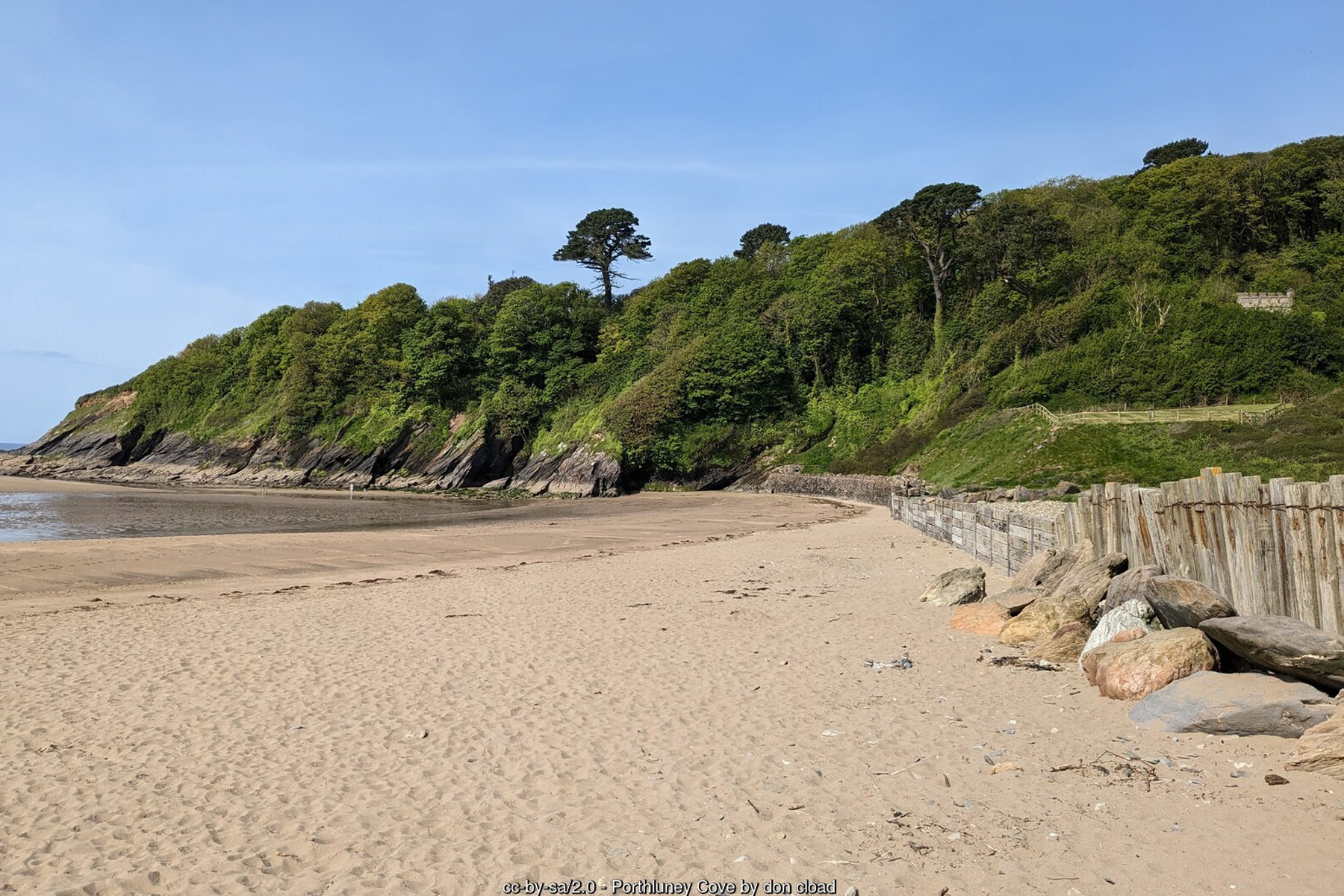
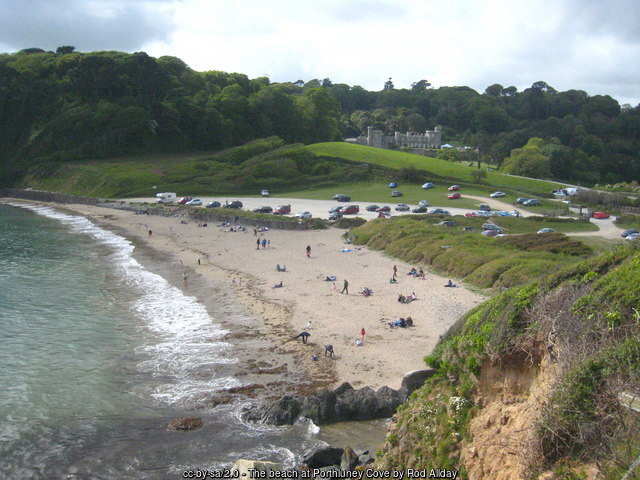
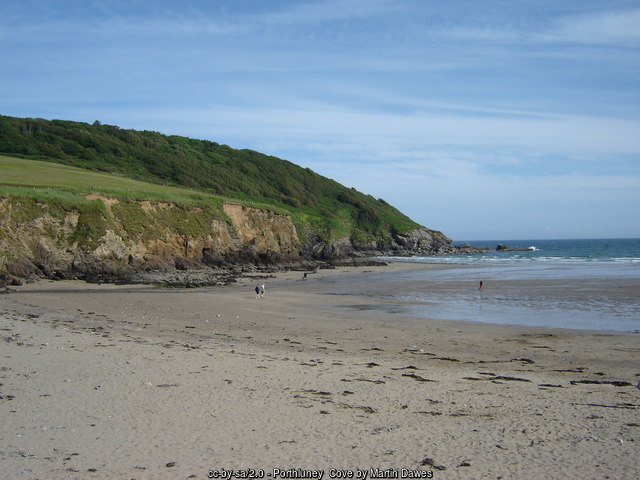
Caerhays Castle itself is a genuinely significant building, not merely a picturesque prop for the beach below. It was built between 1807 and 1810 as a semi-castellated country house, commissioned by John Bettesworth-Trevanion and designed by John Nash, the celebrated Regency architect responsible for some of the era's most recognisable buildings, including Buckingham Palace's remodelling and the Royal Pavilion at Brighton. Nash's design at Caerhays gives the castle its distinctive silhouette of round towers, battlements and irregular massing, a style intended to evoke a genuine medieval fortress while serving as a comfortable, modern country residence - part of the same romantic castellated fashion that swept through British architecture in the early nineteenth century. The result is widely regarded as one of Nash's finest surviving works outside London, and it has been a Grade I listed building since 1988 in recognition of its architectural importance, with its wider parkland registered on the National Register of Historic Parks and Gardens in 1987.
The castle's ownership history stretches back much further than Nash's building, and traces a long, winding line through some of Cornwall's most established families. The manor was held by the Arundell family in the early medieval period before passing to the Trevanion family around 1379 through marriage, and it remained in Trevanion hands for centuries, with John Trevanion inheriting and improving the estate in 1703. The Trevanion line came to an end in 1767, when the property passed to John Bettesworth - who took the Trevanion name and later commissioned Nash's castle - following William Trevanion's death. Financial difficulties eventually overtook the Bettesworth-Trevanion family, and in 1854 the estate was purchased from creditors by Michael Williams II, a member of the prominent Williams mining family long associated with Cornwall's copper and tin industry. In 1880, at just eighteen years old, John Charles Williams inherited Caerhays, and it was under his stewardship that the estate's now-famous gardens began to take shape. The Williams family remain the owners of Caerhays to this day, with Charles Williams continuing the family's long custodianship of the castle and its grounds into the 2020s.
It is the gardens, as much as the castle itself, that have made Caerhays internationally significant. Spread across some 120 acres of steeply wooded valley behind the castle, they hold over 600 different plant varieties, many of them raised from seed collected on plant-hunting expeditions to China and the Himalayas in the early twentieth century - a tradition that John Charles Williams helped establish and that has continued at Caerhays ever since. Azaleas and camellias thrive throughout the grounds, but it is the magnolia collection that has earned Caerhays its greatest horticultural renown: the estate's magnolias are formally accredited as a National Plant Collection by Plant Heritage, and in spring, when the trees are in full bloom, Caerhays draws garden enthusiasts from across the country and beyond, its valley slopes turned pink and white with blossom on a scale rarely seen elsewhere in Britain.
Beyond its architectural and horticultural credentials, Caerhays has also found a place on screen. The castle has been used as a filming location on several occasions, most notably for the 1979 BBC television adaptation of Daphne du Maurier's Rebecca, and again decades later for Tim Burton's 2015 film Miss Peregrine's Home for Peculiar Children, in which its turreted silhouette provided exactly the kind of gothic, faintly otherworldly backdrop the story called for. It is easy to see why filmmakers have been drawn to it: few Cornish buildings offer such a complete, ready-made fantasy-castle appearance, standing as it does with the sea and sand spread out below.
It is worth being clear, though, that Caerhays Castle and its gardens are not open to the public year-round. Access is seasonal and limited, generally concentrated around the spring garden season when the magnolias and camellias are at their best, and visitors hoping to see inside the castle or explore the gardens should check current opening dates before planning a trip specifically around it. The beach itself, by contrast, is freely accessible at any time of year, and a great many visitors come simply to enjoy the sand and the view up towards the castle without ever needing the grounds to be open.
As a beach in its own right, Porthluney Cove is a genuinely good one: broad, sandy, and generally regarded as a safe, family-friendly spot for a swim in normal conditions, though as with most of the Roseland Peninsula's beaches there is no RNLI lifeguard patrol, so visitors should use sensible judgement around tides and conditions. Some parking is available close to the beach on a seasonal, pay-and-display basis, making Porthluney one of the more straightforwardly accessible beaches on this stretch of coast compared with some of its more remote neighbours further along the Roseland. The valley setting shelters the beach reasonably well from the wind, and the gentle slope of the sand makes it a comfortable spot for families to spend a full day, with the castle's ever-present silhouette lending even an ordinary beach afternoon a genuine sense of grandeur.
Porthluney Cove sits within easy reach of the rest of the Roseland's south coast, with Portholland's twin sandy beaches a short walk or drive to the southwest along the coast path, and Hemmick Beach a little further on towards Gorran Haven. For visitors exploring this part of Cornwall, Porthluney Cove makes a natural centrepiece: a genuinely outstanding beach in its own right, and one paired with a piece of Regency architecture and horticultural history that few other stretches of Cornish coastline can match.
John Nash's body of work makes Caerhays' setting all the more remarkable. Best known today for his contribution to Regency London - the remodelling of Buckingham Palace's exterior, the sweeping terraces of Regent's Park, and the exotic domes and minarets of the Royal Pavilion at Brighton for the Prince Regent - Nash was equally at home designing castellated country houses for private clients across Britain, of which Caerhays stands as one of the most complete and best-preserved examples. Unlike a purely defensive medieval castle, Nash's design was always intended to be lived in comfortably, its round towers and battlements arranged as much for picturesque effect when viewed from the beach below as for any historical authenticity - a piece of theatre in stone that has aged into a genuinely beloved Cornish landmark rather than a period curiosity.
The valley setting that shelters Porthluney Cove also shapes its character as a beach. Flanked by rising ground on both sides and with the castle and its wooded gardens closing off the head of the valley, the cove sits noticeably more protected from the wind than many of the more exposed, open beaches further along this coast, which makes it a comfortable choice on blustery days when neighbouring beaches can feel harsh. The same sheltered, south-facing aspect that suits the castle's famous magnolias against late frosts also helps keep the beach itself a pleasant, sun-trap spot for much of the year, and the river that drains the valley reaches the sea here too, adding a further gentle point of interest for children exploring the sand at its western end.
It is little surprise that a beach paired with such a striking piece of architecture has become one of the most photographed spots on the Roseland Peninsula, drawing everyone from casual holiday snapshots to professional landscape and wedding photography, the castle's towers reliably catching the light at either end of the day. Unlike beaches where the main view is out to open sea, Porthluney's principal outlook is inland and upward, back towards the castle and the wooded valley behind it, which makes for a very different kind of beach photograph, and a different kind of beach walk, from most of the Roseland's other coves. The coast path continues east from Porthluney towards Hemmick Beach and on to the Dodman, the peninsula's highest headland, giving energetic walkers a natural next leg once they are ready to leave the castle view behind, while those content to stay put find that few Cornish beaches reward simply sitting and looking quite as generously as this one does.
Visitor Information
Parking
Some parking is available close to the beach on a seasonal, pay-and-display basis. Space can be limited on busy summer days, given the beach's popularity and its castle backdrop.
Facilities
Facilities at the beach itself are limited. Caerhays Castle and its gardens offer seasonal visitor facilities when open, mainly during the spring garden season. There is no RNLI lifeguard patrol.
Disabled Access
The beach is broad and sandy with reasonably level access from the nearby parking area, making it more accessible than many of the Roseland's smaller coves. No dedicated Blue Badge bays are confirmed - check current signage on arrival.
Things to Do Nearby
- Caerhays Castle & Gardens, the Regency castle and its internationally renowned magnolia gardens overlooking the beach, open seasonally
- Portholland, the twin sandy beaches of East and West Portholland, a coast path walk or short drive southwest
- Hemmick Beach, a quieter beach further along the coast towards Gorran Haven
Places to Stay
Porthluney Cove has no dedicated accommodation listings of its own - the nearest general hub covering this part of the Roseland Peninsula is:
Frequently Asked Questions
Page last updated: 17 September 2026