Great & Little Molunan
Two Remote Sandy Coves Beneath St Anthony Head
Great & Little Molunan, near St Anthony Head, Roseland Peninsula, Cornwall, TR2
Great Molunan and Little Molunan are two small, adjoining coves tucked into the last stretch of coastline before the Roseland Peninsula comes to an end at St Anthony Head, the rocky point that marks the eastern side of the entrance to Falmouth's Carrick Roads. At low tide both coves show a decent run of golden sand, narrowing to shingle and rock as the water rises, and the two beaches sit close enough together, separated by a low rocky spur, that most visitors treat them as a single outing rather than two separate destinations - dropping down to whichever looks most sheltered on the day, or exploring both in turn. Neither beach has a road leading to it, and neither has anything resembling a car park; this is a walk-in pair of coves, reached only on foot from the National Trust land that covers the headland above, which has kept them genuinely quiet even by the standards of the Roseland's other small, undeveloped beaches.
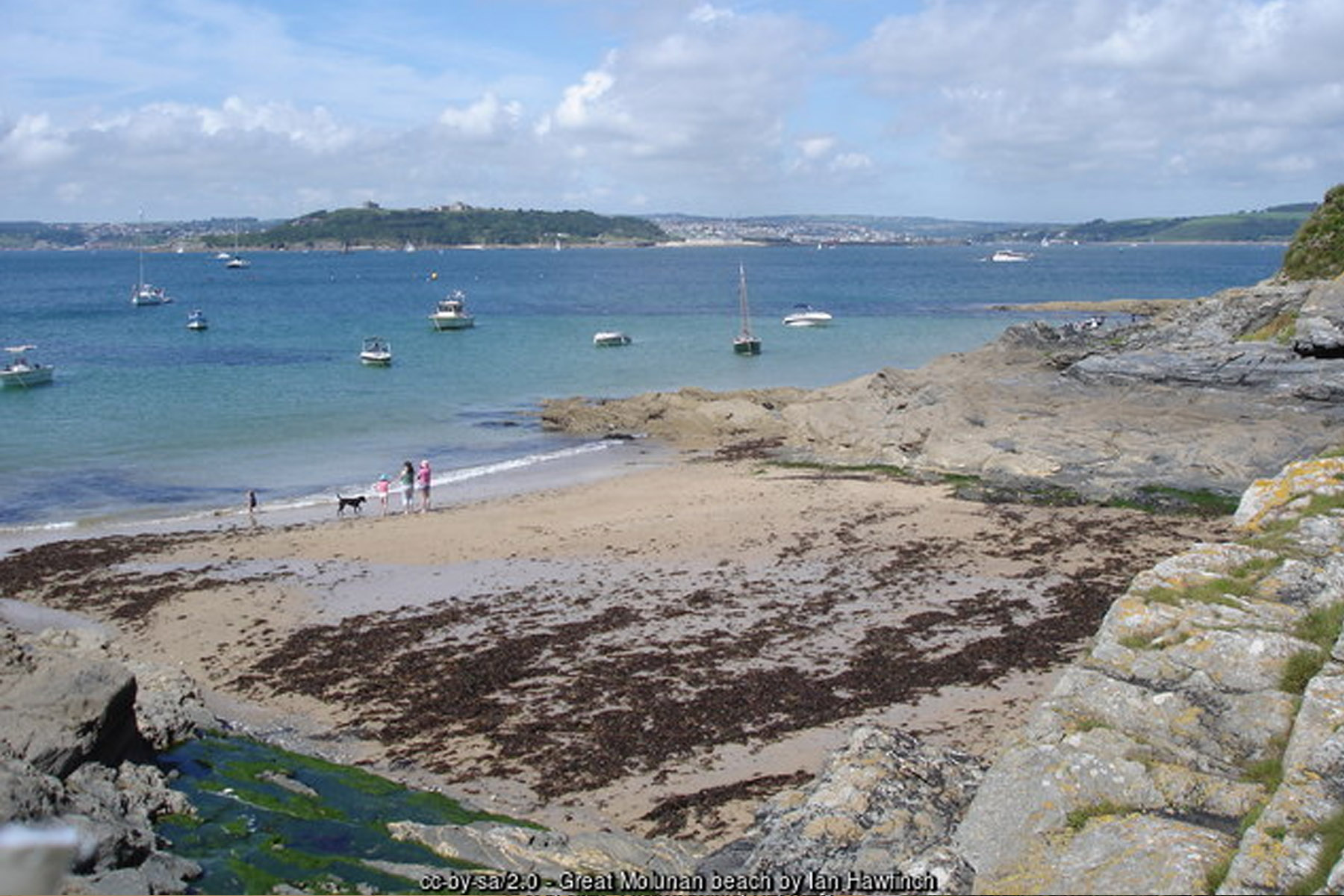
Great Molunan is the larger and more open of the pair, facing out across the mouth of the Carrick Roads with views past St Anthony Head to Falmouth and Pendennis Point on the far side of the estuary. Little Molunan lies just round the point, smaller and more enclosed, tucked in against the cliffs in a way that gives it extra shelter from any wind out of the west. Both beaches sit within a stretch of coast riddled with small sea caves, gullies and rock pools, particularly around the rocky spur that divides them, and low water is the best time to explore this ground properly - there is genuinely interesting rockpooling here for anyone prepared to look, in caves and gullies that see far fewer hands and buckets than the pools at Cornwall's larger, car-accessible beaches.
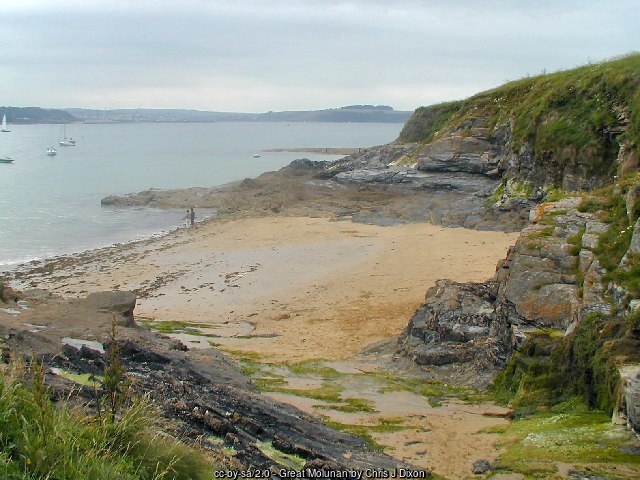
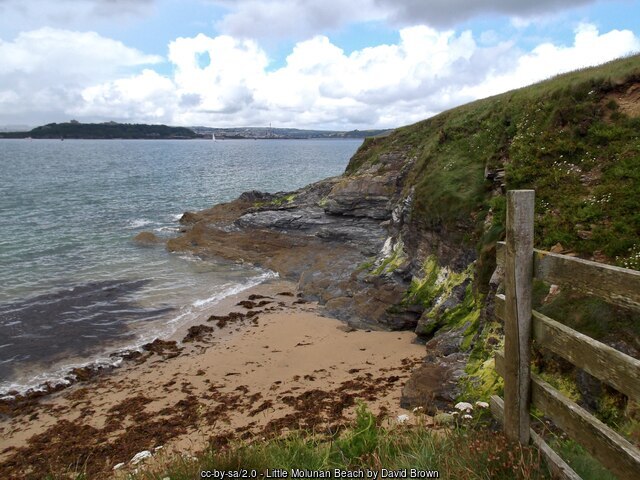
Access is entirely on foot, and there are two realistic ways to arrive. The most direct is via the National Trust car park at St Anthony Head itself, from which a path drops down through the headland's coastal grassland to the coves in around ten minutes - an easy enough walk down, though the return climb back up to the car park is a proper, steady pull that visitors should factor into how much time and energy they keep in reserve. The alternative approach is the small passenger ferry that crosses the harbour mouth from St Mawes to Place, running several times a day, seven days a week, from April to October - a genuinely pleasant, very short crossing that lands visitors on the Place side of the water, from where the coast path leads round past Place House and on towards St Anthony Head and the Molunan coves. For anyone staying in St Mawes without a car, or simply looking for a more interesting way to arrive than a straight walk from a car park, the ferry-and-coast-path route is well worth the small fare.
The Place landing itself is worth a slow look before pressing on towards the coves. Place House, the large private house that dominates the shoreline here, stands on the site of a small Augustinian priory founded as a daughter house of Plympton Priory in Devon in the twelfth century, and after the Dissolution of the Monasteries in 1538 the monastic buildings were converted into a private residence, a process largely completed by around 1597. Tucked in beside and partly hidden by the house is St Anthony's Church, believed to have been built around 1124 on the site of an earlier Celtic chapel, and still, remarkably, largely intact as a thirteenth-century cruciform building with an unusual central tower rather than the more typical west-end one. Its Norman doorway is thought to have been brought over from Plympton Priory itself, and the architectural historian Nikolaus Pevsner rated it as the best surviving example in Cornwall of what a parish church looked like in the twelfth and thirteenth centuries. It is a genuinely unexpected thing to stumble across on the way to a remote beach, and a natural stopping point for anyone taking the ferry-and-coast-path route in from St Mawes.
St Anthony Head itself, immediately beyond the coves, carries two distinct layers of history that reward the short additional walk out to the headland. The most visible is St Anthony's Lighthouse, commissioned by Trinity House and first lit in 1835 to warn shipping of the Manacles rocks and Black Rock, two hazards that lie off this stretch of coast at the entrance to Falmouth harbour and the Carrick Roads. Its fog warning stayed fairly basic - a bell, rather than anything more sophisticated - until the 1950s, when a modern horn system was installed and the light itself was converted to electricity; the keeper was finally withdrawn and the lighthouse made fully automatic in 1987, and Trinity House's former keepers' cottages beside the tower are now let out as holiday accommodation. The lighthouse has one more unusual claim to fame beyond its working history: its white tower featured prominently in the opening titles and several scenes of the 1980s children's television series Fraggle Rock, standing in as the home of the Captain and his dog Sprocket in the UK-produced segments of the show - a detail that still draws the occasional fan out along the coast path for a photograph.
The headland's other layer of history is military rather than maritime. St Anthony Head was first fortified as early as 1796, when a battery of 24-pounder cannon was set up here in response to the threat of French invasion, upgraded to 64-pounder guns in 1885 as artillery technology moved on. The most substantial fortification came in 1904, when a full coastal battery was built with two enormous 6-inch breech-loading guns, each with a 23-foot barrel, mounted in deep pits connected to underground magazines where shells and cartridges were deliberately stored apart and raised separately by hand-cranked hoists, only brought together in the gun pit itself. The battery was manned again through the Second World War, working alongside Pendennis Castle's own defences to examine shipping entering the Fal, before coastal artillery was wound down nationally in 1956 and the guns removed. The National Trust took on the headland in 1959, and in 2012 the eastern gun emplacement was carefully excavated and restored as part of a coastal heritage project, so that visitors can now walk down into the pit itself and see the original walkways, magazine stores and hoist machinery, with guided tours run during the summer months.
Back at beach level, Great and Little Molunan remain deliberately undeveloped. There is no shop, no café, no toilet block and no lifeguard cover at either cove, and the coastal grassland and heath above the beaches, managed by the National Trust as part of its wider St Anthony Head holding, supports grazing livestock, nesting seabirds and a good chance of spotting seals offshore in calmer weather - all of it a reminder that this stretch of coast is being kept as a nature and heritage site first, with visitor facilities a deliberate afterthought. Dogs are welcome at both beaches all year round with no seasonal restriction, which is worth knowing given how many of the Roseland's more developed beaches do apply a summer dog ban; owners should still bring their own water, since there is nowhere on site to get any, and keep dogs close on the approach paths around the grazing land.
For visitors happy to travel light and take the walk in and out on foot, Great and Little Molunan offer exactly the kind of experience that has become genuinely rare on the more accessible parts of the Cornish coast: a sheltered, good-quality sandy beach with no crowds, no infrastructure and no queue for parking, set against a headland with real depth of history above it. The nearest facilities of any kind - café, toilets and a more substantial car park - are a walk away in either direction, at Porth Farm near Towan Beach to the east or in St Mawes to the west, which is exactly what keeps the Molunan coves themselves so quiet.
Visitor Information
Parking
No car park at either beach. The nearest is the National Trust car park at St Anthony Head (around a ten-minute walk down, with a steep climb back), or the Porth Farm car park a little further round the headland. Free for National Trust members.
Facilities
No facilities at either cove - no shop, toilets or refreshments, and no RNLI lifeguard patrol. The nearest café and toilets are at Porth Farm (Towan Beach) or in St Mawes.
Disabled Access
Access is on foot only, down a coast path with a steep climb back up, and is not suitable for wheelchairs, pushchairs or limited mobility. There is no dedicated parking of any kind, so no Blue Badge provision applies here.
Things to Do Nearby
- Porthbeor Beach, another small, quiet Roseland cove a little further along the coast path
- St Mawes, the nearest town, with shops, restaurants and the passenger ferry across to Place
- St Anthony Head, for the 1835 lighthouse, the restored WWII/Victorian gun battery, and National Trust coast path walks
Places to Stay
Great & Little Molunan has no accommodation listings of its own - this is a walk-in pair of coves with no village attached. The nearest genuine accommodation hub, given its position near St Anthony Head, is the St Anthony-in-Roseland area:
Frequently Asked Questions
Page last updated: 17 September 2026