Gorran Haven
A Sandy Fishing-Village Beach at the Eastern Gateway to the Roseland
Gorran Haven, Roseland Peninsula, Cornwall, PL26 6NT
Gorran Haven is a sandy beach at one of the most genuinely picturesque former fishing villages anywhere on the Roseland Peninsula, tucked at the eastern end of this stretch of coast where the Roseland meets St Austell Bay, close under the great green shoulder of Dodman Point. It is the last beach in this guide to the Roseland, geographically the easternmost of the peninsula's named beaches, and the village sits right on the boundary where the Roseland's own coastline gives way to Mevagissey's - a fitting place, in other words, to end a walk down this coast rather than a stop somewhere in the middle of it. Unlike some of the Roseland's more remote, walk-in coves, Gorran Haven is a proper village beach: a good stretch of sand directly below a cluster of cottages, a working slipway and the remains of an old stone pier, with parking, toilets and a handful of places to eat close by, making it one of the more straightforwardly family-friendly beaches on this part of the peninsula.
The village itself is built into the steep little combe that runs down to the harbour, its narrow lanes lined with a mix of old fishermen's cottages, later Victorian villas and more recent infill, all funnelling down towards the beach and the sea. Mevagissey lies only a short distance up the coast to the north, and St Austell a little further inland, which makes Gorran Haven an easy, low-key base for exploring this whole eastern corner of the Roseland without ever feeling like an extension of either larger town - it has always kept its own separate identity as a village in its own right, rather than becoming a satellite of its better-known neighbour along the bay.
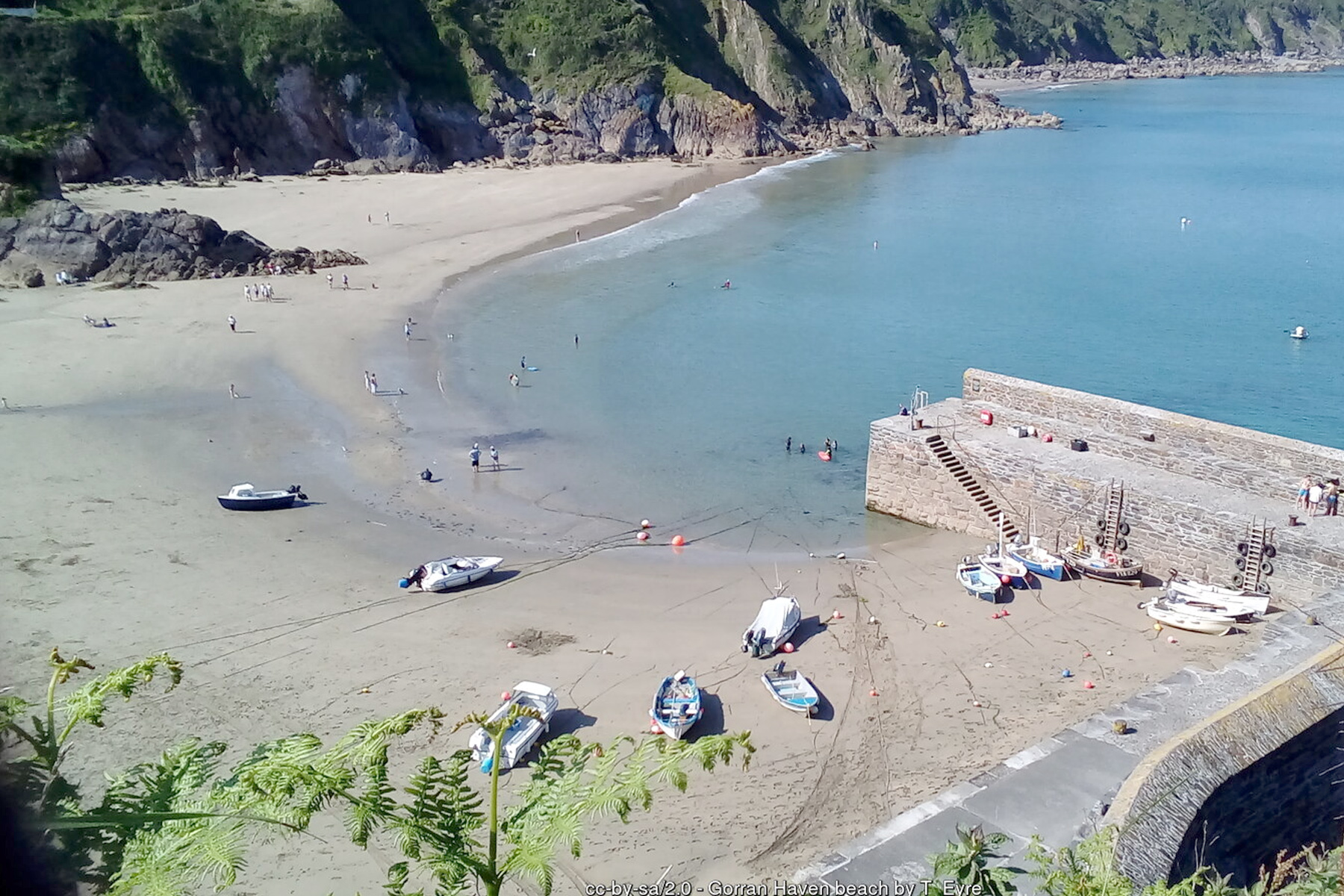
The village's history as a working harbour goes back much further than its present life as a holiday destination. Gorran Haven was an ancient fishing harbour, and its first pier is recorded as having been built as early as the 15th century - a remarkably early date for any Cornish harbour structure, and a sign of just how long this small cove has been worked by boats rather than simply visited by them. Through the 18th and 19th centuries the harbour took on a genuinely mercantile role as well as a fishing one, functioning as a small but useful port that received cargo transported along the coast from Fowey by barge and lighter vessel, part of the everyday coastal trade that once linked Cornwall's smaller harbours together long before decent roads made it unnecessary. The pier itself was rebuilt twice in the century that followed, once in the 1820s and again in 1888, each rebuilding a response to the wear of Cornish weather and the ordinary demands of a working fishing fleet on a small structure never designed for anything grander. Like most of the small harbours dotted along this coast, Gorran Haven's fortunes through the 19th and early 20th centuries were tied closely to the pilchard fishery, with seasonal shoals bringing boats and buyers into the harbour in numbers that the village's present quiet, largely residential character can make easy to forget. Traces of that working past are still visible around the harbour today, in the layout of the old net lofts and fish cellars that back onto the beach, several of which - much like St Just Church itself - have since been converted to entirely different, more domestic uses.
Religious life in the village has an equally layered history, told through its two churches. Haven Church, formerly known as "Mount Zion," is a non-denominational congregation that continues to serve Gorran Haven today. The older and more historically interesting of the two, though, is St Just Church, whose building had a working life as a fish cellar for well over a century before it ever became a place of worship - a common enough fate for small waterside buildings in fishing villages, where a good stone cellar close to the harbour was too useful a space to leave empty. In 1812, Congregationalists from neighbouring Mevagissey established the building as their Meeting House, and it became known locally as the old Chapel Cellar, a name that still carries an echo of its earlier, entirely secular use curing and storing the village's catch.
For a village of its size, Gorran Haven has an unusually rich list of notable residents and connections. Sir Richard Dearlove, born in 1945 and later Chief of the UK Secret Intelligence Service - MI6 - from 1999 to 2004, spent part of his early childhood here, a quietly remarkable fact for such a small and unassuming fishing village to claim. The naturalist and geologist Charles William Peach (1800-1886) is commemorated with a plaque in the village, and his son Ben Peach (1842-1926), who went on to become a distinguished geologist in his own right, was born here. And for more than fifty years Gorran Haven was home to the author and philosopher Colin Wilson (1931-2013), best known for his 1956 debut The Outsider, who lived and worked in the village for the greater part of his long writing life - a genuine literary residency, in a place that otherwise keeps a low profile. Wilson went on to become one of the most prolific British writers of his generation, publishing well over a hundred books from his Gorran Haven home across philosophy, true crime, the occult and science fiction, and the village's quiet, unhurried setting is often cited as part of what allowed him to sustain such an extraordinary output over so many decades. Ben Peach, for his part, went on from his Gorran Haven birthplace to a distinguished career with the Geological Survey, becoming best known for his ground-breaking work mapping the Moine Thrust in the north-west Scottish Highlands alongside fellow geologist John Horne - a world away from the small Cornish harbour village where his own geological curiosity, like his father's before him, first took root.
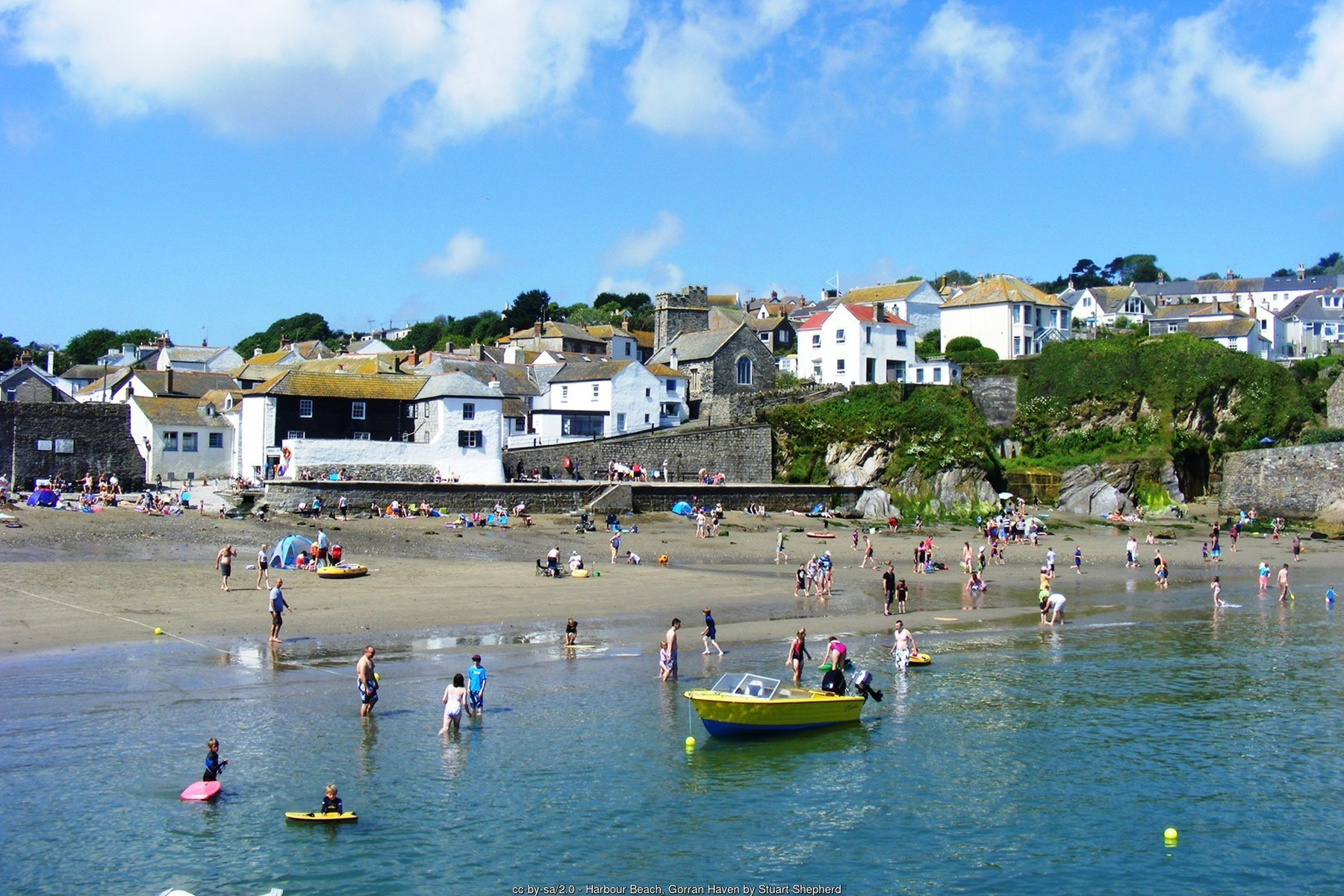
The beach itself is Gorran Haven's simplest pleasure: a good, sandy stretch directly in front of the village, sheltered by the curve of the bay and by the old harbour wall, and generally a safe, easy beach for family swimming and paddling in normal conditions, though as with any unpatrolled Cornish beach it pays to keep a sensible eye on the tide. The sand is at its best from mid to low tide, when a wide, gently sloping beach is exposed in front of the cottages and slipway; higher up the tide, the beach narrows considerably, in keeping with many of the smaller village coves along this coast. Rockpooling is possible around the harbour margins at low water, and the beach's easy, level access from the village car park makes it a genuinely practical choice for a family day out rather than a beach that demands a long walk to reach. Like most beaches along this stretch of coast, Gorran Haven is at its best on a settled day with a moderate tide, when the sand is at its widest and the water within the shelter of the bay stays calm; a falling tide in particular is worth timing a visit around, since it steadily uncovers more sand and rock as the morning or afternoon goes on. There is no permanent RNLI lifeguard cover at Gorran Haven, so as with any of the Roseland's smaller village beaches, swimmers and paddlers are best advised to keep a sensible eye on conditions rather than rely on being watched.
Gorran Haven's position on this stretch of coast puts it between two beaches with a rather different character. To the south lies Vault Beach, also known locally as Bow Beach, a larger and wilder walk-in beach reached via the coast path; to the north lies Great Perhaver Beach. Both of these neighbouring beaches are informally known as naturist beaches, a point worth noting simply as a factual detail of the local coastline rather than as any part of what Gorran Haven's own family beach offers.
Practically speaking, Gorran Haven is well equipped for a straightforward beach visit. There is a pay-and-display car park in the village, a short walk from the sand, with public toilets nearby, and a small selection of cafes, a shop and places to eat serving both visitors and the village's own community through the season. Dog access follows the pattern common to most managed Cornish village beaches, with a seasonal restriction understood to apply to the main section of sand over the busier summer months and dogs welcome for the rest of the year - visitors are advised to check current signage on arrival, since exact dates are set and can be adjusted locally each season rather than fixed indefinitely. As the final, easternmost beach in the Roseland Peninsula guide, Gorran Haven also marks a natural point of geographic continuity with the coastline beyond: the village sits right at the edge of the ground covered by Cornwall Online's separate Mevagissey guide, and walkers following the coast path south from here are, in effect, already stepping from one guide into the next.
Above the village to the south-east rises Dodman Point, one of the most striking headlands anywhere on Cornwall's south coast and a highlight of any visit to Gorran Haven. Owned and cared for by the National Trust, Dodman Point carries the earthwork remains of an Iron Age promontory fort across its neck, a defensive bank and ditch built many centuries before the Roman period made use of the headland's naturally commanding, easily defended position above the sea - much as other cliff castles do at prominent points along the Cornish coast. At the seaward tip of the headland stands a large granite cross, erected in 1896 as both a religious memorial and a practical daymark for sailors navigating this stretch of open water. The coast path over Dodman Point gives some of the finest long views in this part of Cornwall, taking in the whole sweep of St Austell Bay to the north-east and the Roseland's own coastline curling away to the south-west, and makes a natural, rewarding extension to any visit to Gorran Haven's beach below.
Taken together, Gorran Haven offers something a little different from many of the smaller, wilder coves elsewhere on the Roseland: a proper, practical village beach with real facilities on its doorstep, set against a backdrop of genuine maritime history, two churches each with a story worth telling, and a small but surprising roll-call of notable names connected to a village most visitors would otherwise pass through without a second thought. Combined with the walk out to Dodman Point and the wilder beach at Vault just along the coast, it makes a fitting, well-rounded final stop on a tour of the Roseland Peninsula's beaches.
Visitor Information
Parking
A pay-and-display car park serves the village, a short walk from the beach and harbour. Gorran Haven's lanes are narrow, so arriving reasonably early in peak season makes for an easier visit.
Facilities
Public toilets, a small shop and a handful of cafes and places to eat serve the village. There is no permanent RNLI lifeguard patrol on the beach.
Disabled Access
The village car park sits a short, mostly level walk from the beach, though the sand itself limits onward wheelchair access once on the shore. No dedicated Blue Badge bays are confirmed at the village car park - check current signage on arrival.
Things to Do Nearby
- Vault Beach, a larger, wilder walk-in beach just south of the village, reached via the coast path
- Dodman Point, a dramatic National Trust headland with an Iron Age promontory fort, a granite memorial cross and far-reaching coast path views
- The South West Coast Path, which runs through the village and on towards Mevagissey to the north and Dodman Point to the south
Places to Stay
Gorran Haven has its own range of holiday accommodation close to the beach and harbour:
Frequently Asked Questions
Page last updated: 17 September 2026