Hemmick Beach
A Quiet Sandy Cove Below Dodman Point
Hemmick Beach, near Boswinger, Roseland Peninsula, Cornwall, PL26
Hemmick Beach is one of the quietest and most genuinely unspoilt sandy beaches on the whole Roseland Peninsula, tucked in at the east end of Veryan Bay on the west-facing side of the great bulk of Dodman Point, just south of the small hamlet of Boswinger. It is small by design rather than by accident - there is no promenade, no row of beach huts and no sprawling car park here, just a modest stretch of sand backed by rocky outcrops, small inlets and shallow coves that reveal themselves as the tide drops, and a fringe of tall reed grass, including dittander, growing in the damp ground behind the upper beach. A single granite cottage overlooks the cove from the low cliff above, and beyond that there is very little to suggest this is a beach at all until the lane finally opens out and the sand comes into view. For anyone who has grown tired of Cornwall's busier resort beaches, Hemmick offers something increasingly hard to find: a genuinely peaceful spot that has never been developed for tourism.
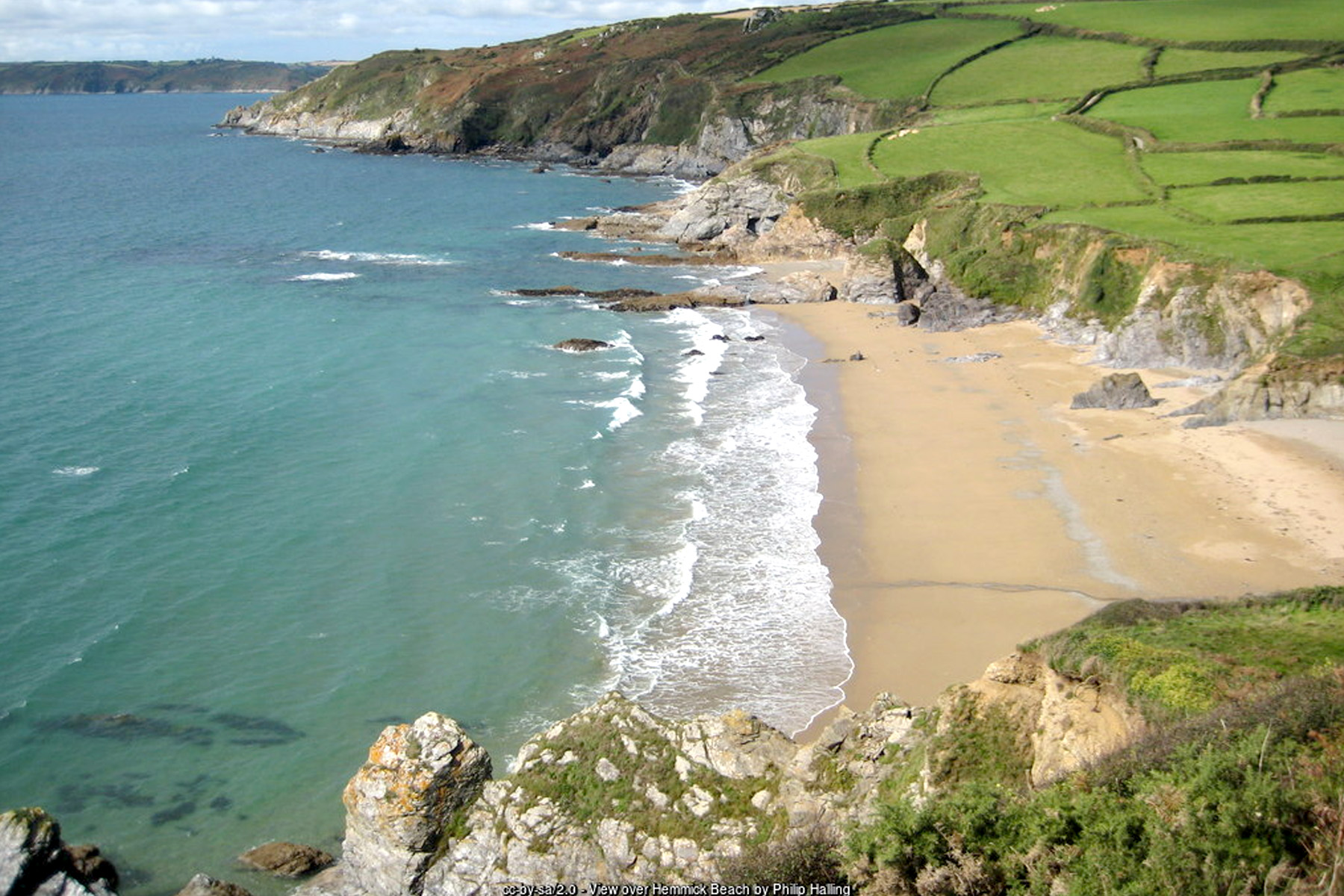
Access to Hemmick is straightforward but deliberately low-key. A small National Trust car park sits a short walk above the beach, reached down a narrow lane from Boswinger, and it is genuinely small - space can run out on a busy summer's day, so arriving early or outside peak hours makes for a far less frustrating visit. There is no shop, café or kiosk anywhere near the beach, and no RNLI lifeguard cover, which is entirely in keeping with a cove that has always been valued for what it lacks as much as for what it has. Anyone planning to spend the day should bring everything they need with them; the nearest facilities of any kind are back in Boswinger or a walk away in Gorran Haven.
The beach itself has a small but genuine claim to maritime history. In 1971, the British vessel Ewt 263, under tow on a voyage from Santander to Rotterdam, broke in half off Lizard Point some way to the west - a dramatic incident on an already notoriously difficult stretch of coast. The bow section of the wreck is believed to have drifted with the tide and currents until it washed up somewhere between Hemmick Beach and Dodman Point, adding Hemmick's name, in a small way, to the long list of Cornish coves with a genuine shipwreck story attached. It is the kind of detail that rewards a slow walk along the tideline at low water, where the rock and sand still occasionally give up something worth a second look.
Hemmick sits within the Roseland section of the Cornwall National Landscape - the area of outstanding natural beauty designation covering much of this coastline, recently rebranded from AONB - and lies at the eastern end of Veryan Bay, the broad sweep of coast that curves round from Nare Head and Pendower in the west to Dodman Point in the east. It is a comparatively little-known corner even within the Roseland itself: while Portscatho and Portloe draw a steady trickle of summer visitors to their harbours and pubs, Hemmick has no village of its own at all, just the single granite cottage above the sand and the wider farmland of the Caerhays estate rising behind it, which gives the whole cove an unusually rural, working-landscape feel rather than the more obviously "seaside" character of the Roseland's bigger coves.
The cliffs either side of Hemmick, and the great mass of Dodman Point beyond, are geologically significant in their own right. The headland is formed largely of Dodman Phyllite, part of the wider Gramscatho Group - a sequence of ancient seabed sediments, originally laid down as mud and sand on the floor of a long-vanished ocean, that were later folded, compressed and metamorphosed into the greenish-grey slates and phyllites now exposed along this coast during the Variscan mountain-building period around 300 million years ago. It is the same broad geological story that shapes much of south Cornwall's coastline, and it gives the cliffs around Hemmick their distinctive dark, layered appearance, quite different from the paler granite headlands found further west on the Lizard or in Land's End.
Dodman Point itself, the huge, dark headland that shelters Hemmick from the east, is one of the most significant landmarks on this entire coast and well worth the walk from the beach. Rising to around 114 metres, it is among the highest headlands in Cornwall, and its clifftop carries the earthwork remains of a large Iron Age promontory fort known locally as The Bulwark - a substantial bank and ditch cut across the neck of the headland roughly two and a half thousand years ago, enclosing an unusually large area for a cliff castle of this kind. At the very tip of the point stands a striking 12-metre granite cross, erected in 1896 by the then rector of Caerhays as both a seamark for passing ships and a mark of faith, inscribed with the words "In the hope of the Resurrection." The whole headland is owned and managed by the National Trust, and the short, steep climb up from Hemmick to the cross and the fort earthworks is one of the best short walks anywhere on the Roseland.
From Hemmick, the South West Coast Path runs both east and west, opening up a genuine choice of walks for visitors willing to explore a little further. Heading east around Dodman Point brings walkers to Gorran Haven and, along the way, to Vault Beach, a striking curved cove of sand and shingle tucked beneath the headland's southern flank. Heading west along the coast path, walkers pass beneath the wooded grounds of Caerhays Castle - a Grade I listed early nineteenth-century house famous today for its spring display of rare magnolias and camellias - before reaching Porthluney Cove and, beyond it, the smaller Lambsoden Cove after around three-quarters of a mile, and on towards Portholland. None of these onward walks is difficult, but the cliff path does climb and dip along the way, so sturdy footwear is worthwhile even for a fairly short outing.
Because Hemmick faces west across Veryan Bay, it catches the afternoon and evening sun particularly well, making a late-afternoon visit, once the tide has dropped and the rocky inlets either side of the beach are fully exposed, one of the most rewarding times to arrive. Low water also opens up the best rock pooling around the margins of the cove, where the same Dodman Phyllite that forms the headland breaks down into shallow ledges and gullies well worth a slow, careful explore. As with any beach on this exposed stretch of the south coast, conditions can change quickly with the weather, and visitors are best advised to check tide times before setting out, particularly if planning to walk on towards Vault Beach or Lambsoden Cove and back within a single visit.
The waters and cliffs around Dodman Point are also genuinely good for wildlife-watching. The headland is a well-regarded seawatching point, with gannets diving offshore, shearwaters passing on migration in late summer and autumn, and, in the right conditions, dolphins and even basking sharks occasionally spotted from the clifftop. Seals are sometimes seen hauled out on the rocks around the coves either side of the point, and the gorse- and heather-covered cliff slopes above Hemmick attract a good range of coastal birds through the spring and summer months. It adds a further, quieter layer of interest to a beach that already rewards visitors happy to look a little closer at their surroundings.
Swimming at Hemmick is generally pleasant in calm conditions, with the sand giving way to rock and small inlets as the tide rises, but as with any beach lacking lifeguard cover, visitors should treat the sea with the same caution they would apply to any unwatched Cornish cove - checking tide times before setting off, and being aware that the beach narrows considerably at high water. The rocky outcrops and inlets that make Hemmick so interesting to explore at low tide are exactly the features that can catch out anyone not paying attention as the water returns.
Boswinger, the small hamlet just inland from the beach, adds a little more substance to a visit without ever threatening the quietness of the cove itself - it is home to a well-regarded youth hostel and a small touring and camping site, both popular with walkers tackling this stretch of the coast path, but it has never grown into anything resembling a resort. That balance is really the whole story of Hemmick Beach: a small, sandy, thoroughly undeveloped cove, watched over by a single cottage and the great dark mass of Dodman Point, offering a genuinely peaceful alternative to the busier beaches further along the Roseland and Cornwall's south coast.
Visitor Information
Parking
A small National Trust car park sits a short walk above the beach, reached down a narrow lane from Boswinger. It is modest in size and can fill on busy summer days, so arrive early where possible.
Facilities
There is no shop, café or lifeguard at Hemmick Beach itself. The nearest facilities are in Boswinger or a walk away in Gorran Haven - come prepared for a self-sufficient visit.
Disabled Access
The lane and car park lead down close to the beach, but the final approach and the beach surface itself (sand, rock and shingle) limit onward wheelchair or pushchair access. No dedicated Blue Badge bays are confirmed at the car park - check current signage on arrival.
Things to Do Nearby
- Porthluney Cove, a short drive or coast path walk to the west, beneath Caerhays Castle
- Vault Beach, a striking curved cove reached via the coast path around Dodman Point
- Dodman Point, the National Trust headland immediately east of the beach, with its Iron Age fort earthworks, 1896 granite cross and excellent coast path walking
Places to Stay
Hemmick Beach has no dedicated accommodation listings of its own. The nearest genuine accommodation hub is nearby Gorran Haven:
Frequently Asked Questions
Page last updated: 17 September 2026