Fistral Beach
Newquay's World-Famous Surfing Beach
Fistral Beach, Newquay, Cornwall, TR7 1HY | Fistral Beach Complex: 01637 850737
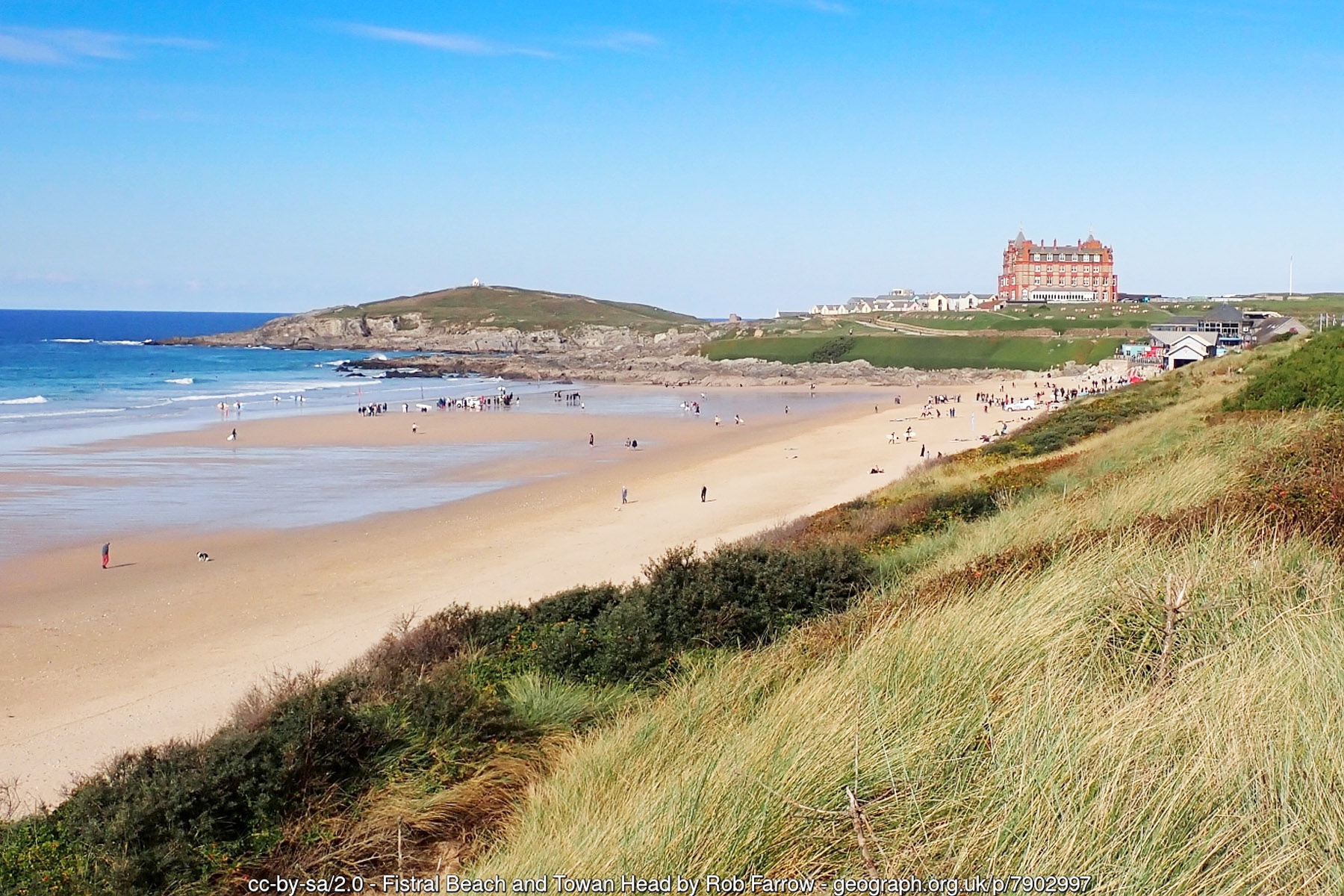
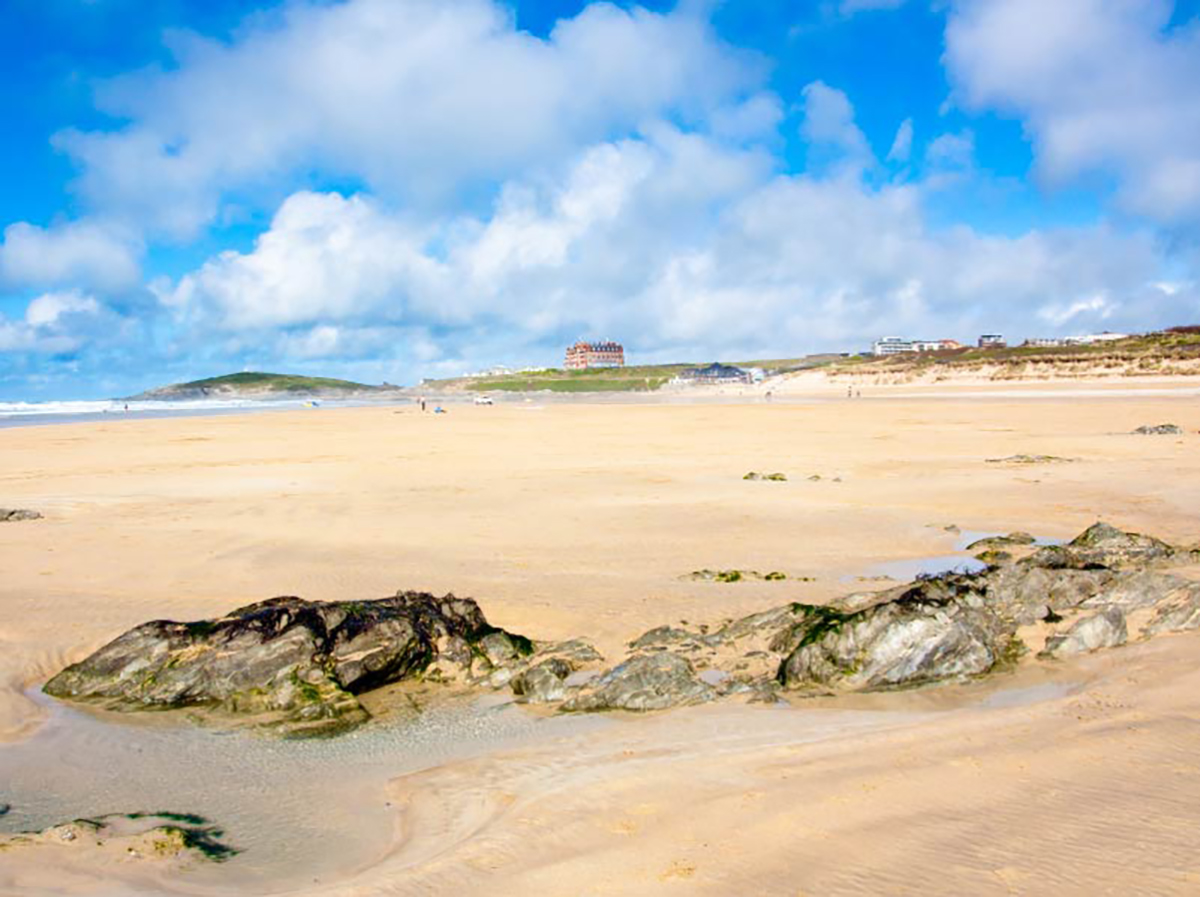
Fistral Beach is Newquay's most famous stretch of sand, and arguably the best-known surfing beach in the country. Roughly 750 metres of golden sand run along the town's western edge, backed by tall dunes and bounded by Towan Head to the north and Pentire Point East to the south. Its west-facing aspect opens it directly onto the Atlantic, so it picks up swell more reliably than almost anywhere else on the Cornish coast - the reason surfers have been drawn here since the sport first took hold in Britain in the 1960s.
The beach's name is thought to come from the Cornish bystel, meaning "foul water" - the bay was recorded as "Fistal" in early nineteenth-century sources, probably a reference to conditions that made it awkward for boats rather than any comment on water quality. Surfing itself reached Newquay long before the sport became fashionable: by most accounts, a Nuneaton dentist named Jimmy Dix became one of the first people in Britain to ride a proper surfboard here in the 1930s, using a heavy wooden board in the style pioneered by the Hawaiian waterman Tom Blake. A local ice-cream seller, Pip Stafferi, built his own copy and became something of a local celebrity riding it in the bay - a curiosity rather than the start of a movement, but proof that Fistral's waves had already caught someone's eye a generation before surf culture properly arrived.
The real turning point came in April 1962, when a group of Australian lifeguards - among them Bob Head, Ian Tiley, John Campbell and Warren Mitchell - arrived in Newquay carrying lightweight fibreglass boards, a world away from the solid wooden boards British surfers had struggled with until then. Their arrival, alongside the American lifeguard Jack "Mahogany" Lydgate, transformed the town almost overnight. A group of young locals - including Chris Jones, Robin Wilson, Brian Colwill, Alan McBride and Roger Mansfield - took to the new boards on Fistral's waves, and within a few years Newquay had its own surfboard industry: Bob Head went into business with Bill Bailey and Doug Wilson as the European Surfboard Company, producing boards under the Bilbo label from a factory on Pargolla Road and selling them through Doug Wilson's Surf Centre shop on Fore Street. The road down to nearby Great Western Beach, known simply as "the Slope," became the social hub where the new surfing crowd gathered. In 1966 the British Surfing Association was founded, the same year Rod Sumpter turned professional and became, by most accounts, Britain's first full-time surfing pro, built on waves he had already been riding at Fistral for several years.
At the beach's northern end, off Towan Head, the Cribbar reef can throw up waves of 30 feet or more when a big Atlantic swell coincides with a low tide and the right wind direction, drawing some of the sport's most experienced big-wave riders on the handful of days a year it truly wakes up. It was first ridden in September 1965, when Bob Head, Rod Sumpter and Jack Lydgate paddled out on 10-foot boards - without wetsuits or leashes, which barely existed in Britain at the time - and rode waves estimated at 15 to 20 feet, a feat commemorated fifty years later with a crowdfunded bronze surfboard sculpture overlooking the break. For most visitors, though, Fistral's appeal is its sheer consistency: there is a rideable wave here on more days of the year than at almost any comparable UK beach, which is why it hosts the British Surfing Association, the Newquay Surf Life Saving Club, the Newquay Boardrider Club, and major events including rounds of the Boardmasters festival.
Through the 1970s and 80s a new generation - Nigel Semmens, Keith Beddoe, Mick Etherington, Lenny Ingram and Lee Parker among them - carried Newquay's competitive surfing further, congregating at Little Fistral, the small cove tucked round the headland from the main beach, and around the old toilet block shelter at North Fistral that served as an informal clubhouse long before any of today's surf schools existed. It was Roger Mansfield, one of the pioneering generation from the 1960s, who coined the phrase "Surf City" for Newquay in a magazine article in 1983 - a label that stuck, and one the town has worn ever since. Fistral's surfing pedigree has continued through the decades since, feeding English and British team surfers and a thriving grassroots scene through junior surf clubs based at the beach.
The Fistral Beach Complex at the northern end of the beach brings together a surf museum and competition suite, cafes and restaurants - including Rick Stein's Fistral and The Stable - along with surfboard and wetsuit hire, surf lessons, and showers. Little Fistral, a smaller cove tucked around the headland near the Towan Headland car park, offers a quieter alternative when the main beach is busy, though it very nearly disappears under the high tide and is best visited on a dropping tide.
Fistral is dog friendly throughout the year, with no seasonal restriction, and RNLI lifeguards patrol the beach daily between 10am and 6pm from the Easter Bank Holiday through to the end of October. Because the beach faces squarely into the Atlantic and the surf can be powerful even on an average day, it suits intermediate and advanced surfers best; anyone newer to the sport is better off booking a lesson with one of the surf schools based here, which teach in the more forgiving sections of the beach under supervision.
Fistral's role as a competition venue runs deeper than any single event. Boardmasters, now one of the UK's largest combined surf-and-music festivals, began life in 1981 as a surfing competition on this beach, decades before music was added to the bill in 2005. The festival has grown enormously since - its main stages now sit a few miles north at Watergate Bay, while Fistral keeps the sporting side, hosting a World Surf League-sanctioned Qualifying Series event alongside WSL longboard, junior and skate/BMX competitions each August. It hasn't always run smoothly: the 2014 event was disrupted by the remnants of Hurricane Bertha, and the festival was cancelled outright in 2019 because of severe weather forecasts and again in 2020 because of the pandemic. It has recovered strongly since, drawing tens of thousands of spectators to Fistral's dunes each summer, and the associated Boardmasters Foundation, set up in 2017, has channelled several hundred thousand pounds into local community and environmental causes.
Behind the beach, Fistral's dune system tells a less triumphant story. The dunes once extended much further inland than they do now, but decades of agricultural use, urban development around Newquay and the construction of the golf course on Pentire Point East have squeezed them into a narrow strip above the top of the beach - today around 1.3 hectares of vegetated dune, roughly a third open sand and two-thirds dense scrub. Studies tracking the system since 2006 have recorded a reduction of around 40 per cent in vegetated dune habitat over that period, with sand being lost from both the upper shore and the base of the dunes; projections built around expected sea-level rise suggest the dune line could retreat by a further 20 metres or so by the end of the century. Part of the problem is competition from non-native plants - Japanese rose, sea buckthorn, tamarisk, bramble and gorse have all spread through the dense scrub, crowding out the native dune flora that would otherwise help stabilise the sand. A Beach and Dune Management Plan adopted in 2016 now guides how the site is managed, balancing coastal protection against habitat restoration and the demands of one of Cornwall's busiest beaches.
The sand and rock around Fistral also fall within the Newquay and the Gannel Marine Conservation Zone, one of the second tranche of English MCZs designated in 2016, which protects around 900 hectares of exposed sandy beach and rocky shore stretching from Fistral around to the Gannel estuary at Crantock. Among the species the zone exists to protect is the giant goby, one of Britain's rarest fish, which shelters in rockpools and crevices along this stretch of coast; the wider designation also covers the reef and boulder habitats that make the Cribbar and Fistral's other reef breaks possible in the first place, tying the beach's surfing reputation and its conservation status together more closely than most visitors realise.
Pentire Point East, the headland closing off the southern end of Fistral, carries its own layer of history beneath the fairways of Newquay Golf Club, the links course that now covers much of it. Archaeological finds on the headland span thousands of years of use, from Mesolithic flint tools through Bronze Age burial barrows to evidence of Iron Age settlement, suggesting people were drawn to this stretch of coast long before anyone thought to surf it. The headland also gives some of the best views along this part of the coast, taking in the whole sweep of Fistral to the north and, to the south, the Gannel estuary and Crantock Beach beyond.
Towan Head, bounding Fistral to the north, has its own landmark in the Huer's Hut, a small stone building thought to date from the fourteenth century and originally used as a hermitage. It later took on a very different role as a lookout post, from which a "huer" watched for the dark shoals of pilchards moving close inshore and cried "Heva!" to alert the fishing boats waiting below - a role it kept for generations while pilchards remained a mainstay of the local economy. The headland is now dominated by the Headland Hotel, an imposing neo-Gothic building completed in 1897 that has hosted royal visitors and once staged summer concerts by London orchestras, and which still looks straight down over Fistral's waves from its clifftop position.
The South West Coast Path runs along the clifftop above the beach, linking Towan Head to Pentire Point East and on toward the Gannel and Crantock, and popular circular walks combine Fistral with Newquay's harbour, Little Fistral and the golf course headland in a single outing of four to five miles. Views from the path take in Newquay Bay to the north and, on a clear day, as far as Trevose Head and Stepper Point across the mouth of the Camel Estuary - a reminder that for all its surfing fame, Fistral sits within one of the most walked and looked-at stretches of coastline in Cornwall.
Visitor Information
Parking
Main Fistral Beach car park (approx. 250 spaces) directly behind the beach, charges vary by season. Dane Road and Towan Headland car parks are five minute walk alternatives when it's full.
Facilities
Toilets, showers, cafes and restaurants at the Fistral Beach Complex, plus surfboard and wetsuit hire and surf lessons. RNLI lifeguards Easter to end of October, 10am-6pm.
Disabled Access
Fairly level, step-free access from the car park to the rear of the beach and complex. A bookable sand chair is available (48 hours' notice); the sand is soft and deep further down the beach. No dedicated Blue Badge bays are confirmed at the main car park - it is worth checking directly with Cornwall Council or the Fistral Beach Complex (01637 850737) before you travel.
Things to Do Nearby
- Blue Reef Aquarium, Towan Promenade, Newquay
- Trerice (National Trust), Kestle Mill, near Newquay
- Lappa Valley Steam Railway, St Newlyn East, near Newquay
- Newquay Zoo, Trenance Gardens, Newquay
- Newquay Surf Beaches Map & Complete Surf Guide - other surf spots, schools and hire near Fistral
- Towan Beach and Harbour Beach, across town on the harbour side of Newquay
Places to Stay
Frequently Asked Questions
Page last updated: 8 September 2026.