Lusty Glaze Beach
A Sheltered Cove Behind 133 Steps
Lusty Glaze Beach, Newquay, Cornwall, TR7 3AE
Lusty Glaze is one of Newquay's most distinctive beaches: a privately owned, west-facing cove tucked beneath dramatic cliffs, reached by a single flight of 133 steps rather than a road or slipway. That seclusion is part of the appeal - the horseshoe-shaped bay feels like a hidden retreat rather than a town beach, even though it lies barely a mile from the centre of Newquay, on the coast path between Tolcarne and Porth.
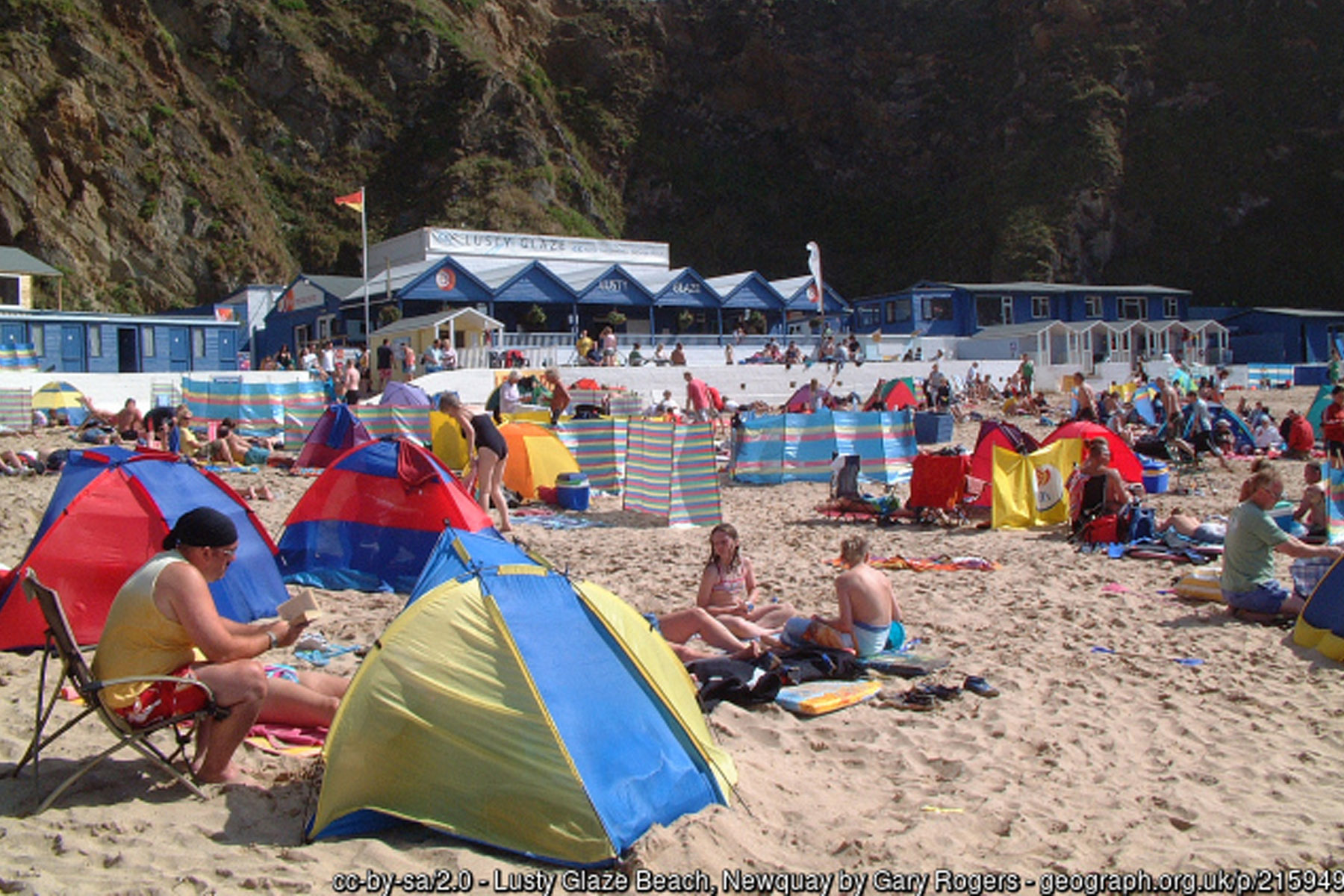
The cove's name is usually traced to the Cornish "Plustri Glas", roughly "green grazing place", a reference to the pasture that once ran along the clifftop above the beach before today's car park and buildings appeared. The site's current operators favour a different, more colourful story - that the name recalls the small blue-hulled boats once used to carry ore away from the cove - though this reads as local lore rather than settled etymology. Whichever explanation is right, the setting itself is unmistakable: a tight, horseshoe-shaped bay walled in by high cliffs on three sides, open only to the sea and to the single flight of steps that forms its public entrance. Those enclosing cliffs create a natural amphitheatre that has made the cove a live-music venue in its own right (more on that below), as well as giving it genuine shelter from onshore winds.
Lusty Glaze has an unusually specific claim to industrial history: it was intended as the sea terminus of the St Columb Canal, an ambitious scheme begun in the 1770s to link inland workings near St Columb Minor with a shipping point on the coast. The canal was never finished as planned, but the remains of an inclined plane - a steep, engineered ramp roughly 30 metres (about 100 feet) high, built to lower goods from the clifftop canal level down towards the beach - are still visible on the cliff above the cove today, a rare surviving trace of Cornwall's 18th-century transport engineering.
The beach's more recent industrial past is iron ore. Through the 1800s, a cave on the eastern side of the cove - said to have been mined to a considerable depth - was worked for ore, which was carried out across the sand and, in rough weather, hauled by horse and cart over the neighbouring town beaches to Newquay harbour for shipping. Mining here had ended by the late 19th century, but it left a lasting legal quirk: when the Crown eventually sold the site, the mineral rights and the foreshore down to the low-water mark were sold with it, which is why Lusty Glaze - unlike most Cornish beaches - remains in private ownership right down to the sea today.
The beach turned to leisure use in 1921, when it opened as a private bathing resort; the beach cottage built that year still stands above the cove and is now let out as holiday accommodation, alongside a small cluster of modern beach cabins. Ownership has changed hands only a handful of times since the Crown's original sale - by most accounts Lusty Glaze has had around five owners in total - and the site had fallen into disrepair before its current owner, Cornish-born Tracey Griffiths, bought the derelict beach in 1999 and began restoring it.
That restoration first took shape as a rescue training and outdoor activity centre, reportedly one of the first dedicated facilities of its kind in the UK, which grew into one of the area's larger seasonal employers. The activity centre run from the cove today, trading as the Lusty Glaze Adventure Centre, keeps that outdoor-activity focus, offering coasteering, rock climbing and abseiling on the surrounding cliffs, high ropes and a zip line strung across the bay, plus surfing and other water-based activities depending on season and tide - all bookable directly with the centre rather than available as a drop-in beach facility.
Alongside the outdoor activities, Lusty Glaze has built a reputation as an events venue, run today under the operating name Blue Boat Trading. The site holds a wedding licence and is marketed as one of the earliest UK beaches licensed for civil marriage ceremonies, hosting everything from small, intimate ceremonies to full exclusive-hire beach weddings. Its amphitheatre-like shape has also made it a genuine live-music setting: summer "Sundowner Sessions" evenings have featured touring acts over the years, and the cove has been picked out by national press among the UK's more picturesque places to hear live music. A restaurant and beach bar operate above the sand for day visitors and event guests alike, and the site holds an entertainment licence for gatherings running into the thousands - a scale only possible because the beach is privately owned and its single point of access can be controlled, and when necessary closed to the public, for a booked event.
Surfers rate Lusty Glaze as something of a swell magnet: sitting slightly more exposed to the Atlantic than its immediate neighbours, it typically picks up noticeably bigger waves than Tolcarne, Great Western or Towan along the same stretch of coast. The wave changes character through the tide - a right-hand break works over sand at lower tide, rocks toward the middle of the beach create wedging peaks around mid-tide, and at high tide the swell wedges off the cliffs at the sides of the cove. Sitting in a tight, west-facing bay, it can hold a clean wave in conditions that blow out more exposed beaches nearby, though the trade-off is a smaller swell window than fully open beaches such as Fistral. A lifeguard service patrols through the main summer season, and as with all Newquay's beaches it's worth checking the current flag and safety information posted at the top of the steps before swimming.
At spring low tides it is possible to pick a way around the rocks from Lusty Glaze towards Tolcarne and on towards the harbour, though this involves rock-scrambling rather than a level walk and should only be attempted on a falling tide with a clear idea of the tide times, since the sea can cut the route off quickly once the tide turns. The more reliable way to link Lusty Glaze with its neighbouring beaches is via the coast path above rather than the shoreline. The South West Coast Path runs along the clifftop directly above the cove, joining Lusty Glaze Road as it threads between the beach and its car park before dropping down again towards Porth. Heading west, the path connects back past Tolcarne and Newquay's central beaches towards the harbour and Fistral; heading east it leads to Porth and on to Trevelgue Head - also known as Porth Island - a dramatic promontory reached by a footbridge, with Iron Age cliff-castle earthworks and sweeping views back along the coast. A there-and-back or circular route taking in Lusty Glaze, Porth and Trevelgue Head is one of the more rewarding short stretches of coast path around Newquay, mixing beach access with genuine clifftop scenery.
Away from the surf and steps, the rocks at either end of the cove hold rockpools worth a look at low tide - typical of this stretch of north Cornish coast, with anemones, small crabs and blennies among the more usual finds - though, as with the wider cove, care is needed on the exposed rock given how quickly the tide can return in a bay this enclosed.
The one significant thing to plan around on an ordinary visit is still access: the 133 steps, with a handrail and rest points along the way, are the only public route down, and there is no lift or ramp - factor the climb back up into the day, especially with pushchairs or heavy beach gear. The beach itself is free to enter, with gates typically opening from around 9.30am. Despite the private ownership, Lusty Glaze is currently promoted by both its operators and Visit Cornwall as dog-friendly all year round, with dogs asked to stay on a lead on the steps and the sand - a more relaxed policy than the seasonal dog restrictions that apply on many of Newquay's other beaches, though as with any privately managed beach it is worth checking current on-site signage, since policies can be changed by the operator at any time.
Visitor Information
Parking
Pay-and-display parking within around 50 metres of the top of the steps down to the beach.
Facilities
Cafe/restaurant at the top of the cove, plus the Lusty Glaze Adventure Centre offering coasteering, climbing and high ropes.
Disabled Access
None - 133 steps with a handrail are the only public access, and there is no lift, ramp, or accessible toilet at the beach. Not confirmed - given the 133-step access, this beach is unlikely to suit Blue Badge holders regardless of parking provision.
Things to Do Nearby
- Blue Reef Aquarium, Towan Promenade, Newquay
- Newquay Zoo, Trenance Gardens, Newquay
- Trerice (National Trust), Kestle Mill, near Newquay
- Newquay Surf Beaches Map & Complete Surf Guide - other surf spots, schools and hire near Lusty Glaze
- Porth Beach, a short walk east around the headland
Places to Stay
Frequently Asked Questions
Page last updated: 8 September 2026.