Porth Beach
A Family Favourite with a 2026 Seaside Award
Porth Beach, Newquay, Cornwall, TR7 3LU
Seaside Award 2026
Porth Beach lies on the north-eastern edge of Newquay, a wide, north-west facing sweep of golden sand that's quieter and more family-oriented than the resort's famous surf beaches. It's flanked by low dunes and, at its eastern end, by Trevelgue Head - also known as Porth Island - a dramatic headland connected to the mainland by a footbridge and home to the remains of an Iron Age cliff castle that was occupied on and off for around 3,000 years, one of the most important prehistoric sites on this stretch of coast. Porth and its neighbour Lusty Glaze are the two beaches within Newquay Bay proper, the wide curve of coast bounded by Towan Head at Newquay itself and by Trevelgue Head at its eastern end, with Watergate Bay opening out beyond.
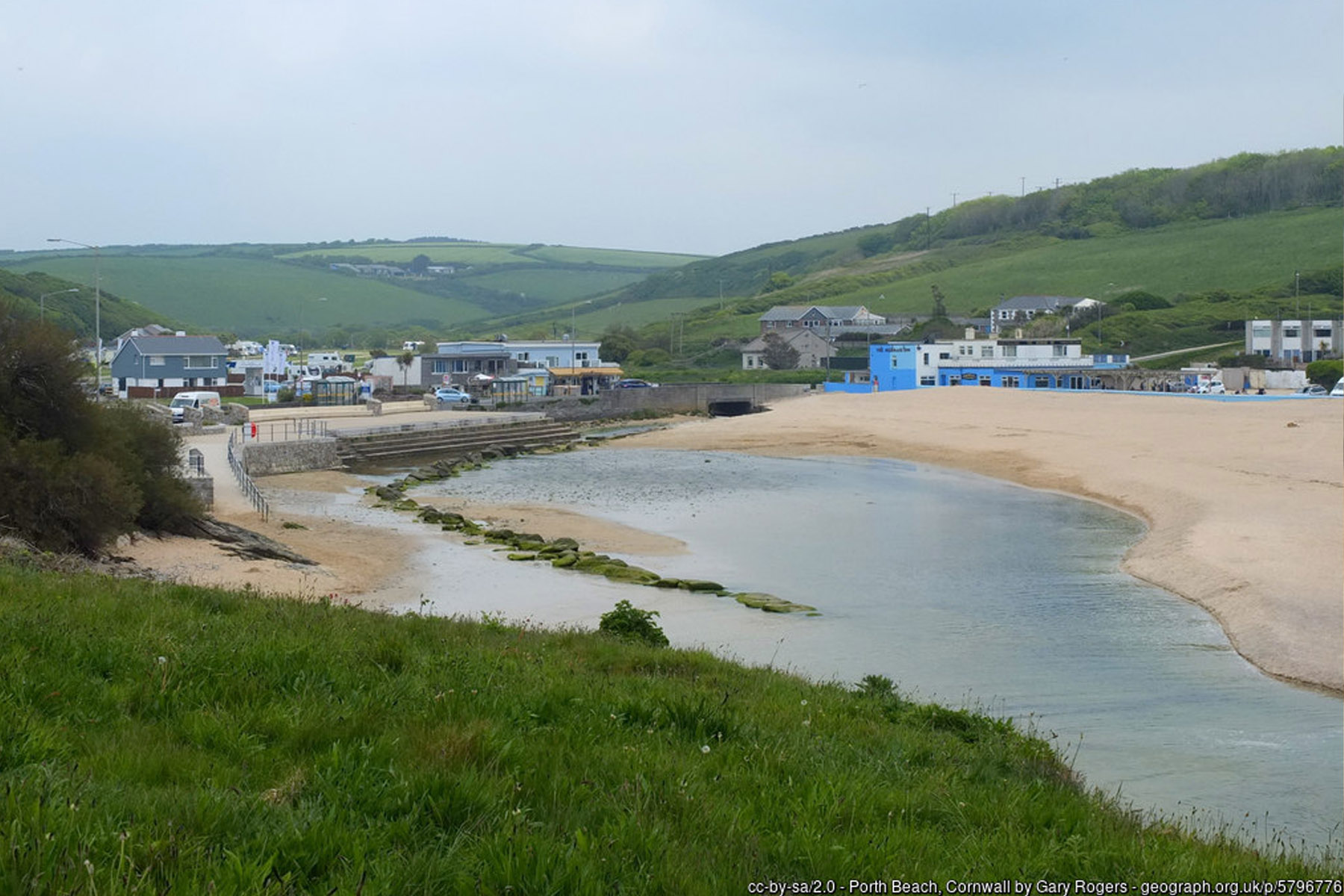
What sets Porth apart from Newquay's other beaches is how sheltered it feels. The beach sits in a deep, steep-sided inlet - a drowned river valley, or ria, cut into the coast long before sea levels rose to their present height - with headlands rising on both sides and Trevelgue Head's bulk breaking the worst of the Atlantic swell before it reaches the sand. That shelter, combined with a gently shelving profile, is what gives Porth its almost lagoon-like feel at low to mid tide: the water arrives calmer and shallower here than on the more exposed beaches either side, and a small stream crosses the sand roughly in the middle, spreading into shallow, sun-warmed channels that are often the first place young children are let loose to paddle. It's worth keeping an eye on that stream as the tide turns, though, since currents can pick up around its mouth and near the rocks at each end of the bay.
The cliffs framing the beach belong to the same Devonian rock sequence that runs along much of this coast - dark grey slaty mudstones and siltstones, with occasional thin sandstone and limestone bands, laid down on a shallow sea floor around 400 million years ago and later folded and fractured almost beyond recognition when the Variscan mountain-building episode crumpled south-west England. Walk the cliff line at low tide and the tilted, sometimes near-vertical bedding and dark cleavage lines are a visible record of that folding - the same slates that were once quarried from the sides of the Porth valley for local building stone.
Porth's sheltered inlet gave it a working life long before it became a beach for holidaymakers. It's a classic drowned river mouth, and before the surrounding land was built up, the tide is recorded as having once reached almost two miles inland towards Rialton, making Porth viable as a small port. Coal, salt, lime and general cargo were landed here through the 19th century, with grain and later china clay and stone shipped back out, and a small shipyard near the foot of Watergate Road built several schooners and smacks between 1857 and 1880. The valley was also worked for tin from its gravels in the 1830s, and clay dug from its sides was used to make bricks - some of which went into the Atlantic Hotel, built on the headland above Newquay's harbour in 1892. Little of that industry is visible today beyond a few old adits and quarry scars in the valley sides, but it's a reminder that this quiet family beach once did a very different job.
Trevelgue Head itself - the promontory that shelters the beach's eastern end - is one of the most thoroughly excavated Iron Age sites in Cornwall. A dig in 1939, not fully published until 2011, uncovered roundhouse foundations (the largest around 14.5 metres across, with a central hearth), along with furnaces and ore-roasting pits pointing to bronze and iron smelting on site, and thousands of pieces of worked stone and pottery. Two early Bronze Age round barrows survive within the fort's earthworks, and flint tools found on the headland suggest people were using the site as far back as the Mesolithic, more than 6,000 years ago. Multiple banks and ditches, some of them substantial, cut across the neck of the headland, and a modern footbridge crosses a narrow chasm that may originally have carried a natural land bridge - the whole site is now protected as a scheduled monument. It's a short, easy walk out onto the headland from the beach, with wide Atlantic views and, on a rising half-tide, a blowhole nearby known to vent with a genuine crack and roar.
The beach holds a Seaside Award for 2026, recognising good water quality and well-kept facilities, and its gentler, more sheltered conditions make it popular with families and beginner surfers alike, particularly at low tide when the sand stretches out towards Trevelgue Head. A handful of cafes and a pub sit across the coast road, and beach huts can be hired for the day - a nice touch if you're settling in for a while.
The long tidal drop at Porth uncovers a good spread of rock at both ends of the beach, and the pools are worth the wander for anyone travelling with children. Typical finds along this stretch of the north Cornwall coast include shore crabs, beadlet and snakelocks anemones, blennies and gobies sheltering under weed-draped ledges, limpets and periwinkles, and the occasional stranded starfish, best returned gently to a pool rather than left in the sun. The slate ledges around Trevelgue Head also attract nesting seabirds in spring and early summer, and it's a reasonable spot from which to watch gannets working the bay further out, alongside the gulls, oystercatchers and turnstones that patrol the tideline at low water. On the far side of Trevelgue Head, the narrow rocky passage down to Whipsiderry beach is submerged for much of the tide cycle, which keeps that little cove - and its own rock pools - noticeably quieter than Porth itself.
Porth is at its best from around mid-tide down to low water, when a wide expanse of firm, level sand opens up and the sheltered feel is most obvious; by high tide the beach narrows considerably and can disappear almost entirely against the upper dunes and sea wall, so it's worth checking tide times before planning a full day here. Sitting in its own bay also gives Porth a slightly gentler microclimate than the more exposed beaches either side, with less wind-blown sand on a breezy day - one reason it has long been popular with families, and with those taking their first steps into bodyboarding or gentle surf outside the lifeguarded, surfing-restricted summer season.
Porth also sits on a well-used stretch of the South West Coast Path. Heading north, the path climbs around Trevelgue Head and on past Whipsiderry - a small, harder-to-reach beach tucked beneath old mine workings and only fully accessible at low tide - before continuing towards Watergate Bay. South from Porth, the path climbs over the headland to Lusty Glaze and on into Newquay itself, making it easy to string Porth together with its neighbouring beaches for a longer coastal walk without needing a car.
Access from the main Cornwall Council car park is rated very good, with a shallow slope down to the sand rather than steps, which makes Porth one of the more manageable Newquay-area beaches for pushchairs and wheelchair users. RNLI lifeguards patrol through the main season, and, like several beaches in the Newquay area, dogs are asked to keep off the sand during the busiest summer weeks.
Visitor Information
Parking
Cornwall Council car park across the road from the beach (TR7 3LU), usually with plentiful spaces. Some visitors park on the sand itself, but this isn't recommended.
Facilities
Toilets nearby, plus cafes and a pub across the coast road, including a beachside kiosk. Beach huts available to hire for the day.
Disabled Access
Rated very good - a shallow slope leads from the main car park onto the sand, one of the easier beaches in the Newquay area to reach. No dedicated Blue Badge bays are confirmed at the main car park - worth checking with Cornwall Council before you travel.
Things to Do Nearby
- Blue Reef Aquarium, Towan Promenade, Newquay
- Newquay Zoo, Trenance Gardens, Newquay
- Trerice (National Trust), Kestle Mill, near Newquay
- Newquay Surf Beaches Map & Complete Surf Guide - other surf spots, schools and hire near Porth
- Trevelgue Head (Porth Island), an Iron Age cliff castle on the beach's eastern headland
- Lusty Glaze Beach, a short walk south around the headland
Places to Stay
Frequently Asked Questions
Page last updated: 8 September 2026.