Porth Joke
An Unspoilt Cove Known Locally as Polly Joke
Porth Joke (Polly Joke), near Crantock, Newquay, Cornwall, TR8 5EQ
Porth Joke - almost always known locally as Polly Joke - is a small, unspoilt sandy cove tucked between Kelsey Head and West Pentire, just south of Crantock and a few miles from central Newquay. With no road running down to it and no development of any kind, it's one of the quietest, most unspoilt beaches on this part of the coast, prized by walkers and locals precisely because it has stayed that way.
The name is something of a puzzle even to local historians. Almost everyone who knows the beach calls it Polly Joke, and several beach guides trace this back to an earlier Cornish form, Pol Lejouack, said to mean roughly "jackdaw cove" - jackdaws still nest in crevices in the surrounding cliffs today, though the derivation is best treated as informed local tradition rather than settled etymology. Whichever name is used, the beach sits within a single large block of National Trust land covering Kelsey Head, Cubert Common and the fields above West Pentire, stretching from the edge of Crantock in the north down to Holywell Bay in the south. It's this continuous stretch of protected coastline, managed by the Trust as one holding rather than carved up between landowners, that has kept Porth Joke free of the car parks, cafes and holiday development found at beaches only a mile or two away.
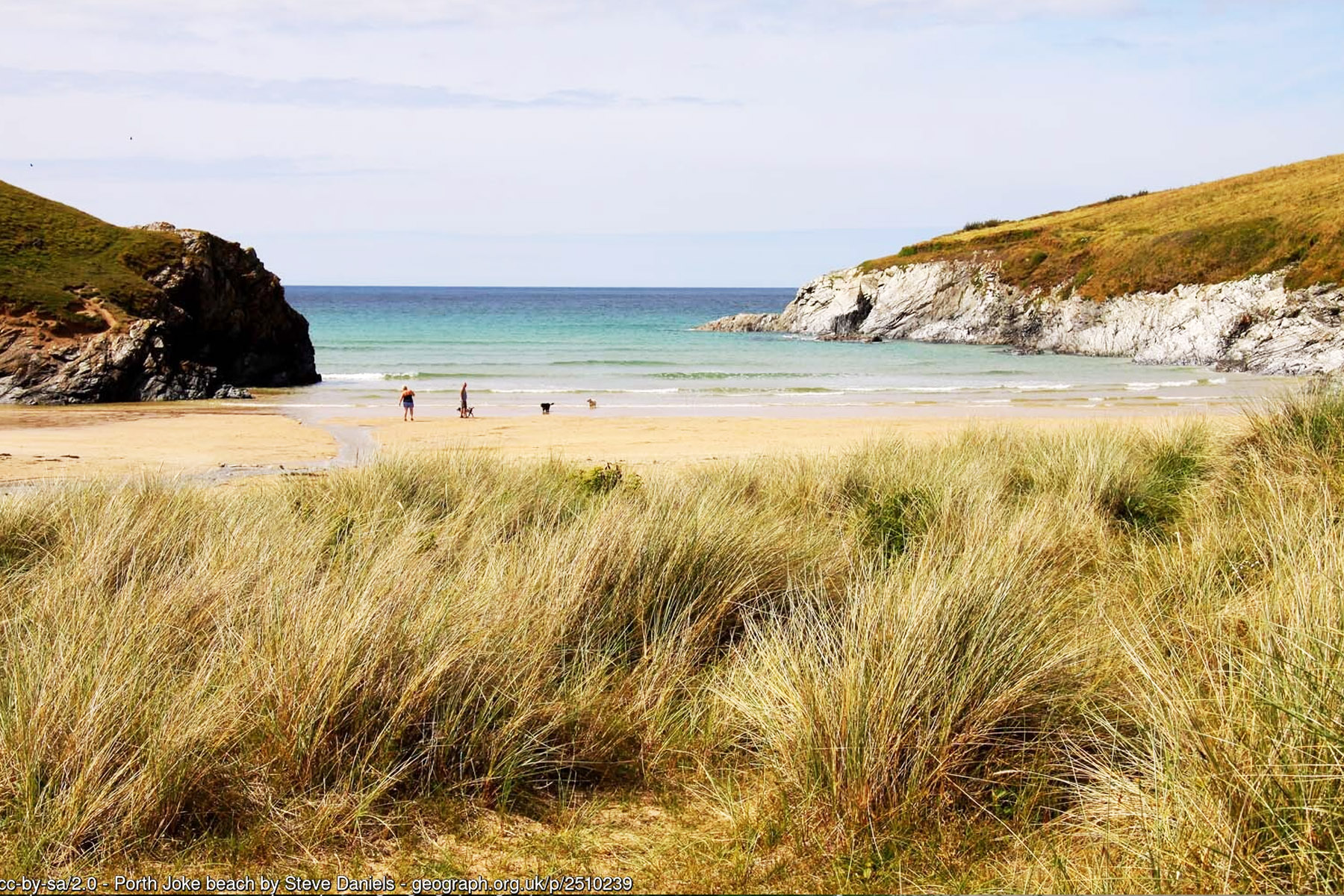
The headlands either side of the cove carry a much older layer of history than the current quiet suggests. Kelsey Head itself, guarding the beach's approach from the north, is the site of a scheduled Iron Age cliff castle - a defensive earthwork roughly 170 by 230 metres across, its single rampart of earth and stone built to incorporate the natural rock outcrops of the headland, generally dated to around the 2nd to 1st century BC. A second, smaller promontory fort of the same period sits on a spur of cliff immediately west of Porth Joke, its curving rampart enclosing an area only around 50 metres across. Two Bronze Age round barrows also survive on the clifftop nearby; the larger of the two, roughly 28 metres across, is recorded as having been pressed into use as a beacon site in the seventeenth century. All four monuments are protected together under a single Historic England scheduling, and while there's little to see at ground level beyond low earthwork banks, they're a reminder that this stretch of coast has been fortified, farmed and watched from for well over two thousand years.
The beach is reached on foot only, either along a gently sloping wooded valley path from the National Trust car park on the edge of Cubert Common (manageable for small children and sturdy buggies), or via a steeper, grassier coastal route from West Pentire that forms part of the South West Coast Path. There is nothing at the beach itself - no cafe, no toilet, no lifeguard - so it's worth bringing a picnic, plenty of water, and taking all litter home; the nearest food and drink is The Bowgie pub up at West Pentire.
The route down from Cubert Common follows a small stream the whole way, tucked into a sheltered, part-wooded valley that feels quite different from the open cliff scenery on either side of it - shady, often a few degrees cooler in summer, with watercress growing along the water's edge. The stream crosses the beach itself close to where it meets the sand, and its shallow, slow-moving water makes a natural paddling spot for younger children who might find the open sea a bit much. It's also a reasonable guide to how busy the beach will be on any given day: because both approach routes involve a walk of fifteen to twenty minutes or more with nothing to buy at the end of it, Porth Joke rarely fills up the way its road-accessible neighbours do, even at the height of summer.
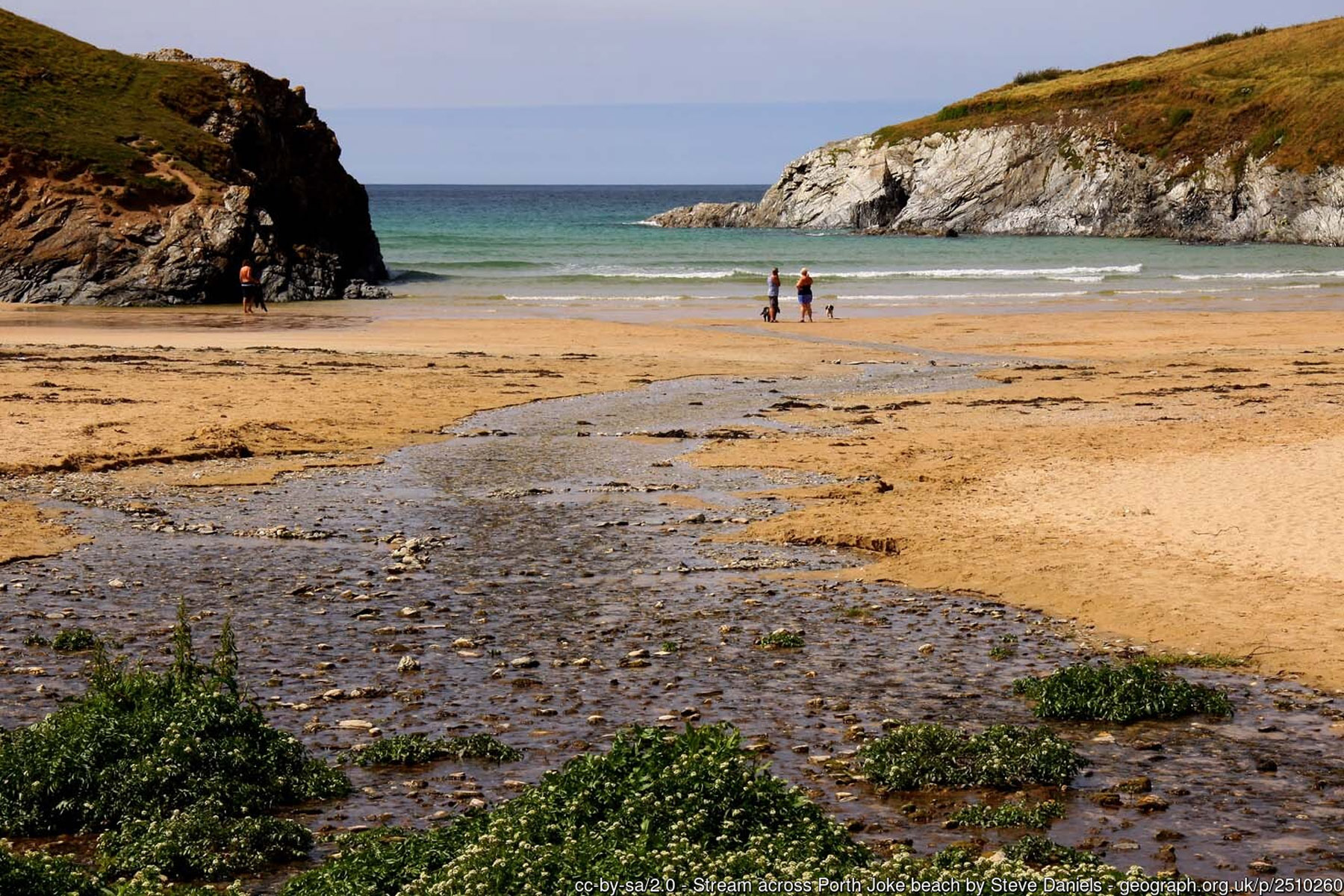
That lack of a lifeguard matters: currents and rips near Porth Joke can be strong, and the coast path runs close to the cliff edge in places, so care is needed with children and dogs. Dogs themselves are welcome all year round with no seasonal restriction, making this a favourite spot for local dog walkers. Given the walk-in access and undeveloped nature of the beach, it is not considered suitable for wheelchair users or anyone with significant mobility limitations.
Above the beach, the fields around West Pentire are one of the best-known wildflower spectacles on this coast. In a good year - poppy numbers vary considerably depending on how wet the preceding winter was - the arable margins above the cliffs turn a vivid red with corn poppies mixed with corn marigolds, typically at their best from June into early July. This isn't a photo-opportunity planting: the National Trust manages the fields under a rotational arable wildlife scheme, ploughing half of each field in autumn and leaving it fallow while the other half is spring-ploughed and sown with barley, then reversing the pattern the following year, with some barley left unharvested over winter as food for farmland birds. The wild-plant conservation charity Plantlife has recognised the West Pentire fields as an Important Plant Area for their arable flora, and the Trust describes the site as one of only a handful in Britain managed specifically for this kind of farmland wildlife. Visitors are asked to keep to the footpaths and out of the flowering margins, keep dogs on leads between March and July while ground-nesting birds are around, and avoid setting up drones or tripods among the flowers themselves.
That conservation approach benefits more than the flowers. Corn buntings and skylarks - both birds in serious decline elsewhere in lowland Britain - nest in the rough grass and cereal margins above the beach, and skylark song is a near-constant soundtrack to the clifftop path through spring and summer. Brown hares are regularly reported in the fields, and grey seals are sometimes seen hauled out on the rocks toward Holywell Bay a little further along the coast path. Adders have also been reported basking in the dunes and rough ground around Cubert Common on quiet days, as they do on other undisturbed stretches of the Cornish coast - one more reason, alongside the ground-nesting birds, to keep dogs under close control away from the beach itself.
Porth Joke isn't really a surf beach in the way its Newquay neighbours are. The cove is narrow, shingle mixes into the sand toward the back of it, and the mouth of the bay sits tucked between two headlands rather than facing the open swell directly, so it doesn't draw the crowds - or the consistent wave quality - of Fistral or Watergate Bay a few miles away. What it does offer is a quieter, more informal alternative for anyone happy to bodyboard or catch the odd wave without a lifeguard, a queue, or a car park charge, plus a genuinely rewarding stretch of the South West Coast Path in both directions: north over Kelsey Head towards Crantock, or south towards Holywell Bay, with West Pentire and its poppy fields sitting on the headland in between. Spring and early summer - when the wildflowers are at their best and the crowds are still concentrated on the bigger beaches - is arguably the most rewarding time to make the walk in.
Geologically, the cove sits in a fold of the same dark, folded slates and shales that make up most of this stretch of the north Cornwall coast, with low reefs and small caves exposed at the base of the cliffs at low water. At low tide there's a generous stretch of sand and rockpools to explore between the two headlands; the beach narrows quickly as the tide comes in, and because there is no lifeguard cover it's worth keeping a closer eye on the tide table than you might at a patrolled beach, particularly if children are exploring the rocks toward either end of the cove.
Visitor Information
Parking
National Trust car park on the edge of Cubert Common, via Treago Farm - free for NT members, charged for non-members. Around a 15-20 minute walk to the beach from there.
Facilities
None at the beach - no cafe, shop or toilet. The nearest food and drink is The Bowgie pub at West Pentire.
Disabled Access
None - reached only via an unmade valley path or a steep coastal route, unsuitable for wheelchairs or limited mobility. Not applicable in any practical sense - the beach is reached on foot only, with no vehicle access close to the sand.
Things to Do Nearby
- Crantock Beach, a walk north along the coast path
- Newquay Surf Beaches Map & Complete Surf Guide - the wider Newquay surf area
- Kelsey Head coastal walk, West Pentire, near Crantock
- Holywell Bay, a further walk south along the coast path
Places to Stay
Frequently Asked Questions
Page last updated: 8 September 2026.