Tolcarne Beach
A Crescent Bay Below the Town
Tolcarne Beach, Newquay, Cornwall, TR7 2QN
Tolcarne Beach is a large, crescent-shaped stretch of sand tucked directly below Newquay town centre, sheltered on three sides by cliffs and facing broadly west into the bay. Its name comes from the headland above it, Tolcarne Point - in Cornish, "tolcarn" (or "talkarn") means roughly "hill-brow tor," a carn being a natural pile of stones equivalent to a Devon tor, so the name simply describes the rocky brow the beach sits beneath. Tolcarne's position right under the town is what sets it apart from Newquay's more famous surf beaches: it's the beach most visitors reach simply by walking down from the shops and seafront hotels on Narrowcliff, rather than one they set out for specially, and its size means it generally absorbs that footfall without feeling as packed as Fistral or Great Western on a busy summer's day.
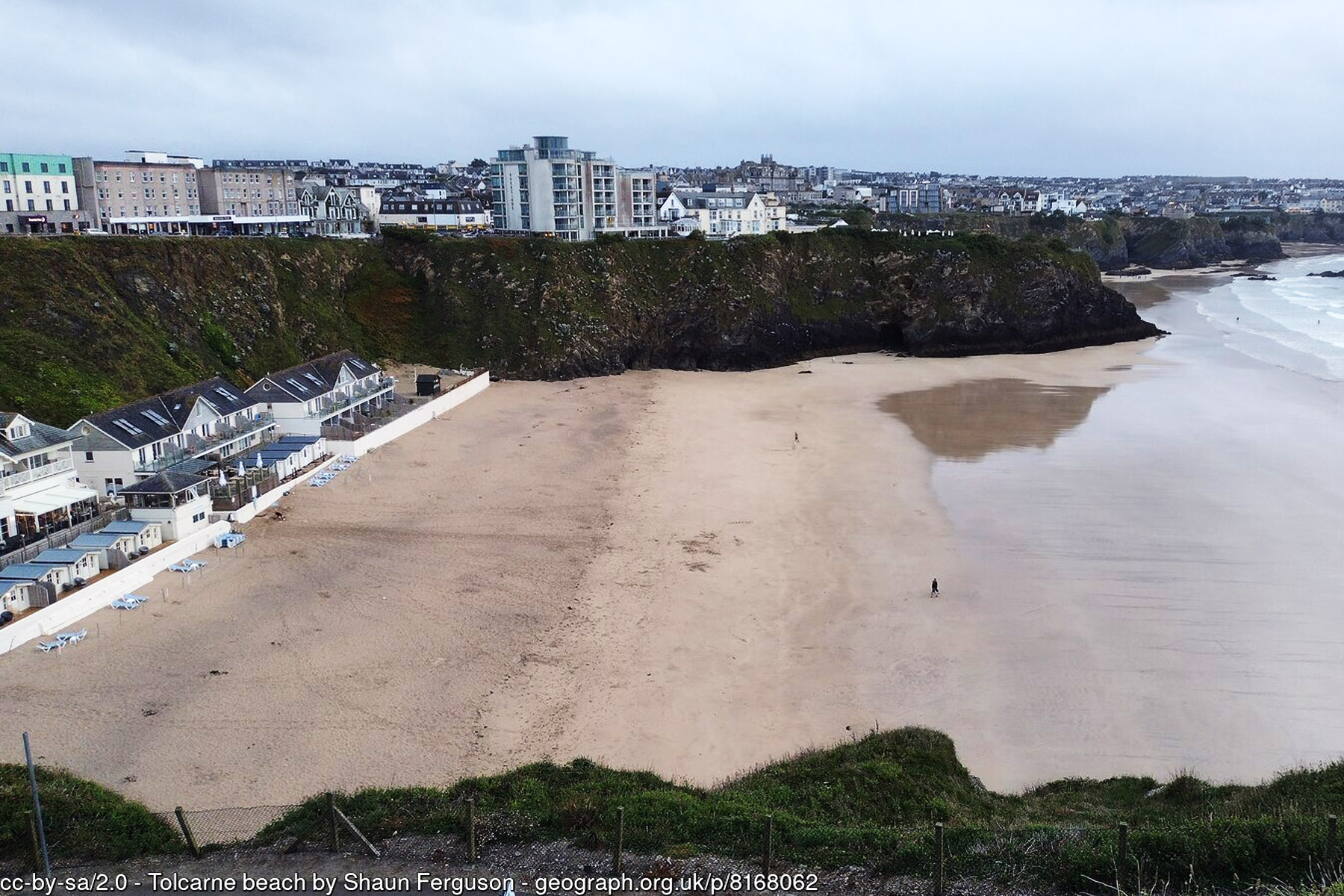
At the foot of the steps is a small, self-contained hub known locally as Tolcarne Beach Village - a shop, beach hut hire, a crazy golf course, toilets, a cafe/restaurant, and Escape Surf School running lessons for beginners and improvers - so it's possible to spend a full day on the sand without needing to climb back up for anything. RNLI lifeguards patrol through the main season, roughly mid-May to the end of September, and the combination of soft sand, gentle shelving and on-site facilities makes Tolcarne one of the more practical family beaches in Newquay, even though it rarely gets the attention that Fistral, Watergate Bay or Great Western attract in guidebooks and surf forecasts.
Getting down to the beach is the main obstacle for many visitors. There is no public lift or ramp - people either follow a steep private roadway down through the Tolcarne holiday complex or descend a long flight of cliff steps, commonly quoted as running to more than two hundred, cut into the cliff from Narrowcliff at the top. Both routes are demanding for buggies, and there is no beach wheelchair hire on site, so Tolcarne is one of the harder Newquay beaches to reach for anyone with limited mobility. The cliffs above aren't entirely stable either: in August 2025 a section of cliff at Narrowcliff, directly above the beach, partially collapsed, closing the steps and the clifftop pavement while Cornwall Council, the coastguard and RNLI lifeguards carried out safety checks - the beach itself stayed reachable via the roadway while the steps were assessed. It's a reminder that access routes here can change at short notice, so it's worth checking locally before planning a visit around one particular route down. Dogs are asked to keep off the sand between 1 May and 30 September; outside those months they're welcome as on most Cornish beaches.
Tolcarne's other defining feature is how it links up with its neighbours. At low tide it joins Great Western Beach to the south and, on bigger spring tides, Lusty Glaze to the north, so that at the right state of the tide it forms part of a near-continuous run of sand stretching towards Newquay Harbour in one direction and Watergate Bay in the other - roughly the same stretch of coast the South West Coast Path follows along the clifftop above. That connection closes again as the tide comes back in, so anyone walking the sand between beaches needs to keep half an eye on the tide table and head back before the gaps between the headlands fill in; Tolcarne itself is described by local walking guides as sandy at every state of the tide, but the routes joining it to its neighbours are not. Tucked in under Towan Head, Tolcarne is usually calmer than the more fully open beaches nearby, and is often recommended for swimming, bodyboarding and gentle family surf rather than serious wave-riding - though it isn't always tame. On the right combination of swell and tide it produces a well-known, heavy left-hander that wraps and rebounds off the old breakwater, nicknamed the "Tolcarne Wedge" by local bodyboarders, and rip currents can develop around the rock ledges and shifting gutters at the beach's margins, which is part of why it's a lifeguarded beach through the summer.
Geologically, Tolcarne sits within the same folded Devonian sequence of slates, mudstones and fine sandstones that forms most of the Newquay coastline, laid down roughly 380-400 million years ago and later crumpled, faulted and cleaved during the Variscan mountain-building episode that shaped much of Cornwall's coastal scenery. That folding is part of what gives the cliffs around Tolcarne their layered, tilted look rather than flat, horizontal bedding. At low tide, rock ledges at the fringes of the beach hold rock pools worth a look for anyone with children in tow, along with reasonable sea fishing from the rocks; as with most Cornish rock pools, expect the usual mix of small crabs, anemones, blennies and periwinkles rather than anything more exotic, and take care on the ledges as the tide turns, since they're among the first places to be cut off.
Tolcarne has a small but genuinely odd footnote in local maritime history. On 19 April 1920, the French coal ship Philamine ran aground here; exactly sixty-seven years later, to the day, on 19 April 1987, the Panamanian cargo vessel Ross Alcedo - carrying a cargo of shellfish - grounded on almost the same spot. Local surfers reportedly hoped the wreck of the Ross Alcedo might break up and form a makeshift reef that would improve Tolcarne's fairly ordinary waves, but the sea stayed calm and a tug refloated her within the week. Coal from the Philamine is still occasionally found washed up on nearby Lusty Glaze Beach today. Older, harder-to-verify local history also mentions a tunnel said to have been cut through the cliffs somewhere between Tolcarne and its neighbours - Great Western on one side, Lusty Glaze and the Criggars on the other - generations ago, supposedly to let fishermen and workers pass between beaches without waiting on the tide; shifting sand levels mean its exact location isn't reliably documented today, so it's best treated as local folklore rather than a fixed landmark.
The South West Coast Path runs along the clifftop directly above Tolcarne, forming part of a popular waymarked stretch between Watergate Bay and Newquay that also passes Porth, Lusty Glaze and the Iron Age hillfort on Trevelgue Head - a good option for anyone who'd rather see several of Newquay's beaches from above in one walk than beach-hop at sea level. Because it's sheltered and relatively compact, Tolcarne tends to be at its best on a calm day, or on a rising tide before the sandy connections to Great Western and Lusty Glaze close off, and it works reasonably well out of season too, since the steps and roadway stay open outside the main summer lifeguard season even if Tolcarne Beach Village's facilities wind down. It's worth being upfront that Tolcarne is a smaller, less individually documented beach than its famous Newquay neighbours - there's no deep well of heritage listings or newspaper archives about it specifically, and much of what's recorded centres on the practical basics of access, tides and facilities rather than a long history of its own. What detail does exist, though, points to a beach whose character is less about spectacle and more about convenience: it's the one that sits directly under the town, sheltered, family-friendly, and quietly linked - tidally and historically - to the busier beaches on either side of it.
Visitor Information
Parking
Newquay town centre car parks are a short walk away; there is no dedicated car park directly at the beach itself.
Facilities
Shop, surf school, crazy golf, toilets and a cafe close to the beach.
Disabled Access
Poor - a steep roadway or over 200 steps lead down to the sand, with no beach wheelchair hire on site. Not confirmed at the nearest town centre car parks - check with Cornwall Council before you travel.
Things to Do Nearby
- Blue Reef Aquarium, Towan Promenade, Newquay
- Newquay Zoo, Trenance Gardens, Newquay
- Trerice (National Trust), Kestle Mill, near Newquay
- Newquay Surf Beaches Map & Complete Surf Guide - other surf spots, schools and hire near Tolcarne
- Great Western Beach, a short walk along the coast path
Places to Stay
Frequently Asked Questions
Page last updated: 8 September 2026.