Towan Beach
Newquay's Own Town Beach
Towan Beach, Newquay, Cornwall, TR7 1DU
Towan Beach is Newquay's own town beach, a good-sized mix of sand and rock backed by a sea wall right at the heart of the resort, a short stroll from the main shopping streets and seafront hotels. It's overlooked by Blue Reef Aquarium on the promenade above, and, at its eastern end, by Jago's Island - also known as Towan Island, or simply "the Island" - a distinctive rock stack some 70-80ft high, topped by a house that now operates as luxury holiday accommodation and is reached by its own private suspension footbridge.
"Towan" is Cornish for "sand dune", a name shared with several other beaches around the county - Porthtowan on the north coast and the Towans at Hayle among them - though Newquay's Towan Beach owes its identity chiefly to its position, hard against the town centre at the end of Beach Road, a couple of minutes' walk from the bus station and the shops around Bank Street and Fore Street. Unlike Fistral on the far side of the headland, Towan sits inside the shelter of Towan Headland and the harbour arm, so the sea here is noticeably calmer, better suited to swimming, paddling and a first go at surfing than to serious wave-riding. At low tide the sand runs on into Great Western Beach and then Tolcarne, forming close to two miles of continuous beach that can be walked in one go - though the way back can be cut off well before high water, so it's worth watching the tide rather than the clock. The beach itself is unusual among Newquay's beaches for its firm, flat sand, and the rocks at its margins hold a scatter of small caves, a tunnel through to the harbour wall, and rockpools worth a look for anemones, crabs and the odd stranded fish as the tide drops.
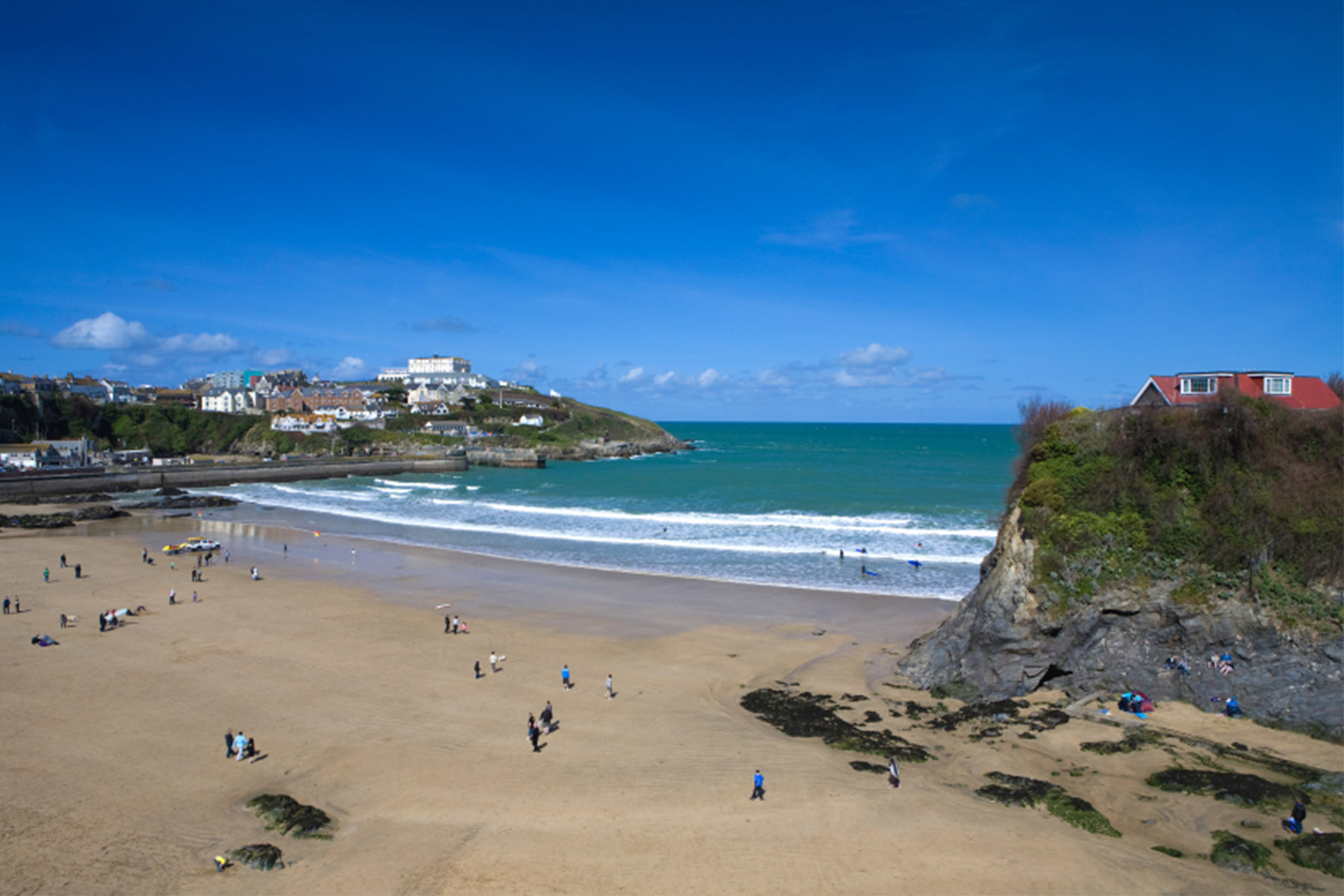
The Island's history is longer and stranger than its size suggests. It was first sold at auction in 1838, and for much of the nineteenth century held little more than a chicken run and a potato patch, reached by a rough path cut into the rock and used at times for open-air religious services. The suspension footbridge that still carries visitors and residents across today - usually dated to somewhere around 1900-1902, with different sources giving slightly different years - is widely reported to be the only privately owned suspension bridge in Britain. The building on top began life as a Victorian tea room and small gallery before being rebuilt, in the 1930s, as the three-bedroom Edwardian-style house that stands there now. Its most celebrated resident was Alexander Lodge, inventor of the Lodge sparking plug and son of the physicist Sir Oliver Lodge; family tradition holds that Sir Arthur Conan Doyle, a friend of the elder Lodge and a fellow enthusiast for spiritualism, was entertained there as a guest. At the foot of the rock, a natural sea pool once refilled twice daily by the incoming Atlantic tide was a popular spot for children for decades, though it has fallen into disrepair in more recent years. The house itself isn't open to the public, but it's clearly visible - and worth a photograph - from the beach, the promenade above, or the grassy terrace at Killacourt.
Being right in the centre of town makes Towan an easy, low-effort choice, popular with families and surfers who want a beach day without straying far from the shops and restaurants. Of all the Newquay beaches it's also one of the more accessible: the slope down is rated fair rather than steep, there are disabled toilets on site, and a sand chair can be booked directly through Blue Reef Aquarium for spring and summer visits.
Long before it was a resort, Newquay was a fishing settlement known as Towan Blystra, and it owes its present name to the harbour itself: in 1439 the Bishop of Exeter granted permission for a stone quay to be built in the manor, and the resulting "new quay" eventually gave the whole town its name. The harbour was substantially rebuilt in the 1830s by the London investor Richard Lomax, then expanded from 1838 by the industrialist Joseph Treffry, who drove a tunnel through to the harbour to move china clay, iron ore and grain out by ship and bring coal, manure, salt and limestone in. Pilchards were the other mainstay of the old harbour economy, spotted from the Huer's Hut - the whitewashed lookout that still stands on Towan Head, on the far side of town, parts of which are thought to go back to at least the fourteenth century. From there a "huer" watched for the telltale silvering of a pilchard shoal on the water (known locally as "shirming") and directed the seine boats below with the traditional cry of "Heva, heva!" Two of the old fish cellars used for salting and pressing the catch, Fly Cellars and Active Cellars, still stand on the harbour's northern side. Commercial fishing continues today on a much smaller scale, alongside pleasure boat trips, wildlife-watching cruises, and a resident colony of grey seals often seen around the harbour mouth.
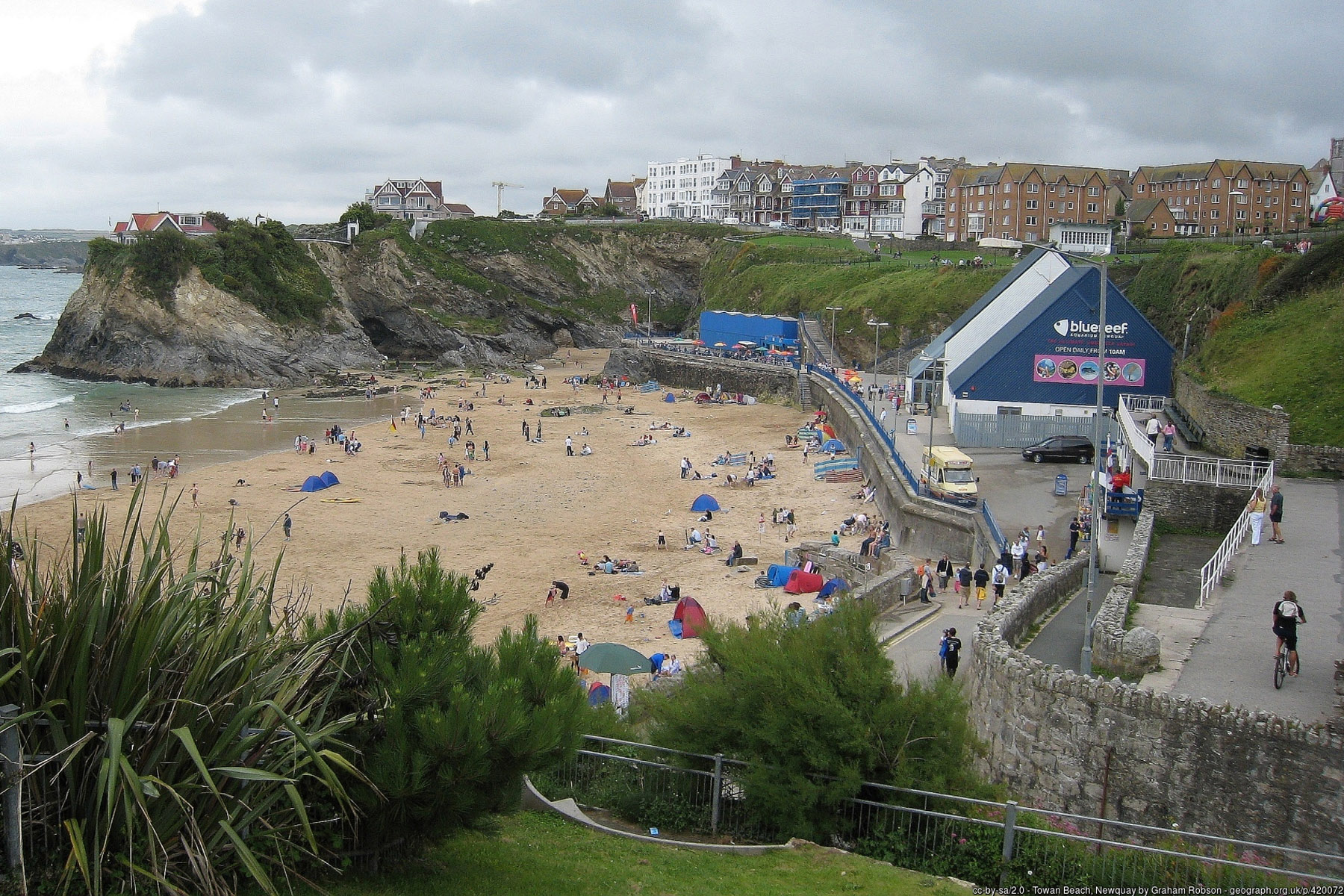
The shift from working port to holiday resort followed the railway. Passenger trains reached Newquay on 20 June 1876, initially run by the Cornwall Minerals Railway before the Great Western Railway took over the following year, and through carriages began running direct from London in 1906. As the number of summer visitors grew, the station itself had to be repeatedly extended, with its platforms lengthened in 1928, 1935 and 1938 to cope with demand. Towan, as the beach closest to the town centre and the station, was well placed to become Newquay's default "town beach" as this transformation took hold - the beach visitors could reach without a car, a bus, or much of a walk - and it still fills that role today.
RNLI lifeguards patrol daily through the main season, from around early May to the end of September, plus the Easter bank holiday weekend, and dogs are generally welcome on Towan throughout the year. Parking directly at the beach is limited, so most visitors use one of Newquay's town centre car parks and walk down.
Because it sits right against the town rather than out on open coastline, Towan tends to be at its best either side of the main summer crowds - a fine, quiet spot for an early swim or a walk on the sand in spring or autumn, when Newquay's shops and harbour are just as much on show but without the height-of-season bustle. Its sheltered position also means it can stay swimmable in conditions that close down more exposed beaches nearby, making it a reliable fallback on a blustery day - though, as with any beach backed by rock and cliff, checking the tide and weather before heading down is always worth the minute it takes.
Visitor Information
Parking
Limited directly at the beach; Newquay town centre car parks (including Manor Road) are a few minutes' walk away and are the more reliable option.
Facilities
Disabled toilets on site, plus cafes, shops and Blue Reef Aquarium right on the beachfront.
Disabled Access
Fair, via a shallow slope, with disabled toilets on site. A sand chair can be hired by calling Blue Reef Aquarium on 01637 878134. Not specifically confirmed at the beach itself - check the nearest town centre car parks with Cornwall Council for current Blue Badge bays.
Things to Do Nearby
- Blue Reef Aquarium, Towan Promenade, Newquay - directly overlooking the beach
- Newquay Zoo, Trenance Gardens, Newquay
- Trerice (National Trust), Kestle Mill, near Newquay
- Newquay Surf Beaches Map & Complete Surf Guide - other surf spots, schools and hire near Towan
- Harbour Beach and Newquay Harbour, a short walk around the headland
Places to Stay
Frequently Asked Questions
Page last updated: 8 September 2026.