Gunwalloe Church Cove
A Sandy Lizard Beach Beside a 13th-Century Church Built into the Cliff
Church Cove, Gunwalloe, near Helston, Cornwall, TR12 7QE
Gunwalloe Church Cove is one of the most instantly recognisable beaches on the Lizard peninsula, not for its sand or its swimming, though both are perfectly good, but for the small grey church that sits at its northern edge, tucked so close against the dune and the cliff that at first glance it looks as though it has simply washed up there alongside everything else the sea has brought in over the centuries. The Church of St Winwaloe, part of it dating back to the 13th century, gives the cove its name, and its position - half-buried in sand, facing directly into the prevailing south-westerlies - has earned it the enduring local nickname the "Church of the Storms". Few beaches in Cornwall pair a working medieval church quite so intimately with open sand and open sea, and it is this combination, as much as the beach itself, that draws a steady stream of visitors down the lane from Gunwalloe village throughout the year.
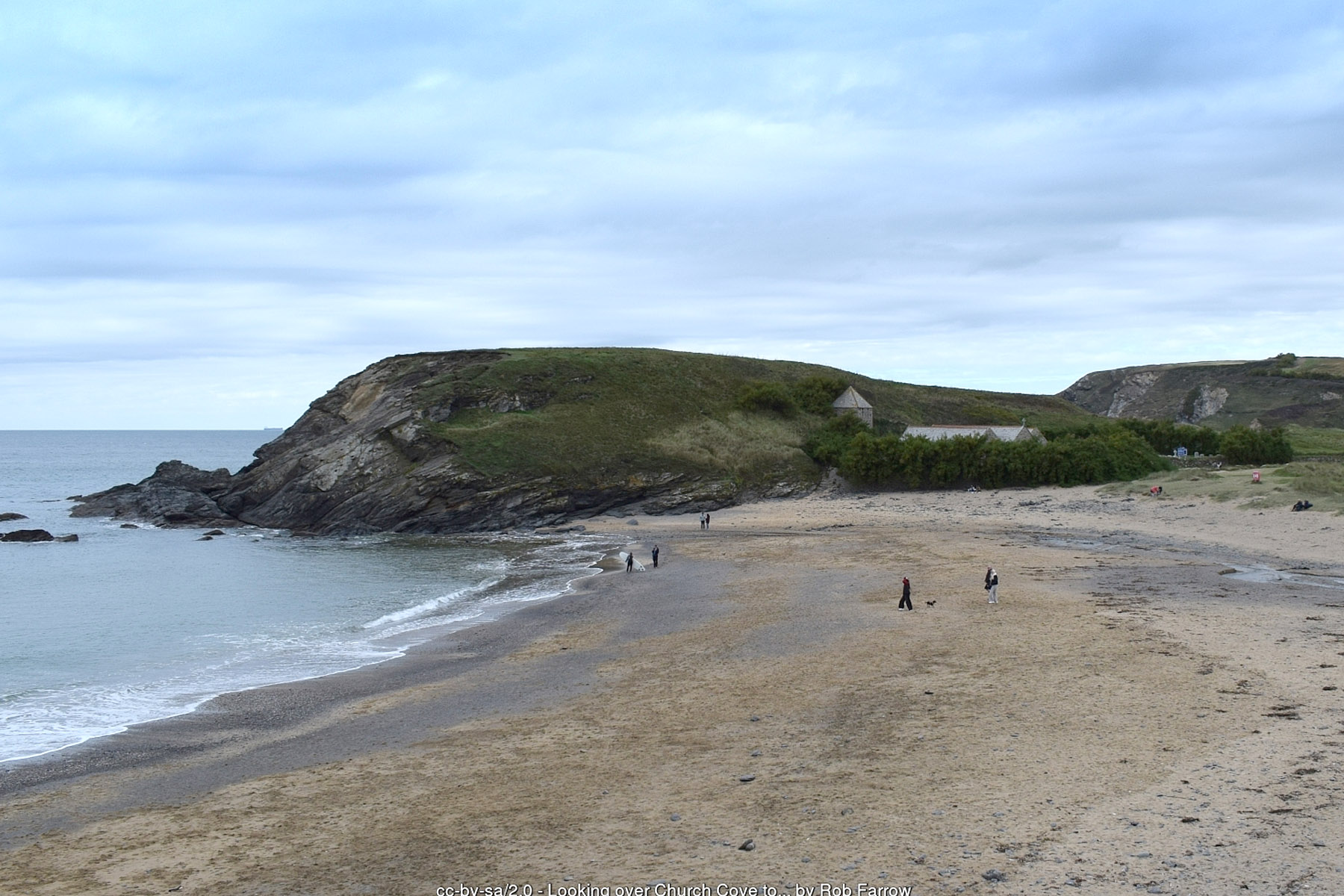
The church's tower is thought to be the oldest surviving part of the building, dating from around the 13th century, with the body of the church rebuilt in the 14th and 15th centuries as the parish grew and the structure was repaired and extended over successive generations. Unusually for an English parish church, its tower stands slightly detached from the main body of the building, set into the rising ground of the dune behind it - a detail that has long fuelled local stories about its foundations resting on the wreck of a Spanish ship, though no evidence supports this beyond folklore. What is certain is that the church's position, so close to the high-water mark and so exposed to Atlantic gales, has meant a long history of storm damage and repair, and it remains a working church today, with services still held inside - a genuinely rare thing for a building standing this close to a beach anywhere in Britain.
That closeness to the sea is no accident of geography so much as a reflection of just how exposed and eventful this stretch of coast has always been. The waters off Gunwalloe and neighbouring Loe Bar, immediately to the north, have claimed a long list of ships over the centuries, and the cove's own sand is said to have yielded coins and wreckage from more than one of them after storms. Among the best documented is a 17th-century English East Indiaman, wrecked near Loe Bar while returning from the East with a cargo of spices, indigo and around 100 long tons of pepper - an extraordinary cargo to have gone down so close to shore, and one that would have made this quiet stretch of coastline a focus of salvage activity for months afterwards. Earlier still, in 1525, the Portuguese ship St Antony came to grief nearby carrying bullion, plate and silver belonging to the King of Portugal himself. The wreck triggered one of the more colourful episodes in the cove's history: three local magistrates are recorded as having led an attack on the official salvagers sent to recover the King's property, making off with goods valued at more than £10,000 - an immense sum for the time - and the affair eventually reached the Court of Star Chamber in London, a rare instance of a remote Cornish cove's wrecking activity generating a genuine national legal case.
That taste for salvage and smuggling did not end with the Tudors. A short distance inland from the cove stands the Halzephron Inn, a pub whose building dates back to 1468 and which is said to incorporate timber salvaged from ships lost on this very coast - a detail entirely in keeping with a stretch of shoreline that has always made better use of what the sea brought in than most. The inn's name comes from the Cornish "als", cliff, and "safarn", hell - "Halzephron" translates roughly as "hell's cliff", a fitting description of a coastline that has proved so dangerous to shipping over the centuries, and the inn itself carries a long-standing, genuine association with smuggling, sitting as it does within easy reach of the beach, the dunes and the many coves along this part of the Lizard where contraband could once be landed with relatively little chance of being seen.
Set that history aside, though, and Gunwalloe Church Cove today is simply a good, honest sandy beach, part of the wider dune system that continues north towards Loe Bar and the Penrose Estate. The sand is clean and reasonably level, widening out at low tide, with rocky outcrops at the northern end near the church offering a modest amount of rock pooling for children and anyone curious about what the tide leaves behind. It is a popular beach for dog walkers throughout the year, helped by the fact that the car park sits so close to the sand, and the broad expanse of dune grass behind the beach makes for an easy, scenic stroll even for visitors who have no intention of getting their feet wet. Swimmers and bodyboarders do use the cove regularly, particularly in the more sheltered central section of the bay, but this is an open, west-facing beach on an exposed part of the Cornish coast, and conditions can change quickly with the swell and the state of the tide.
That exposure is worth taking seriously. There is no RNLI lifeguard patrol at Gunwalloe Church Cove, and the rocks at the northern end, close to the church, are a known spot for rip currents, particularly on a dropping tide when water pulled off the beach funnels back out to sea around the rocky margins. Visitors, and especially anyone swimming with children, should keep well clear of the areas immediately around the rocks, check tide times before heading down, and treat any beach along this stretch of the Lizard's Atlantic-facing coast with the same caution any unwatched Cornish cove deserves. The reward for that caution is a beach that, even on a busy summer weekend, rarely feels crowded in the way that some of Cornwall's more sheltered, family-oriented bays can.
Geologically, Gunwalloe sits at the boundary between the granite and gabbro of the wider Lizard complex and the softer, more mobile dune sands that have built up along this section of coast over thousands of years, fed by longshore drift and shaped by the same Atlantic storms that have wrecked so many ships offshore. The dunes themselves are part of a wider system that runs north to Loe Bar, the shingle bar that separates Cornwall's largest natural freshwater lake, Loe Pool, from the sea - itself formed by exactly the same process of longshore drift building up sediment across a river mouth. That geological continuity is part of what makes this stretch of coast so rich in wrecks: a long, straight, exposed shoreline with few safe harbours, backed by treacherous sandbanks and a bar that has claimed ships of its own, made this one of the most hazardous few miles of coastline in Cornwall for sailing vessels working close to shore.
A visit to Gunwalloe Church Cove works well as either a beach outing in its own right or as one stop on a longer walk along the South West Coast Path, which runs directly along the top of the dunes here and connects the cove to Poldhu Cove a little further south and to the Penrose Estate and Loe Bar to the north. Whether the draw is the sand, the rock pools, the walking, the church itself, or simply the chance to stand on a beach with quite so much genuine history layered into it, Gunwalloe Church Cove remains one of the more quietly remarkable beaches on the whole Lizard peninsula.
Visitor Information
Parking
A pay-and-display car park sits directly above the beach beside the church, giving easy, level access down to the sand. It is popular in summer and can fill on warm days, so arriving earlier is worthwhile.
Facilities
There is no café or shop at the beach itself. The nearest food and drink is a short drive inland at the historic Halzephron Inn, or in Helston, which has the fuller range of shops and services. There is no RNLI lifeguard patrol.
Disabled Access
The car park sits close to the beach with only a short, sandy slope down to the sand, but the beach itself is soft sand and dune, making onward wheelchair or pushchair access difficult beyond the top of the slope. No dedicated Blue Badge bays are confirmed at this beach - check locally.
Things to Do Nearby
- Poldhu Cove, Gunwalloe's neighbouring beach a short walk or drive south along the coast, famous as the site of Marconi's first transatlantic wireless transmission
- The historic Halzephron Inn, a short drive inland, dating from 1468 and said to be built partly from timber salvaged from shipwrecks on this coast
- Penrose Estate & Loe Bar (National Trust), immediately north of Gunwalloe, with woodland and lakeside walks around Cornwall's largest natural freshwater lake
- The South West Coast Path, which runs directly along the dunes above the cove, linking Gunwalloe to Poldhu Cove and the wider Lizard coastline
Places to Stay
Gunwalloe has its own range of holiday accommodation close to the beach and village:
Frequently Asked Questions
Page last updated: 16 September 2026