Porthoustock
A Working Quarry Beach on the Edge of the Manacles Reef
Porthoustock, near St Keverne, The Lizard, Cornwall, TR12 6QT
Porthoustock - pronounced locally "Prowstock" - is one of the more unusual beaches on the Lizard peninsula, a small cove of shingle and coarse sand on the exposed east coast between Coverack and Porthallow, sitting directly beside a working stone quarry whose industrial quay and jetty remain a genuine, active part of the view. It is not a beach that has been prettified or smoothed into a conventional holiday postcard: the quarry's presence, the bare granite-and-gabbro hillside rising behind the cove, and the open, workmanlike feel of the place are all part of Porthoustock's real character, and the village would not be honestly described without them. What draws most visitors here, though, is not the beach itself but what lies just offshore - Porthoustock sits right on the edge of the Manacles, one of the most notorious and feared stretches of water anywhere on the Cornish coast, and the beach's history is inseparable from the wrecks, rescues and losses that have taken place on that reef for centuries.
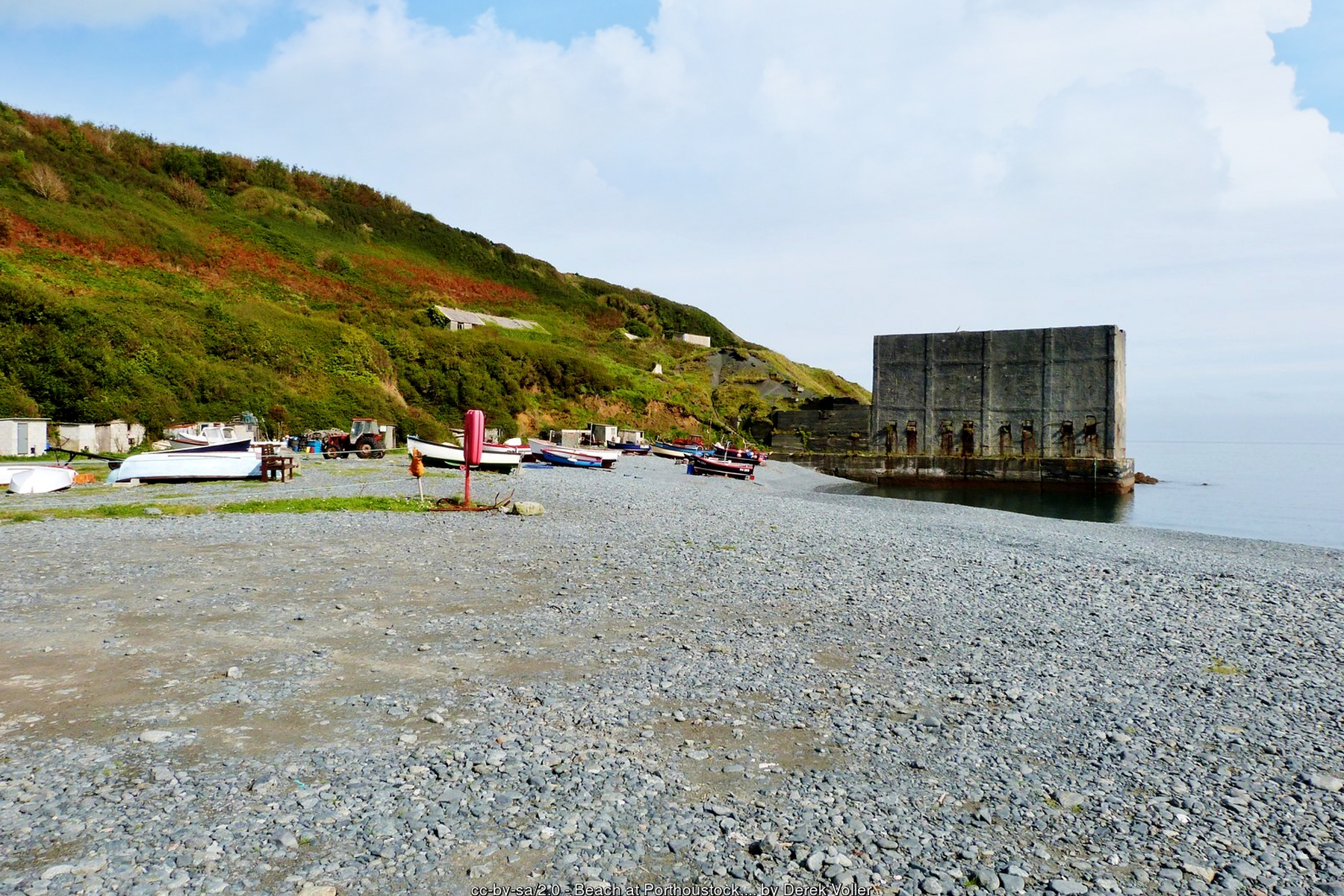
The quarry itself has operated at Porthoustock for well over a century, cutting into the hard igneous gabbro rock that forms this stretch of the Lizard to produce aggregate and roadstone. At its peak the quarry shipped stone out by sea directly from the quay beside the beach, and although operations today are much reduced, the jetty and quay infrastructure remain clearly visible, and occasional loading still takes place. It is an unusually industrial neighbour for a Cornish beach, more reminiscent of a working Cornish harbour village than a seaside resort, and visitors coming for a quiet swim should be aware that this is a working site as much as a leisure one - considerate parking and an awareness of quarry traffic on the approach lane are simply part of visiting Porthoustock responsibly.
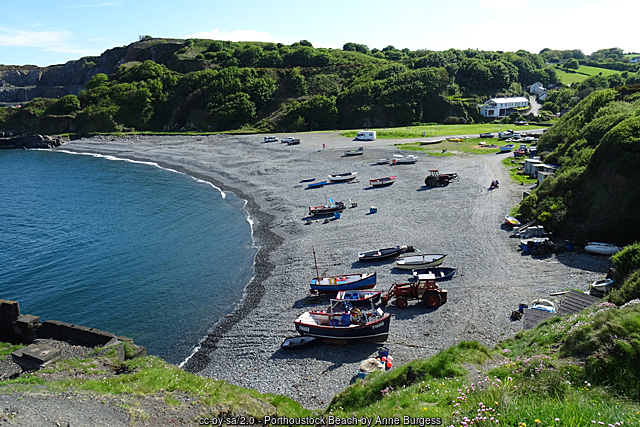
The real reason Porthoustock features so prominently in Cornwall's maritime history, though, is the Manacles - a scattered, semi-submerged reef of rocks lying just off this stretch of coast, and one of the single most dangerous obstacles to shipping anywhere in the South West. Over the centuries the Manacles have claimed a huge number of vessels, from small fishing boats to substantial ocean-going ships, and the communities of Porthoustock and neighbouring Coverack grew up in large part around the grim, recurring business of responding to wrecks here. Porthoustock had its own RNLI lifeboat station from 1869 until 1942, launched time and again to reach ships in distress on the reef, and the beach itself - now so quiet and small-scale - was for decades the front line of one of Cornwall's most active rescue operations.
The single event most associated with Porthoustock and the Manacles is the sinking of the SS Mohegan, an Atlantic Transport Line steamship that struck the reef on the night of 14 October 1898 while on a voyage from London to New York. The ship went down within minutes in the darkness, catching her crew and passengers almost entirely by surprise, and the disaster claimed more than a hundred lives - one of the worst peacetime shipping losses on the Cornish coast. Villagers and boats from both Porthoustock and Coverack were heavily involved in the rescue effort that night and in the grim recovery work that followed, and the Mohegan disaster remains one of the defining events in the area's history, still referenced in local memory and in the wider record of the Manacles' long and largely tragic toll on shipping.
In the decades since, the same reef that made Porthoustock so dangerous for shipping has made it a genuinely well-regarded destination for a very different community: divers. Since the 1960s, Porthoustock has been used as a shore-diving launch site for those visiting the numerous wreck sites scattered across the Manacles, and it remains one of the more accessible and popular points of entry on this stretch of coast for exploring what is, in effect, an open-air museum of Cornish shipwrecks beneath the surface. The same currents, submerged rocks and exposed conditions that make the Manacles dangerous for the unprepared are exactly what make the diving here so rewarding for those who know what they are doing, and Porthoustock's beach - unassuming as it looks from the car - is a genuinely well-known name within Cornwall's diving community.
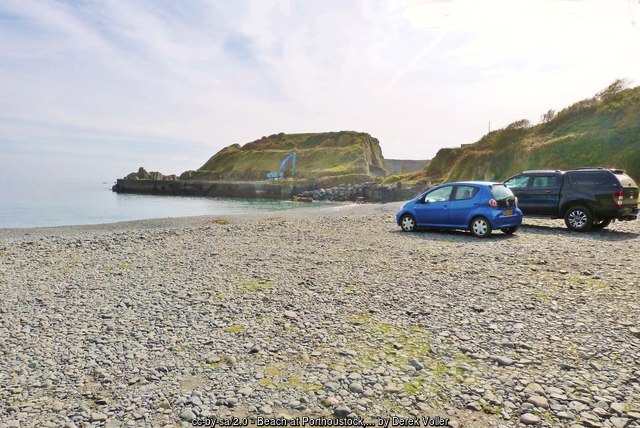
For the ordinary visitor rather than the diver, Porthoustock remains a small, low-key beach with very limited facilities - there is no shop, café or toilet block at the beach itself, and no RNLI lifeguard patrol, a point worth taking seriously given the beach's direct proximity to the Manacles. Parking is informal and limited, clustered near the beach and the quarry entrance, and visitors should park with consideration for both other visitors and the quarry's own working traffic rather than expecting a purpose-built visitor car park. Underfoot the beach is a mix of shingle and coarser sand, more workable at low tide, and the setting - open to the east, backed by the quarry hillside on one side and open coast path on the other - gives Porthoustock a genuinely different feel from the more manicured beaches elsewhere on the Lizard. It rewards visitors who come for its history and its honest, unvarnished character rather than expecting a conventional family beach day.
The hard, dark rock quarried above Porthoustock is gabbro, part of the Lizard Complex - a geologically remarkable slice of ancient oceanic crust and upper mantle rock thrust up onto land, and one of the most complete and best-studied examples of its kind exposed anywhere in Britain. It is this unusually tough, dense rock, rather than the softer granite found elsewhere in Cornwall, that made the Lizard's coastal quarries worth working in the first place, and the same hard rock forms the underwater reef structure of the Manacles just offshore - geology and maritime hazard here are, quite literally, the same rock formation viewed from two different angles. Beyond the quarry itself, the bare, exposed cliffs and rock ledges around Porthoustock reward anyone interested in coastal geology or rockpooling at low tide, when anemones, small crabs and a range of seaweed species can be found in the pools among the rocks either side of the beach.
The wider village of Porthoustock is small and quiet, its handful of houses and the old lifeboat house a reminder of a working maritime community that has changed considerably since the lifeboat station closed in 1942 - responsibility for this stretch of coast now sits with the modern RNLI stations further along the Lizard. The coast path passes directly through the village, offering an easy and genuinely attractive walk in either direction: south towards Coverack, with its own beach, shop and café, or north towards Porthallow, barely a mile away and the next cove up this same stretch of the Manacles-facing coast. Both make natural extensions to a visit to Porthoustock, and together the three villages - Coverack, Porthoustock and Porthallow - give a real sense of how this whole stretch of the Lizard's east coast has been shaped, for centuries, by its relationship with one of Cornwall's most dangerous and storied reefs.
Tides matter more at Porthoustock than at many Cornish beaches, given its exposed easterly aspect and the reef immediately offshore - the beach itself narrows noticeably at high water, and the rocky foreshore either side is best explored on a falling or low tide, when more of the shingle and rock ledges are exposed. Weather from the east or south-east can also bring a more noticeable swell onto this stretch of coast than the more sheltered coves further round the Lizard, another reason the beach suits confident, experienced sea users - divers and coast path walkers - rather better than it suits a casual family paddle. For anyone approaching by road rather than on foot, the lane down to Porthoustock from the St Keverne direction is narrow and shared with quarry traffic, and patience rather than haste is the right approach to both the drive in and the parking once there.
Visitor Information
Parking
Parking at Porthoustock is informal and limited, close to the beach and the entrance to the working quarry. Spaces can fill quickly in summer - park considerately and stay alert for quarry lorries and other working traffic sharing the lane.
Facilities
There are no facilities at Porthoustock beach itself - no toilets, café or shop. The nearest facilities are in Coverack, a short drive or coast path walk to the south. There is no RNLI lifeguard patrol here.
Disabled Access
Access to the beach is over an informal, uneven quarry-side lane and shingle, and is not suitable for wheelchairs or limited mobility. No dedicated Blue Badge bays are confirmed at Porthoustock - check current signage on arrival.
Things to Do Nearby
- Porthallow, a close neighbour about a mile north along the coast path, with its own fishing-village history and the South West Coast Path's famous halfway marker
- Coverack, the nearest village to the south, with a beach, shop, café and the nearest facilities to Porthoustock
- The Manacles reef and the SS Mohegan wreck site, one of Cornwall's best-known shore-diving destinations, reached directly from Porthoustock beach
Places to Stay
Porthoustock itself has no dedicated holiday accommodation listings of its own. The nearest hub with a real range of places to stay is Coverack, a short drive or coast path walk to the south:
Frequently Asked Questions
Page last updated: 16 September 2026.