Poldhu Cove
A Sheltered Family Beach Beneath the Birthplace of Transatlantic Radio
Poldhu Cove, near Mullion, Cornwall, TR12 7JB
Poldhu Cove is, quietly, one of the most historically significant beaches anywhere in the world, though most of the families building sandcastles on its sand each summer are entirely unaware of it. It was on the headland directly above this sheltered Lizard beach that Guglielmo Marconi built the wireless station from which, on 12 December 1901, a signal was transmitted and received roughly 2,100 miles away in St John's, Newfoundland - the world's first transatlantic radio transmission, and a moment that changed global communications forever. That the site of such a landmark achievement in the history of technology should also be one of the Lizard's most pleasant, sheltered and genuinely family-friendly beaches is one of those quirks of Cornish geography that makes Poldhu worth visiting for more than one reason at once.
The wireless station itself was built in 1900-01 to prove that radio signals could travel far beyond the horizon, something many contemporary scientists doubted was even physically possible given the curvature of the earth. Professor John Ambrose Fleming, later famous for inventing the thermionic valve, designed the powerful spark transmitter used at Poldhu, while Marconi oversaw the project and, ultimately, carried out the transatlantic experiment himself from Newfoundland. The original aerial, a striking circular array of 20 masts, was destroyed in a storm on 17 September 1901, barely three months before the historic transmission was due - a serious setback that would have ended a less determined project. Marconi responded by hastily rebuilding a temporary fan-shaped aerial of 50 wires suspended between two 200-foot masts, and it was this improvised replacement, radiating an estimated 10 to 12 kilowatts, that carried the signal - three dots, the Morse letter "S" - across the Atlantic that December.
The station at Poldhu continued in various forms of use for over three decades after that founding moment, eventually closing in 1934 and being demolished in 1937. In a gesture that has preserved the site's significance ever since, six acres of the headland were gifted to the National Trust that same year, and the location is now home to the Marconi Centre, run by the volunteer Marconi Radio Club, where visitors can learn about the station's history and the wider story of early radio - a genuinely worthwhile stop for anyone visiting the beach below, and free to visit alongside the free parking nearby.
The site's history is not entirely one of scientific triumph, however. During the Second World War, Poldhu Cove itself was heavily mined to deter a potential German landing along this stretch of the Lizard coast, part of the extensive coastal defences built around Cornwall during the invasion-scare years of the early 1940s. That precaution came at a real cost: on 24 April 1943, two members of the Royal Air Force Volunteer Reserve were killed at Poldhu when one of them trod on an unmarked mine, a sobering reminder of the very real dangers that lingered on Britain's beaches throughout the war, long after the immediate threat of invasion had receded elsewhere.
More recently, Poldhu has had its share of stranger, gentler local incidents too. In January 2016, thousands of pink plastic bottles washed up along the cove in a single event that puzzled and delighted visitors and locals in equal measure - the National Trust believed at the time that they had been lost overboard from a container ship during severe storms, and the sight of the beach scattered with bright pink debris became one of those small, memorable moments of local news that outlasts its own novelty, still recalled by regular visitors to this day.
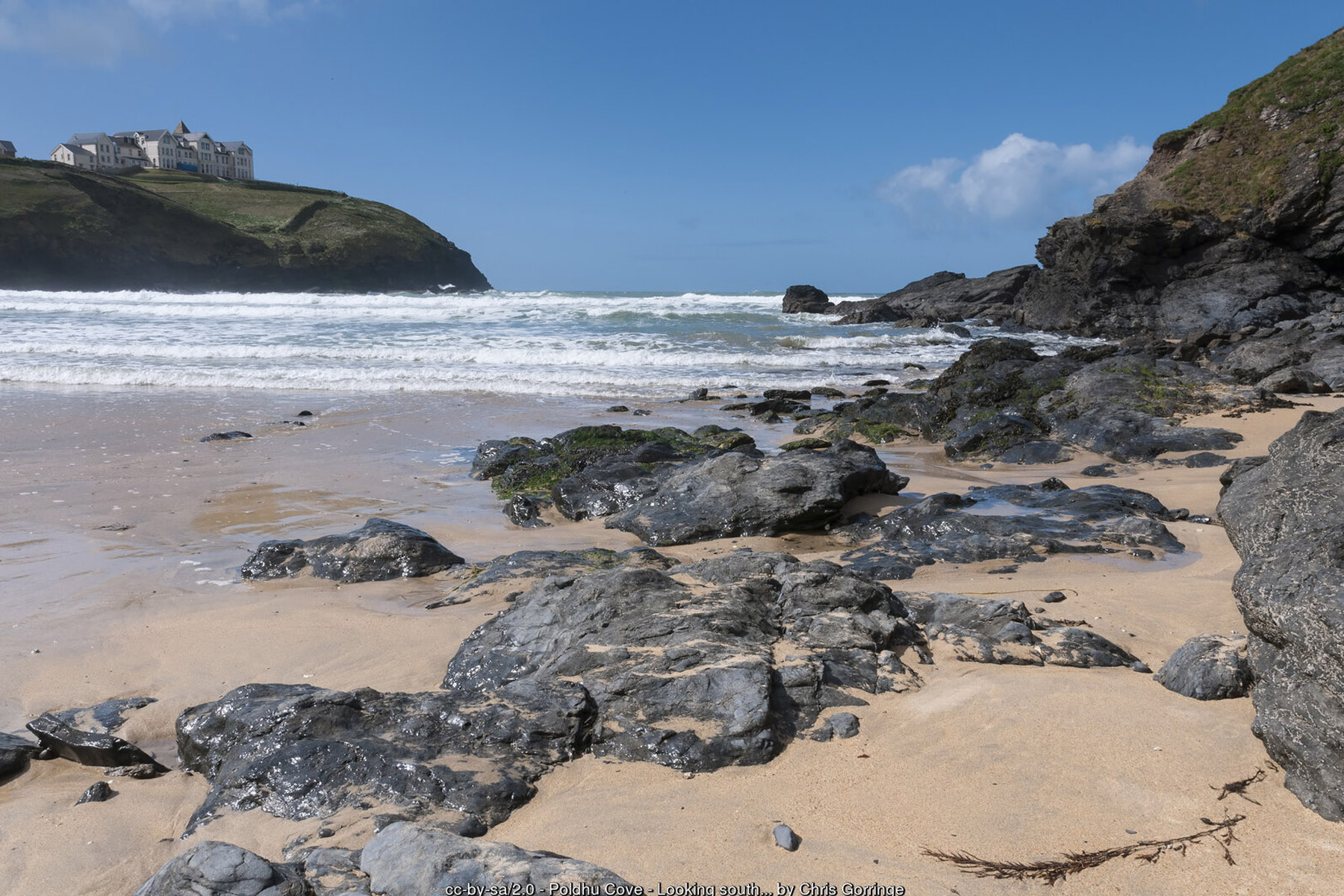
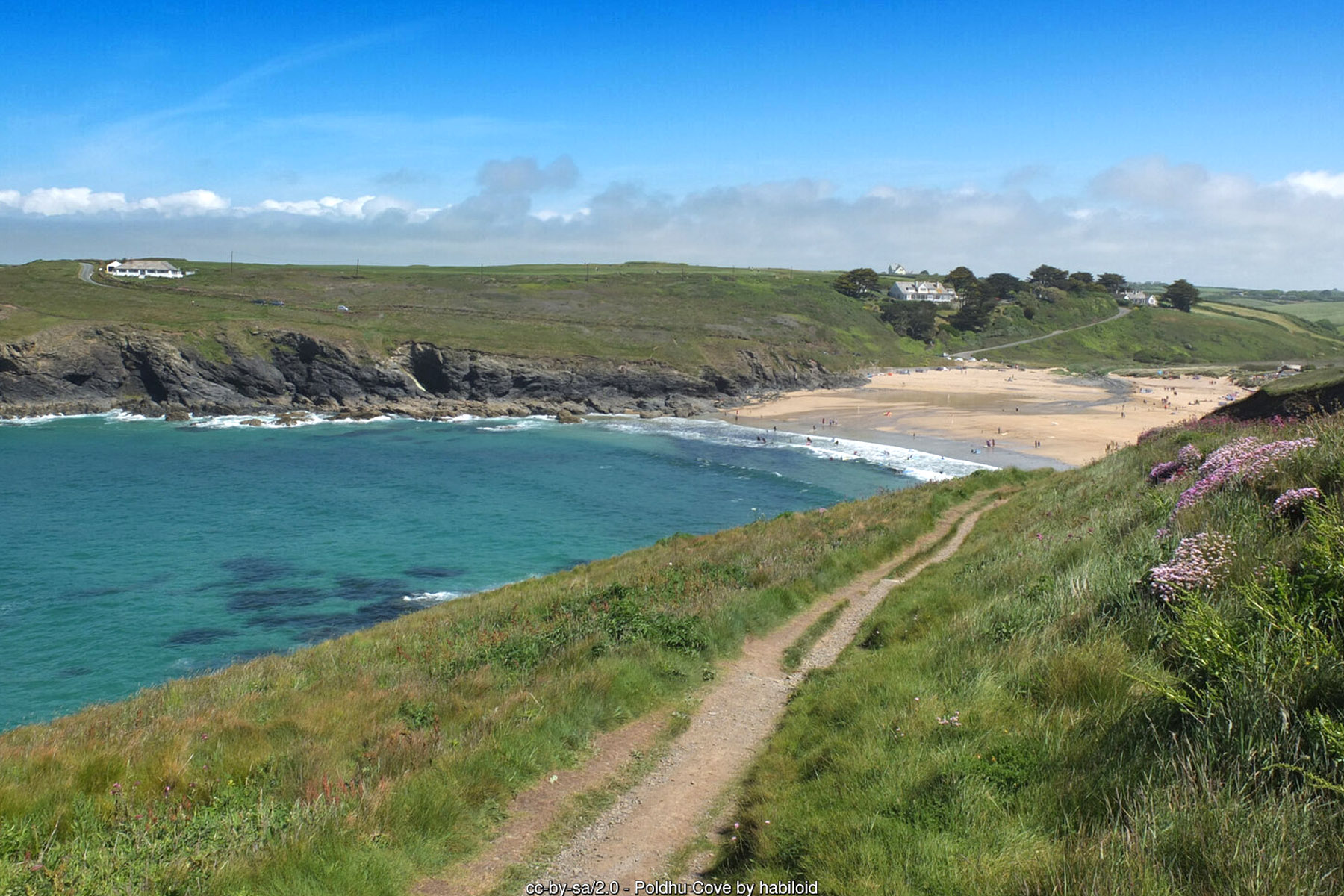
Set against all of that history, the beach itself is straightforwardly good: a sheltered, sandy cove that sits between Gunwalloe Church Cove to the north and Polurrian Cove and Mullion further south along this stretch of the Lizard's west coast. Poldhu is popular with families thanks to its relative shelter from the worst of the Atlantic swell, making it a reliable spot for swimming and bodyboarding when conditions on more exposed nearby beaches can be too rough for younger children. A large National Trust car park sits right beside the beach - as of 2025 it remains free of charge while the site transitions from Cornwall Council to National Trust management, though as with any such transitional arrangement it is worth checking current signage on arrival. A café operates by the beach along with seasonal toilets, and importantly for many visitors, access from the car park to the back of the beach is level and relatively straightforward, making Poldhu one of the more genuinely manageable Lizard beaches for wheelchair users, pushchairs and anyone who finds steep coast-path access difficult elsewhere on this stretch of coast.
There is no permanent RNLI lifeguard patrol confirmed at Poldhu Cove, so the usual sensible precautions apply - checking tide times, being aware of any local warning flags, and keeping a closer eye on children in the water than a lifeguarded beach might otherwise require. That said, the cove's relative shelter compared with the fully open Atlantic beaches further along the Lizard makes it one of the gentler options in this part of Cornwall, which is part of why it has remained such a popular family choice for generations of visitors, entirely independent of its extraordinary place in the history of global communications.
It is worth pausing on just how significant the achievement above Poldhu actually was. Before 1901, most scientists assumed radio waves, like light, travelled in straight lines and would simply be blocked by the curvature of the earth beyond a certain range - meaning transatlantic wireless communication should, in theory, have been impossible. Marconi's success at Poldhu proved otherwise, demonstrating that radio signals could bend around the earth (though the precise reason, reflection off the ionosphere, was not properly understood until years later), and the experiment effectively launched the era of global wireless communication. Within little more than a decade, ship-to-shore wireless of the kind pioneered at Poldhu would play a direct role in maritime safety and rescue efforts around the world, transforming how vessels at sea could call for help - a legacy that traces directly back to this one Cornish headland and the improvised aerial rebuilt here in the autumn of 1901.
The beach itself sits within the same granite and gabbro geology that defines much of the Lizard peninsula, with the cove's sand backed by low cliffs and grassy headland rather than dunes, giving Poldhu a slightly more enclosed, bowl-shaped feel than some of its neighbours along this coast. The sand is clean and firm underfoot for much of its width, particularly useful for families with young children or anyone pushing a buggy, and a stream crosses part of the beach on its way to the sea, adding a small extra point of interest for children exploring at low tide. Rock pooling is possible at the margins of the cove as the tide drops, though Poldhu is best known simply as a reliable swimming and paddling beach rather than a specialist rock-pooling spot. As with anywhere on this coast, a falling tide tends to be the best time to visit, opening up the widest stretch of sand, while the headland above rewards a short walk at any time of day with sweeping views back along the Lizard's west coast towards Mullion and, on a clear day, out across the same stretch of Atlantic that once carried Marconi's signal towards Newfoundland.
Walkers can pick up the South West Coast Path directly from Poldhu, following it north towards Gunwalloe Church Cove and the dune-backed coastline beyond, or south towards Polurrian Cove and Mullion, taking in the same clifftop views that would once have looked out over Marconi's towering wireless masts. Few short stretches of the Cornish coast pack in quite so much - a genuinely important chapter of scientific history, a poignant wartime story, a memorably odd piece of recent local folklore, and a thoroughly pleasant, sheltered family beach - all within the same short walk from one car park.
Visitor Information
Parking
A large National Trust car park sits directly beside the beach. As of 2025 it remains free while the site transitions from Cornwall Council to National Trust management - worth checking current signage on arrival in case this changes.
Facilities
A café operates by the beach along with seasonal toilets. There is no permanent RNLI lifeguard patrol confirmed, so check conditions before swimming.
Disabled Access
Poldhu offers easier access than most Lizard beaches, with a level route from the National Trust car park to the back of the beach suitable for wheelchairs and pushchairs. No dedicated Blue Badge bays are confirmed at this beach - check locally.
Things to Do Nearby
- The Marconi Centre (National Trust), on the headland above the beach, telling the story of the first transatlantic wireless transmission
- Gunwalloe Church Cove, Poldhu's neighbouring beach a short walk or drive north, home to the historic Church of St Winwaloe
- Polurrian Cove, a short drive south towards Mullion, with dramatic cliff scenery
- The South West Coast Path, running along the clifftop above Poldhu and linking the beach to both Gunwalloe and Mullion
Places to Stay
Poldhu itself has no dedicated holiday accommodation listings - it is a beach and headland rather than a village. Mullion, the nearest village and hub for places to stay, offers the widest range of nearby accommodation:
Frequently Asked Questions
Page last updated: 16 September 2026