Porthallow
A Working Fishing Village Beach at the Coast Path's Exact Halfway Point
Porthallow, near St Keverne, The Lizard, Cornwall, TR12 6PL
Porthallow - pronounced locally "Prallow" - is a small, genuine fishing and diving village on the Lizard peninsula's east coast, a mile or so north of Porthoustock along the same Manacles-facing shore. Unlike many of Cornwall's better-known beaches, Porthallow has never really been developed for tourism in the conventional sense: it remains, first and foremost, a working village, with a shingle beach and a stone slipway still used by local fishing boats, a scatter of cottages climbing the valley behind it, and a genuinely unhurried, lived-in feel that has largely disappeared from busier parts of the county. It is precisely this unspoilt, working character - together with one very well-known geographical quirk - that has made Porthallow a small but well-loved name among walkers, divers and anyone who values a Cornish beach that has not been remade purely for visitors.
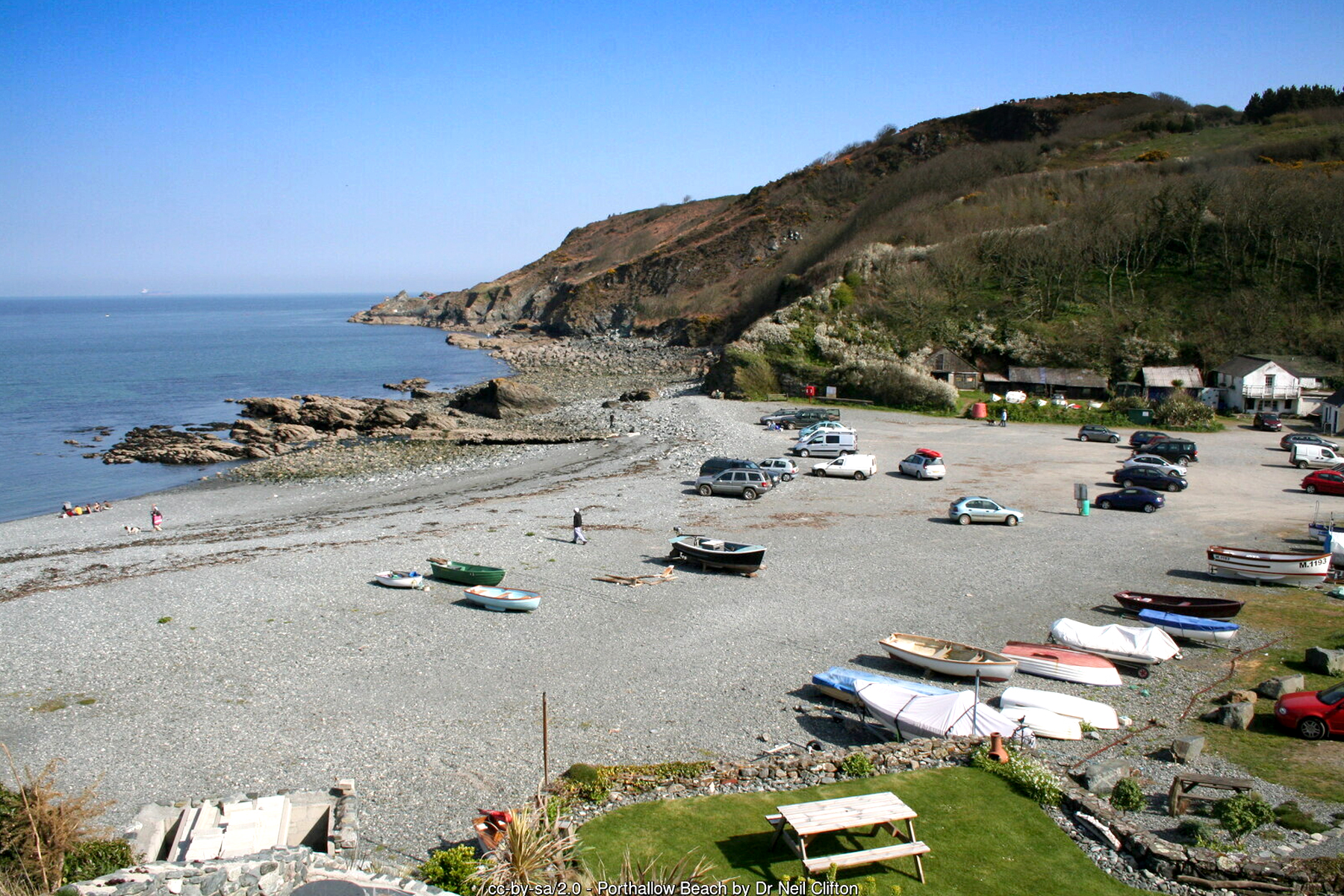
Porthallow's fishing history runs remarkably deep. The village was already a flourishing fishing settlement as early as the 13th century, when it was used as a fishing base by Beaulieu Abbey in Hampshire, one of several distant religious houses that held coastal interests in Cornwall in the medieval period. By the 14th century Porthallow had grown into one of the more significant Duchy of Cornwall fishing ports along this stretch of coast, its boats working the rich local waters for pilchards and other catch that sustained the local economy for centuries afterwards. That fishing tradition reached a particular high point in the early 20th century with the arrival of the Porthallow Pilchard Curing Company, which operated in the village from 1914 to 1937, processing the pilchard catch landed on the beach below. The company is long gone, but its memory survives directly in the name of the village pub, the Five Pilchards Inn, a genuine and much-loved fixture of Porthallow life that commemorates the fishing heritage the whole village grew from.
Porthallow's other great claim to fame has nothing to do with fishing at all, and everything to do with walking. The village sits at the exact midpoint of the South West Coast Path, Britain's longest waymarked long-distance trail, which runs for 630 miles from Minehead in Somerset, around the entire Cornish coast, and on to Poole in Dorset. A large millstone set on Porthallow beach marks this precise halfway point, and it has become something of a genuine pilgrimage stop for coast path walkers - those tackling the full length of the trail, whether in one continuous effort or over many separate trips, traditionally stop to touch or photograph the marker on passing through, a small ritual that has grown up naturally around the stone rather than being imposed from outside. For walkers who have come this far, or who still have this far to go, reaching the Porthallow millstone carries a real sense of achievement that the beach's modest size and quiet setting belie.
Like its near neighbour Porthoustock a mile or so to the south, Porthallow also has a genuine connection to diving. The waters off this stretch of the Lizard's east coast are dominated by the Manacles, one of Cornwall's most notorious reefs and the site of a huge number of historic shipwrecks over the centuries. Since the 1960s, Porthallow has been used, alongside Porthoustock, as a shore-diving launch point for divers heading out to explore wreck sites on the Manacles, and the two villages together form one of the best-known and most accessible stretches of shore-diving coastline in Cornwall. It is a role that suits Porthallow's low-key, unpretentious character well - divers come here for the water and the wrecks, not for polish, and the village has never needed to be anything other than what it genuinely is.
Porthallow's setting is shaped by the same wider geology and coastline as its neighbours along this stretch of the Lizard - a mix of hard, ancient rock and exposed, east-facing shore that has always made this coast both a working fishing ground and a genuine hazard to shipping. The valley behind the beach, wooded and sheltered in contrast to the open coast in front of it, carries a small stream down to the shingle and supports a noticeably different, softer character than the bare cliffs found further round the peninsula towards Kynance and Mullion - a reminder that the Lizard's east coast, facing the Channel rather than the Atlantic, has its own distinct feel, generally calmer but still capable of real weather when the wind swings onshore. The rock ledges either side of the beach are worth a look at low tide for anyone interested in rockpooling, with the usual range of anemones, small crabs and shore life found along this part of the coast.
Practically, Porthallow remains a small and largely unspoilt beach with limited facilities. The beach itself is shingle rather than soft sand, changing character with the state of the tide, and there is no shop or public toilet block directly at the beach - the Five Pilchards Inn, close by in the village, is the main option for food and drink for anyone visiting. Parking is informal, along the lane approaching the beach and slipway, and space is limited, particularly through the summer months and on days when the coast path brings extra walking traffic through the village. There is no RNLI lifeguard patrol at Porthallow, so visitors should treat the sea here with the same care appropriate to any small, unwatched Cornish cove, especially given the proximity of the Manacles reef just offshore.
The Five Pilchards Inn itself is worth a mention beyond its name. Built into the fabric of the village much as the fishing trade once was, it remains the natural gathering point for locals, fishermen, divers and coast path walkers alike, and its very existence - a pub named directly and unambiguously after the fish that built the village - is a small but genuine piece of living local history rather than a marketing flourish. Walking north from Porthallow, the coast path begins to trend towards the mouth of the Helford River, one of Cornwall's most sheltered and wooded tidal inlets, a markedly different, softer landscape from the open, Manacles-facing coast around Porthallow and Porthoustock, and a worthwhile extension for anyone with a full day to spend exploring this stretch of the Lizard on foot.
What makes Porthallow worth the detour, ultimately, is the combination of genuine working history and genuine natural setting rather than any single dramatic feature. The slipway still sees local boats launched and hauled in the traditional way; the valley behind the beach is quiet and green, a world away from Cornwall's busier resort towns; and the coast path in both directions offers some of the finest, least-crowded walking on the whole Lizard peninsula, whether heading south towards Porthoustock and Coverack or north towards the wooded creeks around the Helford River. For a beach with no dramatic cliffs, no famous surf and no large car park, Porthallow has earned its place in Cornwall's coastal story - through thirteenth-century fishermen, twentieth-century pilchard curers, and the thousands of coast path walkers who have stopped, over the years, to touch its quietly famous millstone.
Visitor Information
Parking
Parking at Porthallow is informal, along the lane close to the beach and slipway. There is no large formal car park, so space is limited, particularly in summer - park considerately in this small working village.
Facilities
There are no toilets or shop directly at the beach, though the Five Pilchards Inn nearby offers food and drink. There is no RNLI lifeguard patrol at Porthallow.
Disabled Access
Access to the beach is via the slipway and shingle, and is not suitable for wheelchairs or limited mobility. No dedicated Blue Badge bays are confirmed at Porthallow - check current signage on arrival.
Things to Do Nearby
- Porthoustock, a close neighbour about a mile south, with its own quarry-beach setting and strong Manacles shipwreck history
- Coverack, a further village along the coast path to the south, with a beach, shop and café
- The South West Coast Path, whose 630-mile length reaches its exact midpoint at the millstone marker on Porthallow beach
Places to Stay
Porthallow has its own range of holiday accommodation:
Frequently Asked Questions
Page last updated: 16 September 2026.