Cadgwith Cove
A Genuine, Still-Working Cornish Fishing Village on The Lizard
Cadgwith, The Lizard, Cornwall, TR12 7JX
Cadgwith is one of the most picturesque villages on The Lizard, and one of the few stretches of this coast that still feels like a genuine, working fishing settlement rather than a beach dressed up for visitors. Thatched and stone cottages, capstan houses and old fish cellars, built from local stone or cob, cluster tightly around a small shingle cove on the peninsula's east coast, and it is still entirely normal to find crab and lobster boats hauled up on the beach itself among the visitors, exactly as they have been for centuries.
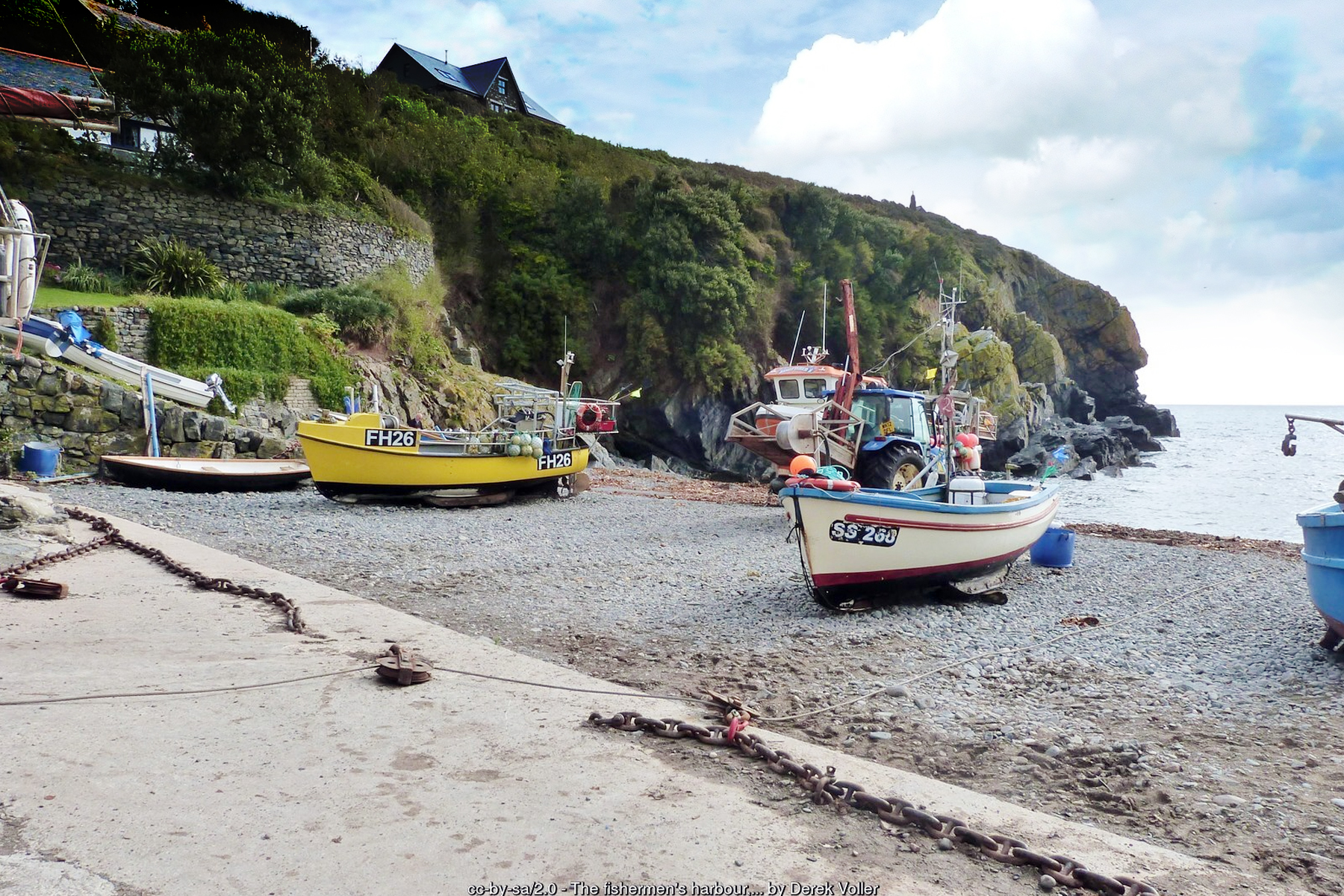
The village's origins go back to medieval times, when Cadgwith began life as little more than a scattering of fish cellars in a sheltered, south-east-facing coastal valley - a practical spot to land and process a catch rather than a settled community in its own right. It grew into a proper village from the sixteenth century onwards, its fortunes tied closely to the sea, and for centuries pilchard fishing dominated the local economy. Large seine boats worked the shoals close to shore, directed from above by lookouts known as "huers", stationed on the surrounding headlands to spot the tell-tale colour change in the water as a shoal of pilchards approached and to shout directions down to the boats below - the same huer tradition found at other historic Cornish fishing villages such as Newquay. Cadgwith's pilchard fishery reached a remarkable peak on record in 1904, when a single, extraordinary catch saw 1,798,000 pilchards landed over just four days, a figure that gives some sense of the scale the industry once reached here.
That pilchard fishery declined steadily through the twentieth century, as overfishing and changing fish populations reduced the shoals that had once sustained the village, and Cadgwith's boats gradually shifted towards crab and lobster potting instead - a trade that continues today, and one of the main reasons the cove still has such a genuinely lived-in, working character rather than feeling like a museum piece. Walking down through the village to the cove, past the capstan houses once used to winch boats up the beach and the old net lofts and fish cellars tucked between the cottages, it is easy to see how closely the whole settlement grew up around the practical business of fishing, long before tourism had any part to play in its story.
A short and genuinely worthwhile walk south of the cove along the coast path leads to the Devil's Frying Pan, one of the most dramatic natural features on this stretch of coast and a well-known local landmark in its own right. It began life as a sea cave, whose roof eventually collapsed under the constant battering of the Atlantic, leaving behind a huge, roughly circular, boulder-filled bay connected to the open sea by a narrow gap spanned by a natural rock arch - in effect, a giant collapsed sinkhole open to the ocean. In calm weather it is an impressive enough sight, but in rough seas the water surges in and out through the narrow arch with real force, churning and "boiling" within the enclosed bay in a way that makes the name entirely understandable, and it is a popular stopping point for walkers exploring the coast path in either direction from the village.
Practicalities at Cadgwith are straightforward without being over-developed. A car park of around seventy-five spaces sits a few minutes' walk up the road from the cove, generally free to use outside the summer season, though as with most car parks on this coast, exact current pricing and policy are worth checking locally rather than assumed, since these details do change from year to year. Public toilets and a small shop and café are close by in the village itself, giving visitors somewhere to eat, drink or pick up supplies without having to leave Cadgwith. There is no RNLI lifeguard patrol here, and the beach itself is shingle and rock rather than sand, so it suits a slower, more atmospheric visit - watching the boats, exploring the lanes between the cottages, or walking on to the Devil's Frying Pan - better than a conventional day on the sand. Swimming is certainly possible in calm conditions and is popular with regular visitors, but given the cove's continuing role as a working harbour, with boats routinely launching, returning and being winched up the beach, both swimmers and sunbathers need to keep half an eye on the water and stay well clear of boat traffic and fishing gear.
Cadgwith's combination of genuine maritime history, real working boats and a setting that has changed remarkably little over the decades makes it one of the more distinctive stops on any tour of The Lizard, and a natural complement to the wilder, more open beaches elsewhere on the peninsula - a place to slow down, watch the fishermen at work, and get a sense of a Cornish coastal village that has never entirely stopped being what it always was.
That sense of a living maritime tradition extends to the village's own singing culture. Cadgwith is home to one of Cornwall's best-known groups of shanty singers, who gather informally to perform traditional sea songs and shanties, often outdoors around the cove itself on summer evenings - a genuinely local, unrehearsed-feeling tradition rather than a staged tourist show, and one that draws its own small following of visitors keen to catch a performance. It's a fitting continuation of a village whose whole identity has always been bound up with the sea and the boats that work it, and it adds a further, very Cornish layer to an evening spent in the cove beyond simply watching the sunset over the water.
Cadgwith's maritime history has a genuine heroic chapter too. The RNLI kept a lifeboat stationed here between 1867 and 1963, and its finest hour came on the night of 17-18 March 1907, when the lifeboat Minnie Moon put out into fog and gales to reach the White Star liner SS Suevic, wrecked on rocks near Lizard Point, and helped rescue an extraordinary 227 people from the stricken vessel - two of the crew were later awarded RNLI silver gallantry medals for the rescue. The station closed in 1963, after Cadgwith's and the nearby Lizard lifeboat crews were merged in 1961 into a single new station at Kilcobben Cove, positioned to give better shelter between the two original sites. Cadgwith's old lifeboat house still stands above the cove, its working life as a lifesaving station long over, and today it serves a rather gentler purpose as the home of the Cadgwith Pilot Gig Club, whose rowers can often be seen training out of the cove in traditional six-oared Cornish pilot gigs.
The coast path in both directions from Cadgwith rewards further exploration beyond the short walk to the Devil's Frying Pan. Heading north, it leads towards the quieter beach at Kennack Sands, a walk of a few miles that takes in some of the finest and least-crowded clifftop scenery on this side of the peninsula, past small coves, old serpentine quarry workings and typical Lizard heathland rich in wildflowers through the spring and summer months. Cadgwith rewards a visit at almost any time of year - busiest, unsurprisingly, in the height of summer when the village's narrow lanes and small car park are at their most stretched, but arguably at its best on a quiet spring or early autumn morning, when the boats are out, the village is going about its ordinary business, and there is time to properly take in a place that has been making its living from this small shingle cove for the best part of five hundred years.
Visitor Information
Parking
A roughly 75-space car park sits a few minutes' walk up the road from the cove, generally free in winter. Pricing and policy can change, so check current signage locally.
Facilities
Public toilets and a small shop/café are close by in the village. There is no RNLI lifeguard patrol - this remains a working fishing cove, so watch for boat traffic in the water.
Disabled Access
The lane down through the village to the cove is fairly steep and narrow, and the beach itself is shingle and rock with no ramp, so access is not fully step-free. No dedicated Blue Badge bays are confirmed at the car park - check current signage on arrival.
Things to Do Nearby
- The Devil's Frying Pan, a dramatic collapsed sea cave a short walk south along the coast path
- Kennack Sands, the nearest built beach along the coast to the north, with a genuine sandy shore
- Lizard Point, the most southerly tip of mainland Britain, a short drive south
- The South West Coast Path, running through Cadgwith and linking it to the rest of The Lizard's coastline
Places to Stay
Cadgwith has its own dedicated holiday accommodation listings on this site:
Frequently Asked Questions
Page last updated: 16 September 2026